
Description
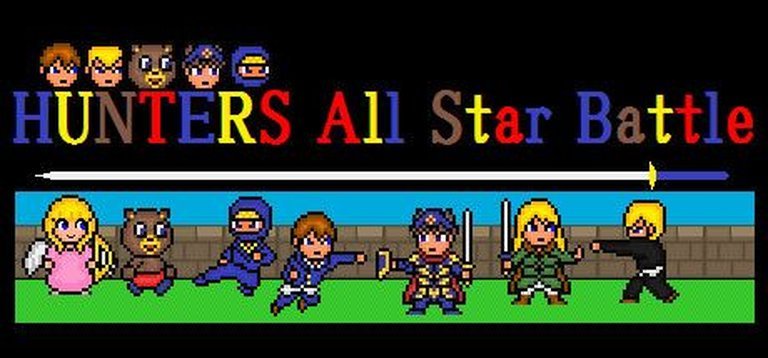
Hunters All Star Battle is a 2D fantasy-themed beat ’em up where players control characters from the HUNTERS series in arcade-style brawls. The gameplay involves selecting doors to fight various opponents, with defeated enemies recruitable as allies, allowing for character and stage swaps in VS mode, along with costume customization in a dress-up room, all supported by keyboard or controller inputs.
Where to Buy Hunters All Star Battle
PC
Hunters All Star Battle: Review
Introduction: The Ghost in the Machine of the “Hunters” Naming Frenzy
In the vast, overcrowded ecosystem of digital storefronts, certain titles exist not as played experiences but as spectral placeholders, entries in a catalog that hint at a game that never was—or at least, never achieved recognition. Hunters All Star Battle is one such ghost. Released on Steam in July 2020 by a developer simply named HUNTERS, it floats in the indistinct space between a genuine, if obscure, indie project and a potential asset-flip or placeholder title. Its name, a concatenation of two of the most overused words in 21st-century gaming (“Hunters” and “All-Star Battle,” the latter itself a staple of crossover fighting games), immediately raises questions of branding desperation or ironic self-awareness. This review, therefore, is not an analysis of a lost classic but a forensic examination of a minimal artifact. Its thesis is that Hunters All Star Battle serves as a perfect case study in the modern digital landscape’s capacity for obscurity—a game with negligible reception, almost non-existent critical discourse, and a design that, based on its own chaotic description, appears less like a cohesive vision and more like a stochastic assembly of genre tropes. We will reconstruct its profile from the scant available data, treating its absence of legacy as its most defining feature.
Development History & Context: The Vanishing Point of a Studio
The development history of Hunters All Star Battle is, quite literally, a blank page. The studio credited is “HUNTERS,” a name so generic it could represent a solo developer’s pseudonym, a shell corporation, or a placeholder in a publishing template. MobyGames lists the game as added by user “Kam1Kaz3NL77” in May 2022—two years after its release—suggesting even dedicated archival communities only belatedly noticed its existence. There are no credits, no developer blog posts, no post-mortems, and no interviews.
This places the game firmly within a specific, contentious micro-era of indie development: the post-Steam Greenlight, pre-Steam Direct overhaul period, where the barrier to entry was low and the deluge of content was high. Released in mid-2020, the world was in the throes of the COVID-19 pandemic, a time that paradoxically saw both a boom in gaming as a social outlet and a crash in discoverability as the market became utterly saturated. Technologically, the game’s listed specs—support for Windows 7/10, a mere 185 MB install size, and support for “Xbox 360 or PS4 controller”—paint a picture of a project built on extremely modest means, likely utilizing a lightweight 2D engine like GameMaker Studio 2, Unity with 2D toolkit, or even a bespoke framework. The “Fixed / flip-screen” visual style is a stark anachronism, harkening back to late-80s arcade brawlers like Double Dragon rather than the scrolling or layered parallax of modern pixel-art indie hits like Streets of Rage 4. This suggests either a deliberate, minimalist retro-chic or, more likely, a technical constraint where creating a dynamic camera system was beyond the project’s scope.
The gaming landscape of July 2020 was dominated by Animal Crossing: New Horizons, The Last of Us Part II, and the rising phenomenon of Fall Guys. In this context, a single-player, fantasy-themed, fixed-screen beat-’em-up with “pixel graphics” was swimming against a massive tide. It had no marketing push, no visible influencer coverage, and no apparent community. Its primary competition was not other major releases, but the infinite scroll of the Steam “New & Trending” list, where it was instantly drowned.
Narrative & Thematic Deep Dive: A Synopsis in Shards
Narrative analysis of Hunters All Star Battle is an exercise in archaeology through broken pottery. The only official source—the Steam Store “ad blurb”—provides a plot summary that is either a masterpiece of minimalist, surrealist storytelling or a catastrophic machine translation. It reads:
“This game is a 2D action in which the successive characters of HUNTERS fight. Choose a door and fight various characters. Defeated characters become friends and can changed in the first room. You can confirm the technique and move the place(Return to the first room) on the menu screen. You can freely change characters and stages in the VS room. It is possible to change the costume in the VS room or dress-up room.”
From this, we can extrapolate a thematic core of recursive identity and existential repetition. The protagonist (or players) are “characters of HUNTERS”—a designation that feels both in-universe (a clan, a title) and meta-textual (referring to the game’s own roster). The central mechanic is choosing a door. This evokes classical archetypes (choose your own adventure, the multiple paths of Mystery House) but stripped of context. What lies behind the doors? “Various characters,” implying a gauntlet of distinct opponents, each potentially representing a different “Hunter” archetype.
The most conceptually rich—and bizarre—element is: “Defeated characters become friends and can changed in the first room.” This suggests a world where combat is a mechanism for conversion, where violence begets camaraderie. It inverts the typical beat-’em-up trope of enemy elimination, hinting at a pacifist or integrative theme. The “first room” is a locus of transformation, a home base where the roster of playable characters is built from the ashes of conquest. The VS and “dress-up room” extend this, transforming the game from a linear brawler into a quasi-collection simulator, where the reward for fighting is the ability to customize and re-fight.
Thus, the underlying theme appears to be the cyclical nature of conflict and community. You fight to recruit, you recruit to customize, you customize to fight again. The “HUNTERS” title may refer to a shared profession or fate that binds all these combatants, making every battle a ritualistic reaffirmation of a collective identity. The lack of a traditional narrative—no cutscenes, no dialogue, no named characters—forces the gameplay loop itself to become the story. It is a story of accumulation and permutation, a digital Groundhog Day where the only progress is the expansion of one’s interchangeable avatar pool. It is thematically pure, if narratively vacant.
Gameplay Mechanics & Systems: The Architecture of Minimalism
Hunters All Star Battle is catalogued as a “Beat ’em up / brawler” with “Arcade” gameplay and “Direct control.” Deconstructing this from its description reveals a game built on a series of core, interlocking loops:
-
The Door Selection & Stage Gauntlet: The “Choose a door” mechanic is the game’s central hub. This is not an open-world exploration but a menu-driven selection between discrete, “fixed / flip-screen” stages. The “flip-screen” descriptor is crucial: it indicates a static screen layout where reaching the edge triggers a hard transition to the next screen, with no scrolling. This is a classic arcade limitation, creating a puzzle-like component to navigation within each stage, as players must clear a screen to proceed.
-
The Combat Loop & Recruitment: Combat is straightforward 2D brawling. The “successive characters” imply you select one Hunter to play as, and they fight through a series of “various characters” (enemies). The innovation—and major systemic pillar—is the recruitment mechanic. Defeating a specific enemy type (presumably a mini-boss or stage boss, given the “various characters” phrasing) permanently adds that character archetype to your pool in “the first room.” There is no mention of experience points, levels, or skill trees. Progression is purely roster expansion.
-
The Central Hub (“The First Room”): This is the game’s meta-hub. Here, players:
- Change Characters: Switch between all recruited Hunters.
- Confirm Technique: Likely a move list or character stats screen, allowing players to learn each Hunter’s unique moveset.
- Move the Place (Return): A menu option to restart the stage selection process, effectively a “main menu” or “title screen” function.
- Access VS Room & Dress-Up Room: (See below).
-
VS Room & Dress-Up Room: These are customization and practice modes detached from the main gauntlet.
- VS Room: Allows “free[ly]” changing “characters and stages.” This suggests a versus mode, possibly for single-player exhibition, where any combination of unlocked characters and stages can be tested. It implies a structured stage list that is unlocked through the main game.
- Dress-Up Room: Allows changing “costume.” This is the only hint of cosmetic progression. Costumes are likely simple palette swaps or alternate sprites, unlocked perhaps through specific achievements or as rare drops from defeated enemies.
-
Technical Systems: “Save is done automatically in the stage switching.” This confirms a lack of manual save states. Progress (unlocked characters, costumes) is saved upon successfully completing a stage and exiting it. The control scheme supports keyboard and modern controllers (Xbox 360/PS4), an important accessibility feature for an indie title.
Systemic Flaws & Innovations:
* Flaw – Repetitive Grind: With no XP or loot system beyond character unlock, the primary motivation to replay stages is to master different characters. After the roster is full (~how many? The description says “various,” perhaps 5-10?), the core loop’s intrinsic reward vanishes.
* Flaw – Opaque Progression: The ad blurb never explains how to unlock costumes or if there are multiple costumes per character. The “dress-up room” is mentioned but its content and unlock conditions are a mystery, potentially a dead end.
* Innovation – Recursive Unlock System: The concept of “defeated characters become friends” is a fascinating inversion of the beat-’em-up formula. It replaces the power fantasy of “I am stronger than you” with the collection fantasy of “I now have you.” It’s a system more commonly found in monster-collection games (Pokémon) grafted onto a brawler.
* Innovation – Meta-Hub as Gameplay Spine: Making the hub (“first room”) the absolute center of all activity—character management, stage selection, practice, cosmetic change—creates a clean, arcade-like structure. There is no overworld, no towns, no useless NPCs. Every system feeds directly into or out of that central menu.
The game, therefore, is a minimalist brawler collection simulator. Its entire economy is based on one currency: defeated enemy types. Its depth is measured in the variety and balance of its unlockable character movesets—a critical unknown.
World-Building, Art & Sound: The Aesthetic of the Placeholder
The world of Hunters All Star Battle is defined almost entirely by its absences and three key tags: “Pixel Graphics,” “Fantasy,” and “Fixed / flip-screen.”
- Visual Direction & Setting: The “Fantasy” setting is presented with zero specificity. There are no orcs, elves, or high-fantasy architecture described. The “pixel graphics” style, combined with the fixed screen, suggests a world viewed as discrete, digestible vignettes. Each stage is a single-screen arena or series of linked single-screens. The fantasy is likely conveyed through sprites—a knight, a wizard, a beast—but without context. The “pixel” aesthetic here is not a lovingly crafted Shovel Knight-style homage but likely a practical choice for a tiny team. The screenshots (which are notably absent from our sources, but the game has them on Steam) presumably show chunky, low-resolution sprites on simple tiled backgrounds.
- Atmosphere: The atmosphere is one of procedural emptiness. The “fixed / flip-screen” layout creates a staccato, almost board-game-like rhythm. There is no sense of a living world, only a sequence of combat arenas. The fantasy is purely functional, a skin for the brawling mechanics. Any thematic resonance from the “recruitment” idea is not visualized or narrated—it exists purely in the menu text.
- Sound Design: There is zero information about sound. No mention of music or sound effects in any source. This is a profound omission. For a beat-’em-up, sound is half the experience—impact sounds, character grunts, stage ambiance, a catchy loop. Its absence from all descriptions points to either a fully silent game (unlikely) or an utterly generic, forgettable soundtrack and soundscape that no one felt compelled to note. The silence in the documentation is deafening.
Together, these elements construct a world that is less a “setting” and more a neutral container. The fantasy is a label, the pixel art a cost-saving measure, the fixed screens a constraint. The game’s world is defined by what it is not: not scrolling, not voiced, not narratively rich. It is a pure abstraction of conflict and collection.
Reception & Legacy: The Sound of One Hand Clapping
The reception of Hunters All Star Battle is a study in non-existence. It is a black hole in critical and commercial metrics.
- Critical Reception: There are zero critic reviews. MobyGames, whose entry is the most formal, lists an “n/a” Moby Score and explicitly states “Be the first to add a critic review for this title!” Metacritic has no user or critic reviews for the PC version. Kotaku’s search yields a bare-bones summary page with no article. The game has not been covered by any major or minor outlet. It is critically invisible.
- Commercial & Player Reception: Steam data provides a sliver of insight. As of the latest aggregation (Steambase, Oct 2025), it has a Player Score of 100/100, but this is calculated from a mere 6 user reviews. All 6 are positive. This perfect score is meaningless with such a microscopic sample size, likely representing a combination of the developer’s friends, a few curious bargain hunters, or an artifact of the “Only reviews from Steam Purchasers” filter (which shows 3 reviews). The Steam store page itself states: “All Reviews: 3 user reviews (3 reviews)” and “Need more user reviews to generate a score.” It is a commercial footnote. Its price fluctuates between $2.39 and $3.99. The “Wanted” plea on MobyGames for a description underscores its complete lack of cultural footprint.
- Legacy & Influence: There is none. It has influenced no subsequent games. It is not cited in developer talks. It is not part of any “best of” lists for its genres. It is not remembered. The only “legacy” is its inclusion in the exhaustive, algorithmic lists of “Similar Games” on sites like Steambase, which merely match it to other obscure titles sharing the tags “Action,” “Casual,” “Pixel Graphics,” “Fighting.” It is a dead end on the flowchart of gaming history.
Its place in the industry is as a data point in the Long Tail. It is one of the thousands of games released annually that exist in a state of perpetual obscurity, sustained only by the minuscule revenue from a handful of sales and the persistent cost of keeping a Steam page live. It represents the democratization of publishing’s dark side: the capacity for total erasure. The “HUNTERS” name, used for this and other titles like Battle Hunters and Star Wars: Hunters, creates a confusing nomenclature that further buries it in search results.
Conclusion: A Definite Verdict on an Indefinite Game
Hunters All Star Battle cannot be judged by standard criteria of “good” or “bad.” It exists outside those binaries. It is not a flawed gem; it is a * nearly featureless pebble.* Its analysis reveals a game built on a single, modestly clever idea (recruitment through defeat) but devoid of the narrative, artistic, or mechanical depth to realize that idea’s potential. The systems are skeletal, the world is nonexistent, the presentation is anonymous, and the reception is a vacuum.
Its final, definitive place in video game history is as a canonical example of digital obscurity. It is the gaming equivalent of an unread book in a vast, uncataloged library. Every element—the placeholder-style title, the generic developer name, the near-empty store page, the lack of reviews, the minimal technical specs—contributes to a perfect storm of anonymity. It serves no purpose as entertainment for the vast majority, but as an object of study, it is invaluable. It reminds us that for every Hades or Celeste that rises from the indie morass, there are countless Hunters All Star Battles that sink without a trace. It is the silent, pixelated proof of the market’s relentless, amnesiac churn. To play it would be to engage with a void, and its historical significance lies precisely in its failure to invite that engagement. It is, in the end, not a game to be played, but an artifact to be documented—a testament to what happens when a concept, a team, and a release date intersect in complete silence.