
- Release Year: 1996
- Platforms: Windows
- Publisher: Activision, Inc.
- Developer: Wizbang! Software Productions
- Genre: Action, Sports
- Perspective: 1st-person
- Game Mode: LAN, Single-player
- Gameplay: Body-checks, Dismemberment, Power-ups, Ramps, Speed boosts, Team Management, Weapons
- Setting: Futuristic, Sci-fi
- Average Score: 78/100
Description
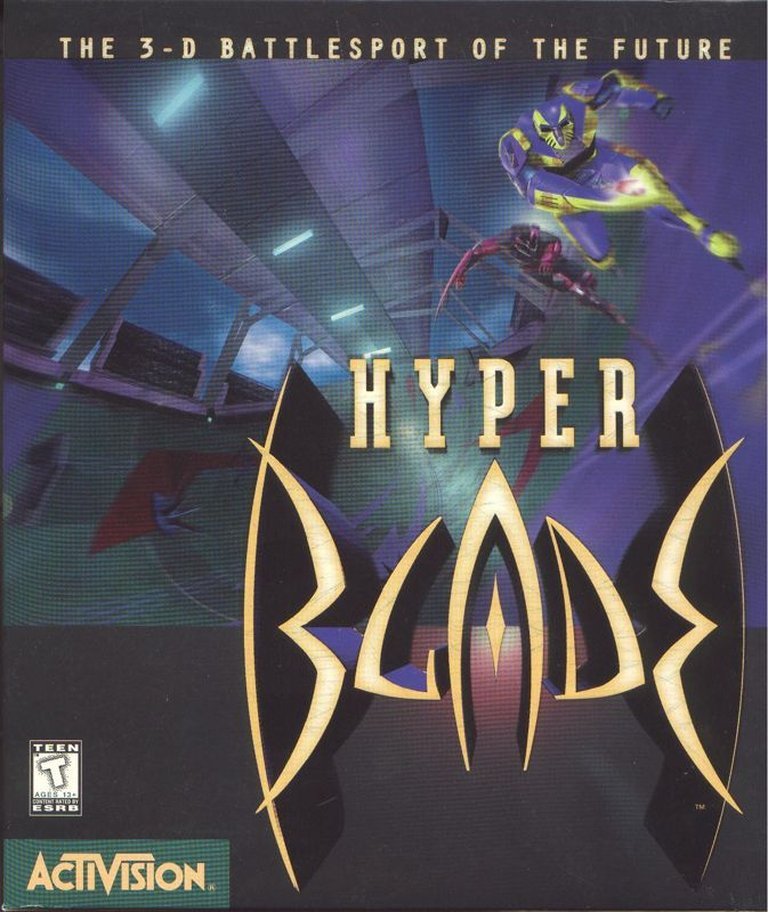
HyperBlade is a sci-fi sports game that reinvents hockey as a brutal 3D battlesport set in a futuristic ellipsoid arena. Players engage in violent street-hockey with weapons, power-ups, and gruesome eliminations—including scoring with dismembered opponent heads—combining fast-paced action with minimal strategy in a high-octane, futuristic setting.
Gameplay Videos
Where to Buy HyperBlade
PC
HyperBlade Free Download
HyperBlade Patches & Updates
HyperBlade Guides & Walkthroughs
HyperBlade Reviews & Reception
myabandonware.com (89.6/100): HyperBlade is a superb futuristic sport game.
mobygames.com (67/100): A bloody, fast, fun mix of hockey/lacrosse.
HyperBlade Cheats & Codes
PC
Enter codes during gameplay to activate cheat functions.
| Code | Effect |
|---|---|
| mdmksb | Stronger attacks and defense |
| shuin | Access a hidden team |
| potato | Smaller character |
| spicybrains | Flipped characters |
| gorilla | Gorilla characters |
| dragon | Monster characters |
| reakout | Chorus line dancers |
| georgesutty | Programmer message |
| smorris | Programmer message |
HyperBlade: A Blood-Soaked Vision of the Future, Frozen in 1996
Introduction: The Brutalist Dream of a Post-Human Sport
In the mid-1990s, as 3D acceleration dawned and game design sprawled in psychedelic new directions, a peculiar and ferocious experiment emerged from the crucible of Activision and the small, ambitious studio Wizbang! Software Productions. HyperBlade was not merely a game; it was a manifesto for a hyper-violent, medically permissive future where sport had devolved into a ritualized bloodsport. Released in late 1996 for Windows 95, it promised the visceral thrill of hockey stripped of all restraint, transposed into a dizzying, lethal arena. Its legacy is one of profound contradiction: a commercially successful pioneer of Direct3D technology that remains a cult curiosity, a game hailed as a “supercharged testosterone-laden title” by some and dismissed as a “faden Nachgeschmack” (bland aftertaste) by others. This review posits that HyperBlade is a critical artifact of its technological moment—a game whose visionary, if flawed, synthesis of sport, combat, and nascent 3D graphics both captured and exceeded the daring spirit of its era, ultimately becoming a tragic “what-if” in the history of brutal sports games.
Development History & Context: Flat Shading, Big Ambitions, and a Cancelled Console Dream
HyperBlade was developed by Wizbang! Software Productions, a company founded in 1994. The project was led by Director/Producer Lewis S. Peterson, with a core team including programmers Drew Johnston, Rob Duisberg, Stuart Rosen, and Vikki Zarkovich. Their corporate partner was the publishing powerhouse Activision, Inc., which provided the muscle for distribution and marketing. Crucially, many team members had prior experience on major titles like MechWarrior 2: 31st Century Combat and Interstate ’76, bringing expertise in vehicle combat and 3D simulation to a sports context.
The game’s development was a tightrope walk between artistic vision and the harsh constraints of mid-90s PC hardware. The most famous technical decision was the widespread use of flat-shaded polygons for players and arenas. As Peterson explained to Next Generation, this was partly an aesthetic choice to give characters a “toy-like” quality, but overwhelmingly a pragmatic one: “a texture-mapped polygon costs about 10 times the processor budget of a flat-shaded polygon.” This allowed for a higher polygon count and smoother animation (supplemented by motion capture) at playable framerates on average PCs. The trade-off was a stark, geometric visual style that polarized players. Notably, support for texture mapping via 3D graphics accelerators using Microsoft’s new DirectX APIs was added post-launch. This made HyperBlade one of the first PC titles to explicitly support Direct3D, and it became a common bundle with 3D accelerator cards from manufacturers seeking a “killer app” to demonstrate their hardware.
The game’s original codename was Hockeydrome, and it wasannounced for a multi-platform release including Sony PlayStation, Sega Saturn, and 32X. None of these console versions materialized, with the Sega Saturn port being notably cancelled close to release. This left HyperBlade a Windows 95 exclusive, a fact that severely limited its cultural penetration at a time when console sports games dominated the market. The PC-only release, combined with its notorious compatibility issues on later operating systems, consigned it to a niche, albeit a commercially significant one: it sold over one million copies, a substantial figure for a PC-only sports oddity.
The gaming landscape of 1996 was defined by the rise of 3D, the dominance of console sports sims (Madden, NBA Jam), and a lingering fascination with dystopian futures. HyperBlade positioned itself as the logical, bloody endpoint of the “future sport” subgenre pioneered by Rollerball (1975) and the Amiga classic Speedball 2: Brutal Deluxe (1991). Its tagline—”the 3D battlesport of the future”—was a direct challenge to the sterility of real-world sports simulations.
Narrative & Thematic Deep Dive: A World Where Medicine Allows Murder
HyperBlade’s narrative is not delivered through traditional cutscenes but is embedded in its diegesis, marketing materials, and in-game UI. The premise is a chilling piece of speculative fiction: in the 24th century, advances in medical science have rendered traditionally fatal injuries—decapitation, dismemberment, electrocution—non-fatal. This technological “solution” has unleashed a societal appetite for spectacle, birthing the Transnational Hyperblade League (THL).
The sport is street-hockey mutated by cybernetic augmentation and lethal arena hazards. Players wear flexible, armored suits colored for their team and wield a bladed gauntlet (“jak”) on their left hand. The weaponization of the body is total; players are enhanced with steroids and bionic parts. The thematic core is a satire of late-capitalist spectacle and medical hubris. The league is sponsored, with trophies named after corporate logos (Supernova, Anvil, Archer). Between matches, the game displays faux-futuristic advertisements for products like “Ford” vehicles—a darkly humorous nod to the integration of sport and commerce. The most grotesque rule is the “head as puck” mechanic: decapitation instantly magnetizes the severed head, converting it into the scoring object (“rok”). This transforms murder into a viable, even high-scoring, tactical play.
There are no individual character arcs or dialogue-driven stories. The “narrative” is the match itself, a episodic tale of attrition and brutal artistry. Teams represent global city-states (Los Angeles Shockwave, Moscow T-34’s, Tokyo Ronins), each with aesthetic identities but no personal histories. The theme is pure anthropological futurism: this is a societal ritual examined from the outside, its rules and consequences laid bare. The game’s violence is not gratuitous in a vacuum; it is thematically consistent with a world that has medically normalized the spectacular elimination of the human body. It asks, with bloody glee: if we can fix anything, what should we fix?
Gameplay Mechanics & Systems: Chaos, Strategy, and the Tyranny of the Goalie
The core gameplay loop of HyperBlade is a first-person, real-time brawl for control of arok in a sealed ellipsoid arena (“drome”). Matches consist of three periods (3, 5, or 7 minutes), with the objective of scoring by throwing the rok into the small wall-mounted goal.
Arena & Hazards (The Drome): The arenas are the game’s most iconic feature. They are concave, egg-shaped tubes with walls used as playing surfaces. Their interiors are littered with interactive, deadly objects:
* Turnstiles: Spinning blades that decapitate players who pass through.
* Laser Hurdles: Fatal barriers that must be jumped.
* Killball Chargers: Pads that convert a carried rok into a high-voltage “killball,” which can be thrown to electrocute opponents.
* Ramps & Gravity Defiers: Allow for soaring jumps and tactical repositioning.
* Mines:拾取后可用于攻击。
Each team also has a home drome with a unique layout of hazards, adding strategic variety.
Player Attributes & Roles: Players have stats (Strength, Speed, Stamina, Rok Handling) that determine their efficacy. Teams are built around archetypes: fast, fragile “speedsters” versus slow, powerful “enforcers.” Rosters feature 4 forwards and 1 goalie per team. Critically, the goalie is invulnerable to all attacks except mines and is notoriously aggressive—a common player complaint. Forwards can be cycled from the bench, but substitutions only occur after a goal or period end. More importantly, killed players are permanently removed from the roster for the remainder of a Gauntlet tournament, creating permanent consequences.
Combat & Movement: The jak (blade) is the primary tool. It’s used for:
* Slashing/Punching/Kicking: Draining opponent health.
* Body Checks & Tripping: Dislodging the rok.
* 拾取 Power-ups: Mines, speed boosts, and the criticalrok itself.
Skating is the primary movement, with jumping essential for obstacle avoidance. The combat is visceral, health-based, and direct. The decapitation mechanic is the ultimate tactical gamble: beheading an opponent instantly creates a new, throwable rok, but leaves you vulnerable.
Game Modes:
* Exhibition: Quick match, any teams, any drome.
* Gauntlet: A brutal single-elimination tournament against all 11 other teams. Lose once, start over. Roster casualties persist.
* LAN Multiplayer: IPX/TCP support for up to 4 players. This was its intended social pinnacle, though configuration was complex for the era.
Innovations & Flaws:
* Innovation: The seamless integration of lethal environmental hazards as core tactical elements was revolutionary. The “head as rok” rule created a shocking, memorable gameplay paradigm. The persistent roster damage in Gauntlet mode introduced high-stakes strategy rarely seen in sports games.
* Flaws: The camera system was frequently criticized as “rörigt” (shaky/jumpy) and disorienting, as the chase cam panned and zoomed erratically. Team management was skeletal—no trades, no player creation, no season mode. The goalies’ imbalance (invincible save-state vs. murderous aggression when approached) broke tactical balance. The game also lacked modem support, limiting multiplayer to LANs.
World-Building, Art & Sound: A Stark, Functional Dystopia
HyperBlade’s world is conveyed through its audiovisual design and UI presentation.
Visual Direction: The flat-shaded polygon aesthetic is its most defining trait. Players and arenas are constructed from simple, brightly colored geometric forms. This was a deliberate stylistic and technical compromise, giving the game a clean, almost clinical look that contrasted with its bloody content. With a 3D accelerator, texture mapping added surface detail, but the core geometry remained simple. The arena designs are the standout: vast, shimmering ovoid spaces with stark black-and-white (or team-colored) flooring, deadly machinery integrated seamlessly, and a sense of immense, claustrophobic scale. The dome” shape creates constant spatial disorientation, reinforcing the hostile environment.
Sound Design: The soundscape is a blend of stadium ambiance (crowd roars, whistles) and aggressive, synthetic sound effects. Blade swings are sharp, explosions concussive, and the thwack of a rok hitting the goal is satisfying. The background music is often described as “fetzige” (snappy/racy) and fittingly techno-industrial, though some reviews noted it could become “unnoticeable” during intense play. The audio design effectively sells the physics of violence and speed.
UI & Presentation: The interface is functional but gritty. The radar is essential for tracking the rok and players in the 3D space. Between periods, the game cuts to faux-sponsor advertisements for futuristic products, reinforcing its satirical corporate dystopia. These ads, while simple by today’s standards, were a clever, immersive touch that fleshed out the world without dialogue.
The overall atmosphere is one of sterile, high-tech brutality. It feels less like a traditional sport and more like a gladiatorial contest run by a bored technocracy. The art style perfectly complements the theme: clean lines and bright colors make the blood—a bright red splatter—more shocking, not less.
Reception & Legacy: Million-Seller Cult Classic
HyperBlade received a polarized critical reception, scoring 67% on MobyGames from 14 critics. Reviews spanned from the hyperbolic (Gamezilla’s 94%: “This game rocks… it made my fingers hurt”) to the dismissive (Génération 4’s 17%). The praise consistently highlighted:
* Unparalleled action and speed.
* Excellent atmosphere and extreme violence.
* Good AI for the time.
* Novel, spectacular arena design.
The criticisms were equally consistent:
* Lack of depth: No season mode, trades, or player management.
* Camera/control issues: Disorienting perspective and “rörig” movement.
* Gameplay quirks: Overpowered goalies, limited strategic variance.
* Graphical austerity (without 3D accelerator).
Player reviews on MobyGames (3.4/5) echo this, with common descriptors being “fast,” “fun,” and a “snack” game—enjoyable in short bursts but lacking the depth of a “full course meal.” The “violent for violence’s sake” critique appeared in German magazines (PC Games: “Kult der Rücksichtslosigkeit” / cult of recklessness).
Commercially, it was a significant success, selling over one million copies. This was likely fueled by its bundling with 3D graphics cards and its unique positioning. It was not a mainstream blockbuster but found its audience.
Legacy & Influence:
HyperBlade’s direct lineage is most visible in the “brutal sports” niche. It is consistently cited as the closest 3D realization of Speedball 2‘s spirit. Games like DeathDrome (1997) directly copied its formula. Its influence can be felt in the “sport as combat” subgenre, from the vehicular mayhem of Rocket League (which shares the “car-hockey” concept) to the arena-based brawls of modern eSports hybrids.
However, its core innovations—persistent player elimination, environmental lethality, and the head-as-puck mechanic—were not widely adopted. Mainstream sports games moved toward simulation, while action sports titles (Tony Hawk, SSX) prioritized tricks over combat. HyperBlade remained a dead-end branch on the evolutionary tree, a brilliant but unsustainable fusion.
Its status today is that of a deep cult classic and an abandonware darling. The modern retro community actively preserves it (evidenced by active MyAbandonware downloads and detailed setup guides for Windows 10/11 using DxWnd and CD emulators). The recurring plea in user comments—”WE WANT HYPERBLADE!” and calls for a remake—speaks to its enduring, if niche, fascination.
Conclusion: The Unfulfilled Promise of the Drome
HyperBlade is a game caught between two eras. It is a last gasp of the flat-shaded, geometric 3D aesthetic and a harbinger of the Direct3D accelerator age. It is a brutalist sports game in an industry increasingly focused on either gritty military sims or sanitized family entertainment. Its genius lies in its unwavering commitment to its own insane premise: a world where medical science has made murder a sporting tactic, and where the arena itself is a killer.
Its failures are as instructive as its triumphs. The shallow team management and chaotic camera reveal a development team stretched thin, prioritizing raw action and technical pioneering over systemic depth. It is, as one player astutely noted, a “snack” game—an intensely pleasurable, immediately gratifying experience that cannot sustain the “full course meal” of a Madden or FIFA.
To play HyperBlade today is to engage with a fascinating fossil. It is a window into a mid-90s design ethos that valued bold, singular concepts over iterative refinement. It succeeded wildly on its own terms: it sold a million copies, pioneered Direct3D adoption, and delivered a pulse-pounding, morally ambiguous experience unlike anything before or since. Its cancellation on consoles and its technical quirks on modern PCs have cemented its status as a lost artifact—a brutal, beautiful, deeply flawed vision of the future that feels, even now, dangerously ahead of its time. It does not deserve to be remembered as a failed game, but as a brilliantly flawed one, whose bloody ghost haunts the perimeter of every arena-based sports game that daresto be more than just a sport.
Final Verdict: 8/10 – A flawed masterpiece of violent futurism and technical pioneering. Essential for historians and masochistic sports fans, but its roughness is not for the faint of heart.