
- Release Year: 2015
- Platforms: PS Vita, Windows
- Publisher: Idea Factory International, Inc.
- Developer: Compile Heart Co., Ltd., Idea Factory Co., Ltd., Tamsoft Corporation
- Genre: Action, Role-playing (RPG)
- Perspective: 3rd-person (Other)
- Game Mode: Single-player
- Gameplay: Action RPG, brawler, Fast-paced combat, Hack-and-slash, Musou
- Setting: Fantasy
- Adult Content: Yes
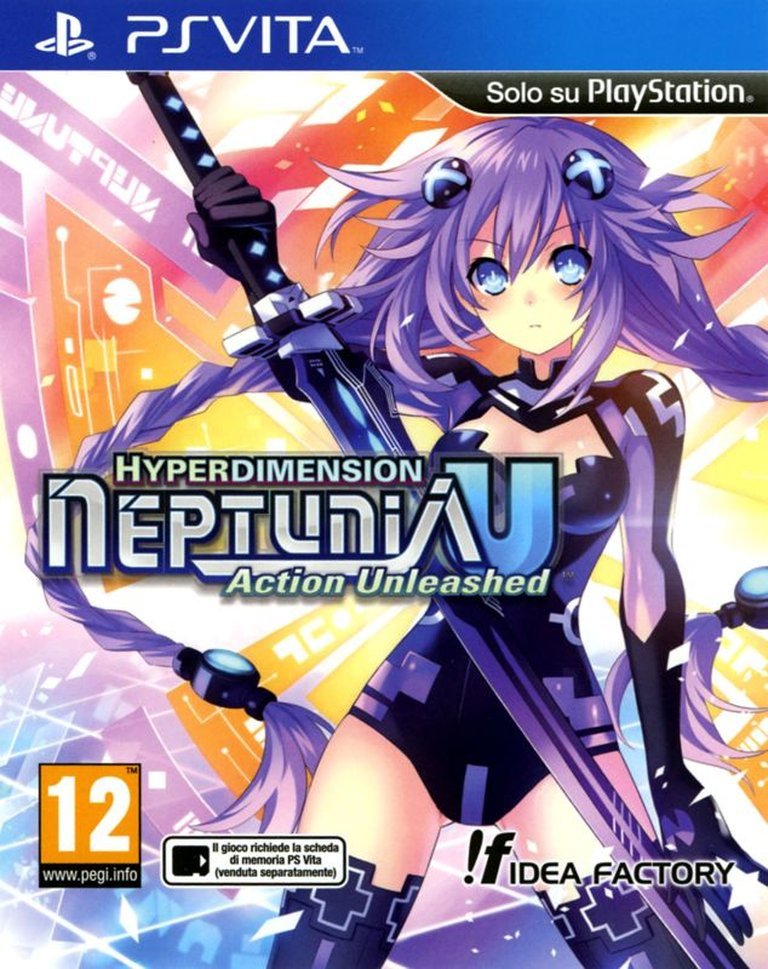
Description
Hyperdimension Neptunia U: Action Unleashed is an action RPG set in the fantasy world of Gamindustri, featuring the iconic characters from the Hyperdimension Neptunia series, such as Neptune and Noire. With an anime/manga art style and third-person perspective, the game emphasizes fast-paced, real-time combat as players explore vibrant environments and battle enemies in this spin-off title.
Gameplay Videos
Where to Buy Hyperdimension Neptunia U: Action Unleashed
Hyperdimension Neptunia U: Action Unleashed Free Download
Hyperdimension Neptunia U: Action Unleashed Guides & Walkthroughs
Hyperdimension Neptunia U: Action Unleashed Reviews & Reception
destructoid.com : The action of course, is the highlight.
gamecritics.com : Action? More Like Buggy Snoozefest Unleashed
Hyperdimension Neptunia U: Action Unleashed: Review
Introduction: A Genre Gamble in Gamindustri
In the sprawling, meta-textual universe of Hyperdimension Neptunia, where video game consoles are personified as warring goddesses and industry jargon becomes literal conflict, Hyperdimension Neptunia U: Action Unleashed represents a daring, if divisive, pivot. Released in 2014 for the PlayStation Vita and later ported to PC, this installment deliberately shed the turn-based RPG roots of its predecessors for the fast-paced, horde-slaying spectacle of the Dynasty Warriors (Musou) formula. The thesis of this review is that Action Unleashed is a fascinating paradox: a technically competent but creatively safe ensemble action game that excels as a complementary, pick-up-and-play side story within the Neptunia canon, yet fails to leverage its unique premise to transcend the proven-but-repetitive mechanics it adopts. Its legacy is not as a genre-defining masterpiece, but as the pivotal gateway that permanently expanded the franchise’s design vocabulary, for better and for worse.
Development History & Context: Tamsoft’s Touch and a Handheld Imperative
The genesis of Action Unleashed lies in a strategic partnership between series stalwarts Compile Heart and Idea Factory with the action-game specialists Tamsoft. Tamsoft, renowned for the Senran Kagura and Oneechanbara series, was explicitly chosen to handle the shift to real-time combat, as announced at the 2014 Dengeki Stage Event. This collaboration was not incidental; 2014 was a year of experimental spin-offs for the franchise, with Hyperdevotion Noire: Goddess Black Heart exploring tactical RPG mechanics just months prior. The technological context was the PlayStation Vita, a handheld with significant power for its time but struggling for identity. Action Unleashed was designed as a “portable powerhouse”—a game that could deliver console-style spectacle in short bursts, leveraging the Vita’s 1080p output (via PSTV) and processing muscle for dense enemy hordes.
The development vision, as pieced together from interviews and post-mortems, was clear: take the beloved characters and satirical world of Gamindustri, transplant them into a proven, accessible action framework, and create a game that could be played in 20-minute increments on the bus. The constraint was not technical limitation but creative scope—how to make a Musou game feel distinctly “Neptunia.” The result was a game that feels less like a radical reinvention and more like a thematic skin applied to a well-understood template, with the “Costume Break” mechanic serving as the primary, and ultimately controversial, signature feature.
Narrative & Thematic Deep Dive: Satire in Peacetime
Set in an alternate, non-canonical dimension following a period of peace after the standard “Console Wars,” Action Unleashed’s plot is intentionally thin, functioning as a narrative vehicle for gameplay. The inciting incident is bureaucratic boredom: the CPUs (Console Patron Units) and their sisters, the CPU Candidates, are so victorious and idle that they seek public validation through press coverage. Enter Dengekiko and Famitsu, personified game journalists from eponymous magazines, who transform into combat-ready reporters to document the goddesses’ “guild missions.”
This premise, while flimsy, is a masterclass in meta-satire that resonates deeply with the series’ core identity. It directly lampoons the symbiotic, often fraught, relationship between game developers (the “gods” of Gamindustri) and the press. The central antagonist, the Next-Gen Mech, is a brilliant personification of the cyclical anxiety in the gaming industry about obsolete hardware being rendered irrelevant by new generations—a theme that would be more seriously explored in the contemporaneous Megadimension Neptunia VII. The narrative’s climax, where the team must learn to coordinate their attacks to break the Mech’s defenses, is a clumsy but intentional allegory for industry collaboration.
The dialogue is a highlight, packed with the series’ signature puns, fourth-wall breaks, and character-based humor. Neptune’s daftness, Noire’s tsundere posturing, Blanc’s sudden violent outbursts, and Vert’s otaku obsession are all present and accounted for. However, critics noted a lack of substantive plot and underutilization of the journalist characters beyond their initial hook. Their transformative armor and near-CPU power levels promise a commentary on influencer culture and media sensationalism that remains largely unexplored, leaving the satire superficial compared to the more layered parodies of the mainline RPGs. The story is a series of vignettes and optional character chats (“City Watch” events) that flesh out dynamics but contribute little to an overarching narrative arc, making it serviceable for fans but forgettable in isolation.
Gameplay Mechanics & Systems: The Musou Mold
The core gameplay loop is a 3D hack-and-slash (Musou) experience. The player selects a character and enters an arena-style stage with a simple clear condition—typically “defeat all enemies” or “defeat the boss.” The controls are straightforward: light attack (fast, low damage), heavy attack (slow, high damage, often launchers), dash (invincibility frames), double jump, and SP skills. The genius is in the “Dual System”: players bring two characters and can swap them instantly. The inactive character regenerates health, encouraging tactical swapping to manage damage and combo potential.
Combat depth comes from:
1. Character-Specific Movesets: Each of the 10 playable characters (8 CPUs/Candidates + 2 journalists) has a unique string of light and heavy attacks, aerial combos, and transformation states. This encourages replaying stages with different pairs.
2. EXE Drive Gauge & Transformation: Landing attacks fills a gauge. At 50%, the character can transform into a more powerful goddess/reporter form with enhanced stats and new moves. This is the game’s primary power fantasy moment.
3. Costume Break Mechanic: Taking damage causes clothing to tear progressively. When broken, defense plummets but critical rate and EXE gauge fill speed increase. This is a high-risk, high-reward gamble that visually reinforces damage taken. While many early reviews derided it as gratuitous fanservice, the Rice Digital analysis correctly notes it introduces a tangible tactical trade-off. However, its impact diminishes as players learn to avoid damage or acquire “unbreakable” costumes, rendering it a novelty rather than a core strategic pillar.
4. Progression & Customization: Medals dropped by enemies are used to purchase permanent stat boosts for all characters (via a shared “Lily Rank” system) and, crucially, to unlock new weapons and accessories. Equipment customization allows for builds, such as items that massively boost attack at the cost of defense, leaning into the “glass cannon” playstyle.
The structure is mission-based, with a Story Mode, a Gamindustri Gauntlet (tournament mode), and the Neptral Tower (a 50-floor endurance challenge). The criticism of repetition is valid; mission objectives rarely vary beyond “kill everything” or “kill the boss.” The enemy roster is small, recycled across dozens of stages with palette swaps. The difficulty curve is erratic, with some story missions being trivial and later Gauntlet/Tower fights becoming grueling grinds. The PC port from the Vita was noted for occasional slowdown and an awkward default keyboard mapping, with reviewers universally recommending a controller.
World-Building, Art & Sound: Familiar Comforts
Action Unleashed is visually and aurally a Neptunia game through and through. The art direction, helmed by Kenji Teshima, maintains the vibrant, candy-colored anime aesthetic of the series. Character models are detailed and expressive, with smooth animations for combos and the iconic, dramatic transformation sequences. The Costume Break mechanic is rendered with a surprising amount of care—outfits tear in specific patterns, providing clear visual feedback. The stages, while functionally arenas, are themed after the four nations of Gamindustri (Planeptune, Lastation, Lowee, Leanbox), with recognizable landmarks and atmospheric touches (e.g., Lowee’s icy caves, Lastation’s industrial zones).
The sound design is functional but unremarkable. The soundtrack, composed primarily by Kenji Kaneko, heavily relies on remixes and reuses of themes from previous games. While this provides comforting familiarity for fans, it also underscores the derivative nature of the project. A few new, high-energy “battle” tracks were created, but many stages recycle a limited set of looped music, leading to the common complaint of audio repetition. The voice acting, featuring the returning Japanese and English casts (Rie Tanaka, Asami Imai, etc.), is consistently high-energy and in-character, with the journalists’ call-outs during battle being a particular source of character and humor.
Reception & Legacy: A Mixed Bag with Lasting Influence
Action Unleashed received a Metacritic score of 71/100 on PS Vita and 50/100 on PC, reflecting a significant discrepancy between the handheld’s optimized version and the less-polished PC port. Critic scores ranged wildly from 95% down to 50%. The consensus, synthesized from dozens of reviews, is:
Praises:
* Excellent character variety and moveset differentiation.
* Smooth, satisfying core combat that captures the “Musou” power fantasy.
* Strong, meta-satirical writing and character banter faithful to the series.
* Perfect for handheld, pick-up-and-play sessions.
* A successful, accessible entry point for newcomers intimidated by complex RPGs.
Criticisms:
* Extreme repetition in mission structure and enemy types.
* Thin, forgettable plot compared to mainline entries.
* The Costume Break mechanic, while mechanically interesting, felt like shallow fanservice to many and was not iterated upon in later games.
* Grindy post-game content (Neptral Tower) with poor reward pacing.
* PC port technical issues and poor default controls.
Its commercial performance is not publicly detailed, but its status as a spin-off in a niche series suggests modest sales, primarily driven by the dedicated Neptunia fanbase.
The legacy of Action Unleashed is its most significant aspect. It was the first true real-time action game in the franchise. Its success (relative to its goals) directly paved the way for:
* MegaTagmension Blanc + Neptune vs. Zombies (2015), which refined the formula with a zombie horde twist.
* More ambitious action titles like Cyberdimension Neptunia: 4 Goddesses Online (2017), which attempted an MMORPG-lite structure.
* The action-RPG hybrid mechanics of Neptunia: Sisters vs. Sisters (2022) and the Tales-inspired combat of the same title.
* It proved the Neptunia characters could work outside turn-based systems, giving developers license to experiment with genres (rhythm games, shooters, rail shooters) in subsequent years.
However, the Costume Break mechanic did not return as a gameplay feature in later titles, suggesting it was seen as a gimmick tied to this specific spin-off’s tone. The game occupies a curious middle ground: it’s often cited as “one of the better spin-offs” (GamingTrend, GamesTM) but also “the weakest entry” (ZTGameDomain) for those expecting the narrative depth of the main series.
Conclusion: A Flawed but Foundational Pivot
Hyperdimension Neptunia U: Action Unleashed is not the best Neptunia game, nor is it the best Musou game. It is, however, an important and functional genre experiment. Its strengths lie in its unwavering commitment to character, its smooth and satisfying combat feel, and its perfect design for on-the-go play. Its weaknesses—repetitive level design, a wafer-thin plot, and a reliance on a single controversial gimmick—are fundamental flaws in its design.
In the grand tapestry of video game history, it will be remembered not for its own merits, but as the crucial prototype. It was the game that broke the Neptunia series’ traditional mold and demonstrated the adaptability of its core cast and satirical world. It took the safe route by applying a popular, existing gameplay template, but in doing so, it expanded the creative possibilities for the franchise. For historians, it marks a clear “before and after” moment: pre-Unleashed, Neptunia was an RPG series with spin-offs; post-Unleashed, it became an action-RPG franchise in the broader sense. It is a game to be appreciated for its role in the series’ evolution, enjoyed in short bursts for its combat and comedy, and studied as a case study in successful—if not spectacular—genre translation. Its verdict is a solid 7/10: a competent, enjoyable, and historically significant, if ultimately superficial, brawler.