
- Release Year: 2001
- Platforms: Linux, Windows Mobile, Windows
- Publisher: Linux Game Publishing Ltd., Monkeystone Games
- Developer: Monkeystone Games
- Genre: Action, Puzzle
- Perspective: Top-down
- Game Mode: Single-player
- Gameplay: Laser redirection, Object manipulation, Puzzle elements, Shooting, Switch activation
- Setting: Futuristic, Sci-fi
- Average Score: 73/100
Description
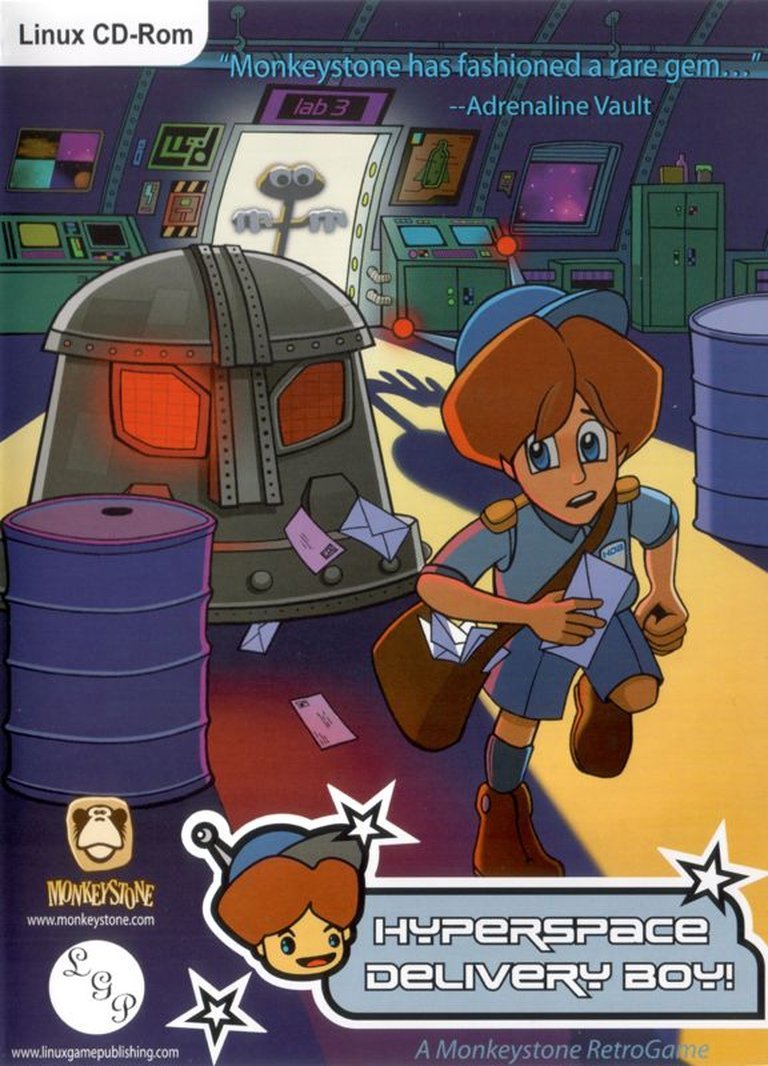
Hyperspace Delivery Boy! is a quirky action-puzzle game set in a sci-fi universe where players take on the role of Guy Carrington, an aspiring delivery boy navigating bizarre environments to complete intergalactic delivery jobs. The game blends top-down 2D scrolling with puzzle elements, requiring players to solve challenges like moving objects, activating switches, and avoiding enemies to earn the title of Delivery Boy 1st Class. With a choice between Puzzle and Action modes, the game offers a mix of strategy and combat, all wrapped in humorous dialogue and creative level design.
Gameplay Videos
Hyperspace Delivery Boy! Free Download
Hyperspace Delivery Boy! Reviews & Reception
metacritic.com (72/100): A rare gem: A product that’s appealing and accessible to both casual and more active gamers.
en.wikipedia.org (70/100): A fun diversion with challenging puzzles, but repetitive and featured sophomoric dialogue.
mobygames.com (79/100): An action-puzzle game with bizarre environments, quirky humor, and complex levels.
squakenet.com : A topdown experience that seems to want to emulate Commander Keen titles.
Hyperspace Delivery Boy!: A Quirky, Underrated Gem from the Minds of Romero and Hall
Introduction: The Forgotten Courier of the Early 2000s
In the annals of video game history, few titles are as delightfully odd and underappreciated as Hyperspace Delivery Boy! (2001). Developed by Monkeystone Games—a studio founded by industry legends John Romero and Tom Hall—this top-down action-puzzle hybrid is a love letter to classic gaming, wrapped in a sci-fi delivery service premise. While it may not have achieved the commercial success of its creators’ earlier works (Doom, Commander Keen), HDB remains a fascinating artifact of early 2000s indie development, blending humor, puzzle-solving, and light action into a charming, if flawed, experience.
This review will dissect Hyperspace Delivery Boy! in exhaustive detail, exploring its development history, narrative quirks, gameplay mechanics, and lasting legacy. Was it a misunderstood masterpiece, or a niche curiosity? Let’s deliver the verdict.
Development History & Context: The Birth of Monkeystone Games
The Studio Behind the Game
Monkeystone Games was founded in 2001 by John Romero (co-creator of Doom and Quake) and Tom Hall (designer of Commander Keen and Anachronox), along with Stevie Case (Romero’s then-girlfriend, who handled music and production). The studio’s mission was to create games for emerging platforms, particularly Windows Mobile (Pocket PC), at a time when handheld gaming was dominated by Nintendo’s Game Boy Advance.
Hyperspace Delivery Boy! was Monkeystone’s first release, debuting on December 23, 2001, for Pocket PC before being ported to Windows (2002) and Linux (2004). The game’s development was a passion project, with Romero and Hall aiming to recapture the magic of their early 2D classics while experimenting with puzzle mechanics.
Technological Constraints & Design Philosophy
- Platform Limitations: The Pocket PC version was constrained by limited processing power and screen real estate, leading to a simplified UI and small character sprites.
- Dual-Mode Gameplay: The game offered Puzzle Mode (non-violent, focused on problem-solving) and Action Mode (allowing combat with enemies), catering to different playstyles.
- Influence of Commander Keen: The game’s top-down perspective, humor, and exploration-heavy design were heavily inspired by Hall’s earlier work, transposing Keen’s side-scrolling action into an isometric puzzle format.
The Gaming Landscape in 2001
- The Rise of 3D Gaming: HDB arrived during the PS2/Xbox/GCN era, when 2D games were increasingly seen as retro curiosities.
- Handheld Gaming’s Evolution: The Game Boy Advance and Pocket PC were competing for portable gaming dominance, with HDB positioning itself as a premium PDA experience.
- Indie Development’s Early Days: Before the indie boom of the late 2000s, HDB was a rare example of a small-team, passion-driven project from industry veterans.
Narrative & Thematic Deep Dive: A Sci-Fi FedEx Adventure
Plot Overview
Players assume the role of Guy Carrington, a rookie courier for the Hyperspace Delivery Service (HDS), tasked with delivering packages across the galaxy. Under the supervision of Sergeant Filibuster, Guy navigates four distinct locations, each filled with eccentric characters, hazardous environments, and Sokoban-style puzzles.
As the story progresses, Guy uncovers a sinister organization known as “THEM”, adding a light conspiracy twist to the otherwise whimsical premise.
Characters & Dialogue
- Guy Carrington: A hapless but determined delivery boy, serving as the player’s avatar.
- Sergeant Filibuster: A no-nonsense superior who assigns missions.
- Various NPCs: From alien scientists to robotic janitors, each character is imbued with quirky, often self-aware humor reminiscent of Futurama or The Hitchhiker’s Guide to the Galaxy.
Themes & Tone
- Satirical Sci-Fi: The game pokes fun at corporate bureaucracy, space opera tropes, and video game conventions.
- Nostalgia & Homage: The writing and design frequently reference classic PC games, particularly Commander Keen and Dangerous Dave.
- Lighthearted Absurdity: The game’s humor is cheesy but endearing, with voice acting that ranges from charming to cringe-worthy (a common critique in reviews).
Storytelling Strengths & Weaknesses
✅ Pros:
– Charming, self-aware dialogue that rewards exploration.
– Optional side quests that expand the world without overburdening the player.
❌ Cons:
– Minimal narrative depth—the plot is thin, serving mostly as a framework for puzzles.
– Repetitive voice acting that some critics (e.g., PC Gamer) called “embarrassingly cheesy.”
Gameplay Mechanics & Systems: Puzzles, Packages, and Peril
Core Gameplay Loop
- Receive a Delivery Mission from Sergeant Filibuster.
- Navigate Hazardous Environments (electrified floors, laser grids, enemy patrols).
- Solve Puzzles (push crates, redirect lasers, activate switches).
- Deliver the Package to the recipient.
- Optional Side Quests (fetch items, retrieve stolen gems, unlock secrets).
Puzzle Design & Sokoban Influences
- Crate-Pushing Mechanics: Many puzzles involve moving objects to trigger switches or clear paths, akin to Sokoban.
- Laser Redirection: Players must align mirrors to activate doors or disable traps.
- Environmental Hazards: Electrified floors, moving platforms, and enemy patrols add tension.
Combat & Action Mode
- Puzzle Mode: Enemies are indestructible obstacles—avoidance is key.
- Action Mode: Guy can shoot gems to stun or defeat enemies, though combat is clunky and secondary to puzzle-solving.
Progression & Exploration
- Non-Linear Level Design: Players can backtrack and explore to find hidden Monkeystone idols (collectibles) and Panic Zone mini-games.
- Quest Tracking: A logbook keeps track of active missions, preventing confusion.
UI & Controls
- Mouse or Keyboard Controls: Simple point-and-click movement (ideal for Pocket PC stylus input).
- Inventory System: Manages deliveries, keys, and special items.
Flaws & Frustrations
- Backtracking Overload: Critics (Game Over Online) noted that re-treading old paths became tedious.
- Lack of a Run Button: Guy’s slow movement speed exacerbated pacing issues.
- Puzzle Trial-and-Error: Some crate puzzles lack feedback, leading to soft locks if players misplace objects.
World-Building, Art & Sound: A Vibrant, Retro-Futuristic Universe
Visual Design
- Top-Down 2D Aesthetic: The game’s isometric perspective and colorful, cartoonish sprites evoke Commander Keen’s charm.
- Diverse Environments: From space stations to alien jungles, each area has distinct visual themes.
- Pocket PC Optimizations: The Windows Mobile version used simplified graphics, while the PC/Linux ports featured higher-resolution assets.
Sound & Music
- Composer: Stevie Case: The soundtrack blends upbeat synth tunes with ambient sci-fi atmospheres.
- Voice Acting: While cheesy, the voice work adds personality to the game’s humor.
- Sound Effects: Crisp and functional, though GameSpot criticized their “minimal” impact.
Atmosphere & Immersion
- Whimsical & Welcoming: The game’s bright colors and playful tone make it accessible to casual players.
- Nostalgic Appeal: Fans of 90s PC gaming will appreciate the retro sensibilities.
Reception & Legacy: A Cult Classic in the Making?
Critical Reception (2002)
- Metacritic Score: 72/100 (Mixed or Average).
- Highest Praise:
- Mobile Tech Review (100%): “A very creatively designed unique adventure game.”
- Game Over Online (85%): “Cheerful, sarcastic, and energetic fun.”
- Adrenaline Vault (80%): “A rare gem… appealing to both casual and hardcore gamers.”
- Mixed Reviews:
- GameSpot (70%): “Fun, but won’t appeal to everyone.”
- PC Gamer (61%): “An inexpensive and silly throwback.”
Player Reception
- MobyGames Player Score: 4.1/5 (based on 7 ratings).
- Common Praise:
- Addictive puzzle-solving.
- Charming humor and world-building.
- Common Criticisms:
- Repetitive backtracking.
- Short length (5-7 hours).
Legacy & Influence
- Cult Following: While not a commercial hit, HDB developed a small but dedicated fanbase.
- Inspiration for Indie Devs: Its blend of puzzle and action influenced later titles like Hyperspace Delivery Service (2019).
- Preservation Efforts: The game is supported by ScummVM, ensuring its playability on modern systems.
Conclusion: A Flawed but Charming Delivery
Hyperspace Delivery Boy! is a quirky, underrated gem that suffers from pacing issues and repetitive design but shines in its humor, puzzle mechanics, and nostalgic charm. It’s not a masterpiece, but it’s a lovable oddity—a game that doesn’t take itself too seriously while still offering genuine challenge and exploration.
Final Verdict: 7.5/10 – “A Delightful Detour”
- For Fans Of: Commander Keen, Zelda-style puzzles, retro sci-fi humor.
- Best Played On: PC/Linux (avoid the Pocket PC version unless you’re a purist).
- Replay Value: Moderate (secret hunts and Action Mode add longevity).
While Hyperspace Delivery Boy! may not have redefined gaming, it remains a testament to the creativity of its developers and a fun, if flawed, slice of early 2000s indie gaming. If you’re a fan of retro puzzlers with personality, this one’s worth delivering to your library.
Final Thought: “It’s not *Doom, but it’s got heart—and sometimes, that’s enough.”* 🚀📦