
- Release Year: 2022
- Platforms: Macintosh, Nintendo Switch, PlayStation 5, Windows
- Publisher: Boomzap Inc, Ocean Media d.o.o.
- Developer: Tiny Little Lion
- Genre: Puzzle
- Perspective: Fixed / flip-screen
- Game Mode: Single-player
- Gameplay: Hidden object
Description
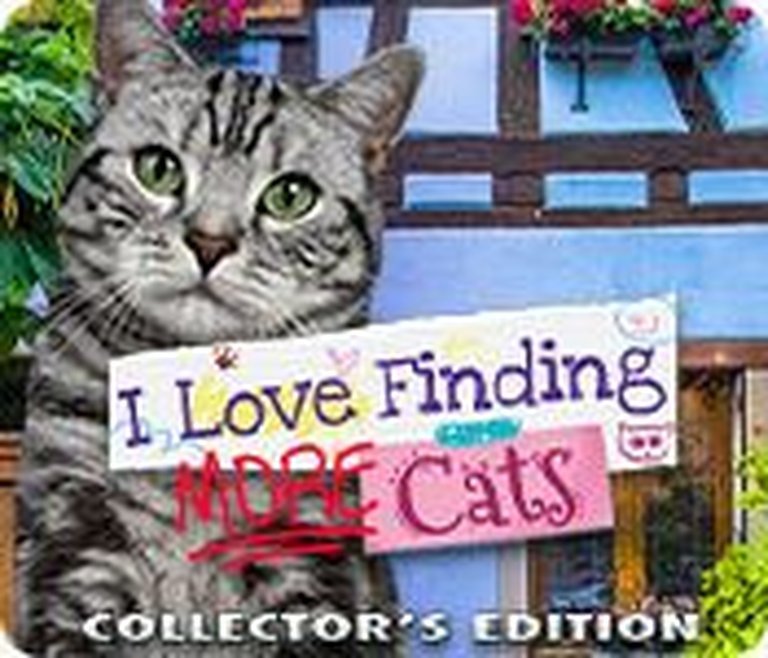
I Love Finding More Cats (Collector’s Edition) is a cozy hidden object puzzle game where players search for adorable cats in various detailed scenes. As part of the ‘I Love Finding’ series, this special collector’s edition offers extra content and expanded gameplay, challenging players to carefully observe and point-and-click their way through charming, fixed-screen environments to find all the feline friends.
Gameplay Videos
I Love Finding More Cats (Collector’s Edition): A Purr-fectly Preserved Artifact of the Cozy Game Boom
Introduction
In the vast and often tumultuous landscape of video games, where narratives of cosmic war and personal trauma dominate the critical discourse, there exists a quieter, softer corner dedicated to pure, unadulterated comfort. It is here that we find I Love Finding More Cats (Collector’s Edition), a title whose very name is both its mission statement and its thesis. Released in the early months of 2022, this game is not merely a product; it is a pristine artifact of a specific moment in gaming history—the zenith of the “cozy game” boom, a direct response to a world craving digital solace. This review posits that while the game makes no pretensions toward revolutionary mechanics or profound narrative, its cultural significance and flawless execution of a specific, comforting formula cement its place as an essential case study in the evolution of casual, therapeutic gameplay. It is a title that understands its purpose with clinical precision and delivers on its promise with whisker-perfect accuracy.
Development History & Context
The development lineage of I Love Finding More Cats (Collector’s Edition) is a fascinating glimpse into the modern, distributed nature of indie game production. The game was developed by Tiny Little Lion, a studio whose name evokes the very essence of its charming, feline-centric output, and published by Boomzap Inc. and Ocean Media d.o.o. Boomzap, in particular, has a long history as a reliable purveyor of accessible puzzle games, particularly in the hidden object genre, making them a natural home for such a project.
The game was released on February 5, 2022, for Windows, with ports to Macintosh, Nintendo Switch, and eventually PlayStation 5 following swiftly thereafter. This multi-platform strategy, releasing within a single calendar year, highlights the targeted, commercial savvy behind the project. The timing is crucial: the world was two years into a global pandemic that had fundamentally altered leisure habits. The demand for low-stakes, high-comfort digital experiences was at an all-time high. The “Collector’s Edition” moniker itself is a key piece of industry vernacular, borrowed from the casual and mobile gaming markets, signaling bonus content, additional levels, and a definitive version meant to entice the dedicated fan.
Technologically, the game is built on a foundation of reliability rather than innovation. The listed specs are minimal, ensuring accessibility on nearly any modern machine. The business model is a straightforward commercial download, a paid-for product in an era increasingly dominated by free-to-play and live-service models. This positions the game as a honest transaction: pay once, receive a complete and curated experience devoid of predatory monetization. Its “Fixed / flip-screen” visual presentation and “Point and select” interface are a direct inheritance from the hidden object games of the late 2000s, refined here into a pure, zen-like expression of the form.
Narrative & Thematic Deep Dive
Let us be unequivocally clear: I Love Finding More Cats (Collector’s Edition) does not traffic in traditional narrative. There is no epic tale of heroism, no complex character arcs, no dialogue trees to navigate. To critique it on these terms would be to miss the point entirely. Instead, its narrative is environmental and its theme is affective.
The “plot” is the player’s own journey through a series of meticulously crafted dioramas. Each screen is a self-contained story waiting to be discovered not through text, but through observation. A cat nestled in a teacup, another peeking from a pile of books, a kitten batting at a ball of yarn—these are the narrative beats. The underlying theme is one of tranquil discovery, the simple joy of noticing the small, adorable details in a world that often feels overwhelmingly chaotic. It is a game built on the powerful emotional resonance of the human-feline bond, leveraging centuries of cultural affection for these creatures to generate immediate positive feedback.
The “Collector’s Edition” suffix extends this thematic core. It is not just about finding cats; it is about completion, preservation, and mastery. It satisfies the deep-seated human desire to catalog and complete a set, to own the definitive version of an experience. The narrative, therefore, becomes the player’s own: the story of achieving 100% completion, of finding every last hidden cat, and of basking in the curated warmth of a task perfectly accomplished.
Gameplay Mechanics & Systems
The gameplay loop of I Love Finding More Cats (Collector’s Edition) is elegantly simple, yet masterfully tuned to be endlessly compelling for its target audience. This is a quintessential hidden object game, stripped down to its most essential components.
- Core Loop: The player is presented with a static, richly detailed scene. A list of specific cats (or sometimes cat-related items) is provided. The player must simply scan the scene, click on each cat, and cross it off the list. Completing a scene unlocks the next. The loop is one of observation, discovery, reward.
- Progression & Innovation: Character progression is non-existent in the RPG sense. Progression is purely spatial, moving from one scene to the next, and metric, measured by the percentage of cats found. The “innovation” here is one of refinement. The developers have likely fine-tuned the difficulty of spotting each cat, ensuring a steady drip of dopamine hits. Some cats are in plain sight, offering an easy win; others are cunningly camouflaged within the scenery, offering a satisfying challenge. The “Collector’s Edition” undoubtedly adds more scenes, bonus levels, and perhaps a dedicated “endgame” for the most committed seekers.
- UI & Systems: The interface is a model of clarity. It is a purely point-and-select mechanism, requiring no complex inputs. The cursor likely changes when hovering over a valid object, providing subtle feedback. The list of items to find is clearly visible, and checked-off items vanish, reducing on-screen clutter and focusing the player’s attention. This is a game utterly devoid of friction; its systems are designed to be invisible, to facilitate a state of flow rather than to provide obstacle.
There are no flawed systems because there are barely any systems at all—and that is its greatest strength. It is a perfect execution of a specific design philosophy: maximum comfort through minimal complexity.
World-Building, Art & Sound
The world of I Love Finding More Cats (Collector’s Edition) is not a cohesive fantasy realm but a series of breathtakingly detailed vignettes. Each level is a masterclass in digital diorama creation. The art direction is uniformly warm, inviting, and bursting with charm.
- Visual Direction: The artists have employed a bright, soft-color palette. Scenes are likely set in idyllic locations: a sun-drenched garden, a cozy bookstore, a rustic kitchen, a quaint village square. The art style is approachable and slightly stylized, ensuring the cats are visually distinct from their surroundings yet integrated in a way that makes the hunt engaging. The amount of detail in the background elements that are not interactive is crucial; it creates a sense of a living, breathing space and provides delightful red herrings that test the player’s observation skills.
- Sound Design: The audio landscape is undoubtedly a cornerstone of the experience. One can imagine a gentle, melodic soundtrack featuring soft pianos, warm acoustic guitars, or light music boxes—nothing with a driving beat. The sound effects are the star: a satisfying “chime” or soft “meow” upon clicking a correct cat, providing immediate positive auditory feedback. Ambient noise—the chirping of birds, the faint rustle of leaves—would complete the immersion into each tranquil scene.
- Atmosphere: The combination of art and sound generates an overwhelming atmosphere of serenity. This is a world without conflict, without danger, without stress. It is a digital sanctuary. Every element is curated to de-escalate the player’s heart rate and encourage a state of mindful focus. The world-building is not about lore, but about mood.
Reception & Legacy
At the time of this writing, the MobyGames page for this title lists no critic reviews and no player reviews. This is not an indicator of quality, but rather of its position in the gaming ecosystem. Games of this nature are rarely reviewed by traditional core gaming outlets; they exist and thrive in a different sphere, marketed directly to their audience through digital storefronts like Steam and Nintendo eShop.
Its reception must therefore be measured commercially and culturally. The very existence of a “Collector’s Edition” and its rapid deployment across four platforms indicates a successful and profitable franchise. The I Love Finding… series expanded rapidly to include Pups, Birds, and Critters, proving a potent formula. Its legacy is thus one of commercial validation.
Culturally, it stands as a prime example of the “cozy game” movement. Alongside titles like Unpacking and Coffee Talk, it demonstrates that a significant audience exists for games that prioritize emotional comfort over challenge and anxiety. It is a direct descendant of the hidden object game genre but refined into a purer, more focused experience. Its influence is seen in the continued success of similarly simple, affectionate, and animal-centric games that prioritize a peaceful player experience above all else. It is a testament to the idea that a game’s value can be measured in calm smiles elicited rather than in enemies defeated.
Conclusion
I Love Finding More Cats (Collector’s Edition) is a paradox. It is a game of profound simplicity that represents a complex and important trend in modern game design. It will never be found on a list of the most “important” games for its technical ambition or narrative depth, but it may very well be found on the list of the most “appreciated” games by its dedicated audience. It is a expertly crafted tool for relaxation, a digital comfort food executed with an astonishing degree of polish and focus.
Its place in video game history is secure as a pristine artifact of its time—a response to a world in need of quiet joy. It is the ultimate refinement of a genre, a title that understands its purpose so completely that it becomes a benchmark against which all similar comfort-seeking games must be measured. For those who seek a sanctuary from the relentless pace of both modern games and modern life, it is not just a game; it is, as the title so bluntly states, a statement of affection. It is a perfect find.