
- Release Year: 2003
- Platforms: Windows
- Publisher: Interplay Entertainment Corp.
- Genre: Compilation, Special edition
- Game Mode: Co-op, LAN, Online Co-op, Single-player
- Gameplay: Dungeon Crawling, Hack and Slash, Path Finding
- Setting: AD&D) licensees, Dungeons & Dragons (D&D, Forgotten Realms
- Average Score: 81/100
Description
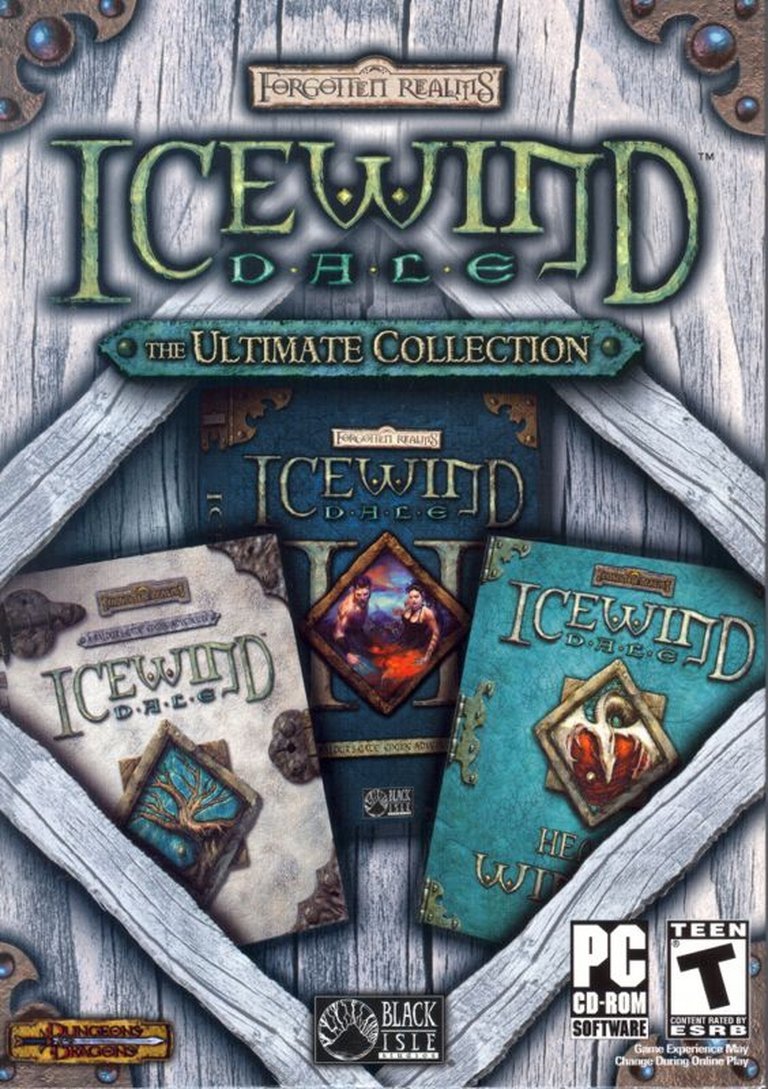
Icewind Dale: The Ultimate Collection is a compilation featuring the epic role-playing adventures set in the frigid wilderness of the Forgotten Realms’ Icewind Dale region. This bundle includes the original Icewind Dale (2000) and its expansion Heart of Winter (2001), as well as Icewind Dale II (2002), both utilizing the classic Infinity Engine for party-based tactical combat. Players battle looming supernatural threats ranging from barbarian invasions to goblin hordes, with gameplay emphasizing challenging real-time-with-pause combat, dungeon exploration, and character customization using Dungeons & Dragons rules. The collection also includes a soundtrack CD, bonus content like additional levels and character portraits, and digital manuals, making it a comprehensive package for fans of classic RPGs.
Icewind Dale: The Ultimate Collection Free Download
Icewind Dale: The Ultimate Collection Patches & Updates
Icewind Dale: The Ultimate Collection Reviews & Reception
mobygames.com (81/100): Icewind Dale has one of the best combat systems around, mixing tactical thinking and reflexes in just the right proportions
Icewind Dale: The Ultimate Collection Cheats & Codes
PC
Enable cheats via ‘icewind.ini’ (add ‘Cheats=1’ under [Game Options]). Press Ctrl + Tab during gameplay to open the console for codes, or use cheat keys directly after enabling.
| Code | Effect |
|---|---|
| CHEATERSDOPROSPER:ExploreArea(); | Full map |
| CHEATERSDOPROSPER:AddGold([#]); | Gives # gold |
| CHEATERSDOPROSPER:FirstAid(); | Gives 5 healing potions, 5 antidotes, and 1 scroll of Stone to Flesh |
| CHEATERSDOPROSPER:Midas(); | Gives 500 gold |
| CHEATERSDOPROSPER:SetCurrentXP([#]); | Gives selected characters # exp |
| CHEATERSDOPROSPER:CreateItem([item name]); | Spawn given item |
| CHEATERSDOPROSPER:Hans(); | Teleport to pointer |
| CHEATERSDOPROSPER:CreateItem(“00AMUL14”); | A Shield Amulet |
| CHEATERSDOPROSPER:CreateItem(“00AMULBT”); | Belibs Tool |
| CHEATERSDOPROSPER:CreateItem(“00HFAMBT”); | Belibs Tool of Fortune |
| CHEATERSDOPROSPER:CreateItem(“00HFPNBI”); | Bile of the Damned |
| CHEATERSDOPROSPER:CreateItem(“53AMULBS”); | Blue Ioun Stone |
| CHEATERSDOPROSPER:CreateItem(“00HFAMES”); | Calm Before the Storm |
| CHEATERSDOPROSPER:CreateItem(“11AMULCM”); | Cleansing Medallion |
| CHEATERSDOPROSPER:CreateItem(“00AMULFD”); | Dance Talisman |
| CHEATERSDOPROSPER:CreateItem(“00AMULDS”); | Druid Stone |
| CHEATERSDOPROSPER:CreateItem(“00AMULES”); | Eye of the Storm |
| CHEATERSDOPROSPER:CreateItem(“00AMULGC”); | Gohoins Charm |
| CHEATERSDOPROSPER:CreateItem(“00HFAMSL”); | Heart of a Snow Leopard Charm |
| CHEATERSDOPROSPER:CreateItem(“12AMULHC”); | Houndstooth Collar |
| CHEATERSDOPROSPER:CreateItem(“53AMULHD”); | House of Despana Insignia |
| CHEATERSDOPROSPER:CreateItem(“00AMUL15”); | Intellect Amulet |
| CHEATERSDOPROSPER:CreateItem(“00AMULSL”); | Leopard Charm |
| CHEATERSDOPROSPER:CreateItem(“11HFAMCM”); | Medallion of Dawn |
| CHEATERSDOPROSPER:CreateItem(“00HFAMMP”); | Mirabels Maleficent Pendant |
| CHEATERSDOPROSPER:CreateItem(“00AMULMP”); | Mirabels Pendant |
| CHEATERSDOPROSPER:CreateItem(“00AMUL12”); | Necklace of Missiles |
| CHEATERSDOPROSPER:CreateItem(“11HFBDWD”); | Pipes of the Craum Straugs |
| CHEATERSDOPROSPER:CreateItem(“11BARDWD”); | Pipes of the Dragon |
| CHEATERSDOPROSPER:CreateItem(“00AMUL13”); | Protection +1 Amulet |
| CHEATERSDOPROSPER:CreateItem(“00HFAMGC”); | Secret Charm |
| CHEATERSDOPROSPER:CreateItem(“00HFAMDS”); | Stone of Thorns |
| CHEATERSDOPROSPER:CreateItem(“00HFAMFD”); | Sunfire Talisman |
| Ctrl+6 | Goes through character icons backwards |
| Ctrl+7 | Goes through character icons forwards |
| Ctrl+R | Heals character under mouse pointer |
| Ctrl+Y | Kills character under mouse pointer |
| Ctrl+Q | Makes monster/npc under mouse pointer join your party |
| Ctrl+J | Moves party to position under mouse pointer |
| Ctrl+9 | Shows boxes around characters |
| Ctrl+4 | Shows triggers and traps |
Icewind Dale: The Ultimate Collection: A Definitive Chronicle of Frost and Fury
Introduction
In the pantheon of late-90s CRPGs, Icewind Dale carved its legacy not through intricate political intrigue or existential philosophy, but by embracing the primal thrill of the dungeon crawl. Released in 2000 by Black Isle Studios, Icewind Dale: The Ultimate Collection (2003) assembles the original game, its expansions Heart of Winter and Trials of the Luremaster, and the sequel Icewind Dale II, alongside a treasure trove of extras like soundtrack CDs and digital manuals. This compilation crystallizes the saga’s essence: a frostbitten odyssey of tactical combat, atmospheric world-building, and the quiet desperation of survival in Faerûn’s northern wastes. This review dissects its creation, mechanics, and enduring influence, arguing that Icewind Dale remains a masterclass in focused, combat-driven RPG design.
Development History & Context
Studio Vision and Technological Constraints
Black Isle Studios, fresh from successes like Fallout 2 and Planescape: Torment, sought to leverage BioWare’s Infinity Engine—a toolset renowned for Baldur’s Gate’s isometric perspective and real-time-with-pause combat. Yet where Baldur’s Gate emphasized narrative depth and Torment philosophical introspection, Icewind Dale pivoted toward tactical attrition. As designer J.E. Sawyer noted, the goal was a “risk-limited” title that maximized the engine’s strengths: pre-rendered environments, AD&D 2nd Edition rules, and party-based strategy.
The 2000 RPG Landscape
The game debuted amid a CRPG renaissance, competing with Diablo II’s action-centric lootfest and Baldur’s Gate II’s sprawling epic. Icewind Dale distinguished itself by focusing on combat density and environmental storytelling. Technological constraints shaped its design: hardware limitations necessitated compact, hand-painted zones (like the claustrophobic Dragon’s Eye dungeon), while memory restrictions influenced the absence of recruitable NPCs, pushing players to craft a full six-character party from scratch.
Expansions and Legacy
Buoyed by strong sales (400,000+ units by 2001), the Heart of Winter expansion (2001) introduced the punishing Heart of Fury mode and lore-rich barbarian conflicts, while Trials of the Luremaster (a free add-on) offered a playful, haunted-castle diversion. Icewind Dale II (2002) iterated with D&D 3rd Edition rules and UI refinements but faced criticism for its dated engine. The 2014 Enhanced Edition modernized the saga, but The Ultimate Collection remains a tangible relic of its era.
Narrative & Thematic Deep Dive
A Symphony of Desolation
The plot is deceptively simple: your party, hired as caravan guards in Easthaven, unravels a conspiracy involving dueling demonic forces—Yxunomei’s yuan-ti cult and Brother Poquelin’s Crenshinibon-fueled apocalypse. Yet beneath this veneer lies a thematic tapestry of futility and resilience. Icewind Dale is a land where warmth is myth, hope is scarce, and history—as narrated by the deceitful Belhifet—is written by the damned.
Characters as Reflections of the Tundra
– Kresselack: The ghostly barbarian king embodies the Dale’s cyclical violence. His tomb, a labyrinth of regret, forces players to confront their role as invaders.
– Yxunomei: Her childlike avatar masks an alien worldview (“physical shells are irrelevant”), a critique of mortal morality.
– Everard: The Tempus priest’s arc—from deriding Jerrod’s sacrifice to embodying it—mirrors the game’s central theme: heroism as Sisyphean duty.
Themes of Sacrifice and Survival
The Ten-Towns’ plight—forced to appease Auril with human offerings or forsake warmth—mirrors the player’s attritional journey. Every victory is pyrrhic: saving Kuldahar’s tree only delays Belhifet’s advance; slaying Yxunomei removes a rival who might have stalled the Crenshinibon’s corruption. The expansions deepen this fatalism, with Heart of Winter’s dragon queen Icasaracht mourning her shattered lineage, echoing Aihonen’s ancient betrayal.
Gameplay Mechanics & Systems
Party Creation: The First Gauntlet
Unlike its contemporaries, Icewind Dale demands strategic party-building from the outset. The absence of premade companions shifts focus to synergy:
– Warriors: Barbarians’ rage trivializes early mobs; Paladins’ immunity to fear proves vital in undead-heavy zones.
– Arcane Casters: Mages’ crowd control (Web, Slow) outshines direct damage, while Sorcerers’ spontaneity suits long dungeon slogs.
– Divine Casters: Clerics’ Turning undead offsets limited healing; Druids’ elemental spells dominate Dragon’s Eye.
– Rogues: Thieves’ trap-disarming is mandatory, but Bards’ songs (+4 saves in Heart of Fury) render them unsung MVPs.
Combat: The Engine’s Crucible
The Infinity Engine’s real-time-with-pause system shines here, demanding micromanagement against overwhelming odds. Key mechanics:
– Positioning: Chokepoints (e.g., Vale of Shadows’ bridges) turn Fireballs into massacres, but friendly fire is ruthlessly punitive.
– Proficiencies: Grand Mastery (+5 damage, +1 APR) transforms Fighters into blenders, but scarcity of top-tier weapons (e.g., katanas) punishes poor planning.
– Spell Disruption: Enemy mages exploit casting delays, making Stoneskin and Mirror Image essential pre-combat buffs.
Flaws and Innovations
– Pathfinding: Units frequently jam in corridors, turning retreats into death sentences.
– Economy: Merchants’ inflated prices (The Ultimate Collection’s Conlan sells +3 weapons for extortionate sums) necessitate loot-hoarding.
– Heart of Fury: Enemy HP bloat (3× +80) turns fights into wars of attrition, rewarding debuffs (Slow) over raw damage.
World-Building, Art & Sound
A Canvas of Desolation
The Dale’s aesthetic is a masterclass in environmental storytelling:
– Kuldahar: The giant tree’s warmth contrasts with its ashen outskirts, symbolizing fragile sanctuary.
– Severed Hand: Elven ruins draped in spectral blue, whispering of betrayed alliances.
– Dorn’s Deep: Dwarven halls choked by ice and corroded by demonic corruption.
Jeremy Soule’s Winter Requiem
Soule’s soundtrack—a highlight of The Ultimate Collection—melds choral melancholy (“Easthaven”) with pulse-pounding dread (“Dragon’s Eye”). Its absence in Icewind Dale II (scored by Inon Zur) is palpably felt, though Zur’s barbarian drums suit the sequel’s tribal conflicts.
Sound Design
From the crunch of snow underfoot to Tony Jay’s guttural Kresselack monologues, audiovisual cohesion sells the Dale’s lethality. The Enhanced Edition’s party banter (“Don’t Bother Me, I’m Icewind Daling!”) adds levity, contrasting David Ogden Stiers’ somber narration.
Reception & Legacy
Critical and Commercial Performance
Launch reviews praised its combat and score (Metacritic: 87/100) but critiqued narrative thinness. PC Gamer called it “Diablo with brains,” while detractors lamented repetitive trash fights. Commercially, it dominated charts, moving 145k U.S. copies by 2000 and topping UK sales briefly.
Long-Term Influence
– Modding: Tools like Near Infinity birthed fan patches (e.g., Icewind Dale II’s unfinished content restoration).
– Genre Impact: Its combat focus inspired Neverwinter Nights 2: Storm of Zehir and Pathfinder: Kingmaker’s dungeon designs.
– Enhanced Edition: Beamdog’s 2014 update introduced quality-of-life fixes but spotlighted aging systems, reaffirming the original’s balance of austerity and depth.
Conclusion
Icewind Dale: The Ultimate Collection is a paradox: a game about desolation that radiates creative warmth. Its unapologetic focus on combat and party-building may alienate story-seekers, but for those who relish strategic depth and atmospheric immersion, it remains unmatched. Viewed as both artifact and art, it embodies the brutal beauty of its setting—a glacier that carves valleys but endures millennia. In the annals of RPG history, Icewind Dale stands not as a revolutionary, but as a perfected archetype: the Dungeon Crawl as elegy.