
- Release Year: 2020
- Platforms: Linux, Macintosh, Windows
- Publisher: The Berry Guild
- Developer: The Berry Guild
- Genre: Adventure
- Perspective: 3rd-person
- Game Mode: Single-player
- Gameplay: Visual novel
- Average Score: 10/100
Description
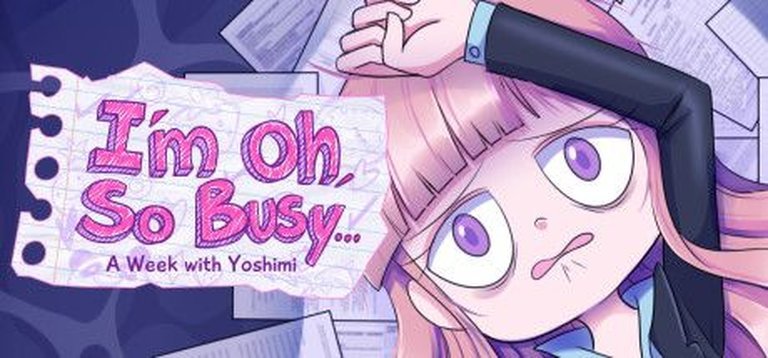
I’m Oh, So Busy…: A Week with Yoshimi is a dark comedy and drama slice-of-life kinetic visual novel that follows Yoshimi Adelina Hertz during her first week after finishing school, as she moves to a new city hundreds of miles from home. The game explores her challenges in finding her place in the world, confronting insecurities, and navigating the trials of adulthood through a linear, text-based narrative with minimalist visuals.
Gameplay Videos
Where to Buy I’m Oh, So Busy…: A Week with Yoshimi
PC
I’m Oh, So Busy…: A Week with Yoshimi Reviews & Reception
lifeisxbox.eu (10/100): Unfortunately, I cannot recommend this game.
I’m Oh, So Busy…: A Week with Yoshimi: Review
Introduction: The Anxious Echoes of a Debut
In the vast, often overwhelming landscape of indie visual novels, I’m Oh, So Busy…: A Week with Yoshimi (hereafter IOSB) emerges not with a roar, but with the quiet, persistent hum of a deeply personal struggle. Released in November 2020 by the freshly formed Berry Guild, this kinetic novel—a story sans player choices—promises a intimate, week-long portrait of Yoshimi Adelina Hertz, a 23-year-old navigating the disorienting transition from academia to independent life in Boston. Its thesis is immediate and potent: the chaos of “adulting” is not a grand adventure but a series of small, often painful, negotiations with one’s own insecurities. As a debut title from a writer-turned-developer channeling his own “dark times,” IOSB is a fascinating case study in art as catharsis. However, its execution reveals the inherent tension between a raw, autobiographical core and the polished craftsmanship required to translate that core into a universally compelling interactive narrative. This review will argue that while IOSB is a technically sound and ambitiously personal entry within the modern visual novel renaissance, its narrative failures and tonal inconsistencies ultimately relegate it to the status of a well-intentioned but flawed cultural artifact, significant more for what it represents about indie development than for what it achieves as a standalone story.
Development History & Context: A Guild Forged in Global Isolation
The genesis of IOSB is inseparable from the biography of its creator, known only as “berry.” An aspiring television comedy writer, berry’s pivotal moment came not on a studio lot but in a Tokyo game store in 2014, where he witnessed the sheer scale of Japan’s visual novel market—a stark contrast to the non-existent Western scene he’d previously known. This sparked an idea that would gestate for years. The script for what would become IOSB was initially written in November 2017 as a spec miniseries, only to be rejected in his local market. Faced with a completed script and no television takers, berry recalled the burgeoning VN scene on platforms like Steam and Itch.io, seeing a viable path to “production experience” and a “sellable product.”
This pivot from traditional media to indie games is the game’s foundational context. Developed by the entirely remote “Berry Guild,” IOSB was a globally collaborative effort against significant odds. As berry detailed in a 2019 interview with GameCuddle, the team spanned continents, with artists in Mexico and Russia, leading to sleepless nights coordinating across time zones. This decentralized model, while common now, was a major challenge, especially for a first-time project. Technologically, the game was built in Ren’Py (v7.3.5), the accessible, Python-based engine that has democratized VN development. This choice reflects a pragmatic approach: leveraging a stable, community-supported tool to focus resources on writing and art rather than coding from scratch. The post-2020 period saw a boom in Western-developed visual novels on Steam, with titles like Doki Doki Literature Club! having paved the way. IOSB arrived into this expanding niche, aiming to blend “a western style of writing with an anime-esque visual style.” Its development timeline, from 2017 script to 2020 release, mirrors the increasing viability of the solo/small-team VN as a legitimate indie genre.
Narrative & Thematic Deep Dive: The Heavyweight of a Lightweight Format
At its core, IOSB is a character study of Yoshimi, a protagonist whose defining traits are her过度打包的行李 (overpacked luggage) and her even more excessive emotional baggage. The plot, covering a single week, is deliberately quotidian: Yoshimi navigates a new city, a dull data entry job, a sick pet (her ferret), awkward social interactions, and familial calls from her Midwestern parents. The “conflict” is internalized, a battle against her own “bad habits” of self-doubt and social maladjustment.
The narrative is framed as a dark comedy/drama/slice-of-life, but this tonal cocktail is where the game stumbles. berry’s interview cites inspirations like Gord Downie’s “Bedtime” and Ne-Yo’s “Miss Independent,” songs that grapple with loneliness and self-reliance. However, the translation of this inspiration into dialogue and scene composition is inconsistent. Yoshimi’s narration is voluminous—the game contains 25,349 words—and often spirals into repetitive, circular monologues about her anxiety. A critical review from LifeisXbox.eu astutely noted her “annoying amount of time talking about cupcakes,” a point that encapsulates a larger issue: the narrative frequently substitutes mundane obsession (cupcakes, nostalgia) for meaningful metaphor, risking viewer boredom rather than fostering empathy.
The themes of “mental health, purpose, meaning, desire, and trying to find footing in a world of modernity in the presence of a traditionalist upbringing” are explicitly stated but superficially explored. Yoshimi’s discussions with her parents hint at cultural friction (her mother is Japanese-American), but this thread dissipates. The intended “dark comedy” feels more like a default, melancholic narration punctuated by occasional, sometimes jarring, innuendo (as warned by the mature content descriptor). The kinetic format—with no player choices—is a bold, TV-script-like choice that enforces a specific, linear psychological journey. It removes agency, forcing the player to simply witness Yoshimi’s spiral. This can be powerfully immersive or exhaustingly passive, and IOSB too often tips toward the latter, lacking the narrative variation or payoff needed to justify its determinism. The story’s resolution, a quiet moment of potential self-acceptance, feels earned only by the sheer accumulation of time spent with Yoshimi, not by a definitive narrative arc.
Gameplay Mechanics & Systems: The Virtue and Vice of Simplicity
As a kinetic novel, IOSB’s “gameplay” is purely textual and visual. There are no puzzles, no stat management, no branching paths. The core loop is reading dialogue and narration, clicking to advance, and occasionally selecting from trivial binary options (e.g., “Yes” or “No” to a mundane question) that have zero consequence on the plot, as confirmed by patch notes fixing their functionality. This purity of format is both its greatest strength and its most significant limitation.
The User Interface (UI) is a standard Ren’Py affair, clean and functional. The preferences menu, which was patched in v1.1.5, allows for basic text speed and auto-read settings. The game’s “menu structures” (per MobyGames specs) consist of a title screen, save/load menus, and a gallery unlocked via achievements. The achievement system—14 Steam Achievements—is tied to progression (“Read Chapter 1,” “Finish the Game”) and viewing all sprite variations, offering mild encouragement for completionists but no meaningful gameplay hook.
The character progression is entirely existential. Yoshimi “progresses” only in her internal state, which the player observes. The voice acting (full/partial, from 10 actors) is a notable feature, with berry himself handling casting and direction. According to the credits and interview, over 300 auditions were fielded. This added layer of performance can deepen immersion, but its partial nature—not every line is voiced—can create a jarring rhythm between spoken and silent text. Ultimately, the systems are Bare Minimum Viable Product for a VN. They serve the story without enhancement, which is appropriate for the kinetic format but offers little to discuss in terms of innovative or flawed gameplay. The flaw lies not in the systems themselves, but in the narrative they supplantly serve, which fails to consistently reward the player’s passive attention.
World-Building, Art & Sound: Aesthetic Cohesion vs. Emotional Void
Where IOSB most consistently succeeds is in its audiovisual presentation, which crafts a specific, lo-fi, modern-anxious atmosphere. The game features 19 colorful, 3D backgrounds depicting urban Boston and interiors, and 322 expressive character sprites for Yoshimi across 7 chapters, including alternate outfits. This volume of art is impressive for an indie project.
The visual direction employs a distinct style: Yoshimi is rendered as a 2D anime-style sprite placed against 3D-rendered or manipulated photographic backgrounds. This hybrid approach, common in mid-2010s VNs, aims for a tactile, “real-world” feel for settings while keeping the protagonist iconic. The sprites, created by Erickiwi, have a wide range of expressions, a point praised even by the negative LifeisXbox review. However, the artistic cohesion is uneven. The 3D backgrounds (by Fuyu no Kawa) can vary in quality and stylistic match to the sprites. Sometimes they feel like generic stock cityscapes, failing to imbue Boston with the specific, nostalgic weight Yoshimi’s narration ascribes to it. The world feels conceptually “modern” but lacks deeper architectural or cultural texture.
The sound design is a high point. The lo-fi soundtrack, comprising 18 tracks from various producers like furino, idealism, CRÆTION, and an exclusive track from Axian (“The Plan”), is integral to the game’s mood. The music is often ambient, melancholic, or gently playful, providing an emotional throughline that the writing sometimes misses. The sound effects, sourced from free libraries, are serviceable. The inclusion of full voice acting for key characters (Anastasia Lyle as Yoshimi being the standout) adds another layer of realism, though the supporting cast’s performances are more variable. Together, the art and sound create a “minimalist, colorful, cartoony” (per Steam user tags) aesthetic that effectively牌子 (brands) the game. But this polished aesthetic sometimes clashes with the gritty, self-loathing internal monologue, creating a cognitive dissonance that undermines the intended “dark comedy.” The game looks and sounds too pleasant for the psychological discomfort it wants to convey.
Reception & Legacy: A Whisper in the Visual Novel Crowd
IOSB‘s launch was a quiet, multi-platform affair. Following a demo, it released on Steam, itch.io, and later expanded to DLSite, Yamary.com, and Android (September 2021). It was sold at a standard indie VN price point of $9.99 (with frequent sales down to ~$5), and even had a DLC artbook (“The Art of I’m Oh, So Busy,” 46 pages). This aggressive, platform-agnostic distribution strategy is typical for small indie VN studios seeking maximum reach.
Its critical reception was virtually non-existent on major aggregators. MobyGames, the source for this review’s structural request, lists no critic reviews and a “n/a” MobyScore. The one notable professional review, from LifeisXbox.eu, was scathing (10%), criticizing a failure to deliver on its promised genres (“it wasn’t dark, it wasn’t funny, and it wasn’t dramatic”), a protagonist who failed to engage, and a story where “nothing really happens.” This review highlights the central risk of autobiographical work: what is cathartic for the creator can be self-indulgent or opaque to an audience.
User reception is mixed, per data aggregated by sites like Steambase (Player Score 64/100 from ~11 reviews, as of early 2026). Steam user reviews praise its cute art, relatable themes of anxiety and moving out, and the voice acting. Detractors echo the LifeisXbox critique, citing boredom, unlikable protagonist, and a lack of dramatic payoff. The VNDB entry gives it a user score of 8.00 from a single vote (rank 29,434), indicating extreme obscurity even within the niche VN community.
Its legacy is therefore dual. First, as a case study in indie dev processes: berry’s interview is a valuable document on the realities of global collaboration, casting voice actors via open calls (300+ auditions), using free sound libraries, and maintaining a devlog across multiple storefronts. Second, as a data point in the “western indie VN” evolution. It embodies the post-Doki Doki boom trend of personal, often angst-ridden, slice-of-life stories. However, it lacks the meta-narrative innovation or cultural impact of genre leaders. Its most tangible legacy is its expansion to Android and the release of its artbook, showing a commitment to monetizing and preserving the asset pipeline beyond the initial game release. It is a footnote—a diligently produced, personally meaningful footnote, but a footnote nonetheless—in the crowded history of 2020s visual novels.
Conclusion: A Week That Felt Like a Lifetime
I’m Oh, So Busy…: A Week with Yoshimi is a game of profound ambition confined by the very format that enabled it. As a technical and managerial achievement for a first-time developer leading a global team, it is commendable. The assets are plentiful (322 sprites, 19 backgrounds, 18 tracks + voice-acting), the platform support is exhaustive, and the post-launch support (patches, ports, DLC) was diligent. This speaks to berry’s passion and work ethic.
As a narrative experience, however, it falters. The kinetic structure demands a story of relentless quality, yet IOSB’s script is bloated with repetitive introspection andTonally inconsistent. It promises a “dark comedy/drama” but often settles for a drizzle of melancholy punctuated by moments of crude humor that feel unearned. Yoshimi, intended as an everywoman grappling with modern anxieties, too often becomes a bore, her struggles rendered inert by the lack of narrative consequence or meaningful external conflict. The player observes her week but is rarely invited to feel it, a fatal flaw for a story reliant on empathy.
Its place in video game history is secure as a representative artifact of the accessible, personal, and platform-diverse indie visual novel wave of the late 2010s/early 2020s. It demonstrates the power of Ren’Py to turn a writer’s spec script into a released product. But its artistic execution ensures it will be remembered more in development post-mortems and niche VN databases than in critical canon. For the curious player, the demo is essential—it will either resonate with its specific, anxious frequency or confirm the critiques of its pacing and tone. Ultimately, IOSB is a valiant, visible effort that proves not all personal stories, when rendered verbatim into an interactive medium, automatically translate into compelling interactive experiences. It is a game that is very busy indeed, but too often busy going in circles.