
- Release Year: 2020
- Platforms: Linux, Macintosh, Windows
- Publisher: Notovia
- Developer: Notovia
- Genre: Puzzle
- Perspective: 1st-person
- Game Mode: Single-player
- Gameplay: Point and select
Description
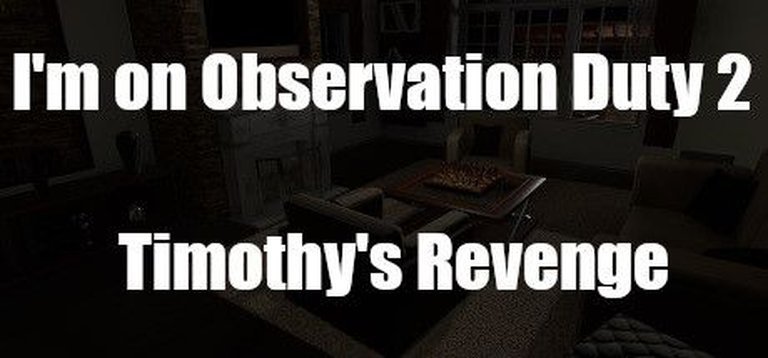
I’m on Observation Duty 2: Timothy’s Revenge is a first-person horror puzzle game played entirely through a surveillance system. As an observer, you monitor security cameras in two distinct houses, identifying and reporting paranormal anomalies and intruders to survive until 4 AM. The game’s core loop revolves around careful observation and quick decision-making to uncover the mystery of Timothy’s Revenge and lift the curses on each property.
Gameplay Videos
I’m on Observation Duty 2: Timothy’s Revenge Guides & Walkthroughs
I’m on Observation Duty 2: Timothy’s Revenage: A Microscopic Masterpiece of Surveillance Horror
Introduction: The Unblinking Eye
In the vast landscape of video game horror, where AAA titles often rely on visceral spectacle and complex narratives, a quiet, pixelated revolution has been unfolding in the shadows. At the forefront of this movement stands Notovia’s I’m on Observation Duty 2: Timothy’s Revenge, a 2020 indie horror puzzle game that distills the genre to its terrifying essence: the dread of the unseen, the anxiety of the forgotten, and the paralysis of the observer. As the direct sequel to the 2019 cult hit I’m on Observation Duty, this game refines a brutally simple premise into a meticulously crafted instrument of psychological torture. My thesis is this: Timothy’s Revenge is not merely a game but a profound experience of mediated terror, one that uses its restrictive, surveillance-based gameplay loop to strip away player agency and force a confrontation with helplessness, memory, and the haunting ambiguity of what is real. It represents a pivotal, minimalist counterpoint to narrative-heavy horror, proving that atmosphere and mechanics alone can construct a deeply unsettling and philosophically resonant world.
Development History & Context: The Birth of a Mechanic
Studio & Vision: I’m on Observation Duty 2: Timothy’s Revenge was developed and published by the enigmatic Notovia, a studio whose identity is almost entirely subsumed by its singular franchise. Little is known about the team’s size or history, but their output—a rapid series of sequels and spin-offs released annually from 2019 onward—suggests a focused, iterative design philosophy. The game was created by Director Zaster (as credited on IMDb), whose vision appears centered on exploring a core, unsettling mechanic: the act of passive, error-prone observation as a source of horror.
Technological & Design Context: Utilizing the accessible Unity engine, the game’s technical constraints are its strengths. The visual style is deliberately low-fidelity, utilizing static, grainy security camera feeds, simple 3D models, and a stark, domestic environment. This aesthetic choice is fundamental to its atmosphere. The 2020 release placed it in a golden era for indie horror, following the “liminal space” and “PS1 horror” trends, but Observation Duty carved its own niche by focusing not on exploration but on interpretation. The technological limitation of a single, pivoting camera (with a secondary “second cam” that vanishes at 3:20 AM, per wiki notes) becomes a narrative device—the player is literally trapped in a single viewpoint, mirroring the protagonist’s helpless security guard role.
Gaming Landscape: Releasing just a year after its predecessor, Timothy’s Revenge operated in a market saturated with atmospheric horror (Layers of Fear, Visage) and innovative indie titles (Yuppie Psycho, The Lament). Its distinction was its extreme minimalism. While others used complex puzzles or stories, Observation Duty 2 presented a pure, unadulterated test of vigilance and pattern recognition within a fixed, nine-room house layout. Its success can be attributed to perfecting this “spot-the-difference” formula within a horror context, a concept so potent it spawned an entire franchise of annual releases.
Narrative & Thematic Deep Dive: Stories Told Through Glitches
The narrative of Timothy’s Revenge is an archaeological dig, buried not in text logs or voice acting, but in environmental anomalies, cryptic Easter eggs, and the implied history of the house itself. There is no traditional plot delivered to the player. Instead, the story emerges from the act of observation.
The Core Premise & The “Timothy” Enigma: The player is a security guard (implied to be the same protagonist from the first game) monitoring a haunted house from a remote office. The subtitle, Timothy’s Revenge, points to a vengeful spirit or entity named Timothy, a figure whose presence is felt more than seen. The connection to the previous game is explicit via a wiki note: activating a secret ending in the first game triggers the phrase “Why did you do that to Timothy?” at its conclusion. This establishes Timothy as a victim of a past injustice—likely a murder—whose spirit now haunts the domestic space, warping it through “anomalies” as an act of posthumous rage.
The Secret Ending: A Buried History: The most substantive narrative clue is the multi-step Easter egg detailed in the Steam guide. By clicking a painting in the Study, a door in the Hallway, and a specific flower bundle in the Yard, the player uncovers a fragmented message: “Find me” → “I’m buried under the flowers.” This reveals a hidden, literal burial—a corpse (presumably Timothy’s victim, or Timothy himself) interred in the garden. The female silhouette that rises is presumably the ghost of the murdered woman, or a manifestation of Timothy’s target. This transforms the house from a generic haunted locale into a crime scene, grounding the supernatural phenomena in a tragedy of domestic violence or burial. The “revenge” is the house’s constant, glitching reminder of this secret.
Thematic Analysis:
* Mediated Trauma: All horror is experienced through a camera screen, a metaphor for how trauma is often processed indirectly—through memories, reports, and filtered perceptions. The player never confronts anything directly; they are a bureaucrat of the bizarre, filing reports to “fix” manifestations of pain.
* The Domestic as Uncanny: The anomalies occur not in a monster-filled castle, but in a perfectly normal suburban home—a bedroom, kitchen, garage, study. The horror is the violation of the familiar: a chair shrinking, a painting changing, a plant shaking. This taps into a deep unease about the safety of one’s own home, a theme central to the Observation Duty series (as noted by the wiki’s mention of shared maps with Welcome Back, Daddy).
* Memory and Failure: The core gameplay loop is a test of visual memory. Did you see what was in the bathroom a minute ago? Is that new object supposed to be there? The penalty for four active “anomalies” is death—a system that punishes forgetfulness. Thematically, this suggests that unresolved trauma (unreported anomalies) accumulates until it consumes the observer. You are being psychologically broken by the minutiae of a haunted past you are tasked to manage but never understand.
* Ambiguity as Horror: The game revels in what it doesn’t explain. What is the “Alien” intruder in the House of the Past? Why is it a pure white, humanoid figure that pulls the camera? This unexplained, Lovecraftian intrusion breaks the domestic logic, suggesting the house’s corruption is multidimensional or timeless.
Gameplay Mechanics & Systems: The Ritual of Reporting
The entire experience is a masterclass in constrained, systemic gameplay. The mechanics are the narrative.
Core Loop: Starting at midnight, the player has six in-game hours (real-time) to survive until 6 AM. They monitor nine static camera feeds (Bedroom, Living Room, Kitchen, Toilet, Yard/Outside, Garage, Study, Dining Room, Hallway). A tenth slot is often missing due to a persistent Camera Malfunction anomaly, a narrative choice that increases tension by limiting perspective from the start.
Anomaly Detection & Reporting: This is the entire game. Anomalies are discrete, categorized events:
* Object Disappearance/Movement/Growth/Shrinkage: The simplest, testing memory of the room’s baseline state.
* Painting Anomaly: A painting’s image changes.
* Ghost/Intruder: Supernatural or physical entities appearing. Critically, the wiki and achievement guide highlight that classification is complex. A “ghost” might be an “extra object” (like a floating arm), and “intruders” are often naked humanoid figures (a disturbing, unexplained design choice). Misreporting yields a “No problem found” message but does not clear the anomaly, wasting critical time.
* Corpse: A body appears (e.g., in the Yard), often requiring a specific report (Yard/Outside location).
* Door Opening: A door swings open.
* Camera Malfunction: A feed distort or cuts out; one slot is permanently gone.
The “Four Anomaly” Rule & Death States: The central tension. Anomalies appear on timers or triggers. If four are active simultaneously, the “Too many anomalies” warning appears, and the player soon dies. This creates a frantic triage system. Some anomalies have instant-death conditions if ignored, such as:
* The baby intruder in the Toilet that locks the camera with a grotesque laugh.
* The white alien figure in the House of the Past’s Storage room that disables camera switching.
* Certain corpse or hanging corpse sightings.
Progression & Secrets: There is no character progression or ability growth. The only “progression” is player skill—learning anomaly patterns, room layouts, and report categories. The primary reward is survival and uncovering secrets:
1. Achievements: Beat each “house” (The Cursed House, The House of the Past) to get Curse of the House / Back To The Past.
2. The Timothy’s Revenge Secret: The multi-step click sequence in Study → Hallway → Yard that reveals the buried narrative. Getting “Who Is She? Who Killed Her?” achievement triggers the secret ending, showing the woman’s silhouette rising from the flowers.
UI & Feedback: The UI is brutally simple: a grid of camera feeds, a selected feed view, and a bottom-right menu for reporting (Room + Anomaly Type). Feedback is minimalistic: a success is a brief control screen with a “match” lighting up; failure is a text pop-up. There is no health bar, only the looming count of active anomalies. This austerity perfectly mirrors the protagonist’s lonely, procedural job.
Innovation & Flaws: The innovation is the mechanic-as-horror paradigm. The flaw is its sheer repetition. For some, the lack of dynamic events or a deeper story beyond the Easter egg will feel hollow. The difficulty curve is also uneven; some anomalies are exquisitely subtle (a slightly moved chair), while others are blatant (a giant intruder in a window), leading to frustration. The “House of the Past” introduces the alien and presumably different anomaly sets, but the core loop remains identical, emphasizing the game’s status as a pure, almost academic, exercise in tension.
World-Building, Art & Sound: The Haunting of the Mundane
Setting & Atmosphere: The game takes place in two variants of the same architectural floorplan: The Cursed House and The House of the Past (implied to be a historical or spiritual echo). The environment is a prototypical, sparsely furnished modern house. Its mundanity is the first layer of horror. The wiki confirms it shares a map structure with another indie horror game, Welcome Back, Daddy, suggesting a common, potent architectural template for domestic dread.
Visual Direction: The art direction is “security camera realism.” Grainy filters, slight static, muted colors, and 4:3 aspect ratios sell the VHS surveillance aesthetic. The low-poly models and simple textures force the player to focus on changes rather than details—a chair is a chair, so when it’s gone or shrunk, the absence screams. The lighting is flat, with no dramatic shadows except those cast by objects themselves, making the sudden appearance of a ghostly figure or intruder in a well-lit room profoundly wrong.
Sound Design: Sound is the game’s most powerful and under-discussed weapon. The soundtrack is almost non-existent, replaced by:
* Ambient Room Tone: A low, constant hum or silence for each camera, broken by…
* Diegetic Sounds: A crashing shelf in the Garage, a laugh from the Toilet, the creak of a swinging door, the hum of a refrigerator door opening. These sounds often precede or accompany an anomaly, but crucially, they can be misdirected. You hear a crash in the Garage, switch cameras, and see an anomaly in the Kitchen—a brilliant design that plays on your attention and memory.
* The Report Sound: The satisfying, definitive click or chime when a report is accepted is a moment of temporary relief, a punctuation in the tension.
* The 3:20 AM Event: The wiki notes that at 3:20 AM, the second cam disappears with a crackling sound. This is a diegetic, in-world system failure, not an anomaly. It’s a narrative beat—a reduction of your already limited perspective—that ratchets up the horror without fanfare.
The marriage of visual simplicity and critical sound design creates an environment where the player’s imagination, fueled by a single anomalous pixel or an unexplained thump, becomes the primary engine of terror.
Reception & Legacy: A Cult Standard in Minimalist Horror
Critical & Commercial Reception: Official critic reviews are notably absent from aggregators like MobyGames (noted as “n/a”). However, its Steam user reviews are “Very Positive” at 92% (483 reviews), a remarkable score for a niche horror game. Its IMDb rating sits at 6.1/10 from 19 ratings, indicating a moderately favorable but not spectacular mainstream reception. The commercial success is evident in its persistent presence and the launch of a full franchise. Priced at a low $2.99, it’s an accessible impulse buy that delivers a concentrated dose of its intended experience.
Evolution of Reputation: Timothy’s Revenge is not a game that had a “poor launch, great on Steam” story. It seems to have been immediately embraced by the indie horror community as a purveyor of a specific, effective kind of dread. Its reputation has solidified as a “must-play” for fans of atmospheric, puzzle-based horror. It is frequently compared to and discussed alongside games like Sally Bow (another surveillance horror title) and the “Back Room” genre, for its use of liminal, empty spaces.
Influence on the Industry: Its direct influence is seen in Notovia’s own relentless output—seven mainline sequels by 2025, plus collections. This suggests a successful, replicable formula. More broadly, it has helped cement the “observation duty” sub-genre: games where the player is a static observer (security guard, CCTV operator, control room technician) who must identify anomalies in a monitored environment. This design philosophy strips away combat and exploration, placing 100% emphasis on sustained attention and nervous system response. While not the first, Observation Duty 2 refined the template so effectively that it became a benchmark.
Cultural Footprint: The “Timothy” Easter egg and the cryptic lore have spawned community speculation and guide-making (as evidenced by the detailed Steam guide). Its appearance on platforms like HowLongToBeat (with a 3-hour main story) marks it as a short-form “horror snack,” a format increasingly popular in an era of time-pressed gamers. The game’s mature content tags (Nudity, Gore, Sexual Content) are noteworthy for their matter-of-fact listing; the nudity of most “intruders” is a bizarre, unsettling detail that adds to the feeling of violating, exposed wrongness in the house.
Conclusion: The Unseen Legacy
I’m on Observation Duty 2: Timothy’s Revenge is a paradox: a sequel that perfects a formula almost to the point of abstraction, a horror game with almost no story that tells a more compelling tale of buried trauma than many with sprawling scripts. Its genius lies in its ruthless commitment to a single, brilliant idea: that the most profound horror stems from the responsibility to notice, and the devastating consequences of failing that simple duty.
It is not without flaws. Its repetitive structure will fatigue some. Its lore is tantalizingly thin, existing mostly in fan speculation and optional Easter eggs. But as a piece of experiential game design, it is almost unimpeachable. It turns your living room (played on a monitor) into a pressure cooker of anxiety. The sound of a shifting chair in the next room while your camera is elsewhere becomes a moment of pure, unadulterated panic.
In video game history, it will not be remembered as a revolution in graphics or storytelling. Instead, it will be cited as a definitive case study in minimalist horror design, a game that weaponizes simplicity, uses its technical limitations as artistic strengths, and proves that a player’s own eyes, memory, and imagination are the most terrifying assets in a developer’s arsenal. For its unwavering execution of a terrifyingly simple premise, for its creation of a persistent, unsettling universe from a handful of polygons and sound files, and for birthing a franchise that explores this niche with relentless dedication, I’m on Observation Duty 2: Timothy’s Revenge earns its place as a modern classic of psychological horror. It is a game that doesn’t just scare you with what you see, but with what you might have missed—and that is a fear that lingers long after the monitor goes dark at 6 AM.
Final Verdict: 8/10 – A masterclass in atmospheric, mechanic-driven horror. Inessential for those needing traditional stories, but an absolute essential for anyone interested in the psychology of fear and the power of restraint in game design.