
- Release Year: 1997
- Platforms: DOS, Windows
- Publisher: GT Interactive Software Corp., THQ Nordic GmbH
- Developer: Digital Reality Software Kft
- Genre: Action, Role-playing (RPG), Strategy, Tactics
- Perspective: Top-down
- Game Mode: Single-player
- Gameplay: 4X, Turn-based strategy (TBS)
- Setting: Cyberpunk, dark sci-fi, Futuristic, Sci-fi
- Average Score: 74/100
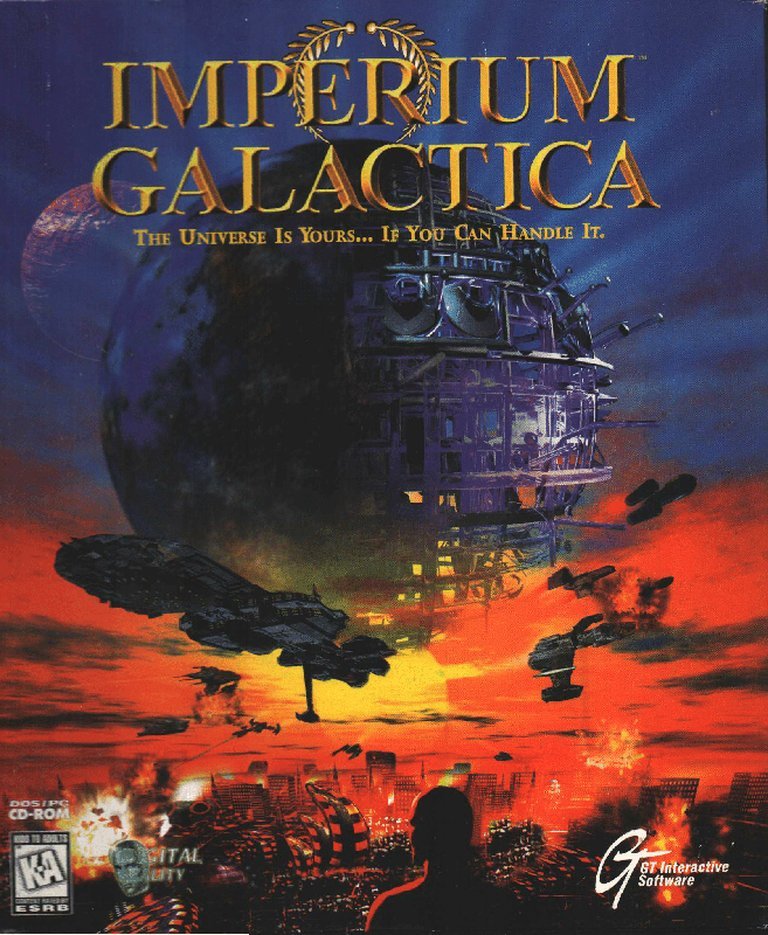
Description
Imperium Galactica is a sci-fi strategy game set in the fourth millennium, where players begin as a human lieutenant rebuilding the shattered Human Empire through a series of missions, advancing ranks to command fleets, manage colony economies, research 75 technologies, and engage in diplomacy or combat against diverse alien races with unique ships, architecture, and units, culminating in galactic supremacy via real-time space battles and Command & Conquer-style land skirmishes featuring full-motion video cutscenes.
Gameplay Videos
Where to Buy Imperium Galactica
Imperium Galactica Free Download
Imperium Galactica Cracks & Fixes
Imperium Galactica Patches & Updates
Imperium Galactica Guides & Walkthroughs
Imperium Galactica Reviews & Reception
en.wikipedia.org (80/100): Imperium Galactica is an excellent choice for strategy-game fans because it goes beyond a simple strategy game.
Imperium Galactica Cheats & Codes
PC
While playing the game, hold [Left Shift], type “karoly”, then press one of the following keys to activate the corresponding cheat function.
| Code | Effect |
|---|---|
| C | All colonies and inventions. Press C again to enable cheats on the planets. |
| V | 100,000 Credits |
| 5 | Promotion to Rank 1 |
| 6 | Promotion to Rank 2 |
| 7 | Promotion to Rank 3 |
| 8 | Promotion to Rank 4 |
| 9 | Promotion to Rank 5 |
Imperium Galactica: Review
Introduction
In the vast cosmos of 1990s strategy gaming, where titans like Master of Orion reigned over turn-based 4X empires and real-time skirmishes erupted in Command & Conquer, Imperium Galactica emerged as a bold hybrid—a real-time 4X odyssey laced with RPG progression and cinematic flair. Released in 1997 by Hungarian studio Digital Reality and published by GT Interactive, this DOS-era gem thrust players into the role of a rising imperial officer tasked with resurrecting a crumbling human empire amid alien threats. Its legacy endures not as a flawless masterpiece, but as a pioneering experiment in narrative-driven space strategy, blending colony sims, fleet command, and plot twists in a way that foreshadowed modern titles like Homeworld or Stellaris campaigns. My thesis: Imperium Galactica is a fascinating artifact of its time—ambitious, immersive, and structurally innovative—yet hampered by linearity, UI clunkiness, and AI shortcomings that prevent it from transcending cult status, making it essential retro fare for genre historians but a curiosity for newcomers.
Development History & Context
Digital Reality Software Kft., a small Hungarian outfit founded in the mid-1990s, debuted with Imperium Galactica, showcasing Eastern European talent in a Western-dominated industry. Key figures included lead programmer and designer István Árpád Kiss, who handled core coding alongside Ferenc Szabó; designer Gábor Fehér, doubling as a 3D modeler; and multi-talented Tamás Kreiner on music and modeling. Producers Jason Schreiber and Nick Bridger from GT Interactive bridged the gap between Budapest’s vision and global markets, with quality assurance by Andre Garcia and a team of Hungarian testers like László Peller.
The creators’ vision was audacious: fuse Master of Orion‘s expansive 4X empire-building (explore, expand, exploit, exterminate) with real-time tactics akin to C&C, gated behind RPG-style rank progression to tutorialize complexity organically. This addressed a common 4X pitfall—overwhelming newbies—while delivering a “plot-driven interactive movie” via full-motion video (FMV) cutscenes. Technological constraints of 1997 DOS were stark: CD-ROM delivery across two discs for FMVs, software-rendered 3D models, and real-time pacing demanding constant player input without modern multitasking. The Hungarian prototype featured live-action opening cutscenes, but GT Interactive mandated CGI replacements for international releases due to poor actor-background blending and unfinished textures—yet retained quirky in-game Hungarian messages, a nod to cultural roots.
The gaming landscape was electric. 1993’s Master of Orion had codified 4X, while 1995’s Command & Conquer popularized RTS micromanagement. StarCraft loomed in 1998, and space sims like Wing Commander emphasized story. Imperium Galactica slotted into this nexus, predating Homeworld‘s 3D fleets (1999) and blending genres amid GT Interactive’s portfolio (Hexen, Destroyer Command). Rushed elements—evident in abrupt mission shifts—suggest development pressures, but its March 1997 launch captured a hunger for narrative depth in strategy, influencing Hungarian studios’ later works like Hegemonia.
Narrative & Thematic Deep Dive
Imperium Galactica‘s narrative is its crown jewel, a cyberpunk-tinged space opera set in the 3200s amid a vestigial Galactic Empire fractured by overexpansion and alien incursions. Players embody Dante Johnson, a “young lieutenant” commanding a Guardian-class destroyer, three Raptor fighters, and colonies Achilles, Naxos, and San Sterling. Progression unfolds via rank-ups (Lieutenant → Captain → Commander → Admiral → Grand Admiral), each unlocking map sectors, commands, and plot beats through FMV cutscenes with computer-generated voices—cheesy yet immersive, evoking B-movie sci-fi.
The plot hooks with empire-rebuilding: police pirates, quell plagues (revealed as alien bioweapons), and confront foes like the antagonistic Dargslan Kingdom. Flashbacks unveil Johnson’s “shrouded past”—a Tomato in the Mirror twist: he’s an android, the Empire’s desperate secret weapon. Themes probe imperialism’s hubris (empire too vast, spawning breakaways), technological desperation (android saviors, 75 research discoveries), and xenophobia (unique alien architectures/ships mask transplanted humans or proud warriors). Dialogue, delivered via “TV screen” briefings, is stiff and mismatched—like dubbed kung-fu flicks—but advances hardwired missions: anti-piracy patrols escalate to galactic supremacy.
Characters are archetypal: Johnson as stoic riser, crew for “Local” lounge chats (unlocked post-Captain), aliens as stylistic foes (Sullep/Dargslan as proud warriors). No deep arcs, but progression mirrors military ascent, critiquing blind loyalty. Subtle motifs—like capturing alien planets to inherit their tech/buildings—explore assimilation vs. annihilation. Flaws abound: linearity kills replay (no skips), missions vanish abruptly (rushed feel), yet this scripted saga innovates 4X by making story the spine, not afterthought.
Gameplay Mechanics & Systems
At its core, Imperium Galactica loops through real-time 4X: explore fixed galaxies (unveiling via ranks/scanners), expand via conquest/colonization, exploit economies/research, exterminate in hybrid combat. Start small—manage three colonies’ taxes, food, reproduction—then scale to dozens, juggling UI screens: galactic map, planetary views, fleet production.
Core Loops: Colony management shines—build residences, factories, hospitals, radars for personalization (outposts vs. shipyards). Economy demands balance: overtax, unrest; underfeed, population crashes. Research spans 75 techs across five centers (Computer, Construction, A.I., Military, Machinery), but per-planet limits force multi-colony specialization or rebuilds (AI cheats with fixed pools). Production mandates manual ship refits—weapons/modules per vessel—escalating micromanagement (28 capitals + 180 fighters max, though mergeable).
Combat: Space battles auto-trigger on encounters, shifting to tactical view for orders (move/fire; pre-set strategies post-Commander). Scripted enemy waves (fighters → small ships → mass assault) frustrate, especially Dargslan’s “cheating” endless identical fleets. Ground invasions echo C&C—vehicle-only tanks/forts—but player’s defenses scatter fire poorly vs. AI focus-fire, devolving to slugfests. Pirates/mercenaries add chaos.
Progression/UI: Rank gates brilliance—tutorializes via story—but caps research/exploration, baffling players (e.g., unbuildable flagships pre-rank). UI is cluttered: excessive clicks for refits/satellites, no multiplayer/custom games. Innovations: alien integration (capture buildings/tech permanently; let foes upgrade before conquering), diplomacy (non-war victory). Flaws: linearity (hardwired missions, zero replay), AI stupidity (predictable), pacing lulls (post-mission voids). Real-time pacing breeds early hectic fun, late attrition wars.
World-Building, Art & Sound
The setting—a dark sci-fi galaxy blending cyberpunk intrigue with futuristic sprawl—immerses via progression: fog-shrouded sectors reveal Andromeda/Magellanic Clouds, alien empires with bespoke aesthetics (e.g., Garthog dual-research anomaly). Atmosphere evokes decline: war-ravaged outposts to grand admiralty, pirates raiding traders.
Visuals impress for 1997: 2D galactic maps overlay software 3D ships/planets; FMVs (two CDs’ worth) mix CGI gloss with laughable dubbing, enhancing matinee charm. Alien architectures dazzle—captured worlds yield exotic buildings unbuildable elsewhere. Ground views personalize colonies; space combat’s “wild amoebas” feels dated.
Tamás Kreiner’s symphonic soundtrack elevates: epic swells for battles, ambient hums for management. Sound design—laser pew-pews, tank rumbles—is solid, though spherical tones grate long-term. Collectively, they forge cozy nostalgia: visuals/sound propel empire fantasy, flaws (wireframe cutscenes in Hungarian original) humanize the craft.
Reception & Legacy
Launch reception was solid but polarized: MobyGames aggregates 72% critics (Svenska PC Gamer 84%, PC Games 56%), praising genre mix (“Lords of the Realm 2 in space”) and fun (“makes you climb ranks motivated”), critiquing simplicity (“not deep,” “slugfest”), linearity, and combat (” scripted amoebas”). Players average 3.3/5: weregamer lauds story tutorial; Maury Markowitz decries rushed missions/AI cheats. Next Generation gave 4/5 for immersion.
Commercially modest (collected by 80 Moby users today), re-releases (2016 GOG/Steam at $1.24) sustain via Imperium Galactica Complete. Reputation evolved to cult classic: innovative rank-story fusion influenced Sins of a Solar Empire campaigns, Hungarian RTS (Hegemonia). Sequel Imperium Galactica II: Alliances (1999) refined (three campaigns, design-your-own ships), but GT bankruptcy derailed IG3 into Nexus: The Jupiter Incident (2004 prequel). Fan projects: open-ig remake, stalled Spring RTS mod. In 4X history, it marks real-time evolution pre-Sins, a “nifty landmark” blending interactivity/story.
Conclusion
Imperium Galactica masterfully weds 4X depth—colony sims, research sprawl, diplomatic nuance—with real-time urgency and RPG ascent, birthing a narrative engine rare for 1997. Its triumphs (unique progression, alien flair, FMV immersion) clash with tedium (micromanagement hell, scripted foes, no replay), yielding a 7/10 retro gem: exhilarating first playthrough, skippable repeats. In video game history, it carves a niche as Digital Reality’s spark—proof Hungarians punched above weight—paving hybrid paths for story-rich strategy. Grab the GOG version, embrace the cheese, and reclaim the stars; it’s a flawed empire worth restoring. Final Verdict: Cult Classic (8/10 for Historians, 6/10 Modern Play).