
- Release Year: 1997
- Platforms: PlayStation, SEGA Saturn, Windows
- Publisher: Fox Interactive, Inc., Tec Toy Indústria de Brinquedos S.A.
- Developer: Radical Entertainment Inc.
- Genre: Action, Simulation
- Perspective: Third-person
- Game Mode: LAN, Single-player
- Gameplay: Arcade, Aviation, Flight, Shooter, Vehicular
- Setting: Futuristic, Sci-fi
- Average Score: 37/100
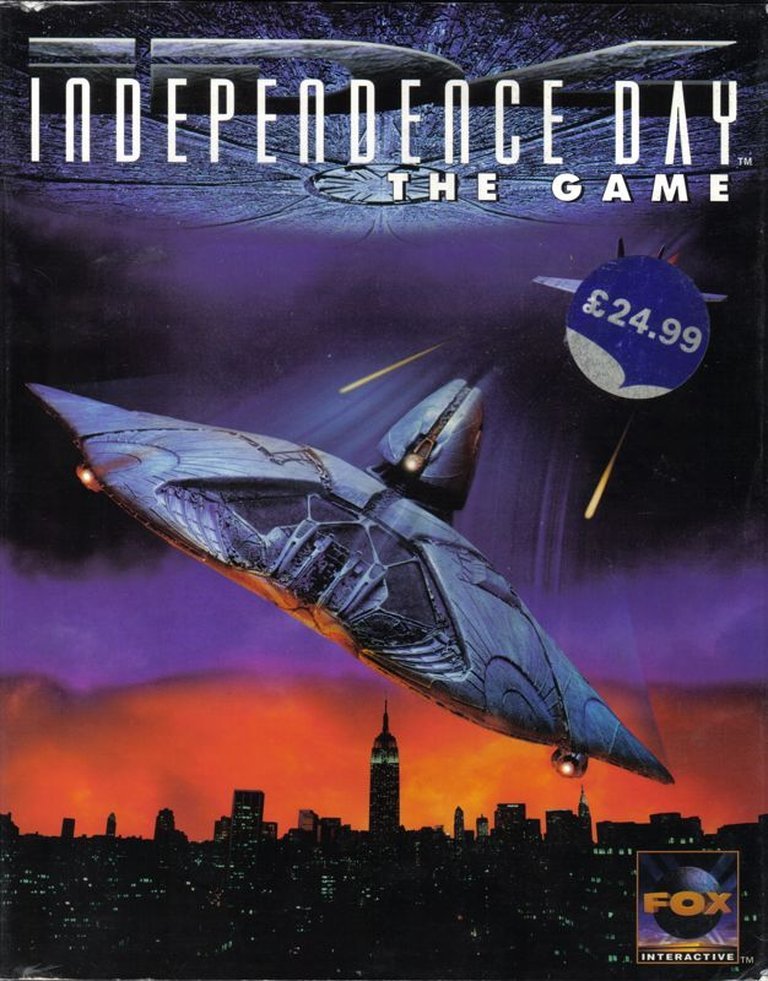
Description
Independence Day is an arcade-style flight shooter based on the 1996 blockbuster film, where players pilot various aircraft to combat massive alien motherships threatening Earth. Set across iconic locations like Washington D.C., New York City, and the Grand Canyon, the game tasks players with destroying shield generators, alien fighters, and ultimately the mothership’s main cannon. Featuring cutscenes from the movie, power-ups, and two-player head-to-head modes, the game blends 3D flight combat with sci-fi action, though its repetitive missions and dated graphics received mixed reviews.
Gameplay Videos
Independence Day Free Download
Independence Day Guides & Walkthroughs
Independence Day Reviews & Reception
en.wikipedia.org (68/100): Independence Day received mixed to negative reviews. Most critics remarked that the game is solidly playable, but becomes dry and repetitive due to the lack of variety in the objectives.
retropunk.substack.com (10/100): Fox Interactive has such a great reputation when it comes to making games from movies. Take a look at Die Hard Trilogy – great movies, great game. What happened? Independence Day for the PlayStation possesses no redeeming qualities.
ign.com (20/100): If Independence Day was a box office hit, then the game is just a matinee at a drive-in – it’s not even worth showing up for
mobygames.com (50/100): This arcade game is based loosely on the 1996 blockbuster movie “Independence Day.” Interspersed with cutscenes lifted from the film, the game consists of flying a jet through various missions in order to take down the gargantuan, city-destroying spaceships.
Independence Day Cheats & Codes
PlayStation
Go to the options menu and enter your name as specified. Exit to the game select screen and quickly press Left, Right, Square, Circle, Triangle, Triangle, Down.
| Code | Effect |
|---|---|
| MR HAPPY | Unlocks several cheats and lets you choose your plane. |
| GREG FM | Unlocks all cheats available in the cheat menu. |
| RADARMY | Unlocks all codes at once. |
| DAB DAB | Unlocks all codes at once. |
| GO POSTAL | Unlocks Fast Reload, Damage Bonus, and Unlimited Weapons. |
| LIVE FREE | Unlocks Invincibility. |
| FOX ROX | Unlocks Level Select. |
| GODZILLA | Unlocks Target Civilians and Friendlies. |
| TOURIST | Unlocks Tourist Mode. |
PC
Go to the options menu and enter your name as specified. Exit to the game select screen and quickly press Control + Right Shift + 8.
| Code | Effect |
|---|---|
| LIVE FREE | Unlocks Invincibility. |
| TOURIST | Unlocks City, Tourist, Demo cam, No time. |
| FOX ROX | Unlocks Level Select. |
| MR HAPPY | Unlocks Select Plane. |
| GO POSTAL | Unlocks Fast Reload, Damage Bonus, and Unlimited Weapons. |
| GODZILLA | Unlocks Target Civilians and Friendlies. |
| RADARMY | Unlocks all options. |
| KIWI | Unlocks Select level, plane; Invincible, Weapons, Fast reload. |
| GODZILLA | Unlocks Kill civil, Kill wing. |
| KYRA NR | Unlocks All options. |
| BRENDAN QR | Unlocks All options. |
| DOOFUS | Unlocks All options. |
| GREG FM | Unlocks All options. |
| SCOTTYWAR | Unlocks All options. |
| ROSA DUONG | Unlocks All options. |
| COCO | Unlocks All options. |
| DAB DAB | Unlocks All options. |
| TRI S | Unlocks All options. |
Sega Saturn
Enter the options screen and enter the specified player name. Enter the game selection screen and quickly press Left, Right, Up, Down, X, Z, then Y.
| Code | Effect |
|---|---|
| MR HAPPY | Unlocks Plane Select. |
| FOX ROX | Unlocks City Select. |
| LIVE FREE | Unlocks Invincibility. |
| GO_POSTAL | Unlocks Fast Reload, Damage Bonus, and Weapons. |
| GODZILLA | Unlocks Kill Civilians and Wingman. |
| TOURIST | Unlocks City, Tourist, Demo Cam, No Time. |
| RADARMY | Unlocks All Cheat Options. |
| DAB_DAB | Unlocks All Cheat Options. |
Independence Day: A Retrospective on a Flawed but Fascinating Relic of the 90s
Introduction
In the annals of video game history, few titles embody the spirit of the mid-90s quite like Independence Day, the 1997 combat flight simulator based on Roland Emmerich’s blockbuster film. Released at the height of the licensed game craze, Independence Day is a fascinating case study in the challenges of adapting a cinematic spectacle into an interactive experience. While it failed to capture the magic of its source material, the game remains a curious artifact of its era—a reminder of the growing pains of 3D gaming, the pitfalls of rushed development, and the enduring appeal of blowing up alien invaders.
This review will dissect Independence Day in exhaustive detail, exploring its development history, narrative (or lack thereof), gameplay mechanics, technical achievements, and lasting legacy. By examining the game through the lens of its historical context, we can better understand why it fell short of expectations and how it reflects the broader trends of late-90s gaming.
Development History & Context
The Studio and the License
Independence Day was developed by Radical Entertainment, a Canadian studio founded in 1991 that would later become known for titles like The Simpsons: Hit & Run and Scarface: The World Is Yours. At the time, Radical was still cutting its teeth in the industry, having previously worked on licensed games like The Terminator and Wayne’s World. The studio was tasked with creating a game tied to one of the biggest films of 1996—a daunting challenge, especially given the tight development timeline.
The game was published by Fox Interactive, the gaming arm of 20th Century Fox, which had recently found success with Die Hard Trilogy (1996). That game’s critical and commercial success set high expectations for Independence Day, but the two titles couldn’t have been more different in execution. Where Die Hard Trilogy cleverly adapted its source material into three distinct gameplay styles, Independence Day opted for a more straightforward approach: a 3D flight combat simulator.
Technological Constraints and the Gaming Landscape
Independence Day was released in March 1997 for Windows, PlayStation, and Sega Saturn, a time when 3D gaming was still in its infancy. The PlayStation and Saturn were capable of rudimentary 3D graphics, but developers were still grappling with the limitations of the hardware. The Windows version, meanwhile, was designed to take advantage of early 3D accelerators like the Voodoo Graphics card, though this feature was poorly implemented and often unstable.
The gaming landscape of 1997 was dominated by a few key trends:
– The rise of 3D: Games like Tomb Raider (1996) and Quake (1996) had proven the viability of 3D environments, but many developers struggled to balance visual fidelity with gameplay depth.
– Licensed games as cash grabs: The success of Die Hard Trilogy and GoldenEye 007 (1997) demonstrated that movie tie-ins could be both profitable and critically acclaimed, but most licensed games were rushed to market with little regard for quality.
– The arcade-to-console transition: Many developers were still adapting arcade-style gameplay to home consoles, leading to titles that were either too simplistic or too punishing for casual players.
Independence Day was caught in the middle of these trends. It attempted to deliver a cinematic, arcade-style flight combat experience but was hampered by technical limitations and a lack of innovation.
Development Challenges
The development of Independence Day was fraught with difficulties:
– Tight deadlines: The game was originally slated for a late 1996 release to coincide with the film’s VHS launch, but delays pushed it back to early 1997. This rushed schedule left little time for polish or playtesting.
– Multi-platform development: Radical developed the PlayStation and Saturn versions simultaneously, which often led to compromises in gameplay and graphics.
– Licensing restrictions: The game’s reliance on footage and assets from the film limited the developers’ creative freedom. Cutscenes were lifted directly from the movie, and the gameplay was constrained by the need to adhere to the film’s narrative beats.
Despite these challenges, the developers managed to create a functional, if unremarkable, flight combat game. The question remains: could Independence Day have been more than just a forgettable licensed title?
Narrative & Thematic Deep Dive
Plot: A Loose Adaptation
Independence Day loosely follows the events of the film, but its narrative is so barebones that it barely qualifies as a story. The game opens with the alien motherships arriving on Earth, followed by a series of missions in which the player—presumably acting as Eagle Leader, a nameless squadron commander—must destroy alien forces across various global landmarks. The player’s wingman is Captain Steven Hiller (Will Smith’s character from the film), but his presence is purely cosmetic; he offers no dialogue or meaningful interaction.
The game’s missions are structured as follows:
1. Destroy shield generators to weaken the alien defenses.
2. Take out the City Destroyer’s main weapon before it fires.
3. Repeat in a new location.
There are no cutscenes or story beats between missions, save for compressed FMV clips lifted from the film. These clips are so heavily compressed that they’re barely recognizable, serving as little more than a reminder that the game is, in fact, based on a movie.
Characters and Dialogue
The game’s lack of original dialogue or character development is one of its most glaring weaknesses. Unlike Die Hard Trilogy, which featured voice acting and mission briefings, Independence Day offers no context for the player’s actions. There are no briefings, no debriefings, and no sense of progression beyond the mechanical act of completing objectives.
The only “characters” in the game are:
– Eagle Leader (the player): A silent protagonist with no backstory or personality.
– Captain Steven Hiller (wingman): A non-interactive AI companion who occasionally shoots down enemies but never communicates.
– The aliens: Faceless enemies with no distinct behaviors or personalities.
This lack of narrative depth makes the game feel hollow, especially when compared to other flight combat titles of the era, such as Ace Combat 2 (1997), which featured a fully voiced campaign with distinct characters and a coherent story.
Themes: Patriotism and Survival
The film Independence Day is a celebration of American patriotism, unity, and resilience in the face of an existential threat. The game, however, reduces these themes to their most basic elements: survival and destruction. There is no sense of global cooperation, no emotional stakes, and no triumphant climax—just a series of repetitive missions where the player blows up alien ships.
The game’s only nod to the film’s themes comes in the form of its mission locations, which include iconic landmarks like the White House, the Eiffel Tower, and the Statue of Liberty. These settings are purely aesthetic, however, and do little to evoke the film’s sense of global unity.
Missed Opportunities
Independence Day had the potential to be a compelling narrative experience. Imagine a game where:
– The player takes on the role of David Levinson (Jeff Goldblum’s character), using his technical expertise to hack alien systems and coordinate global defenses.
– Missions are interspersed with cinematic briefings featuring the film’s cast, providing context and emotional weight.
– The game’s story diverges from the film, allowing players to experience alternate outcomes or new perspectives on the invasion.
Instead, Independence Day settles for being a generic flight combat game with a thin veneer of cinematic licensing. It’s a missed opportunity that underscores the challenges of adapting a blockbuster film into a video game.
Gameplay Mechanics & Systems
Core Gameplay Loop
At its heart, Independence Day is a 3D combat flight simulator with arcade-style mechanics. The player pilots a variety of fighter jets, engaging in dogfights with alien ships and destroying ground-based targets. The game’s structure is linear, with each mission following the same basic formula:
1. Fly to the objective area (e.g., a city under attack by a City Destroyer).
2. Destroy secondary targets (shield generators, communication uplinks, enemy fighters).
3. Destroy the primary weapon before the timer runs out.
4. Escape the explosion as the City Destroyer is destroyed.
This loop is repeated across 13 missions, with little variation in objectives or gameplay. The lack of diversity makes the game feel repetitive, especially when compared to contemporaries like Ace Combat 2, which featured a wider range of mission types and objectives.
Combat and Controls
The game’s combat is arcade-style, emphasizing fast-paced action over realism. The player’s jet is equipped with machine guns and heat-seeking missiles, which can be upgraded via power-ups scattered throughout the levels. Enemy ships come in a few basic varieties:
– Attackers: Fast, agile fighters that engage the player in dogfights.
– Turrets: Stationary or slow-moving ground targets that fire lasers or projectiles.
– City Destroyers: Massive alien ships that serve as the primary objective in each mission.
The controls are serviceable but clunky, especially on console versions. The PlayStation and Saturn versions rely on the D-pad for movement, which makes precise maneuvering difficult. The Windows version supports mouse and keyboard controls, but the lack of analog input (a standard feature in modern flight sims) makes the game feel stiff and unresponsive.
One of the game’s most frustrating mechanics is the force field that surrounds each mission area. This invisible barrier prevents the player from flying too far from the objective, creating a cramped, claustrophobic feel that contrasts sharply with the open skies of real flight combat.
Character Progression and Aircraft
The game features a plane unlock system, allowing players to choose from a variety of fighter jets as they progress. The player starts with the F/A-18 Hornet and can unlock additional planes by flying through special icons during missions. Unlockable aircraft include:
– A-10 Warthog (slow but durable)
– F-15 Eagle (balanced speed and firepower)
– F-22 Raptor (fast and agile)
– Sukhoi Su-27 (high maneuverability)
Each plane has unique stats for speed, agility, durability, and stealth, but these differences are minimal in practice. The stealth stat, for example, supposedly affects how much enemy fire the player attracts, but this mechanic is so poorly implemented that it’s barely noticeable.
One of the game’s most punishing mechanics is the permanent loss of aircraft. If the player is shot down, the plane they were flying is lost forever, and if the player runs out of planes, the game ends. This mechanic adds an unnecessary layer of frustration, especially given the game’s already high difficulty.
Power-Ups and Secrets
The game features a variety of power-ups, including:
– Health packs: Restore damage to the player’s jet.
– Missile upgrades: Increase the player’s firepower.
– Shield: Grants temporary invincibility.
– Freeze: Temporarily immobilizes enemy ships.
These power-ups are scattered throughout the levels, often in hard-to-reach areas. The game also features secret levels, accessible by flying through hidden portals. These levels offer a brief diversion from the main campaign but are ultimately forgettable.
Multiplayer
Independence Day includes two-player multiplayer modes, allowing players to engage in split-screen or link-cable dogfights. The split-screen mode is particularly notable, as it was a rare feature in flight combat games of the era. However, the mode suffers from slowdown and choppy frame rates, making it difficult to enjoy.
The multiplayer experience is further hampered by the game’s lack of depth. There are no distinct multiplayer modes or objectives—just a basic dogfight where players fly in circles until one shoots the other down. This lack of variety makes the multiplayer mode feel like an afterthought.
UI and HUD
The game’s user interface (UI) is functional but uninspired. The heads-up display (HUD) provides basic information, including:
– Radar: Shows the location of enemies and objectives.
– Health and ammo: Displays the player’s current status.
– Timer: Counts down to the destruction of the City Destroyer’s primary weapon.
The radar is particularly problematic, as it’s difficult to read and often fails to provide useful information. The lack of a mini-map or waypoint system makes navigation needlessly confusing, especially in later missions where objectives are spread across large areas.
World-Building, Art & Sound
Setting and Atmosphere
Independence Day takes place in a near-future Earth under siege by alien invaders. The game’s missions span a variety of global locations, including:
– Grand Canyon, USA
– Washington D.C., USA
– New York City, USA
– Paris, France
– Tokyo, Japan
– Moscow, Russia
– The alien mothership
These settings are rendered in low-poly 3D, with minimal texture detail and flat, uninspired landscapes. The game’s visuals are a far cry from the cinematic spectacle of the film, with jagged polygons, pop-in textures, and bland color palettes dominating the experience.
The game’s atmosphere is tense but repetitive. The constant threat of the City Destroyer’s primary weapon creates a sense of urgency, but the lack of variety in mission design makes the experience feel monotonous. The absence of civilian NPCs or environmental storytelling further detracts from the game’s immersive potential.
Visual Direction
The game’s visual direction is utilitarian, prioritizing functionality over aesthetics. The alien ships are designed to resemble their film counterparts, but their low-poly models and flat textures make them look more like toys than terrifying invaders. The Earth environments are similarly underwhelming, with blocky buildings, repetitive textures, and a lack of detail.
One of the game’s most glaring visual flaws is its draw distance. Objects and enemies often pop into existence just a few meters in front of the player, making it difficult to navigate or aim effectively. This issue is particularly problematic in missions where the player must destroy shield generators or other small targets, as the lack of visibility forces the player to fly blindly until the objective suddenly appears.
Sound Design
The game’s sound design is minimalist, with little attention paid to immersion or atmosphere. The sound effects are basic, with generic laser blasts, explosion noises, and engine hums dominating the audio landscape. The lack of dynamic music or ambient noise makes the game feel eerily quiet, especially during missions where the player is flying over empty cityscapes.
The game’s voice acting is limited to compressed FMV clips from the film, which are barely audible and add little to the experience. There is no original dialogue or mission briefings, further emphasizing the game’s lack of narrative depth.
Music
The game’s soundtrack is one of its most overlooked aspects. While the in-game music is nonexistent, the Saturn version of the game includes a hidden soundtrack that was later extracted by fans. This music, composed by Marc Baril, is surprisingly atmospheric, with synth-heavy tracks that evoke the tension and excitement of the film.
The decision to exclude the soundtrack from the gameplay is baffling, as it would have significantly enhanced the game’s atmosphere. Playing the game with the soundtrack enabled (via fan mods or external playback) reveals how much potential the game had to be a more immersive experience.
Reception & Legacy
Critical Reception
Independence Day received mixed to negative reviews upon release, with critics praising its arcade-style gameplay but criticizing its repetitive missions, poor graphics, and lack of innovation. The game holds a 48% aggregate score on MobyGames, based on 28 critic reviews, and a 2.2/5 player score, based on 23 ratings.
Positive Aspects:
– GamePro (80%): Praised the game’s accessibility for casual players, noting that “mid-level jet jocks who give this game a chance could find that Independence is worth fighting for.”
– Mega Fun (72%): Highlighted the game’s split-screen multiplayer and power-up system as standout features.
– Game Express (73%): Found the game enjoyable in short bursts, especially in networked multiplayer.
Negative Aspects:
– IGN (20%): Called the game “the lamest game to ever hit the PSX,” criticizing its grainy graphics, choppy animation, and lack of innovation.
– Edge (30%): Described the game as “energetic but shallow,” noting that its multiplayer mode was tedious and uninspired.
– GameSpot (55%): Found the game repetitive and unexciting, stating that “each new level brings a sense of deja vu.”
The consensus among critics was that Independence Day was a functional but forgettable licensed game, lacking the polish and depth of its contemporaries.
Commercial Performance
Despite its lukewarm reception, Independence Day sold well upon release, likely due to the strength of the film’s brand. The game’s commercial success underscores the power of licensed properties in the 90s, even when the games themselves were mediocre.
Legacy and Influence
Independence Day has had little lasting impact on the gaming industry. It is rarely mentioned in discussions of classic flight combat games, and its reputation has only diminished with time. However, the game serves as a cautionary tale for licensed games, demonstrating the risks of rushed development, lack of innovation, and over-reliance on source material.
The game’s most enduring legacy is its status as a cult curiosity. Fans of the film and retro gaming enthusiasts occasionally revisit Independence Day for its nostalgic value, but even they acknowledge its many flaws. The game’s hidden soundtrack and split-screen multiplayer are often cited as its only redeeming qualities.
Comparisons to Contemporaries
Independence Day pales in comparison to other flight combat games of its era:
– Ace Combat 2 (1997): Featured a fully voiced campaign, diverse mission types, and superior graphics.
– Star Fox 64 (1997): Offered tight controls, memorable characters, and a branching mission structure.
– Wing Commander IV (1996): Delivered a cinematic narrative experience with full-motion video and deep storytelling.
By contrast, Independence Day feels shallow and unfinished, a victim of its rushed development and lack of ambition.
Conclusion: A Flawed but Fascinating Relic
Independence Day is not a good game by any objective measure. Its repetitive missions, clunky controls, and lack of narrative depth make it a chore to play, especially by modern standards. However, the game is not without its historical significance. It is a product of its time—a licensed cash-in that reflects the growing pains of 3D gaming and the challenges of adapting a blockbuster film into an interactive experience.
For retro gaming enthusiasts, Independence Day offers a glimpse into the late 90s, when developers were still figuring out how to make 3D games fun and accessible. For fans of the film, it serves as a curiosity—a flawed but fascinating attempt to capture the excitement of the movie in video game form.
Final Verdict: 4/10 – A Forgettable but Interesting Artifact
Independence Day is not worth playing unless you’re a die-hard fan of the film or a retro gaming completist. Its repetitive gameplay, poor graphics, and lack of innovation make it a tedious experience, but its historical context and cult appeal ensure that it will remain a footnote in gaming history.
If you’re looking for a good flight combat game, play Ace Combat 2 or Star Fox 64. If you’re looking for a good Independence Day game, watch the movie instead. But if you’re curious about the challenges of licensed games in the 90s, Independence Day is a fascinating case study—one that reminds us how far gaming has come in the past 25 years.