
- Release Year: 1999
- Platforms: Windows
- Publisher: Brainscan Interactive, Sony Online Entertainment Inc.
- Developer: Harmless Games LLC
- Genre: Action
- Perspective: Diagonal-down
- Game Mode: Online PVP
- Gameplay: Arcade, Shooter
- Setting: Futuristic, Sci-fi
- Average Score: 98/100
Description
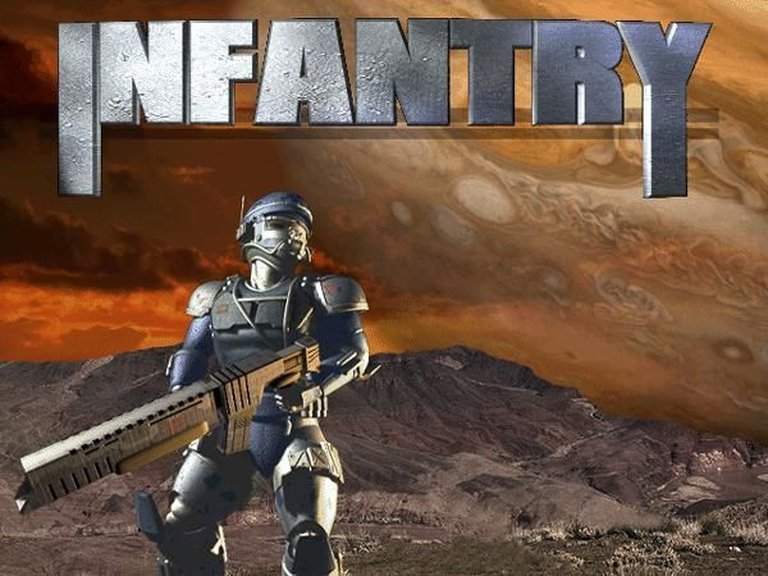
Infantry is an online-only multiplayer action game set in a science fiction universe, featuring diagonal-down perspective arcade shooter gameplay where players join or spectate simultaneous team-based matches like marines vs. aliens, capture the flag, and futuristic sports such as football, hockey, and Gravball, all powered by the same engine with in-game chat and custom level creation tools.
Where to Buy Infantry
PC
Infantry Reviews & Reception
neoseeker.com (98/100): One of the most addictive games ever.
gamefaqs.gamespot.com : Was a good game when it was free, but now an experience where you pay to be hassled by idiot players.
Infantry Cheats & Codes
PC
Requires running your own server. Enter the code with the star (*).
| Code | Effect |
|---|---|
| *cash 9999999999 | Gives 9999999999 cash (up to 10 numbers) |
Infantry: Review
Introduction
In the nascent days of online gaming, when dial-up modems screeched like banshees and “massively multiplayer” evoked grainy sprites rather than sprawling 3D worlds, Infantry (aka Infantry Online) burst onto the scene in 1999 as a raw, adrenaline-fueled revelation. Developed by a scrappy team of ex-SubSpace veterans, this isometric multiplayer shooter pitted players in chaotic, team-based sci-fi skirmishes that could swell to over 100 combatants per match—numbers unheard of in such accessible 2D action. Its legacy endures not just as a product of its time but as a harbinger of persistent online combat, influencing the free-to-play model, community-driven content, and even modern emulations like its recent Steam revival as Free Infantry. This review argues that Infantry occupies a vital niche in gaming history: a pioneering “MMO shooter” that prioritized addictive, zone-hopping multiplayer mayhem over narrative pomp, proving that simplicity, when paired with emergent chaos, can outlast graphical flash.
Development History & Context
Infantry‘s genesis traces back to the late 1990s, a wild west era for online gaming dominated by text MUDs, early MMORPGs like Ultima Online (1997), and arcade relics clinging to life via broadband dreams. The core team at Harmless Games LLC—formed by alumni of Virgin Interactive’s 1997 2D space shooter SubSpace—embodied this transitional spirit. Rod Humble (game producer and designer, later a Sony Online Entertainment VP overseeing EverQuest) envisioned a ground-based evolution of SubSpace‘s multiplayer dogfights, shifting to infantry combat with vehicles and sprawling zones. Jeff Petersen led programming, Larry J. Cordner handled tools and level design, Juan L. Sanchez directed art, and Jerimy Weeks contributed as artist and zone designer. External support came from Nick Fisher of Brainscan Interactive, the initial publisher.
Development kicked off with pre-testing in December 1997, involving staff and close friends, evolving into a pre-alpha for ~30 testers (SubSpace squadmates and potential publishers) by early 1998. An alpha test in April 1999 drew 200 players, mostly SubSpace fans, yielding crucial feedback on bugs and balance. Open beta followed in summer 1999, introducing new maps, graphics, and features amid the dot-com boom’s promise of endless connectivity.
Brainscan launched it on their EnterNET network, but catastrophe struck: parent company GameFan bankrupt in 2000, leaving the game in limbo under Express.com. Enter Sony Online Entertainment (SOE), who acquired Harmless Games and Infantry in October 2000 for an undisclosed sum. Humble and others joined SOE; Petersen and Weeks continued development. A brief outage preceded integration into SOE’s “The Station” platform. Technological constraints—sprite animation on Windows via keyboard/mouse input—kept it lightweight for 56k modems, contrasting behemoths like EverQuest. By 2002, SOE bundled it with Cosmic Rift (an Infantry offshoot targeting SubSpace) and Tanarus under Station Pass ($6.95/month), though free tiers persisted with limits (e.g., 30-minute sessions). Full free-to-play arrived in June 2007, alongside map editor release for user-generated content. Staff churn (e.g., Petersen’s EverQuest II shift, Weeks’ layoffs) stagnated growth, culminating in shutdown on March 29, 2012. The gaming landscape? Infantry bridged arcade shooters (Quake) and MMOs, predating Planetside (2003) in scale while embracing freeware ethos amid rising subscriptions.
Narrative & Thematic Deep Dive
Infantry eschews traditional storytelling for emergent multiplayer narratives, a deliberate choice in its sci-fi sandbox. No campaigns or voiced protagonists exist; instead, players embody faceless soldiers, marines, aliens, or pilots in perpetual warfare. Dialogue emerges via in-game chat—taunts, strategies, kill macros—forging player-driven epics of squad rivalries and global tournaments. Zones dictate “plots”: Mechanized Skirmish evokes gritty trench wars with fog of war and Newtonian physics; Bug Hunt (marines vs. aliens) channels Starship Troopers-esque infestation defenses; CTF zones like Chaos in EOL demand flag heists amid turret fire; sports modes (futuristic football, hockey, Gravball) parody conflict as game.
Themes revolve around factional chaos and technological hubris. Sci-fi futurism permeates: infantry wield shotguns (SG), micro-missile launchers (MML), flamers; vehicles like Trident/Salamander tanks rumble across terrains; spaceships enable fleet battles. Progression feels Darwinian—earn cash for upgrades, but death resets you, underscoring fragility in massive brawls (100+ players). Underlying motifs include teamwork vs. individualism (team-based modes punish lone wolves), asymmetry (classes/vehicles balance power fantasies), and impermanence (session-based resets mirror live-service volatility). Chat fosters tribalism—squads like IDI formed worldwide alliances, turning pixels into legends. Critiques note overpowered weapons (e.g., RR, SG) disrupting balance, yet this fueled adaptive narratives. In a post-shutdown era, community servers like Free Infantry extend the “story,” with players reclaiming the IP as folk heroes against corporate closure.
Gameplay Mechanics & Systems
At its core, Infantry loops through zone selection → spectate/join → combat → respawn/adapt, powered by a unified engine for seamless 100+ player lobbies. Diagonal-down isometric view offers tactical oversight, blending arcade twitch with strategy. Combat shines: sprite-based models animate fluidly—soldiers dash, vehicles crush, ships strafe—governed by Newtonian physics (momentum, collisions) and fog of war for ambushes. Weapons diversify: rapid-fire rifles, area-denial flamers, homing MMLs, shotguns for CQC. Vehicles (tanks, hovers) and spaceships add layers, with upgrades (via in-game currency) enabling loadouts.
Progression is session-tied: earn money for gear, but die and restart—encouraging risk-reward. Classes imply roles (e.g., anti-infantry vs. vehicle hunters), though fluid switching promotes experimentation. Modes innovate:
– Skirmish/No Man’s Land: Free-for-all/team deathmatch.
– CTF: Objective-driven flag wars.
– Sports: Physics-based goals (e.g., Gravball).
– Co-op: Vs. AI bugs.
– Fleet: Space dogfights.
UI is spartan: zone browser, chat window, minimap—functional but dated, with mouse/keyboard controls criticized for clunkiness (e.g., Game Vortex: “overcome these control issues… addictive”). Flaws: lag on dial-up, cheater accusations, imbalances (MML/SG dominance). Strengths: infinite replayability, spectator mode for scouting, user maps post-2007. Recent Free Infantry refines with emulators, open-source tools for custom zones.
World-Building, Art & Sound
Infantry‘s universe is a modular sci-fi tapestry: complex terrains (hills, bases, arenas) host zones as self-contained “worlds.” Fog-shrouded battlefields evoke alien frontiers; urban sprawls pulse with turrets; space voids host Newtonian fleets. Atmosphere thrives on scale—hundreds clashing creates emergent spectacle, Newtonian bounces turning kills poetic.
Visuals: 2D sprite animation punches above weight, modeling intricate soldiers (animations for reloads, deaths), hulking tanks, agile ships on layered terrains. Art direction (Sanchez/Weeks) favors functional futurism: neon HUDs, explosive effects, no photorealism needed. Low-poly era constraints yield charm—sprites scale dynamically, fog adds tension.
Sound: Sparse details, but inferred industrial sci-fi: weapon barks (flamer roars, missile whines), vehicle hums, explosion booms, chat pings. Ambient zone tracks (e.g., eerie Bug Hunt drones) amplify immersion, though multiplayer chatter dominates. Collectively, elements forge claustrophobic frenzy—visual chaos mirrors auditory overload, immersing via sensory barrage over polish.
Reception & Legacy
Launch reception was niche-positive: MobyGames aggregates 70% critic (Game Vortex: “plays well… infinite hours… addictive” despite controls), 3/5 player average. User raves (Neoseeker: 9.6/10, “most addictive ever”; GameFAQs: fun pre-paywall) lauded tanks/weapons, decried paywalls/lag. Peaks hit 140,000 users (2001), but populations dwindled post-Station Pass.
Legacy looms large: first “massive multiplayer isometric shooter,” predating Planetside. Influenced SOE’s ecosystem (Cosmic Rift, Station), free-to-play shifts (2007), user content (map editor). Shutdown sparked community heroism—Free Infantry emulator (SourceForge), open-source servers, 2018 revival, 2024 Steam launch (microtransaction-free remaster). Forums (MMO-Champion, Reddit) evoke nostalgia: “like heroin,” “kept my attention 25 years.” It pioneered defunct-service resurrection (cf. Project 1999), cementing place in MMO archaeology.
Conclusion
Infantry endures as a scrappy testament to multiplayer’s raw power: flawed controls, absent story, dated sprites belied addictive loops that sustained 13 years and fan revivals. Its place in history? A bridge from arcade to MMO, proving 2D scale trumps 3D spectacle; a cautionary live-service tale redeemed by community. Verdict: Essential pioneer (8.5/10)—fire up Free Infantry on Steam for a time capsule of chaotic glory. In gaming’s canon, it marches eternal.