
- Release Year: 2024
- Platforms: Linux, Macintosh, Windows
- Publisher: Raven Novels
- Developer: Raven Novels
- Genre: Adventure
- Perspective: 1st-person
- Game Mode: Single-player
- Gameplay: Point and select, Visual novel
- Setting: Horror
- Average Score: 75/100
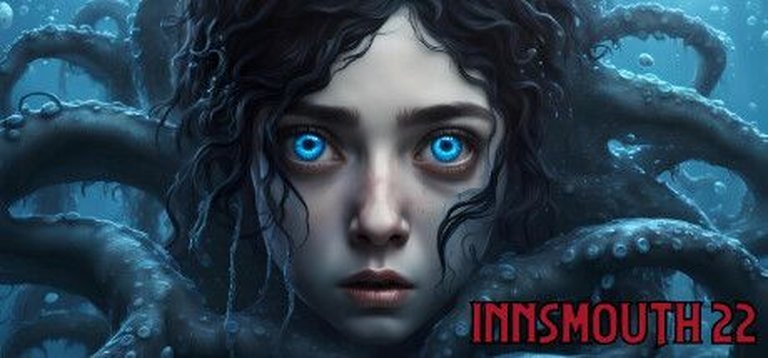
Description
Innsmouth 22 is a Lovecraft-inspired horror visual novel that follows Lorenzo Righi, an Italian professor invited to a history scholars’ meeting in Boston, as he uncovers a sinister and mysterious fate tied to the ominous town of Innsmouth. Blending first-person perspective with point-and-select gameplay, the game delves into cosmic dread and hidden secrets within a narrative-rich, atmospheric setting.
Gameplay Videos
Where to Buy Innsmouth 22
PC
Innsmouth 22 Reviews & Reception
metacritic.com (100/100): Sadly first impressions count, and no matter how intriguing the game project, if this developer makes a second I’m going to be much more wary about giving it my time.
opencritic.com : Sadly first impressions count, and no matter how intriguing the game project, if this developer makes a second I’m going to be much more wary about giving it my time.
mkaugaming.com (50/100): Innesmouth 22 is interesting, but it ends as abruptly as it starts.
digitallydownloaded.net : Putting that aside, nothing about Innsmouth 22 redeems it.
Innsmouth 22: A Critical Autopsy of an AI-Generated Lovecraftian Misfire
Introduction: The Allure of the Abyss and the Abyss of Execution
The deep, chaotic waters of the Cthulhu Mythos have long beckoned game developers, promising a rich tapestry of cosmic horror, forbidden knowledge, and existential dread. Few settings are as potent as Innsmouth, H.P. Lovecraft’s decaying, fish-tinged port town, a perfect crucible for interactive storytelling. “Innsmouth 22,” released in October 2024 by the solo outfit Raven Novels, enters this hallowed, treacherous territory with the stated ambition of crafting an “original” plot within Lovecraft’s 1920s-30s milieu. However, a thorough analysis of the finished product—coupled with its toxic reception—reveals not a daring descent into madness, but a cautionary tale about creative vision utterly abandoned to technological shortcutting and fundamental misalignment of resources. This review will argue that Innsmouth 22 is not merely a bad game, but a symptomatic artifact of a fraught development era, where the ethical and artistic perils of AI-generated content, combined with a profound misunderstanding of the horror genre and the visual novel format, resulted in a project that fundamentally fails on every conceivable level of design, narrative, and cultural stewardship.
Development History & Context: The Solo Developer’s Dilemma in the Age of AI
The Studio & Vision: Raven Novels, as presented, is a one-person (or very small team) independent studio. The developer’s publicly stated vision was to create a Lovecraft-inspired visual novel with a branching narrative and second-person narration. The ambition is evident: to contribute meaningfully to a beloved niche genre. However, the execution of this vision is where the project derails catastrophically. The most defining—and controversial—development choice was the decision to utilize artificial intelligence not as a supplementary tool for a human artist, but as the “lead artist” for all graphics, both character portraits and backgrounds. This is explicitly confirmed in the Steam store page’s “AI Generated Content Disclosure.”
Technological Constraints & The AI Crutch: For a small indie developer, resource constraints are a constant reality. Traditional hand-drawn or painted art for a 30,000-40,000 word visual novel with multiple scenes and character expressions is a monumental, expensive task. AI image generation presented a tempting, low-cost solution. Yet, this choice reveals a catastrophic misunderstanding of the technology’s limitations. AI models, trained on vast but generic datasets, lack the intentionality, consistency, and deep contextual understanding required for cohesive horror world-building. The result, as critics universally noted, is a “haphazard patchwork” of styles and a fundamental breakdown in atmospheric unity. The developer chose the path of least resistance over the path of artistic integrity, prioritizing volume and speed over quality and coherence. This is not a tool empowering an artist; it is a replacement that exposes the project’s lack of foundational artistic direction.
The Gaming Landscape & The Early Access Shield: Innsmouth 22 arrived in a crowded market for narrative games and Lovecraftian adaptations, from the polished Call of Cthulhu (2018) to the acclaimed The House in Fata Morgana series. It also emerged amid growing, contentious debate about AI art in creative industries. The decision to launch in Steam Early Access on October 25, 2024, is a critical part of its context. The developers stated they wanted “feedback on their favourite characters” to “deepen the story.” However, as critic Matt Sainsbury of Digitally Downloaded excoriatingly argued, this is a blatant misuse of the Early Access model. A visual novel with a fixed script and AI-generated assets is not a “game in development” in the traditional sense; it is a complete, albeit shoddily assembled, product. The “Early Access” tag here functions not as a genuine development phase but as a preemptive shield against criticism, a way to sell an unfinished, incoherent experience while deflecting accountability with promises of future polish that, as of the last update over 15 months ago (per the Steam page note), have not materialized. This tactic is seen as ethically dubious and commercially cynical.
Narrative & Thematic Deep Dive: A Plot adrift in Translation and Truncation
Plot Synopsis & Structure: The game follows Lorenzo Righi, an Italian professor of Greco-Roman mythology and an avid diver, who is invited to a scholarly conference in Boston. This mundane academic premise quickly pivots into horror when he is lured to the infamous town of Innsmouth. The narrative is delivered through second-person narration (“you feel…”, “you say…”) and presented via static images with text boxes and character sprites. Branching dialogue choices are promised, suggesting a web of potential outcomes.
Thematic Ambition vs. Thematic Emptiness: The source material states the plot is original but set in Lovecraft’s environment. Theoretically, this allows for exploration of classic Mythos themes: forbidden archaeology, hybrid degeneration, the terror of the deep, and the collapse of human sanity upon confronting the cosmic. However, the execution is bereft of the poetic, lyrical dread that defines Lovecraft. The writing, originally in Italian and then translated (poorly, according to all critics), is described as “flat,” “poorly translated,” and lacking the “poetic, lyrical writing style” of its inspiration. The atmosphere is not built through simmering tension and exquisite, wordy descriptions of the unnatural, but through clunky dialogue and “pointless digressions.”
Pacing and Narrative Flow: A fatal flaw identified by MKAU Gaming is the disastrous pacing. The story is clogged with irrelevant “fluff”—conversations about objects seized in Tuscany or lengthy car rental negotiations—that do nothing to advance the plot or develop character. This bloat saps narrative momentum, meaning the actual horror elements are delayed until the “third act,” leading to a “sluggish” experience. When the horror does arrive, it lands “with no intensity or sense of fear” because the prose lacks the necessary menace and the accompanying AI art consistently fails to visualize the intended terror. The game’s promise of a “lore-rich” experience (per Steam tags) rings hollow when the lore is delivered through such uninspired channels.
Characterization and Dialogue: The characters are uniformly criticized as “emotionless” and poorly realized. The protagonist, Lorenzo Righi, is a cipher. The review from Digitally Downloaded savages the inclusion of “Howard Lovecraft” himself as a missed opportunity, noting he “tonally he’s no different to the protagonist,” betraying a lack of research into the real writer’s persona. The dialogue, meant to have a “mystical air,” instead feels functional and disconnected from any authentic voice. The second-person narration, a potentially immersive choice, falls flat because the player is never given a compelling reason to invest in the “you” of the story.
Gameplay Mechanics & Systems: The Illusion of Choice
Core Loop & Interaction: As a visual novel built in the Ren’Py engine, the core gameplay loop is minimalist: read text on a static background image, occasionally accompanied by a character sprite. The player is presented with discrete dialogue or action choices that purportedly “branch the story.” However, given the scant critical coverage and the game’s apparent brevity (“Not very long,” per MKAU Gaming), the meaningfulness and scope of this branching are questionable. The Steam page mentions 80 scenes and a save/load system (“recast”), but there is no evidence from reviews of substantial, divergent narrative pathways that reward replay. The choices feel like superficial variants rather than meaningful narrative divergences.
Progression & Systems: There is no traditional character progression (stats, skills, inventory management) as would be expected from an “RPG” tagged title on Steam. The “RPG” tag seems to be a misapplication, likely referring only to the branching-choice format. The only “system” is the narrative itself, which the player passively consumes. The promised Steam Achievements (planned for the full release) are the only traditional game-like feature mentioned.
UI and UX Flaws: The user interface is bare-bones Ren’Py defaults. The initial default language being Italian is an inexplicable and user-hostile oversight for a game targeting an international audience, forcing players to manually navigate to “Opzioni” to switch to English. This signals a lack of localization care from the outset. The static nature of the visuals—a single image for extended scenes of dialogue—is repeatedly cited as a source of fatigue. “Occasionally, it can be hard to just sit and read for ten minutes with a still image in the background,” notes MKAU Gaming. The lack of dynamic visuals, minimal soundscapes, and total absence of voice acting creates a stultifying, un-engaging experience that fails to leverage the interactive potential of the medium.
World-Building, Art & Sound: The Collapse of Coherent Atmosphere
Visual Direction & AI Art Catastrophe: This is the game’s most infamous and devastating failure. The AI-generated art is universally panned. Its first and most damning flaw is inconsistency. Backgrounds shift between clashing artistic styles—”some have an impressionistic quality, while others have clean, sharp lines that look like they come directly from DC comic books.” This results in a world that feels spatially and temporally incoherent: a hotel room looks nothing like its lobby; a dockside seems to exist in a different era than a nearby church. This immediately and irrevocably destroys any sense of a believable, haunting place. Innsmouth should be a character itself— decaying, brackish, unnervingly still. Instead, it’s a jarring slideshow of unrelated stock images.
The second flaw is contextual inappropriateness. Character sprites are “emotionless” and often feature “facial expressions that mismatch the emotions portrayed in the scene.” Worse, the AI’s training data limitations create bizarre lacunae in the narrative representation. The infamous example cited by Digitally Downloaded is the diving scene: the male protagonist is in a suit, other male passengers are in swimwear, but “none of the female passengers even have a sprite (despite having spoken lines), and the tour guide… is also fully dressed.” This isn’t a stylistic choice; it’s a glaring, immersion-breaking error that exposes the AI’s dependence on its training set and the developer’s failure to curate or correct its output. The art is not a tool for storytelling; it is an active antagonist to it, constantly “jarring the audience out of… suspension of disbelief.”
Sound Design & Musical Sparse-ness: The audio landscape is barely more developed than the visuals. The sound design is described as “lacklustre” and “sporadic.” While some “sound effects add a much-needed bit of suspense,” their infrequent use often makes them feel like jarring jump scares in “dead silence.” The background music is criticized for being a single, repetitive “faint… melodic tune” with “an air of fantasy” that is wholly unsuited to cosmic horror, which demands unease, dread, and the unknown. The lack of a dynamic, thematic, or even varied audio track fails to compensate for the static visuals, leaving vast stretches of the experience sonically barren.
Reception & Legacy: A Critical Panning and an Ethical Warning
Critical Reception at Launch: Innsmouth 22 was met with near-universal derision from the few critics who covered it. Its MobyGames critic average stands at 30%, based on two reviews. On OpenCritic, it sits in the -1st percentile. The scores are damning: MKAU Gaming: 5/10 (50%); Digitally Downloaded: 0.5/5 (10%). The language in the reviews is not merely negative but condemnatory, citing “horrific” design, “squeamish” ethical choices, and a project that is “incapable of achieving delivering on the creative ambition.”
User Reception & Steam Dynamics: Steam user reviews are minimal (only 3 as of the latest data) and do not generate a score, indicating extremely low visibility and player engagement. The Steam discussion boards are sparse, with threads inquiring about the AI generation and Spanish translation, suggesting a small, curious, or concerned audience rather than an engaged player base. The note that “the last update made by the developers was over 15 months ago” is a stark admission of abandonment or profound stagnation for an “Early Access” title.
Influence and Industry Impact: Innsmouth 22 will not have a positive influence. Its legacy is that of a paragon of caution. It stands as a primary example of what not to do with AI-assisted development: use it as a crutch that replaces fundamental craft, ignore consistency and tone, and hide behind Early Access to avoid accountability. It highlights the stark difference between a curated, human-directed project (like the praised indie title Light de Deux, mentioned by Digitally Downloaded) and a technologically expedient but artistically void one. In the broader conversation about AI in games, Innsmouth 22 will be cited as evidence of the technology’s current inability to sustain a coherent, emotionally resonant, or atmospherically rich narrative experience without a masterful human hand guiding every output—a hand that was clearly absent here.
Conclusion: A Footnote in the Annals of Failed Ambition
“Innsmouth 22” is a profound disappointment. Its premise—a Lovecraftian visual novel following an academic into the heart of cosmic horror—is sound. Its execution is a multi-layered failure. The narrative is bloated, poorly paced, and translated with neither grace nor accuracy. The gameplay is passive and engages only the most basic interactivity of clicking to advance text. The world, which should be the game’s greatest asset, is its greatest liability, shattered by incoherent, context-blind AI visuals that betray a startling absence of artistic direction. The sound design is minimal and mismatched.
Most damningly, the project’s use of the “Early Access” label feels like a calculated act of bad faith, a transparent attempt to monetize an incomplete, unpolished product while sheltering from the criticism it so richly deserves. Raven Novels did not lack ambition; they lacked the resources, discipline, and artistic rigor to realize it. They mistook quantity of words and images for quality of experience.
In the grand history of video games, Innsmouth 22 will not be remembered as a classic nor as a cult “so-bad-it’s-good” title. It will be remembered as a sterile, corporate-feeling artifact of a specific moment—a time when the siren song of AI generation lured a developer into sacrificing the soul of their project for the illusion of progress. It is not a descent into Lovecraftian madness; it is a descent into creative bankruptcy. Its final, ironic horror is not in its story, but in its very existence: a stark reminder that the deepest abyss in game development is not found in the mythos of R’lyeh, but in the abandonment of craft itself. Final Verdict: 2/10 – A historical footnote for all the wrong reasons.
Critic Score Synthesis: MobyGames (30%) | OpenCritic (-1st percentile) | MKAU Gaming (5/10) | Digitally Downloaded (0.5/5)
Platforms: Windows, macOS, Linux | Engine: Ren’Py | Business Model: Commercial (Early Access, $9.99)
Key Developer Choice: 100% AI-Generated Art | Key Critical Complaint: Artistic incoherence & Early Access misuse.