
- Release Year: 1997
- Platforms: DOS, Windows
- Publisher: TopWare CD-Service AG, ZUXXEZ Entertainment AG
- Developer: Toontraxx, TopWare Programmy Sp. z o.o.
- Genre: Adventure
- Perspective: Third-person
- Game Mode: Single-player
- Gameplay: Point-and-click, Puzzle-solving
- Setting: 1930s, Interwar
- Average Score: 85/100
Description
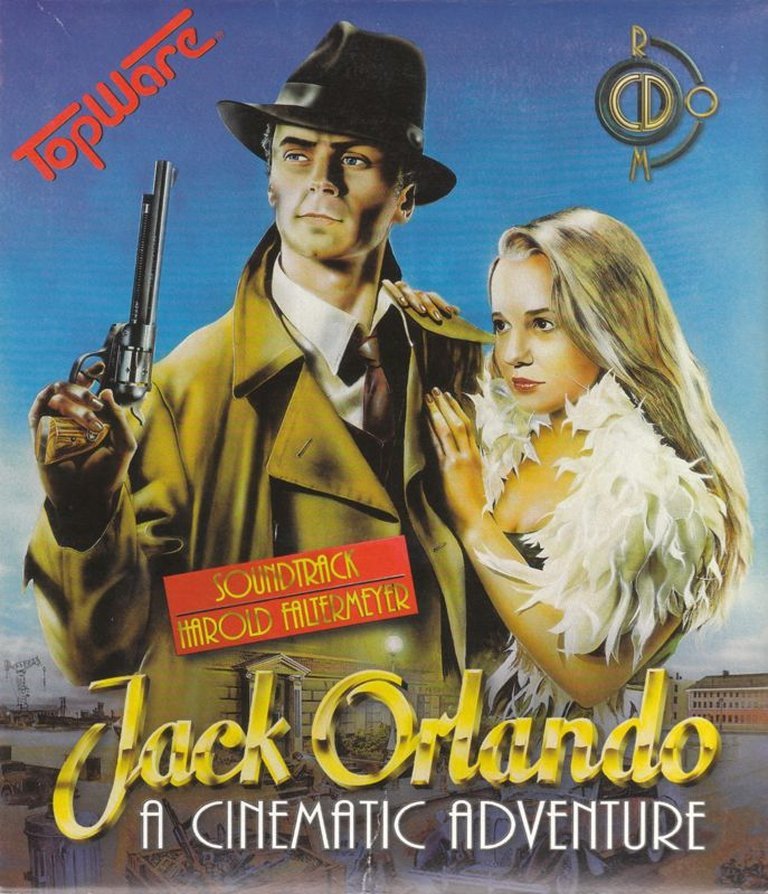
Jack Orlando: A Cinematic Adventure is a point-and-click adventure game set in the interwar 1930s, where players take on the role of Jack Orlando, a former private investigator whose career was ruined by alcoholism. After accidentally witnessing a murder and being framed for it, he has just 48 hours to solve the case and clear his name, exploring hand-painted backdrops and interacting with characters through voice-acted dialogue and puzzle-solving.
Gameplay Videos
Jack Orlando: A Cinematic Adventure Free Download
Jack Orlando: A Cinematic Adventure Guides & Walkthroughs
Jack Orlando: A Cinematic Adventure Reviews & Reception
gamesreviews2010.com (85/100): The game is a must-play for fans of the genre.
adventuregamers.com : Jack Orlando turned out to be one of the best-worst games I’ve ever had the privilege to play.
Jack Orlando: A Cinematic Adventure Cheats & Codes
PC
Press F9 during gameplay to open a console window, then enter the code.
| Code | Effect |
|---|---|
| EPILOGUE | Shows the final sequence |
Jack Orlando: A Cinematic Adventure – A Review
Introduction: The Alcoholic Detective’s Last Stand
In the pantheon of 1990s point-and-click adventures, few titles evoke such a profound sense of conflicted legacy as Jack Orlando: A Cinematic Adventure. Released in 1997 by the Polish studio Toontraxx under German publisher TopWare Interactive, it arrived at a time when the genre was dominated by the narrative polish of LucasArts and the cinematic ambitions of Sierra. Jack Orlando promised a gritty, film noir experience set in the immediate post-Prohibition era of 1933 America, helmed by a protagonist who was a washed-up relic of a bygone heroic age—a mirror to the adventure genre itself, which was beginning to feel the first tremors of its own declining commercial relevance. The game’s thesis is bold: to marry the hard-boiled detective story with the interactive form, leveraging hand-painted art and a star-studded soundtrack to create a “cinematic” experience. However, as history and countless player accounts reveal, execution is everything. Jack Orlando is not a forgotten classic unfairly lost to time; it is a fascinating, deeply flawed artifact—a game whose considerable ambitions are repeatedly undermined by baffling design choices, catastrophic localization, and a fundamental misunderstanding of what makes an adventure game engaging. Yet, its sheer audacity and peculiar charm prevent it from being dismissed as mere refuse. This review will dissect Jack Orlando not as a successful game, but as a compelling case study in developmental fervor meeting profound creative missteps, a title that perfectly encapsulates the risks of a mid-to-late-90s European studio attempting to conquer a genre defined by its American and Japanese pioneers.
Development History & Context: Eastern Europe’s Noir Gamble
The early-to-mid 1990s saw a surge of adventure game development in Central and Eastern Europe, fueled by lower production costs, a pool of talented artists, and the global success of titles like Monkey Island and King’s Quest. TopWare Interactive, a German publisher, partnered with Toontraxx, a Polish developer, to create Jack Orlando. The core team, led by Project Leader Lucjan Mikociak and Director/Game Designer Jarosław Parchański, was relatively small for an ambitious CD-ROM title (credited with 147 developers on the MobyGames entry). Their vision was clear: a classical graphic adventure in the vein of Broken Sword or Gabriel Knight, but with a distinct hand-drawn, comic-book aesthetic and a soundtrack by Harold Faltermeyer, the Hollywood composer famous for Beverly Hills Cop and Top Gun. This was a major selling point on the game’s box and in its marketing—a genuine celebrity composer for a niche PC adventure.
Technologically, the game was built for the tail end of the DOS era and the dawn of Windows 95. It utilized hand-painted, pre-rendered backgrounds (a common practice) with cel-animated character sprites. The “cinematic” aspiration was partly technical: full voice acting for all dialogue (displayed as text), Dolby Surround sound support, and a heavy reliance on cutscenes. However, the constraints of the era are evident in the choppy character animations, the limited color palettes, and the clunky, non-standard interface that deviated from the more refined verb coin systems popularized by LucasArts.
The gaming landscape of 1997 was pivotal. The adventure genre was a shadow of its early-90speak, with streamlined narratives and CD-ROM excess. Jack Orlando competed directly with titles like Broken Sword II: The Smoking Mirror (1997) and The Longest Journey (1999). It lacked the financial muscle of a Sierra or LucasArts but attempted to compete on the terms of artistic presentation and narrative scope. Its development history is a patchwork; the MobyGames credits list multiple sub-teams (Graphics & Character Design, Animations, Scene Programmers) and the Wikipedia/TV Tropes entries hint at a complex corporate web involving “TopWare Programmy Sp. z o.o.,” “Toontraxx,” and later “Reality Pump” for the Director’s Cut. This fragmentation may partly explain the game’s wildly inconsistent quality across its various elements.
Narrative & Thematic Deep Dive: A Noir Plot Drowning in Translation
The plot premise is a serviceable, even compelling, noir trope: Jack Orlando, once a celebrated Prohibition-era detective who nabbed bootleggers, is now a down-on-his-luck alcoholic, “ruining his career” with the bottle. On a drunken night, he stumbles upon a murder in an alley, is knocked unconscious, and awakens to find himself the prime suspect. His friend, Inspector Tom Rogers, grants him a ludicrous but narratively convenient 48 hours to solve the case and clear his name. What follows is a journey through a “city without a name”—a grimy, Depression-era American port metropolis populated by gangsters, corrupt officials, and a mysterious conspiracy involving a US Army major, the Mafia (Don Scaletti), and a weapons deal.
Thematically, the game aims for classic hard-boiled motifs: the fallen hero, institutional corruption, the lone wolf against a system, and the possibility of redemption. Jack’s alcoholism is not just a character quirk but the engine of his downfall and, potentially, his salvation. The 1933 setting is crucial—the 21st Amendment has just repealed Prohibition, symbolizing the end of one era and the chaotic birth of another, mirroring Jack’s personal transition. Themes of betrayal (“He Knows Too Much”), the corrupting influence of money (“Evil Pays Better”), and the “Dirty Cop” are all present.
However, the narrative execution is catastrophically undermined by what TV Tropes accurately labels a “Blind Idiot Translation” and “Asian Speekee Engrish.” The English script (likely translated from Polish) is riddled with nonsensical phrasing, unnatural dialogue flows, and bizarre idioms. Characters speak in jarring, disjointed bursts. The voice acting, as universally panned in every review, is hampered by this script and often features unforgivably poor foreign accents (the Irish cop, the Chinese laundry owner). This transforms potentially gritty dialogue into unintentional comedy. Jack’s own internal monologue and exclamations (“a guy could do something good with that!”) are famously awkward. The result is a profound “Deliberate Values Dissonance”—Jack is a bigot even by 1930s standards, referring to characters with crude racial epithets, which is presented as unremarkable character detail but comes across as poorly considered writing rather than intentional period commentary.
Structurally, the plot is simple but functional, concluding satisfactorily without supernatural elements (a plus noted by critics). Yet, it is littered with extraneous characters and locations that serve no plot purpose, a symptom of the game’s “more is more” design philosophy. The infamous sequence where Jack discovers medieval catacombs beneath a 1930s American city—followed by an exit into a café straight out of Full Throttle—is a narrative and tonal derailment so extreme it becomes the game’s most notorious “WTF” moment, seemingly inserted as a surreal homage with zero narrative justification.
Gameplay Mechanics & Systems: A Masterclass in Frustration
Jack Orlando employs a classic point-and-click interface with a verb coin-like menu, but it is here the game’s foundational flaws become irreparable. The core gameplay loop is: explore the free-roaming city map, talk to every character, examine every location, collect every item, and use items on everything in a desperate attempt to trigger the next story beat.
-
Puzzle Design & Inventory Management: The game is infamous for its “Kleptomaniac Hero” syndrome. Players can pick up dozens of utterly useless items (banana peels, scraps of paper, random trash), which clutter the inventory with no means of examination to discern purpose. Reviews consistently note that “90% of items are useless.” The logic for puzzle solutions is often obscure to the point of absurdity. Solutions frequently require mind-reading—the game expects you to use an item on a character or location for a reason that is never hinted at. As the Adventure Gamers review starkly states, it feels like “the company spent all their time on animation and added a game as an afterthought.” This leads to rampant pixel-hunting and trial-and-error.
-
Progression & Objectives: The “48-hour” countdown is a narrative device with zero gameplay consequence. There is no real sense of urgency. The open city structure is initially impressive but becomes a curse. Players are often given no clear objective, roaming freely while being arbitrarily blocked from entering key locations until a minor character mentions them in passing. This creates a “where do I go next?” paralysis that is the opposite of satisfying exploration.
-
Interface & Control: The interface is clunky. The inventory button is keyboard-mapped only, despite manual claims of a top-screen hot spot. Action hotspots on animated cursors are imprecisely defined. The “shoot” verb is nearly useless. The need to re-select inventory items for every interaction is a chore. Combined with the sheer number of dead ends and “trial-and-error death sequences,” the player is constantly battling the UI as much as the puzzles.
-
Death & Fail States: Unlike many modern adventures, Jack Orlando features meaningful (and often cheap) deaths. You can die by entering the wrong location or failing a timed sequence, forcing a reload with no retry option. This is a relic of earlier Sierra design that feels punitive and unfair in a game where failure is so often the result of opaque design rather than player error.
In essence, the gameplay actively works against the player’s desire to progress, transforming what could be an atmospheric stroll into a grind of inventory management and guesswork.
World-Building, Art & Sound: A Gorgeous Facade
Where Jack Orlando unequivocally shines is in its artistic presentation and sound design, which form the core of its “cinematic” ambition.
-
Visuals: The hand-painted backgrounds are the game’s crown jewel. They are detailed, atmospheric, and full of life. Critics and players alike praise the “gorgeous game map complete with animated traffic,” the flapping paper, characters walking in the background, and the three-dimensional cars. This creates a surprisingly bustling, immersive 1930s cityscape. The character models are cartoon-like and generally well-animated for the sprite-based technology, though cutscenes (especially the intro/outro) are rougher and more amateurish. The “little round-framed close-up shots of Jack” that appear after solving puzzles are a charming and effective reward system. The overall graphic style is a successful blend of comic-book exaggeration and noir grit, even if some locations veer into a slightly too-colorful, comedic tone.
-
Sound & Music: This is the other unassailable high point. Harold Faltermeyer’s jazz-infused, moody score is universally acclaimed. It perfectly captures the period’s sound—sultry, tense, and cinematic—looping effectively to maintain atmosphere. The use of Dolby Surround was a technical boast for the time. Unfortunately, this professional soundscape is juxtaposed against the “entertainingly bad” voice acting and script, creating a jarring cognitive dissonance. The sound effects are adequate but can be artificial.
-
Atmosphere vs. Tone: The world-building is inconsistent. The “Downtown” episode is frequently cited as the strongest, capturing a seedy, lived-in noir feel. However, other areas (like the incongruous European castle catacombs or the final military base) shatter the illusion. The game cannot decide if it wants to be a gritty detective story, a surreal comedy, or a Broken Sword clone. This tonal whiplash is its most damaging narrative flaw.
Reception & Legacy: A Cult Curiosity, Not a Classic
At launch, Jack Orlando received mixed-to-poor reviews that largely align with its current standing. German magazines like PC Joker (78%), Power Play (77%), and PC Action (75%) were relatively generous, praising its graphics, soundtrack, and value-for-money as a budget title. They noted technical “Kinderkrankheiten” (childhood ailments) and design flaws but found it a solid, enjoyable adventure for the price. In contrast, GameStar (61%) and PC Player (60%) were far harsher, calling it an “Aushilfskrimi” (substitute crime story) with poor voice acting, frustrating puzzles, and a lack of atmosphere.
English-language reviews were even more damning. Just Adventure gave it a C−, calling elements a “mixed bag.” Adventure Gamers awarded a mere 2/5 stars, stating its good elements (art, music, plot) “just about save it from total failure” while savaging the “badly designed puzzles and a worse script.” GameSpot’s 6.8/10 noted the abundance of useless items and conversations, finding it “an interesting change of pace” but flawed.
Its commercial performance was unremarkable. It was included in budget compilations like Gold Games 3, re-released as a Director’s Cut in 2001 (which added difficulty settings and minor content but did not fix core issues), and later found a home on GOG.com and Steam, where its user ratings are middling (GOG: 3.3/5, Steam: “Mostly Positive” but with widespread complaints). The Metacritic score is not aggregated, indicating its niche status.
Its legacy is that of a cult “so-bad-it’s-good” curiosity. It is not cited as an influence on major developers or trends. Instead, it is remembered—and occasionally streamed or joked about—for its spectacular failures: the translation, the voice acting, the medieval catacombs, the dysfunctional puzzles. It serves as a cautionary tale about the perils of prioritizing artistic assets and star-name composers over fundamental gameplay and writing integrity. For scholars, it represents a specific moment: a capable Eastern European studio attempting to compete in a Western-dominated genre, hampered by language barriers, potentially disjointed internal management, and a design philosophy that valued density and “cinematic” moments over player agency and logical progression.
Conclusion: The Verdict on a Fallen Detective
Jack Orlando: A Cinematic Adventure is a profound enigma. It is a game whose constituent parts—a gorgeous, atmospheric art style, a legendary composer’s soundtrack, a potentially compelling noir plot—should, by all rights, coalesce into a memorable adventure. Instead, they are dragged into the mire by a perfect storm of catastrophic narrative translation, amateurish voice direction, and puzzle design that feels contemptuous of the player’s intellect. The 1930s setting is evoked brilliantly in the visuals and music, yet shattered by tonal inconsistency and narrative absurdities. The gameplay is an exercise in frustration, built on the false pillars of excessive inventory bloat, opaque logic, and a free-roam structure that provides no clear direction.
To call Jack Orlando a “bad game” is an understatement; it is a fundamentally misguided one. Its failures are not those of a small team lacking resources, but of a team that seemingly misunderstood the interactive contract of the adventure genre. It is a game where you spend more time fighting the interface and second-guessing nonsensical design than you do engaged in its story.
However, to dismiss it entirely is to miss its peculiar, enduring value. For the retro adventurer with a high tolerance for jank and a taste for the bizarre, Jack Orlando offers an experience unlike any other. Its sheer, unadulterated weirdness—the Chinese man who speaks in riddles, the magical item appearances, the inexplicable castle—achieves a kind of surreal, dreamlike logic that is, in its own way, memorable. It is a game you experience more than you play, a testament to ambition gone critically awry.
Final Verdict: Jack Orlando: A Cinematic Adventure is not a lost classic. It is a flawed, fascinating, and often infuriating relic. Its place in video game history is not as a pillar of the adventure genre, but as a potent “what-not-to-do” case study and a cult artifact of the 90s European adventure boom. It earns a rating not on a scale of quality, but of historical interest: a 5/10 for its catastrophic design, but a 9/10 for its inadvertent camp and the haunting quality of its missed potential. Play it with a walkthrough, a strong drink (in the spirit of its protagonist), and a healthy sense of humor. It is, ultimately, the story of a detective who couldn’t clear his own name—and a game that, for all its struggles, can’t quite clear its either.