
- Release Year: 2022
- Platforms: Windows
- Publisher: Mama Makes Games, LLC
- Developer: Mama Makes Games, LLC
- Genre: Action
- Perspective: Side view
- Game Mode: Single-player
- Gameplay: Platform
- Setting: Fantasy
Description
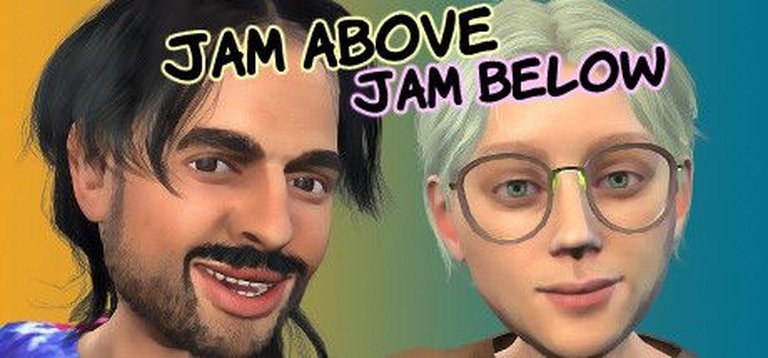
Jam Above Jam Below is an all-ages action platformer set in a fantasy-inspired game jam world, following Witz and Doobz as they race to develop a video game in just one week. Featuring seven diverse mini-games—including platforming, biking, puzzles, and dating sims—and fully-voiced cartoon cutscenes, this recursive title, crafted in seven days for the 2022 Epic MegaJam, playfully explores the creative chaos and joys of indie game development.
Where to Buy Jam Above Jam Below
PC
Jam Above Jam Below: Recursive Rays of Genius in a MegaJam Kaleidoscope
Introduction: The Meta-Jam That Built Itself
In the vast, often opaque museum of video game history, certain titles exist not as monolithic landmarks but as exquisite, hand-blown glass paperweights—small, self-contained wonders that encapsulate an entire philosophy in a diminutive form. Jam Above Jam Below (2022) is precisely such an artifact. Conceived and executed in a single week by solo developer Kimberly Blais for the 2022 Epic MegaJam, the game is a recursive, meta-commentary on the very act of frantic, creative constraint that birthed it. Its thesis is elegantly simple: to simulate the chaotic joy, panic, and profound satisfaction of a game jam by having players guide two hapless developers, Witz and Doobz, through a series of wildly disparate mini-games in a quest to “make a video game in just a week.” This review will argue that Jam Above Jam Below transcends its status as a mere jam submission to become a brilliant, distilled case study in design clarity, thematic coherence, and the potent alchemy of clever asset reuse. It is a masterclass in using limitations not as barriers, but as the very bedrock of creativity, offering a poignant, funny, and surprisingly deep look at the collaborative heart of indie development.
Development History & Context: A Solo Symphony Under the Gun
The Studio & The Visionary: Jam Above Jam Below is the product of Mama Makes Games, LLC, a one-woman studio fronted by Kimberly Blais. In an industry increasingly dominated by large teams and multi-year cycles, Blais’s decision to enter the Epic MegaJam solo is a statement in itself. Her vision was not to create a sprawling epic but a compact, narrative-driven experience that directly mirrored the jam’s core prompt: “As Above, So Below.” This hermetic principle—that the microcosm reflects the macrocosm—became the game’s structural and thematic backbone. The game is about a game jam; it was made in a game jam. This recursion is not a gimmick but the foundational design pillar.
Technological Constraints as Catalyst: Developed in Unreal Engine 5, a powerhouse engine synonymous with AAA fidelity, Blais’s achievement is one of brilliant resourcefulness. The technological constraint was not horsepower but time: one week. This necessitated a complete reliance on pre-made asset packs, a common jam strategy elevated here to an art form. The official description meticulously credits these assets, revealing a designer who saw tools not as replacements for originality, but as a palette for remixing:
* KitBash3D’s “Neo City” provided the core 3D models and textures, with Blais ingeniously noting that even the “bug” robots were constructed from the kit’s building pieces.
* Synty Studios’ “Polygon – City Pack” was used for a specific level, demonstrating targeted, purpose-driven asset selection.
* Kubold’s “Movement Animset Pro” and Orca Games’ “Bicycle with Animations” handled core in-game movement, proving that even character motion can be purchased and integrated seamlessly.
* Dynamedion’s “We Love Indies” music and sound pack supplied the entire audio landscape, a crucial element for establishing tone across seven distinct gameplay vignettes.
* JanPecnik’s “Animal Pack Ultra 2” and SUMFX’s “Chameleon Post Process” added specific character flair and visual polish.
This approach wasn’t about hiding the assets but celebrating their modularity. The “Neo City” futuristic aesthetic becomes the visual glue for a game that jumps from platforming to dating sim, creating a cohesive, if intentionally jarring, world. The constraint forced extreme scope management, resulting in a tight 20-30 minute experience where every second is designed.
The 2022 Gaming Landscape: Released in September 2022, the game emerged into a post-pandemic indie scene buzzing with successful game-jam-born titles (Among Us, Fall Guys). It spoke directly to a community fascinated by the “behind-the-scenes” of creation, a trend amplified by streams and documentaries. Its free-to-start model (on Steam and itch.io) and family-friendly “all ages” branding made it widely accessible, a pure passion project with no commercial pressure, allowing its meta-narrative to shine without compromise.
Narrative & Thematic Deep Dive: The Game Within the Game
The narrative of Jam Above Jam Below is deceptively simple but laden with layers of meta-textual meaning. It follows Witz and Doobz, two archetypal indie developers (one perhaps more anxious, the other more optimistic) tasked with creating a game for a fictional “MegaJam” within the game’s world. The entire 20-30 minute runtime is framed by fully-voiced, hand-animated cartoon cutscenes—Blais’s personal touchstone that provides the story’s heartbeat and humor.
Plot as a Development Cycle: The plot is not a traditional hero’s journey but a simulated development timeline. The seven mini-games are not arbitrary; each represents a common phase or challenge of jam development:
1. Concept/Prototyping: Likely a simple, teachable mechanic.
2. Core Gameplay Loop: The foundational platforming or action.
3. Feature Creep/Polish: Introducing a new, more complex mechanic (like the bike).
4. Testing/Bug Squashing: Possibly reflected in a precision or puzzle challenge.
5. Art/Asset Integration: A level that visually showcases the kit-bashed environment.
6. Audio/Polish: A rhythm or sound-based segment.
7. The “Big Finish”/Submission: The climactic level combining previous elements.
The dialogue, performed by Blais herself, is key. It’s playful, self-deprecating, and rife with in-jokes about scope, last-minute bugs, and the desperation of the final hours. Lines about needing “just one more feature” or the terror of the approaching deadline will resonate instantly with anyone who has participated in a hackathon or jam. The theme “As Above, So Below” manifests in this perfect parallel: the player’s experience of struggling with a mini-game is Witz and Doobz’s experience of struggling to implement that very game.
Underlying Themes:
* The Fetishization of Constraint: The game argues that creativity flourishes within strict, arbitrary boundaries. The one-week limit isn’t a handicap; it’s the engine of the entire experience.
* Community & Collaboration: Despite being a solo project, the game’s existence is a testament to the game jam community—its reliance on shared asset packs and the shared understanding of the jam format. The cutscenes often show Witz and Doobz working together, mirroring Blais’s own solo struggle but framed as a duo for narrative efficiency and charm.
* The Joy of Finished Things: The ultimate “save the day” goal is simply to submit a complete, functional game. The victory is not over a dark lord but over entropy and scope creep. It’s a profound, humble celebration of completion.
Gameplay Mechanics & Systems: A Mini-Game Menagerie
Jam Above Jam Below is a compilation game or minigame arcade, with its core loop being “play one mini-game, unlock the next story beat.” This structure has inherent advantages for a jam game: it allows for rapid prototyping of distinct mechanics without the burden of a single, deep system.
Core Loops & Deconstruction:
1. The Platforming Foundation: The primary perspective is a 2D side-scrolling platformer (MobyGames’ classification), but rendered in a 2.5D style using 3D assets—a perfect compromise for a solo artist. Controls are direct and responsive. This acts as the “common language” between mini-games.
2. The Biking Segment: Highlighted in user reviews and the official description, this is a vehicular platformer with a unique mechanic: a double jump on the bike. As one player noted on Steam, this was “intentional” to clear the final hurdle. This is a fascinating design choice—adding a single, simple ability that fundamentally changes the feel and challenge of a level, a classic jam trick to add depth quickly.
3. Puzzle & Rhythm Elements: The description mentions “puzzle” and “rhythm” components. These are likely short, self-contained vignettes that break up the action, testing different cognitive skills. Their brevity is essential; they don’t overstay their welcome.
4. The Dating Sim Surprise: This is the game’s most celebrated quirk, as noted by the Steam user (“AC surprise”). It’s a bonafide, short-form dating sim/conversation segment inserted into the meta-narrative. This is a masterstroke of tonal whiplash and budget creativity. It requires no complex assets (just character portraits and dialogue boxes), yet provides immense personality and humor, perfectly satirizing both dating sims and the sometimes-absurd priorities of game development (“we need more romance options!”).
Progression & UI: Progression is purely linear and story-driven. Completing a mini-game advances the cutscene. There is no character progression (leveling up, skill trees) because the game’s “character” is the game development process itself. The UI is minimalistic, likely using the “Komika Hand” font credited by Blais, reinforcing the cartoon, storybook aesthetic. Its simplicity is a feature, not a bug, ensuring zero friction between the player and the next joke or challenge.
Innovations & Flaws: The primary innovation is the thematic-cl mechanic integration. The gameplay is the metaphor. A potential flaw, inherent to the format, is lack of depth. Each mini-game is a sketch, not a fully realized mechanic. For a player seeking a deep platformer or dating sim, this will feel superficial. But judged within its own hermetic context, this superficiality is the point—it mirrors the rough, prototype-like nature of a real jam game.
World-Building, Art & Sound: The Kit-Bashed Cosmos
The world of Jam Above Jam Below is a fantasy setting, but one filtered through a cyberpunk-ish, synthwave-inspired “Neo City” lens provided by the KitBash3D asset pack. This creates a delightful dissonance: a bright, cartoony story about game development takes place in a sleek, futuristic cityscape. The setting is not a deep, lore-filled world but a stage—a literal and metaphorical workshop where the “magic” of game creation happens. The “fantasy” tag on MobyGames likely stems from the anthropomorphic characters (Witz and Doobz) and the slightly absurdist tone.
Visual Direction: The art is a collage of professional, pre-built assets assembled into a new whole. This gives the game a unique, intentionally “unoriginal” aesthetic that is ironically perfect for its theme. It looks like a game made from a box of parts, which is exactly what it is. The 2.5D side-view perspective allows the 3D models to shine while keeping platforming precise. The hand-animated cutscenes are the visual crown jewels, offering a contrast of fluid, expressive 2D animation against the static 3D backgrounds, emphasizing the human (or anthropomorphic) element of the story.
Sound Design: The music, from Dynamedion’s “We Love Indies” pack, is crucial. Pack names are prescriptive; this collection is tailored for indie games, meaning tracks are likely upbeat, melodic, and evocative of classic platformers and adventure games. It provides the emotional scaffolding—energetic for platforming, tense for climactic moments, sweet for the dating sim. Sound effects are similarly sourced, ensuring a cohesive, professional-grade audio experience that belies the one-week development cycle. The sound doesn’t just accompany the gameplay; it narrates the emotional beat of Witz and Doobz’s journey.
Together, the art and sound create an atmosphere of bright, optimistic chaos. It feels like the inside of a creative mind during a deadline: colorful, noisy, slightly disorganized, but brimming with life and ideas.
Reception & Legacy: A Quiet Cult Classic
Critical & Commercial Reception: By any traditional metric, Jam Above Jam Below is an indie ghost. It has no critic reviews on aggregated sites like Metacritic. Its Steam page shows only 6 user reviews, all positive, yielding a perfect 100 score on Steambase. This sample size is minuscule, but the sentiment is uniformly appreciative. Reviews (like the one mentioning the bike double-jump) engage with its mechanics and quirks directly, indicating a player base that “gets it.” Its commercial success is irrelevant; it was always free, a love letter first and a product second.
Evolving Reputation & Influence: Its reputation has settled into that of a beloved niche artifact. It is not a “forgotten gem” because it was never widely played. Instead, it is a cult classic among game jam enthusiasts and solo developers. Its legacy is threefold:
1. The archetype of the “meta-jam game”: It joins a small pantheon of games that directly simulate their own creation (The Beginner’s Guide’s meta-narrative is different, but shares a reflective quality). It provides a template for using the jam format as the game’s subject.
2. A testament to Unreal Engine 5’s accessibility for jams: For all its complexity, UE5 can be used for rapid prototyping, especially with market assets. Blais’s work demonstrates a pipeline that balances engine power with jam practicality.
3. Inspiration for asset-pack creativity: It stands as a case study in how to see beyond “placeholder” in asset packs and find thematic and mechanical utility in every piece, from building blocks to bug robots.
Its influence is likely subtle—inspiring other solo jam entrants to embrace a cohesive, thematic mini-game structure rather than one sprawling, unfinished idea. It proves that a game’s “soul” is in its design and intent, not in whether every model was custom-sculpted.
Conclusion: A Perfect, Precious Artifact
Jam Above Jam Below is not a contender for “Greatest Game of All Time.” It is, however, a perfect artifact. It succeeds on its own exquisitely modest terms: it is a funny, charming, and mechanically varied 30-minute experience that perfectly realizes its recursive premise. Its brilliance lies in its authenticity. There is no pretense, no wasted scope. Every system, every piece of art, every line of dialogue serves the central metaphor of the creative struggle and triumph of the game jam.
Kimberly Blais, wearing every hat from designer to voice actor, created a game that feels like what it is: a joyful, stressful, ultimately fulfilling week of making. It captures the camaraderie of the duo, the panic of the deadline, the satisfaction of a working prototype, and the absurdist humor of it all. In doing so, it elevates itself from a simple compilation to a poignant piece of game development folklore. For historians, it is a vital document of 2020s indie practice—solo, asset-forward, jam-centric. For players, it is a delightful, bite-sized tour through the surreal landscape of a creator’s mind. Its place in history is secured not by sales or scores, but by its unwavering, heartfelt embodiment of its own theme: a tiny, brilliant world that perfectly reflects the vast, chaotic, wonderful cosmos of game creation. It is, quite simply, a jam above all jams.