
- Release Year: 2009
- Platforms: Windows
- Publisher: phenomedia publishing gmbh, Realore Studios
- Developer: Realore Studios
- Genre: Strategy, Tactics
- Perspective: Diagonal-down
- Game Mode: Single-player
- Gameplay: Business simulation, Managerial
- Average Score: 70/100
Description
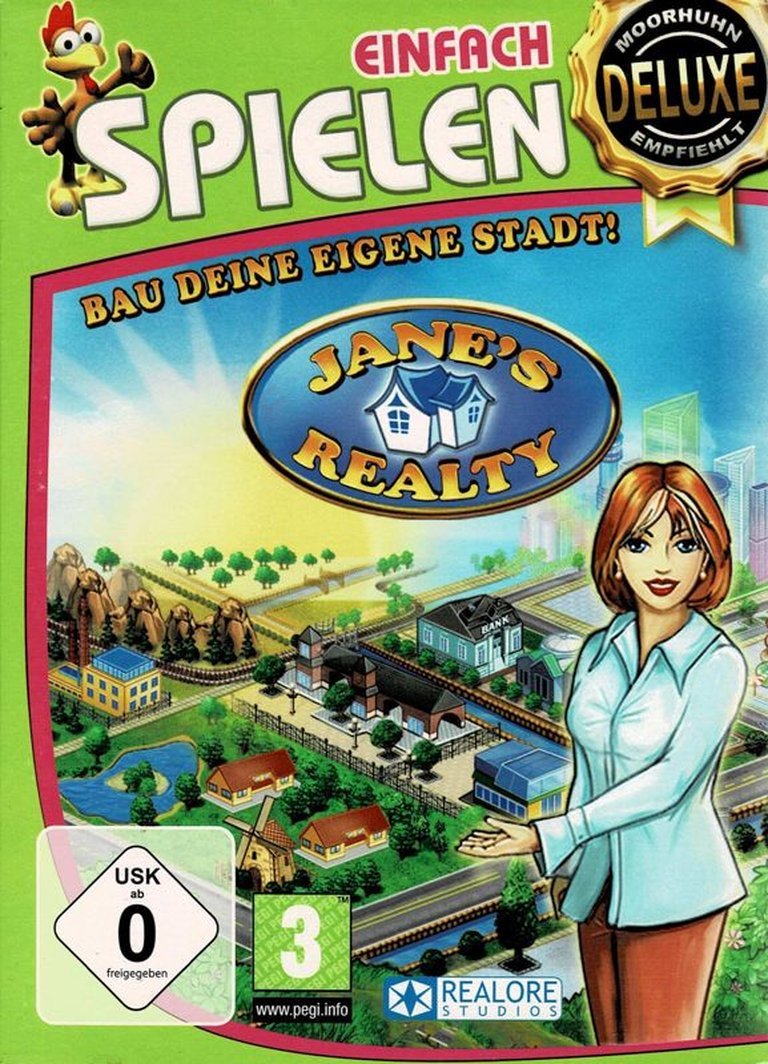
Jane’s Realty is a managerial business simulation game where Jane, the protagonist from the Jane’s Hotel series, shifts her focus from hotels to real estate. Players assist her in constructing and managing a city, including building houses and infrastructure, hiring workers, adapting to changing weather conditions, and ensuring citizen happiness, all within a real-time time management framework that combines strategic planning with addictive gameplay.
Where to Buy Jane’s Realty
PC
Jane’s Realty Guides & Walkthroughs
Jane’s Realty: A Franchise’s Faltering Step into City-Building
Introduction: The Reluctant Tycoon
The Jane’s series, born from the unexpectedly delightful time-management chaos of Jane’s Hotel (2007), carved a cozy niche in the casual simulation landscape. Its heroine, Jane, was a relatable every-heiress whose competence in turning dilapidated hotels into five-star paradises charmed a dedicated audience. With Jane’s Realty (2009), developer Realore Studios (later operating as Qumaron for re-releases) attempted a bold pivot: trading the frantic hospitality of concierge desks and room service for the grand, strategic scope of urban development. This review posits that Jane’s Realty is not merely a misstep but a fundamental misreading of its own premise. It is a game that promises the addictive “just one more level” gratification of its predecessors but structurally delivers a sparse, often obtuse resource-management puzzle that actively works against its own stated goals. Its legacy is one of curious obscurity—a title that faded from conversation almost immediately,留下ing behind only a faint digital footprint and a cautionary tale about franchise evolution.
Development History & Context: AStudio at a Crossroads
Realore Studios, a Latvian developer, found its sweet spot in the late 2000s casual market with the Jane’s series. Following two successful hotel-management titles, the logical—and risky—next step was to expand Jane’s entrepreneurial empire. The year 2009 was a pivotal moment for the “casual” genre. While Facebook games and mobile apps were rising, the PC downloadable market (via platforms like Big Fish Games and GameHouse) still thrived on polished, bite-sized time-management and simulation titles. Jane’s Realty was developed during this transitional period, aiming to leverage the established “Jane” brand while attempting to tap into the lighter side of the city-builder genre popularized by SimCity and more accessibly by Build-a-Lot.
The technological constraints were modest but telling. The game’s specs (Pentium III 800MHz, 256MB RAM, 32MB VRAM) place it firmly in the era of lightweight, 2D fixed-perspective games. The “Diagonal-down” perspective and “Fixed / flip-screen” visual style were cost-effective choices, avoiding the complexity of scrolling 3D worlds. This technical simplicity, however, would later clash with the game’s ambitions. The development vision seems to have been a hybrid: the progression and goal-oriented structure of time-management games fused with the systemic depth of a business sim. This fusion, as will be explored, is where the project unravels. The game was initially published by phenomedia publishing gmbh and Realore Studios, with later re-releases on Steam (2015) managed by Qumaron, indicating a long but quiet shelf-life and a shift in distribution strategies.
Narrative & Thematic Deep Dive: The City as a Metaphor for Ambition
If the Jane’s Hotel series was a narrative about restoration and personalized service, Jane’s Realty attempts to frame Jane’s journey as one of macro-scale creation. The official description states she is “build[ing] your own city together with our successful business lady.” Thematically, this represents a shift from the micro (the individual guest’s happiness) to the macro (the citizenry’s collective well-being). Jane is no longer just a manager; she is an urban planner, a utility magnate, and a mayor rolled into one.
However, the narrative execution is virtually non-existent beyond this high-concept pitch. There is no discernible plot, no character arcs, and no dialogue of note. Jane is a silent protagonist, an icon on the interface. The “citizens” are abstract population units tied to housing, not individuals with needs or stories. The theme of “making all citizens happy” is reduced to a numerical goal—a quota of population or building types to achieve. The game squanders a rich opportunity to explore the tensions of urban development: the balance between growth and infrastructure, the ethical weight of displacing “wilderness” for housing, or the personal stakes of Jane building a legacy beyond her family’s hotels. Instead, it presents a sterile, goal-oriented checklist. The absence of narrative is not just a omission; it’s a symptom of a game that confuses thematic scope with thematic substance. The city is not a living world; it is a grid to be filled, a puzzle whose pieces are buildings and power plants.
Gameplay Mechanics & Systems: The Broken Foundation
This is the core of Jane’s Realty’s failure. The official description boasts a “Combination of time management and sim-style features.” In practice, the game is a real-time, 2D tile-placing puzzle with a deeply flawed economic feedback loop that strangles any sense of satisfying progression.
Core Loop & The Resource Trap: Each level is a confined grid. The player starts with limited funds. The mandatory, sequential goal is typically: 1) Purchase land, 2) Build an Electric Power Station and a Water Company, 3) Build residential houses. The houses generate rent over time, which is the only source of income. Here lies the critical, fatal flaw: the rent income is minuscule and slow to accumulate, while the cost of essential infrastructure upgrades (required to allow more houses) is prohibitively high.
As critic Cassandra Morgan succinctly observed in her scathing review, “I couldn’t raise enough money to finish all of my goals so I couldn’t pass the level. I’ve played the level five different times and I still can’t figure out the key to passing it.” This is not a player skill issue; it is a design catastrophe. The game provides no clear indication of the optimal build order or the precise timing needed to eke out enough profit before the arbitrary “level complete” timer or goal list expires. The “time management” element is absent—there are no customer timers to juggle, no crises to avert. The “sim-style” features are shallow, lacking the complex chains (Build-a-Lot‘s construction material dependencies) or the dynamic needs (SimCity‘s zoning demand) that give such games depth. The gameplay loop becomes a frustrating exercise in watching a tiny number tick up slowly while upgrade costs loom immovably.
Progression & Systems: Progression is strictly level-based. “Acquiring new skills in real estate business,” as advertised, translates simply to unlocking new building types in later levels, not a growing toolkit of abilities or efficiency upgrades for Jane herself. The “changing weather conditions” mentioned in the ad blurb are a purely cosmetic or minor mechanical effect (e.g., rain might slightly slow construction), with no meaningful strategic impact. The hiring of “the best workers” is likely a placeholder for a non-existent or trivial system, given the total absence of personnel management in any available description or review. The UI, while fitting the fixed-perspective aesthetic, offers little guidance, contributing to the player’s confusion about why growth stagnates.
Innovation vs. Flaw: The only semblance of innovation is the attempt to merge genres. However, the innovation is purely superficial. It lacks the satisfying, clear cause-and-effect of good time-management and the deep systemic interactivity of a true sim. It occupies a frustrating no-man’s-land, inheriting the restrictive pace of the former without the tactile feedback, and the complexity of the latter without the explanatory transparency.
World-Building, Art & Sound: A Serviceable, Soulless Facade
Given its technical specifications and genre, Jane’s Realty was never aiming for graphical spectacle. The “Fixed / flip-screen” presentation means each level is a static, hand-drawn (or very simply rendered) tile set. The art direction is bright, colorful, and overly cheerful, adhering to the “casual” aesthetic of the era. Buildings are distinct icons—a house is a house, a power plant is a smokestack—but there is little visual personality or charm. The world feels like a generic board game come to life, lacking the thematic cohesion of Jane’s Hotel‘s European resorts or the vibrant clutter of a true city.
The atmospheric contribution is nil. The “changing weather” is likely a simple overlay effect. There is no day/night cycle, no emergent events (construction accidents, tenant strikes), no sense of a living city beyond the population counter. The sound design, based on the complete lack of mention in all sources and the 25MB install size, is almost certainly limited to a few repetitive, cheerful musical loops and basic construction/placement sound effects. It is functional background noise, not an immersive layer. The world is not a place to inhabit; it is a spreadsheet given a cartoonish skin.
Reception & Legacy: A Whisper in the Casual Cloud
At launch in 2009, Jane’s Realty generated almost no critical discourse. Metacritic lists the PC version with “Critic reviews are not available,” a testament to its niche status and the casual market’s oft-ignored presence in “serious” games journalism. The limited user reviews on Steam (acquired much later in 2015) paint a picture of a “Mostly Positive” (71% of 14 reviews at the time of data collection) but extremely small pool of players. The low review count itself is the most telling statistic—this was not a game that captured attention.
Its commercial performance was likely modest, disappearing into the vast catalogues of digital distributors without fanfare. The series itself continued, but in a different direction: Jane’s Hotel Mania (2010) returned to the familiar hotel management template. This is the ultimate indictment of Jane’s Realty: it was so poorly received or so evidently flawed that the franchise immediately course-corrected back to its winning formula. The game’s influence on the industry is negligible. It did not pioneer a new subgenre, nor did its broken mechanics become a cautionary study in game design textbooks (unlike, say, the infamous E.T. for Atari). Its legacy is purely as a franchise footnote—the black sheep of the Jane’s family.
The Steam re-release under the “Qumaron” name in 2015 suggests a rights holder attempting to milk a dormant asset with minimal investment, targeting the timeless “casual” and “simulation” tags for unsuspecting browsers. Its continued presence at a $2.99 price point is less a sign of enduring value and more a reflection of the digital storefront’s endless shelf space for forgotten curiosities.
Conclusion: A Well-Intentioned Miscalculation
Jane’s Realty represents a critical inflection point for its series: a failed experiment in scale. Its vision—expanding Jane’s empire from buildings to a city—was logical but its execution was a cascade of poor design decisions. By stripping away the core, satisfying feedback loops of time-management (the ticking customer needs, the clear rewards for efficiency) and failing to implement the deep, interconnected systems of a city-builder (clear resource chains, dynamic demand), it created a hollow shell. The gameplay is a frustrating, opaque grind that contradicts its own “addictive gameplay” promise. The narrative is nonexistent, the world is lifeless, and the mechanics are fundamentally broken.
In the grand canon of video game history, Jane’s Realty is insignificant. It is not a classic, not a cult hit, and not even a notable “bad” game. It is simply a forgotten, flawed product from a small studio aiming above its design capabilities. Its true value lies in being a perfect case study in why genre hybridizations require more than a superficial mix of elements; they demand a deep understanding of what makes each component work. For the Jane’s series, it was a brief, misguided detour that confirmed the strength of its original formula. For players, it remains a $2.99 lesson in the importance of a well-tuned economic loop—and a reminder that even a familiar, likable protagonist cannot save a game built on shaky ground. Final Verdict: A bold but broken franchise extension, notable only for its swift relegation to the deepest archives of casual gaming obscurity.