
- Release Year: 1998
- Platforms: Windows
- Publisher: Data Becker GmbH & Co. KG, Micro Application, S.A.
- Developer: Calculus Softwareentwicklung
- Genre: Gambling, Strategy, Tactics
- Perspective: 1st-person
- Game Mode: Single-player
- Gameplay: Cards, Tiles
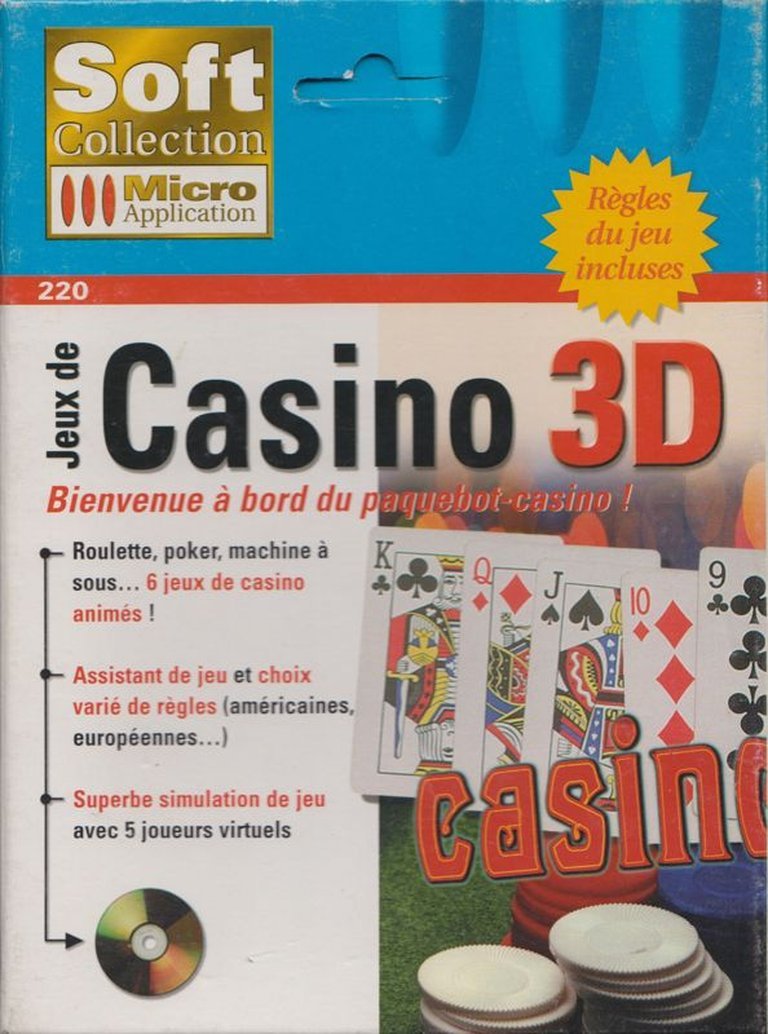
Description
Jeux de Casino 3D is a 1998 Windows game that offers a virtual casino experience featuring classic games like roulette, craps, baccarat, blackjack, poker, and slot machines. Players can explore the casino in either a top-down or first-person perspective, register to play, and access an in-game library to learn the rules. The game includes customizable options such as disabling background music and commentaries, providing an immersive gambling simulation.
Jeux de Casino 3D: A Forgotten Gem of Late ’90s Casino Gaming
Introduction
In the annals of video game history, certain titles emerge as towering monuments of innovation and cultural impact, while others fade into obscurity, remembered only by the most dedicated historians and enthusiasts. Jeux de Casino 3D (1998) belongs to the latter category—a modest yet intriguing artifact of the late ’90s gaming landscape. Developed by Calculus Softwareentwicklung and published by Micro Application, S.A. and Data Becker GmbH & Co. KG, this Windows-exclusive title offered players a virtual casino experience at a time when the genre was still finding its footing in the digital realm. While it may not have the name recognition of The Legend of Zelda: Ocarina of Time or Half-Life—both released the same year—Jeux de Casino 3D serves as a fascinating case study in early casino simulation design, reflecting the technological constraints and creative ambitions of its era.
This review aims to resurrect Jeux de Casino 3D from the shadows of gaming history, examining its development, gameplay mechanics, and the broader context of its release. By doing so, we can better understand its place in the evolution of digital casino games and appreciate the nuances that made it a unique, if overlooked, contribution to the medium.
Development History & Context
The Studio and Creators’ Vision
Jeux de Casino 3D was developed by Calculus Softwareentwicklung, a studio that, while not widely recognized today, contributed to the burgeoning European gaming scene of the late ’90s. The studio’s work on this title reflects a broader trend in the industry: the growing interest in simulating real-world experiences, particularly those centered around gambling and strategy. The game’s development coincided with a period of rapid technological advancement, as developers grappled with the transition from 2D to 3D graphics and the increasing expectations of players for immersive, interactive experiences.
The creators’ vision for Jeux de Casino 3D was straightforward yet ambitious: to deliver a virtual casino that captured the allure and excitement of its real-world counterpart. The game’s title—translated as 3D Casino Games in some regions—hints at its primary selling point: the use of 3D graphics to enhance the player’s immersion. While the 3D elements were rudimentary by today’s standards, they represented a significant step forward for casino simulations, which had previously relied on 2D sprites and static images.
Technological Constraints of the Era
The late ’90s were a time of transition in the gaming industry. The PlayStation and Nintendo 64 dominated the console market, while Windows 95/98 became the standard for PC gaming. Jeux de Casino 3D was developed for Windows, leveraging the platform’s growing capabilities to deliver a more dynamic casino experience. However, the technological constraints of the era were evident in the game’s design:
- Graphical Limitations: The 3D graphics in Jeux de Casino 3D were basic, with simple textures and models that pale in comparison to modern standards. The game’s use of both first-person and top-down perspectives—depending on the game being played—was a practical solution to the limitations of 3D rendering at the time.
- Storage and Distribution: Released on CD-ROM, the game’s size was constrained by the medium’s storage capacity. This likely influenced the decision to include a limited number of casino games rather than a more expansive selection.
- Processing Power: The average PC in 1998 was far less powerful than today’s machines, which meant that complex animations and physics were out of the question. The game’s turn-based nature and simple UI were likely designed to accommodate these hardware limitations.
The Gaming Landscape in 1998
1998 was a landmark year for the video game industry, often regarded as one of the greatest in gaming history. The release of titles like The Legend of Zelda: Ocarina of Time, Half-Life, Metal Gear Solid, and StarCraft set new benchmarks for storytelling, gameplay, and technical achievement. In contrast, Jeux de Casino 3D occupied a niche corner of the market, catering to players interested in strategy and gambling rather than action or adventure.
The casino genre itself was still in its infancy in 1998. Earlier titles like Casino (1982) for the Apple II and Casino Master (1996) for Windows had laid the groundwork, but Jeux de Casino 3D sought to elevate the genre by incorporating 3D visuals and a more interactive experience. Its release coincided with the growing popularity of online gambling, which was beginning to take shape as internet connectivity became more widespread. However, Jeux de Casino 3D remained firmly rooted in the offline experience, offering a solitary, single-player casino simulation rather than a multiplayer or online alternative.
Narrative & Thematic Deep Dive
Plot and Setting
Jeux de Casino 3D is not a narrative-driven game in the traditional sense. Unlike the epic storytelling of Final Fantasy VII or the cinematic tension of Metal Gear Solid, this title eschews a conventional plot in favor of a simulation-based experience. The game’s “narrative” is minimal, revolving around the player’s journey through a virtual casino. Upon entering, players are prompted to register, creating a sense of immersion and personalization. This registration process, while simple, serves as the game’s only real attempt at storytelling, framing the player as a visitor to a grand, digital casino.
The setting is a luxury cruise ship casino, a choice that adds a layer of thematic richness to the experience. The cruise ship setting evokes images of glamour, exclusivity, and high stakes—elements that align perfectly with the allure of casino gaming. The game’s subtitle, Bienvenue à bord du paquebot-casino! (“Welcome aboard the casino cruise ship!”), reinforces this theme, positioning the player as a guest on a lavish voyage where fortune and fate intertwine.
Characters and Dialogue
Given its focus on simulation, Jeux de Casino 3D lacks the deep character development found in other 1998 releases. However, the game does feature NPCs (non-playable characters) who populate the casino, providing a sense of atmosphere and interaction. These characters are largely functional, serving as dealers, croupiers, and fellow gamblers. Their dialogue is limited to commentaries and game instructions, which can be toggled on or off in the options menu.
The game’s library—a unique feature for the genre—offers players the opportunity to learn about the rules and strategies of each casino game. While not a narrative device in the traditional sense, the library serves as a form of environmental storytelling, reinforcing the idea that the player is entering a world where knowledge and skill are as important as luck.
Themes
Jeux de Casino 3D explores several themes that are central to the casino experience:
- Risk and Reward: At its core, the game is a meditation on the thrill of gambling—the tension between risking it all and the potential for a life-changing win. This theme is reinforced by the high-stakes atmosphere of the cruise ship setting, where players are encouraged to embrace the unpredictability of chance.
- Luck vs. Skill: While games like poker and blackjack allow for strategic play, others, like roulette and slot machines, are purely luck-based. Jeux de Casino 3D highlights this dichotomy, offering players a mix of games that cater to different playstyles and preferences.
- Escapism: The cruise ship casino is a world unto itself, a place where the rules of everyday life are suspended in favor of glamour and excitement. This theme of escapism is central to the appeal of casino games, and Jeux de Casino 3D leans into it by creating a self-contained, immersive environment.
Gameplay Mechanics & Systems
Core Gameplay Loop
Jeux de Casino 3D is, at its heart, a collection of mini-games, each representing a different casino classic. The core gameplay loop is simple: players choose a game, place their bets, and attempt to win as much virtual currency as possible. The game’s structure is non-linear, allowing players to move freely between different casino games at their leisure. This freedom is one of the title’s strengths, as it caters to both casual players looking for a quick round of slots and more serious gamblers interested in mastering poker or blackjack.
The game’s progression system is tied to the player’s virtual wealth. There are no experience points or level-ups; instead, success is measured by the size of the player’s bankroll. This design choice reinforces the game’s simulationist approach, prioritizing authenticity over traditional video game mechanics.
Casino Games Included
Jeux de Casino 3D features a curated selection of six casino games, each with its own rules and strategies:
- Roulette: Played from a top-down perspective, this classic game of chance allows players to bet on numbers, colors, or groups of numbers. The game’s 3D wheel adds a touch of realism, though the graphics are rudimentary by modern standards.
- Craps: Another dice-based game, craps is presented in a first-person view, immersing the player in the action. The game’s rules are explained in the library, making it accessible to newcomers.
- Baccarat: A card game with simple rules but high stakes, baccarat is played from a top-down perspective. The game’s minimalist presentation keeps the focus on the cards and the tension of each hand.
- Super Black Jack: A variation of the classic card game, Super Black Jack offers players the chance to test their strategy and luck. The game is played from a first-person perspective, with the dealer and cards rendered in 3D.
- Poker: The poker variant in Jeux de Casino 3D is a simplified version of the game, designed to be accessible to casual players. The first-person perspective and 3D cards add a layer of immersion.
- Slot Machine: The game’s slot machine is a straightforward affair, with players pulling the lever and hoping for a winning combination. The first-person view and 3D graphics make it one of the more visually engaging games in the collection.
User Interface and Controls
The UI (user interface) in Jeux de Casino 3D is functional but unremarkable. The game’s menus are text-based, with simple graphics and a no-frills design. Players navigate the casino using a point-and-click system, selecting games and placing bets with the mouse. The controls are intuitive, though the lack of keyboard shortcuts or advanced options may frustrate modern players accustomed to more streamlined interfaces.
One of the game’s most notable features is its library system, which serves as both a tutorial and a reference guide. Players can access the library at any time to read about the rules and strategies of each game, making Jeux de Casino 3D one of the more educational casino simulations of its era. The library’s inclusion reflects the developers’ commitment to creating a game that is both entertaining and informative.
Innovations and Flaws
Jeux de Casino 3D introduced several innovations to the casino genre, though it was not without its flaws:
Innovations:
– 3D Graphics: While rudimentary, the game’s use of 3D visuals was a step forward for casino simulations, which had previously relied on 2D sprites.
– Library System: The inclusion of an in-game library was a novel feature, providing players with a built-in tutorial and reference guide.
– Cruise Ship Setting: The game’s unique setting added thematic depth, distinguishing it from other casino titles that opted for generic or abstract environments.
Flaws:
– Limited Game Selection: With only six games, Jeux de Casino 3D offered a relatively narrow experience compared to later casino simulations.
– Basic Graphics: The 3D visuals, while innovative for the time, have not aged well and may feel dated to modern players.
– Lack of Multiplayer: The game’s single-player-only design limits its replayability, particularly in an era where online multiplayer was becoming increasingly popular.
World-Building, Art & Sound
Setting and Atmosphere
Jeux de Casino 3D excels in creating a cohesive and immersive atmosphere, thanks in large part to its cruise ship casino setting. The game’s world is small but well-realized, with each area of the casino designed to evoke the glamour and excitement of high-stakes gambling. The top-down and first-person perspectives work together to create a sense of scale and depth, though the 3D graphics are simplistic by today’s standards.
The cruise ship setting is more than just a backdrop; it informs the game’s thematic identity. The idea of a floating casino—isolated from the rest of the world—reinforces the themes of escapism and risk, making the player’s journey feel like a high-stakes adventure. The game’s library further enhances this atmosphere, positioning the casino as a place of both entertainment and education.
Visual Direction
The visual direction of Jeux de Casino 3D is functional rather than flashy. The game’s 3D graphics are rudimentary, with low-polygon models and basic textures that reflect the technological limitations of the late ’90s. However, the developers made clever use of these constraints, employing a clean and minimalist aesthetic that keeps the focus on the gameplay.
The first-person perspective used in games like the slot machine and poker adds a layer of immersion, placing the player directly in the action. Meanwhile, the top-down view in roulette and baccarat provides a strategic overview, allowing players to see the entire table at a glance. This dual-perspective approach is one of the game’s most effective visual techniques, catering to different playstyles and preferences.
Sound Design
The sound design in Jeux de Casino 3D is subtle but effective. The game features ambient casino noises—the clinking of chips, the shuffling of cards, the spinning of the roulette wheel—that create a sense of atmosphere and immersion. The background music is similarly understated, with a jazz-inspired soundtrack that evokes the glamour of a high-end casino.
One of the game’s most notable audio features is its commentary system, which provides players with real-time feedback on their performance. These commentaries can be toggled on or off in the options menu, allowing players to customize their experience. While the voice acting is not particularly memorable, the inclusion of commentary was an innovative touch that added depth to the gameplay.
Reception & Legacy
Critical and Commercial Reception
Jeux de Casino 3D received little critical attention upon its release in 1998, a fate shared by many niche titles of the era. The game’s modest sales and lack of mainstream recognition meant that it failed to make a significant impact on the broader gaming landscape. However, it found a small but dedicated audience among fans of casino simulations, who appreciated its accessible gameplay and educational library system.
The game’s reception was likely hindered by several factors:
– Genre Niche: Casino games were not a major focus of the gaming industry in 1998, which was dominated by action, adventure, and RPG titles.
– Technological Limitations: The game’s basic 3D graphics and limited game selection made it difficult to compete with more visually impressive or content-rich titles.
– Lack of Marketing: As a budget title, Jeux de Casino 3D did not receive the same level of promotion as major releases like Half-Life or Ocarina of Time.
Evolution of the Casino Genre
Despite its obscurity, Jeux de Casino 3D played a small but meaningful role in the evolution of digital casino games. Its use of 3D graphics and interactive tutorials set a precedent for future titles, which would go on to incorporate more advanced visuals and gameplay mechanics. The game’s cruise ship setting also demonstrated the potential for thematic depth in casino simulations, inspiring later titles to explore more immersive and narrative-driven environments.
The casino genre itself would undergo significant changes in the years following Jeux de Casino 3D‘s release. The rise of online gambling in the early 2000s shifted the focus away from offline simulations, as players increasingly sought the thrill of real-money wagering in virtual spaces. However, single-player casino games continued to evolve, with titles like Casino Mogul (2001) and Casino Inc. (2003) introducing management and strategy elements that expanded the genre’s scope.
Influence on Subsequent Games
While Jeux de Casino 3D did not directly inspire any major franchises, its design philosophies can be seen in later casino simulations. The game’s library system, for example, foreshadowed the tutorial modes and strategy guides that would become standard in later titles. Its dual-perspective approach—combining first-person and top-down views—also influenced the design of subsequent casino games, which sought to balance immersion with strategic clarity.
The game’s cruise ship setting has been echoed in later titles, such as Lianhai Casino (2022), which also uses a luxury vessel as its primary backdrop. This thematic connection suggests that Jeux de Casino 3D‘s emphasis on atmosphere and escapism resonated with developers and players alike.
Conclusion: A Modest but Meaningful Contribution
Jeux de Casino 3D is not a game that will be remembered alongside the titans of 1998, nor is it likely to appear on lists of the greatest video games of all time. However, its modest ambitions and thoughtful design make it a worthy subject of study for anyone interested in the history of video games. The title represents a transitional moment in the casino genre, bridging the gap between the 2D simulations of the early ’90s and the 3D, online experiences that would dominate the 2000s.
The game’s strengths lie in its accessibility, educational value, and thematic coherence. Its library system remains one of its most innovative features, providing players with a built-in resource for learning the rules and strategies of each game. The cruise ship setting adds a layer of atmosphere and escapism, distinguishing it from more generic casino simulations. Meanwhile, the dual-perspective approach—combining first-person and top-down views—offers a flexible and engaging gameplay experience.
Of course, Jeux de Casino 3D is not without its flaws. The basic 3D graphics and limited game selection reflect the technological and creative constraints of its era, and the lack of multiplayer limits its replayability. However, these shortcomings do not diminish the game’s historical significance. Instead, they serve as a reminder of the challenges and opportunities that defined late ’90s game development.
In the grand tapestry of video game history, Jeux de Casino 3D is a small but meaningful thread. It may not have changed the industry, but it contributed to the evolution of a niche genre, paving the way for future innovations in casino simulations. For historians and enthusiasts, it offers a fascinating glimpse into the creative ambitions and technological limitations of its time—a modest gem waiting to be rediscovered.
Final Verdict: 6.5/10 – A flawed but fascinating artifact of late ’90s casino gaming, worth exploring for its historical significance and unique design choices.