
- Release Year: 2013
- Platforms: Windows
- Publisher: astragon Software GmbH
- Developer: Contendo Media GmbH
- Genre: Puzzle, Tile matching puzzle
- Perspective: Fixed
- Game Mode: Single-player
- Gameplay: Match-3, Mini-games, Tile matching puzzle
- Setting: Fantasy
- Average Score: 96/100
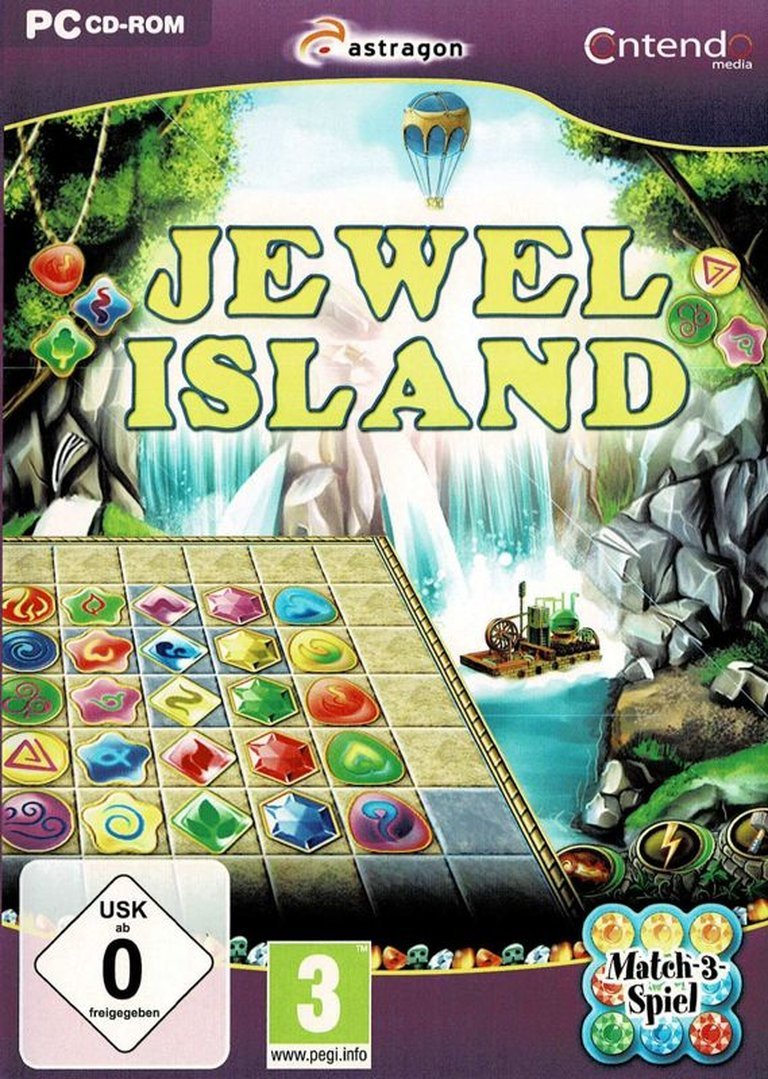
Description
Jewel Island is a fantasy-themed match-3 puzzle game where players embark on a quest to restore magic to a magical kingdom from which it has disappeared. The game features 80 levels spread across five chapters, all embedded within this core story. Gameplay primarily involves completing tile-matching puzzles and numerous mini-games to progress and save the inhabitants of the island.
Patches & Mods
Guides & Walkthroughs
Reviews & Reception
play.google.com (96/100): So far fun to play, but get rid of the idiotic kiddy cheerleader.
Jewel Island: A Forgotten Relic in the Match-3 Archipelago
Introduction
In the vast, churning ocean of digital entertainment, where blockbuster titles rise and fall like leviathans, there exists a quieter, more mysterious ecosystem: the world of casual and shareware games. Here, titles appear with little fanfare, are enjoyed by a dedicated few, and often vanish into the abyss of digital obsolescence. Among these spectral entries sits Jewel Island, a match-3 puzzle game released in 2013 for Windows. Its legacy is not one of critical acclaim or commercial triumph, but of fragmentation, confusion, and a quiet, persistent struggle for preservation. This review will argue that Jewel Island is a quintessential artifact of its era—a game whose very obscurity and convoluted history tell a more compelling story than its straightforward gameplay, serving as a poignant case study in the challenges of preserving the “long tail” of video game history.
Development History & Context
The story of Jewel Island is not a single narrative, but a tangled web of versions, developers, and re-releases, making its history as much a puzzle as its gameplay.
The Original Vision: Ivanche Games (c. 2008)
The earliest traceable incarnation of Jewel Island predates its official 2013 listing. According to archives, a version was created by Ivanche Games around 2008. This was a classic shareware model: a 70-minute trial version distributed online, with a full unlock available via purchase. The game was described as “a pretty much lost match 3 game… with a pirate theme,” featuring time-limited levels and a “Pirate’s Shop” for purchasing bonuses. This version, now abandonware, represents the foundational layer of Jewel Island—a product of the late-2000s casual game market, built for low-spec PCs and distributed through now-defunct digital portals.
The Official Release: Contendo Media & astragon (2013)
The version formally documented on MobyGames was released on March 13, 2013, published by the German publisher astragon Software GmbH and developed by Contendo Media GmbH. This release presented a more structured product:
* Media: It was sold on CD-ROM, a physical format already becoming anachronistic in an age of digital distribution giants like Steam.
* Scope: It contained 80 levels across five chapters, framed by a simple fantasy narrative.
* Context: By 2013, the match-3 genre was well-established, dominated by giants like Bejeweled and Candy Crush Saga. For a small European developer like Contendo Media, entering this saturated market with a budget-priced, physically distributed title was a significant challenge. The technological constraints were minimal, but the market constraints were immense.
The Mobile Doppelgangers
Further complicating the history are multiple mobile games bearing the Jewel Island name, such as Jewel Island: Match-3 by “Jewel – Lazy Chick” and JEWEL ISLAND – Pirate Adventur by “BSS COMPANY.” These are not ports but entirely separate entities, capitalizing on a recognizable name. They feature different mechanics (e.g., “Caroline the Pirate” as a host), thousands of levels, and modern free-to-play trappings like ads and in-app purchases. This phenomenon illustrates the chaotic nature of mobile marketplaces, where intellectual property is often blurred, and legacy PC titles are resurrected in name only.
Narrative & Thematic Deep Dive
The narrative of the 2013 Jewel Island is, like many in its genre, a thin veneer designed to contextualize the core gameplay loop. The official description states: “Magic has disappeared from a magical kingdom. Complete the match-3 levels and numerous mini games to find the magic again and save the inhabitants.”
This is the quintessential “MacGuffin” plot. The “magic” is not a deeply explored concept; it is a quantitative resource the player replenishes by completing puzzles. There are no detailed characters, no branching dialogue trees, and no moral quandaries. The “inhabitants” are abstract entities in need of salvation, their plight serving only to motivate the player’s progression through the five chapters.
Thematically, the game leans into two well-worn archetypes:
1. The Restoration of Order: The core theme is the reversal of a magical decay, a common fantasy trope that provides a clear, unambiguous goal.
2. The Pirate Adventure: As evidenced by the shop and the title itself, there is a secondary theme of nautical treasure hunting. The player is not just a restorer of magic, but an explorer uncovering “hidden treasure passages” and “secrets kept for centuries.”
The narrative’s primary function is to provide a sense of journey and escalation, moving the player from one level set to the next. It is a framework, not a focus, and its simplicity is a deliberate design choice aimed at an audience seeking relaxation over narrative immersion.
Gameplay Mechanics & Systems
Jewel Island operates on the foundational principles of the match-3 genre, with a few distinctive twists that define its specific flavor.
The Core Loop:
The primary gameplay is classic gem-swapping. The player is presented with a grid of colorful jewels and must swap adjacent gems to create rows or columns of three or more identical pieces, causing them to disappear and new gems to fall into place. Success in each level is typically governed by achieving a target score or clearing a specific number of certain-colored gems within a move or time limit.
Key Differentiators:
* Hexagonal Grid: Unlike the standard square grid of Bejeweled, several sources indicate Jewel Island utilized a hexagonal game board. This alters the match-making logic significantly, creating more potential match paths and a different spatial challenge for the player.
* Structured Progression: The 80 levels are divided into five distinct chapters, providing a clear sense of progression that was absent from the more endless, arcade-style puzzle games of the early 2000s.
* The Pirate’s Shop & Power-Ups: Between levels, players can visit a shop to purchase or upgrade “bonuses” and “abilities.” This meta-progression system adds a light strategic layer, allowing players to customize their approach to harder levels. Common power-ups in this genre include bombs (clearing a cluster of gems), lightning bolts (clearing a line of gems), and color-morphing tools.
* Mini-Games: The 2013 version explicitly mentions “numerous mini games” interspersed between the match-3 levels. These likely served as palate cleansers, breaking the monotony with different puzzle mechanics, a common practice in the genre to maintain player engagement.
UI and Player Experience:
The interface was undoubtedly simple, built for clarity and ease of use. The focus is entirely on the jewel board, with score, objectives, and moves/meter displayed unobtrusively. The mobile offshoots, however, highlight potential flaws that may have been present in the original: user reviews for Jewel Island: Match-3 complain of buggy progression (needing to restart the game to advance), nonsensical scoring, and annoying audio feedback—issues that often plague smaller-scale, lower-budget productions.
World-Building, Art & Sound
The aesthetic of Jewel Island can be pieced together from promotional snippets and screenshots. It is a game of bright, cheerful, and generic fantasy.
- Visual Direction: Descriptions promise “fantastic backgrounds,” “variety colorful jewels,” and “fantastic backgrounds.” The art style is best described as commercial-friendly stylization. Expect lush, pre-rendered environments for the level backgrounds—perhaps tropical beaches, mysterious caves, and ancient temples—that are pleasant but lack a distinctive artistic fingerprint. The jewels themselves are likely highly polished, gem-facetted sprites designed to catch the light and provide satisfying visual feedback upon matching.
- Atmosphere: The atmosphere is one of lighthearted adventure. There is no horror or tension, only the cheerful challenge of puzzle-solving and the promise of discovery. The pirate theme suggests a sense of whimsy rather than swashbuckling danger.
- Sound Design: While no specific audio details are available for the PC version, we can extrapolate from genre conventions. The soundscape would have consisted of:
- A light, looping, melodic soundtrack with possible nautical or mystical themes.
- Crisp, satisfying sound effects for gem swaps, matches, and cascades.
- Possibly celebratory fanfares for level completion and more urgent music for time-limited stages.
The mobile version’s user reviews, which complain about an “idiotic kiddy cheerleader,” suggest that audio feedback could sometimes cross the line from satisfying into the realm of the irritating.
Reception & Legacy
Jewel Island‘s impact on the gaming world was, by any measurable standard, negligible. Yet, its legacy is fascinating in its own right.
Critical and Commercial Reception:
The game exists in a critical vacuum. As of its documentation on MobyGames in 2024, there are zero critic reviews and zero user reviews for the 2013 PC version. On Metacritic, the page for the game remains blank, with no scores or reviews. This profound silence is its review. Commercially, it was almost certainly a minor release, one of hundreds of such titles that filled bargain bins and digital download sites, failing to capture the zeitgeist in a market dominated by more sophisticated and aggressively marketed competitors.
Evolving Reputation: An Artifact of Digital Archaeology
Jewel Island‘s modern reputation is not built on its quality as a game, but on its status as a preservation case study. The game is discussed today on platforms like Reddit’s r/abandonware, where users ask, “Do someone know this VERY obscure game?” Its entry on the Internet Archive is accompanied by a poignant note from the uploader: “A pretty much lost match 3 game… I upload it for preservation purposes but i hope one day the full version can get restored since you cannot buy it anymore.”
Its legacy is one of fragmentation and confusion. The existence of multiple, unrelated mobile games using the same name has splintered its identity. For historians and archivists, Jewel Island represents the challenge of documenting the “long tail” of game development—the thousands of titles that, while not influential or highly rated, are nonetheless part of the medium’s rich and varied history. It highlights the fragility of digital distribution, especially from smaller studios, and the heroic efforts required by communities to prevent these pieces of history from being lost forever.
Conclusion
Jewel Island is not a hidden masterpiece. It is a competent, perhaps even charming, but ultimately unremarkable entry in the crowded match-3 genre. Its hexagonal grid and pirate-themed progression were minor innovations in a well-defined space, insufficient to elevate it above its countless peers.
However, to dismiss it entirely would be to miss the point. Jewel Island is a vital artifact. It is a snapshot of a specific time and business model—the era of the shareware trial and the budget PC CD-ROM. Its convoluted history, spanning original developers, official publishers, and mobile copycats, tells a story of a industry in rapid, chaotic transition. Its current status as an abandonware relic, sought after by digital archaeologists, speaks volumes about the impermanence of our digital culture.
The final verdict on Jewel Island is thus a dual one. As a game, it is a footnote, a three-star experience in a five-star world. But as a historical document, it is a compelling five-star example of the stories that lie buried beneath the industry’s mainstream surface. It deserves to be remembered not for the magic it sought to restore in its fantasy kingdom, but for the lesson it teaches about the fragile magic of preservation in our own.