
- Release Year: 2008
- Platforms: Macintosh, Windows
- Publisher: GSP Software, iWin, Inc.
- Developer: iWin, Inc.
- Genre: Puzzle
- Perspective: Side view
- Game Mode: Online PVP, Single-player
- Gameplay: Falling block puzzle, Point and select, Tile matching puzzle
- Setting: Global, Museum
Description
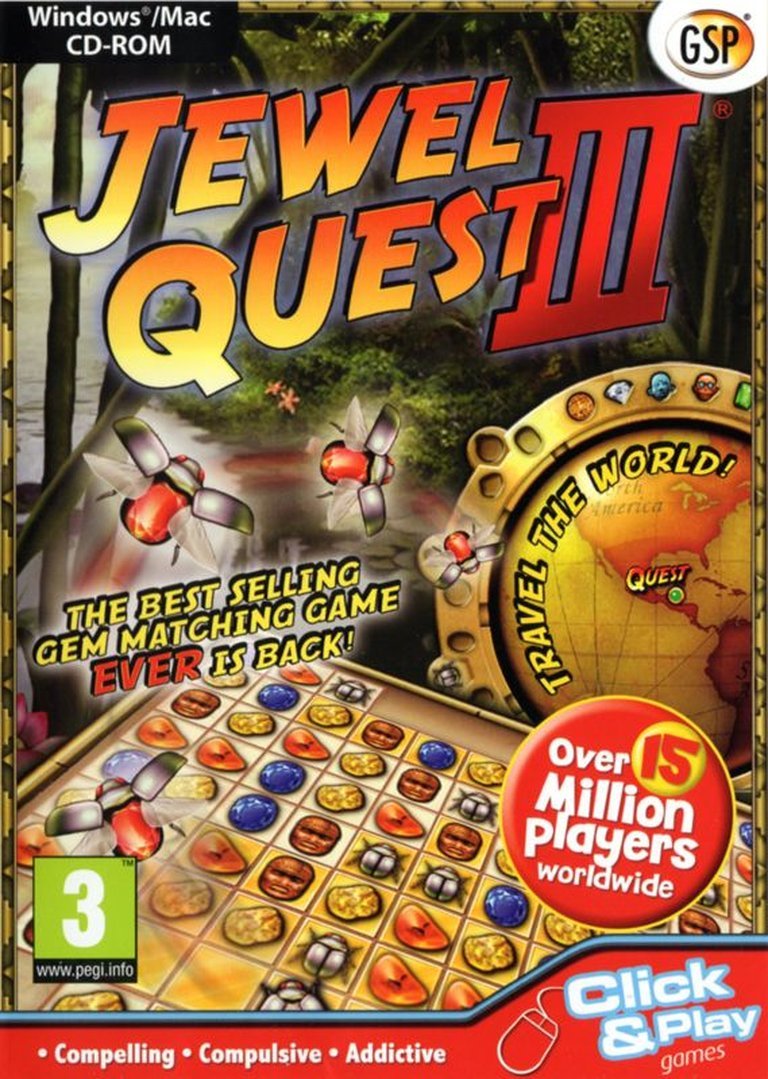
Jewel Quest III follows Rupert and Emma as they embark on a globe-trotting adventure to find a cure for their daughter Natalie’s blindness, caused by mysterious spores released from a secret compartment in their museum. Players match three or more colorful jewels on grids to turn tiles gold, advancing through unlockable continents with flexible level order. The game features competitive modes against AI opponents and global tournaments, blending match-3 puzzles with an urgent family narrative.
Gameplay Videos
Where to Buy Jewel Quest III
PC
Jewel Quest III Free Download
Jewel Quest III Cracks & Fixes
Jewel Quest III Guides & Walkthroughs
Jewel Quest III Reviews & Reception
ign.com : Matching jewels made more complicated, more annoying.
godmindedgaming.com : The bad news is that none of these regions have many levels
gamezebo.com : Because of these foibles, Jewel Quest III is a game perhaps best enjoyed in shorter intervals rather than marathon sessions
gameramble.com : This can make the game incredibly frustrating at times and I recommend sticking to short bursts when you play.
Jewel Quest III Cheats & Codes
PC
Press [Ctrl] + [Enter] or [Alt] + [Enter] will let you into a locked board.
| Code | Effect |
|---|---|
| Ctrl + Enter | Enter locked board |
| Alt + Enter | Enter locked board |
PC (Jewel Quest Deluxe)
Press [Ctrl] + [Alt] + [Shift] + Z to enable cheat mode. Then, enter one of the following codes.
| Code | Effect |
|---|---|
| Ctrl + Alt + Shift + Z | Activate Cheats |
| Ctrl + 1 thru 5 | Levels |
| Alt + 1 thru 0 | Rounds |
| Shift + 1 thru 5 | Cycles |
| Ctrl + W | Auto-Win |
| Alt + W | Kill Auto-Win |
| Ctrl + l | Add Life |
| Alt + l | Lose Life |
| Ctrl + t | Add 1 minute |
| Alt + t | Subtract 1 minute |
Jewel Quest III: Review
Introduction
In the crowded landscape of casual gaming, few franchises have achieved the ubiquity and longevity of Jewel Quest. Since its 2004 debut, iWin’s match-3 series has blended archaeological adventure with addictive tile-swapping mechanics, creating a distinctive identity amid a sea of Bejeweled clones. Jewel Quest III, released in 2008 as the series’ third core installment, represents a pivotal moment: an ambitious attempt to evolve the formula while doubling down on the globe-trotting narrative that defined its predecessors. Yet, as this review will explore, the game’s noble ambitions collide with executional flaws that result in a title both compelling and confounding. While its sheer volume of content and regional innovations earn it a place in casual gaming history, Jewel Quest III ultimately stands as a cautionary tale about the perils of overambition in a genre rooted in simplicity.
Development History & Context
Developed and published by iWin, Inc. in 2008, Jewel Quest III emerged during a golden era for casual gaming on Windows. The platform, driven by accessibility and low system requirements (a mere 1.2GHz CPU, 512MB RAM, and DirectX 8.0 compatibility), was becoming the primary battleground for puzzle and hidden-object games. iWin, already a dominant force in the space, sought to capitalize on the franchise’s growing popularity—Jewel Quest II had solidified its match-3 niche, and the studio was experimenting with spin-offs like Jewel Quest Mysteries (2008), which diverged into adventure-HOG territory.
The development team, led by producer Warren Schwader and featuring core members like Dwain Theobald, Alexey Stashin, and artist Zachary Present, faced a unique challenge: how to innovate within a notoriously rigid genre. Their solution was radical regionalization—transforming the core match-3 loop with continent-specific mechanics. This ambition, however, was tempered by the technological constraints of the era. The game relied on CD-ROM media for distribution, limiting asset scope, and its fixed/flip-screen interface favored clarity over visual spectacle. The result was a game that pushed the boundaries of casual design while remaining tethered to the limitations of its time, reflecting the broader tension in 2008’s gaming landscape between innovation and accessibility.
Narrative & Thematic Deep Dive
Jewel Quest III’s narrative begins with a rare moment of domesticity for its hero, Rupert Pack. Having settled with his anthropologist wife Emma, he prepares to open a museum showcasing their collected artifacts—culminating in the display of the enigmatic “Golden Jewelboard,” a recurring artifact from the series. This tranquility shatters when their daughter Natalie, drawn to the board’s secrets, triggers a hidden compartment releasing blinding fungal spores. The plot thickens as Rupert suspects his perennial rival, the aristocratic Sebastian Grenard, of sabotage, setting the stage for a globe-spanning quest for a cure.
Told through Rupert’s diary entries, the narrative is a blend of Indiana Jones-esque adventure and family drama. Themes of paternal sacrifice and redemption permeate Rupert’s journey, while Sebastian’s rivalry adds a layer of personal conflict. However, the game’s non-linear structure—allowing players to tackle region levels in any order—fractures the storytelling. Vignettes become disjointed, with plot threads (like Natalie’s temporary disappearance) unresolved. The most glaring thematic inconsistency is the Jewelboard itself: after three games, its sudden transformation into a trap feels unearned, undermining the series’ established lore. Magical artifacts, from cursed masks to jewels containing cryptic messages, further blur the line between adventure and fantasy, adding a layer of supernatural intrigue that feels both charming and incongruous.
Gameplay Mechanics & Systems
At its core, Jewel Quest III retains the series’ signature match-3 loop: swap adjacent jewels to create lines of three or more, causing tiles to disappear and turn the background gold. Complete the board before the timer expires to progress. Yet, the game’s defining innovation is its regional mechanics, which reimagine the formula with localized twists:
– Iceland: Frozen jewels require adjacent “ember” tiles to melt ice, adding a layer of spatial strategy.
– Central America: Locks block portions of the board until three gold coins are matched, forcing resource prioritization.
– China: Players must trap “monkey” jewels in cage tiles, introducing time-sensitive objectives.
– South America: Turn-based duels against AI opponents (Emma or Hani) where the goal is to turn more tiles gold per move.
These variations, while inventive, suffer from inconsistent implementation. Silver and Gold quests (re unlockable challenges) and hidden objectives (e.g., “trap 10 monkeys”) add depth, but the brevity of each region—often just a handful of levels—prevents mastery. Worse, the inability to skip disliked mechanics creates artificial bottlenecks. The Tournament Mode, which allows online competitive play, offers a more satisfying experience, emphasizing skill over luck.
Frustrations abound, however. Time limits often feel punitive, especially in later levels where chain reactions hinge on luck. AI opponents in duel modes exhibit near-perfect play, leading to moments of borderline unfairness. As IGN noted, the game’s reliance on chance can make progress feel “arbitrary, sort of like playing solitaire.” Despite these issues, the sheer volume of content—over 150 levels across continents—ensures longevity for dedicated players.
World-Building, Art & Sound
Jewel Quest III’s world is a curated tour of global landmarks, with each region represented by a single, beautifully illustrated background. From the coastal ruins of Iceland (which inexplicably serve as the backdrop for all European levels) to the jungles of South America, these backdrops evoke a sense of place through painterly detail. The rotating globe menu and interactive museum lobby further immerse players in Rupert’s collection, unlocking artifacts like gems and statues as rewards. This “scenery porn,” as Tropedia notes, contrasts with the game’s minimalist board design, which prioritizes jewel clarity over aesthetic flair.
The sound design, led by Michael Scott, is functional yet unobtrusive. Ambient tracks evoke regional atmospheres—e.g., icy chimes for Iceland—without overwhelming the gameplay. Sound effects for jewel matches and board clearing provide satisfying audio feedback, though they lack the distinctiveness of the series’ earlier entries. The overall package creates a cohesive atmosphere of adventure, but the reuse of backgrounds per region and static visuals feel like a missed opportunity to elevate the experience.
Reception & Legacy
At launch, Jewel Quest III garnered a respectable 77% average critic score (based on three reviews), reflecting its strengths and weaknesses:
– GameZebo (80%) praised its “great bang for the buck” in content but warned that frustration might limit marathon sessions.
– Impulse Gamer (80%) lauded its “addictive” nature and value for money, celebrating the Tournament Mode.
– IGN (70%) critiqued its luck-based difficulty, noting it was “nowhere near as varied or entertaining as Puzzle Quest.”
Commercially, the game found success as part of iWin’s expanding portfolio, bundled in collections like The Jewel Quest Pack (2009) and Amazing Match 3 Games: Jewel Quest 10 Pack (2017). Its legacy, however, is mixed. While it expanded the franchise’s scope with regional mechanics and online play, it is often regarded as the weakest entry in the core series. Critics like God Minded Gaming called it a “cobbled together” effort, citing its disjointed narrative and unfair difficulty. Yet, its influence endures: the regional variations foreshadowed the genre’s trend toward hybridized mechanics, and its length set a benchmark for casual game value.
Conclusion
Jewel Quest III is a study in contradictions. It delivers on the series’ promise of addictive, accessible gameplay while overcomplicating its formula with ambitious regional mechanics. Its narrative, rich with themes of family and rivalry, is undermined by a non-linear structure that fractures coherence. Visually, it offers charming backdrops and a polished museum aesthetic, yet its reuse of assets betrays budget constraints. The gameplay, bolstered by sheer volume and competitive modes, can be both thrilling and exasperating, oscillating between moments of mastery and frustration.
Ultimately, Jewel Quest III occupies a unique space in casual gaming history: a title that dared to evolve a beloved formula but stumbled in execution. For fans of the series, it offers a rewarding, if uneven, journey through Rupert’s world. For newcomers, it serves as a reminder that even the most addictive genres can be tripped up by overambition. In a genre defined by simplicity, Jewel Quest III’s greatest strength—and its greatest flaw—was its refusal to stand still.