
- Release Year: 2011
- Platforms: Nintendo DS, Windows
- Publisher: GSP Software
- Genre: Compilation, Puzzle
- Game Mode: Single-player
- Gameplay: Cards, Tiles
- Average Score: 50/100
Description
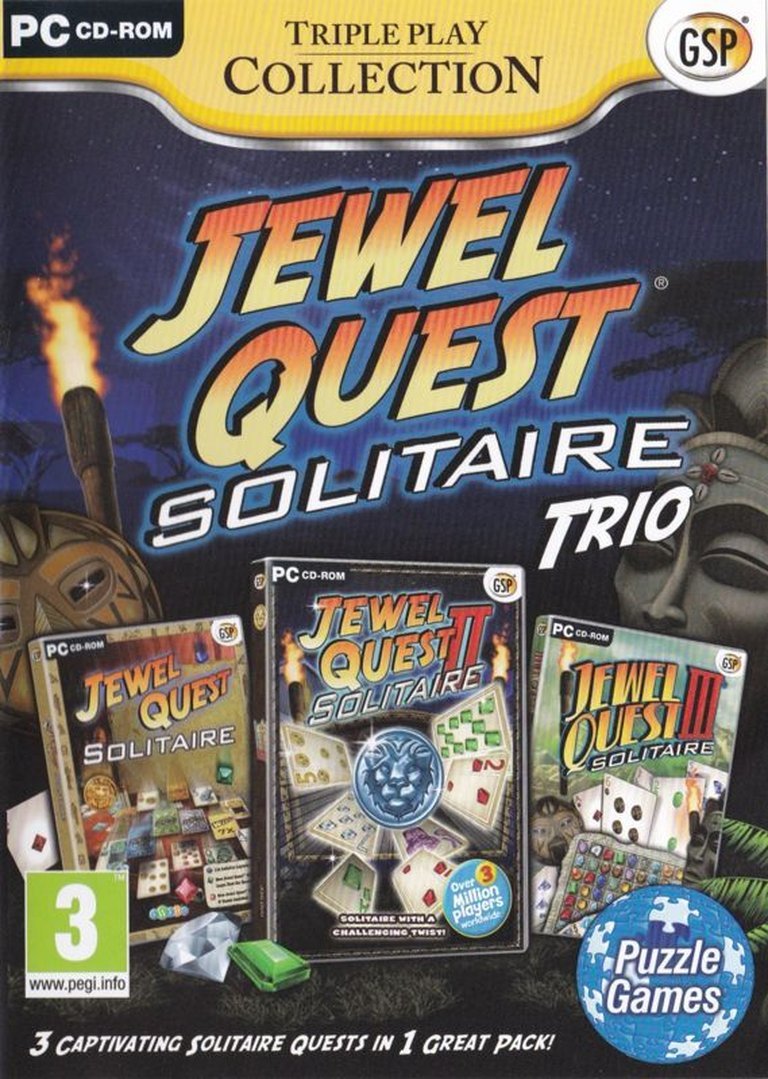
Jewel Quest Solitaire Trio is a compilation of three puzzle games from the Jewel Quest series, featuring Jewel Quest Solitaire, Jewel Quest Solitaire II, and Jewel Quest Solitaire III. Released in 2011 for Windows and Nintendo DS, the game combines card-based gameplay with tile-matching mechanics, offering a blend of solitaire and puzzle challenges. Players embark on adventures to solve puzzles, collect jewels, and progress through various levels, all set within the vibrant and engaging world of the Jewel Quest franchise.
Gameplay Videos
Jewel Quest Solitaire Trio Reviews & Reception
metacritic.com (50/100): You would be better off buying two separate solitaire and Match-3 games, both of far better quality.
Jewel Quest Solitaire Trio: A Compilation of Casual Brilliance and Missed Potential
Introduction: The Allure of the Trio
Jewel Quest Solitaire Trio (2011) is a curious artifact in the annals of casual gaming—a compilation that bundles three distinct Jewel Quest Solitaire titles into a single package. Released during the twilight of the Nintendo DS’s dominance and the rise of digital distribution, this collection aimed to capitalize on the enduring popularity of both solitaire and match-three mechanics. Yet, despite its ambitious packaging, the game remains an understudied relic, overshadowed by its more illustrious predecessors and contemporaries.
This review seeks to dissect Jewel Quest Solitaire Trio with surgical precision, examining its development context, narrative quirks, gameplay innovations, and its place in the broader Jewel Quest franchise. Was it a cynical cash grab, a lovingly curated anthology, or something in between? By analyzing its mechanics, reception, and legacy, we’ll determine whether this trio harmonizes into a cohesive experience or merely serves as a footnote in gaming history.
Development History & Context: The Rise of the Casual Compilation
The Studio and the Franchise
Jewel Quest Solitaire Trio was developed by iWin, a studio synonymous with casual and puzzle games in the late 2000s. The Jewel Quest series, which began in 2004, was a cornerstone of iWin’s portfolio, blending match-three mechanics with light adventure narratives. The Solitaire spin-offs emerged in 2007, reimagining the formula by fusing traditional card games with the jewel-board mechanics of the original.
The compilation itself was published by GSP Software (Windows) and Destineer (Nintendo DS), the latter known for its work with licensed and family-friendly titles. The DS version arrived in February 2011, a time when the handheld was nearing the end of its lifecycle but still dominated the portable gaming market. The Windows release, meanwhile, catered to the burgeoning digital download audience, a space where casual compilations thrived.
The Gaming Landscape of 2011
By 2011, the casual gaming market was in flux. The DS, though aging, remained a powerhouse for puzzle and card games, while mobile platforms (iOS and Android) were rapidly ascendant. Jewel Quest Solitaire Trio was positioned as a “value pack,” offering three full games for the price of one—a common strategy in an era where physical media still held sway.
However, the compilation faced stiff competition:
– Mobile Disruption: Games like Angry Birds and Fruit Ninja were redefining casual gaming, making traditional solitaire feel quaint.
– Digital Fatigue: Players were increasingly turning to app stores for cheaper, bite-sized experiences.
– Franchise Saturation: The Jewel Quest series had already spawned multiple sequels and spin-offs, risking oversaturation.
Technological Constraints and Design Philosophy
The DS version of Jewel Quest Solitaire Trio was constrained by the hardware’s limitations:
– Screen Real Estate: The DS’s dual screens were underutilized; the touchscreen handled card interactions, while the top screen displayed static jewel boards or minimal animations.
– No Online Multiplayer: Unlike The Quest Trio (2008), which featured local multiplayer, Solitaire Trio was a solitary experience.
– Repetitive Assets: The three games shared visual and auditory assets, leading to a sense of déjà vu.
Despite these limitations, the compilation’s core appeal lay in its accessibility. The games were designed for short play sessions, ideal for commuters or casual players seeking a quick mental challenge.
Narrative & Thematic Deep Dive: Jewels, Cards, and Thinly Veiled Adventures
Plot Overview: A Trio of Lightweight Tales
Each game in the compilation features a minimalist narrative, serving as little more than a framing device for the gameplay:
-
Jewel Quest Solitaire (2007):
- Premise: Professor Rupert Pack, a globetrotting archaeologist, stumbles upon an ancient jewel board in the jungles of South America. By playing solitaire, he unlocks the board’s secrets, turning spaces gold to reveal hidden treasures.
- Themes: Adventure, discovery, and the allure of the unknown. The story is reminiscent of Indiana Jones, albeit without the Nazis or rolling boulders.
-
Jewel Quest Solitaire II (2007):
- Premise: Rupert’s wife, Emma, embarks on a rescue mission after he vanishes in Africa. Players alternate between solitaire and jewel-matching to track his whereabouts.
- Themes: Love, perseverance, and the bond between partners. The narrative is slight but adds a personal stakes to the gameplay.
-
Jewel Quest Solitaire III (2009):
- Premise: Ratu, a friend of Rupert and Emma, discovers an ancient tablet that leads to the abduction of his assistant, Yumi. The player must solve solitaire puzzles to uncover clues and rescue her.
- Themes: Friendship, betrayal, and the consequences of unchecked ambition. The story is the most involved of the trio, though still peripheral to the core experience.
Characterization and Dialogue: The Illusion of Depth
The characters in Jewel Quest Solitaire Trio are archetypal:
– Rupert Pack: The quintessential adventurer, defined by his fedora and penchant for trouble.
– Emma Pack: The determined spouse, whose motivations are reduced to “save my husband.”
– Ratu and Yumi: Exoticized side characters, with Ratu serving as the “wise local guide” and Yumi as the damsel in distress.
Dialogue is sparse, often limited to expositional text boxes between levels. The writing is functional but lacks personality, relying on clichés like:
“The jewel board’s power is beyond anything I’ve ever seen!”
“Yumi’s been taken! We must act fast!”
Underlying Themes: Obsession and Repetition
Beneath the superficial adventure tropes lies a more intriguing meta-narrative:
– The Addiction of Puzzle-Solving: Each protagonist becomes obsessed with their respective games—Rupert with the jewel board, Emma with the cards, Ratu with the tablet. This mirrors the player’s own compulsion to “just complete one more level.”
– The Futility of the Quest: Despite their efforts, the characters’ goals are abstract (turning a board gold, rescuing a vaguely defined assistant). The games subtly critique the grind culture of casual gaming, where progress is often illusory.
Gameplay Mechanics & Systems: Solitaire Reinvented (or Repackaged?)
Core Gameplay Loops: A Hybrid Approach
Each entry in the trio blends solitaire variants with jewel-board mini-games, creating a two-phase structure:
-
Solitaire Phase:
- Jewel Quest Solitaire (I): Uses Tri-Peaks rules, where cards are dealt in overlapping rows, and players clear them by selecting cards one rank higher or lower than the active card.
- Jewel Quest Solitaire II: Introduces Klondike mechanics, with a twist—players must clear cards to uncover hidden jewels.
- Jewel Quest Solitaire III: Expands on Klondike but adds power-ups (e.g., shuffling the deck, revealing hidden cards).
-
Jewel Board Phase:
- After completing a solitaire layout, players engage in a match-three puzzle where they swap adjacent jewels to turn spaces gold.
- The goal is to fully gild the board within a set number of moves, adding a strategic layer to the otherwise luck-based solitaire.
Innovations and Flaws
Strengths:
– Varied Layouts: Each game offers over 100 solitaire configurations, preventing monotony.
– Risk-Reward Mechanics: In Solitaire III, players can choose between easier solitaire layouts (fewer points) or harder ones (more jewel-board progress).
– Accessibility: The games are easy to pick up but offer subtle depth in optimizing moves for high scores.
Weaknesses:
– Repetition: The jewel-board mini-games grow tedious, as they rely on the same match-three mechanics across all three titles.
– Lack of Depth: Unlike The Quest Trio (2008), which included Mah Jong Quest, Solitaire Trio feels homogeneous—three variations on the same theme.
– AI Limitations: The DS version suffers from clunky controls; dragging cards with the stylus lacks precision.
UI and Progression Systems
- Menu Design: The compilation’s main menu is barebones, offering little more than a selection screen for the three games.
- Progression: Players unlock new levels linearly, with no branching paths or meaningful customization.
- Scoring: High scores are saved, but there’s no online leaderboard, diminishing replay value.
World-Building, Art & Sound: Aesthetic Consistency vs. Creative Stagnation
Visual Design: A Safe, Familiar Palette
The art style across all three games is consistent but unremarkable:
– Jewel Boards: Vibrant, colorful gems that evoke Bejeweled, with gold accents to signify progress.
– Card Designs: Standard playing cards with jewel-themed backs, reinforcing the franchise’s identity.
– Character Portraits: Static, cartoonish renderings that lack expressiveness.
The DS version’s top screen is largely underutilized, often displaying a static image of the current location (e.g., a jungle temple) with minimal animation.
Sound Design: The Sound of Repetition
- Music: A loop of generic “adventure” tunes, heavy on pan flutes and light percussion. The tracks are inoffensive but forgettable.
- Sound Effects: Card flips, jewel swaps, and the satisfying “ding” of a completed board are functional but lack personality.
- Voice Acting: Nonexistent—all dialogue is text-based.
Atmosphere: The Illusion of Adventure
The games attempt to evoke a sense of globetrotting excitement, but the lack of dynamic environments or interactive elements undermines this. The “quest” feels more like a static slideshow than an immersive journey.
Reception & Legacy: A Compilation Lost in Time
Critical Reception: Mixed Signals
- Metacritic (DS): The sole critic review from Cubed3 awarded it a 50/100, criticizing its lack of innovation and suggesting players buy “two separate solitaire and Match-3 games” instead.
- Player Reception: On MobyGames, the compilation has no user reviews, indicating negligible impact.
- Comparisons to The Quest Trio: The 2008 predecessor, which included Mah Jong Quest, was better received (IGN: 8.1/10), praised for its variety and lasting appeal.
Commercial Performance: A Niche Product
- The compilation likely sold modestly, catering to die-hard Jewel Quest fans and casual DS owners in 2011.
- Its Windows release was overshadowed by the rise of mobile solitaire games (e.g., Solitaire Bliss, Fairway Solitaire).
Legacy: The End of an Era
Jewel Quest Solitaire Trio represents the tail end of the DS’s puzzle-game boom. By 2011, the franchise was already pivoting to mobile (Jewel Quest Mysteries on iOS), and compilations like this felt like relics of a bygone era.
Its influence is minimal, though it serves as a time capsule of:
– The casual gaming bubble of the late 2000s.
– The transition from physical to digital distribution.
– The decline of mid-tier puzzle compilations in favor of free-to-play mobile games.
Conclusion: A Trio of Diminishing Returns
Jewel Quest Solitaire Trio is a competent but uninspired compilation. It succeeds in delivering three full games for the price of one, but its lack of innovation, repetitive mechanics, and underwhelming presentation prevent it from standing out in the crowded casual market.
Final Verdict: 6/10 – “Adequate for Fans, Skippable for Everyone Else”
- For Jewel Quest Enthusiasts: If you’re a completionist or a devotee of the series, the trio offers hours of familiar gameplay.
- For Casual Gamers: Better alternatives exist (Fairway Solitaire, Peggle Nights), and the jewel-board gimmick wears thin.
- For Historian: A fascinating artifact of the DS’s twilight years and the casual gaming transition.
Ultimately, Jewel Quest Solitaire Trio is neither a disaster nor a masterpiece—it’s a serviceable compilation that reflects the strengths and limitations of its era. In the grand tapestry of gaming history, it’s a footnote, but one worth examining for what it reveals about the evolution of casual design.
Would I recommend it? Only to those who already love the series or have a nostalgic attachment to DS-era puzzle games. For everyone else, the jewels in this quest are fool’s gold.