
- Release Year: 2013
- Platforms: Windows
- Publisher: iWin, Inc.
- Developer: iWin, Inc.
- Genre: Compilation
- Perspective: Top-down
- Game Mode: Single-player
- Gameplay: Hidden object, Match-3, Puzzle, Solitaire
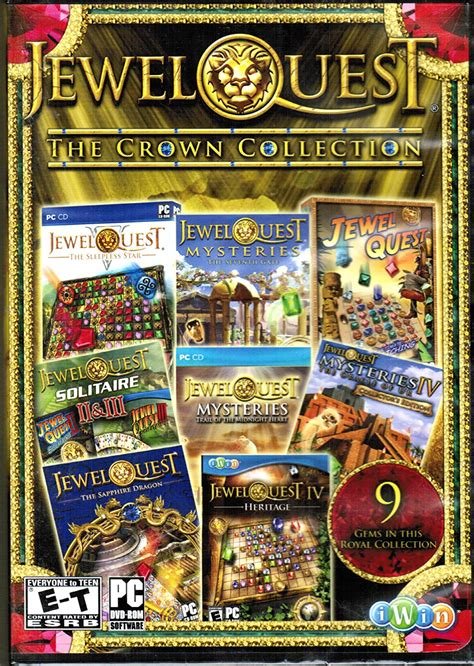
Description
Jewel Quest: The Crown Collection is a comprehensive compilation released in 2013 by iWin, Inc., bundling multiple titles from the Jewel Quest franchise, including the original Mayan-set adventure (1942) and its sequels/spin-offs. Players engage in match-3 tile-swapping puzzles, swapping adjacent tokens to form lines of three or more, which disappear and allow new tiles to drop, with the goal of turning every grid square gold while navigating time limits and escalating challenges across diverse exotic locales and storylines.
Jewel Quest: The Crown Collection: Review
Introduction
In the pantheon of casual gaming, few franchises command the cultural footprint of Jewel Quest. Launched in 2004 by iWin, the series popularized the “match-3” puzzle genre, weaving archaeological adventure into its addictive mechanics. Jewel Quest: The Crown Collection, released in 2013 for Windows, stands as a definitive anthology—a compendium of nine titles spanning the series’ first decade. This compilation is not merely a nostalgic curiosity; it is a historical artifact, capturing the evolution of a genre-defining franchise. Its legacy lies in its ability to distill the appeal of accessible, story-driven puzzle gaming into a single package, offering players a journey through 180+ levels, multiple gameplay styles, and decades of Pack family lore. This review dissects the collection as a cohesive whole, analyzing its narrative depth, mechanical innovation, and cultural significance to argue that it remains a cornerstone of casual gaming history.
Development History & Context
iWin, founded in 1999, spearheaded the casual gaming boom by targeting non-traditional players with accessible, low-barrier-to-entry titles. Jewel Quest (2004) emerged as their breakthrough, capitalizing on the burgeoning popularity of puzzle games like Bejeweled but infusing it with a tangible narrative. The original’s development was constrained by early 2000s technology—simple 2D graphics, limited RAM, and a focus on stability over spectacle. Yet this limitation fostered ingenuity: tile-matching mechanics were optimized for smooth cascades and responsive controls, ensuring addictive gameplay on mid-range PCs.
By 2013, when The Crown Collection was released, the gaming landscape had shifted. Casual games had migrated to mobile platforms, while free-to-play models dominated. iWin’s anthology was a deliberate act of preservation and re-contextualization. It bundled titles from 2004–2016, including the Mysteries spin-offs and Solitaire sequels, positioning the collection as a “greatest hits” for dedicated fans. The ESRB’s “Teen” rating reflects the series’ subtle thematic complexity—violence (e.g., cursed tiles), mild peril, and historical conflicts—while its $9.97–$29.95 price point on platforms like eBay underscored its value proposition for budget-conscious players. This compilation was less a commercial blockbuster and more a love letter to a bygone era of PC-centric casual gaming, where narrative and mechanics coexisted without microtransactions or live-service demands.
Narrative & Thematic Deep Dive
The collection’s narrative architecture is a sprawling saga of the Pack family, interwoven with global history, archaeology, and supernatural artifacts. It evolves from episodic adventures to an epic generational odyssey, anchored by recurring characters and themes.
-
Jewel Quest (2004): Set in 1942 amidst Mayan ruins, the game unfolds through fragmented journal entries, framing tile-matching as a ritualistic key to unlocking ancient secrets. Themes of cultural preservation and the peril of colonial looting permeate the diary entries, which read like field notes from an anthropologist’s worst nightmare.
-
Jewel Quest II: Introduces Rupert Pack, an Indiana Jones-esque protagonist, and his rival, the aristocratic Sebastian Grenard. The African journey (1940s) explores themes of exploration versus exploitation, with Emma Swimmingly’s anthropological perspective contrasting Sebastian’s avarice. First-person narratives from Emma and Sebastian humanize the conflict, turning grid-based puzzles into a proxy for ideological battles.
-
Jewel Quest III (2008): The stakes intensify as Rupert and Emma’s daughter, Natalie, is blinded by fungal spores from the Golden Jewelboard. The global quest (1952) transforms the gameplay into a familial crusade, emphasizing sacrifice and the consequences of meddling with relics. Themes of disability and redemption are woven into the Hawaiian Islands’ secret levels, described by TVTropes as “Super Hard” for their punishing difficulty—a metaphor for the arduous journey to cure Natalie.
-
Jewel Quest: Heritage (2009): A genealogical thriller set in 1953, where Rupert must prove his lineage to Emperor Moctezuma to reclaim the Golden Jewelboard from Sebastian, a descendant of Hernán Cortés. This delves into colonial trauma and the erasure of indigenous heritage, with the gameplay mirroring the uncovering of buried history.
-
Jewel Quest: The Sleepless Star (2010): A prequel featuring Rupert’s uncle, Percy Pack, and his companion Yellow Feather (Pattawaset). Set in 1901 during the Industrial Revolution, the story spans Scotland, Slovakia, and the lost city of Estgard, critiquing colonialism through Anton Golchev’s theft of the Phoenix Jewel (Sleepless Star). Chapters like “Castaways” and “Maxwell’s Demon” frame puzzle-solving as survival against imperialist greed, with Yellow Feather’s perspective offering indigenous counter-narratives.
-
Mysteries and Solitaire: Hidden-object titles like The Oracle of Ur and card-based games like Solitaire II & III expand the universe into detective noir and strategic realms, maintaining the series’ core themes of legacy and discovery through gameplay diversification.
The unifying thread is the Pack family’s burden: each generation grapples with the weight of history, the ethics of artifact-hunting, and the cyclical nature of conflict. Sebastian’s heel-face-turn in III—moved by Natalie’s kindness—only underscores the series’ belief in redemption, while the cursed black tiles in later levels symbolize the lingering toxicity of colonialism.
Gameplay Mechanics & Systems
The collection’s genius lies in its evolution of the “match-3” formula, expanding it with innovative subsystems while retaining accessibility.
-
Core Mechanics: The foundation—swapping adjacent tiles to form lines of three or more—remains consistent, but its execution evolves. Cascading combos, where new matches form from falling tiles, reward foresight. Cursed black tiles, introduced later, penalize direct matches but can be safely cleared via cascades, adding risk-reward tension. The “turn-the-board-gold” objective transforms a simple puzzle into a spatial puzzle, demanding strategic planning.
-
Narrative Integration:
- Jewel Quest II’s map-based progression and empty-square mechanic (allowing jewels to be moved into vacant spaces) introduced spatial strategy, turning puzzles into resource-management challenges.
- Heritage’s “Swaps Mode” (limited moves) and “Limited Jewels Mode” (finite tiles) elevated difficulty, mimicking resource scarcity in historical contexts.
- The Sleepless Star adds layers: uncovering buried tiles, trapping mischievous monkeys, stopping exploding jewels, and dodging obstacles. These mechanics contextualize puzzle-solving as survival, with falling boulders or enemy jewels representing colonial threats.
-
Genre Hybridization:
- Solitaire: Card-based puzzles test pattern recognition and risk management, offering respite from match-3 intensity.
- Mysteries: Hidden-object games (e.g., The Seventh Gate) require keen observation, weaving narrative clues into pixel-hunting.
-
Scoring & Lives: Points scale with combo chains and cascades, while lives are lost for timeouts or dead-end boards. Every 50,000 points grants an extra life, incentivizing mastery. Early games like Jewel Quest enforce strict time limits, but later entries (e.g., III) abandon lives entirely, prioritizing exploration over punishment.
-
UI & Progression: The globe interface in III and Heritage allows players to traverse global hotspots, with regional art reflecting settings. The journal system in early entries provides context, while later games use cutscenes and dialogue, enhancing immersion without overwhelming.
This mechanical diversity showcases iWin’s commitment to iteration: what began as a simple tile-matcher became a genre-spanning suite, proving that accessibility need not preclude depth.
World-Building, Art & Sound
The collection’s world-building is a masterclass in “show, don’t tell,” using art and sound to evoke atmosphere without 3D graphics or voice acting.
-
Settings: From Mayan jungles to Scottish castles, the games draw from real-world history and myth. TVTropes notes the “Scenery Porn” of landmark backgrounds—e.g., the Oracle of Ur’s Mesopotamian ziggurats or Seven Seas’ pirate-infested isles—turning geography into a character. Each location’s art reflects its cultural and historical weight: African savannas in Jewel Quest II use earthy tones to signify authenticity, while Heritage’s Aztec temples employ gold and obsidian to highlight wealth and danger.
-
Visual Direction: Characters like Rupert and Sebastian are rendered in static 2D sprites—cartoonish yet expressive—with their attire and accessories (e.g., Sebastian’s monocle) signaling class and motive. The jewel designs are functional but distinctive: skulls, coins, and gems are visually distinct, ensuring clarity during fast-paced matches. Special jewels (e.g., clock tiles in The Sleepless Star) use unique icons to communicate purpose without text.
-
Sound Design: Ambient tracks evoke location-specific moods—jungle drums for Jewel Quest II, Celtic strings for The Sleepless Star’s Scotland chapter. Sound effects are tactile: the clink of matches, the thud of cursed tiles, and the triumphant chime of level completion create feedback loops. Journal entries in early games read aloud (via text-to-speech) add intimacy, turning solitary play into a story session.
-
Atmosphere: The art and sound converge to create a sense of place. In Heritage, the somber palette and foreboding music during Moctezuma’s ancestral levels underscore the gravity of reclaiming heritage. Conversely, The Sleepless Star’s industrial chapters use clanking machinery and frantic tempos to mirror Percy’s urgency. This synergy transforms grids into dioramas, making each puzzle a portal to another world.
Reception & Legacy
-
Launch Reception: While The Crown Collection lacks contemporary reviews, its individual titles were critical and commercial successes. Jewel Quest (2004) sold over 10 million copies, popularizing the match-3 genre beyond Bejeweled. Heritage and The Sleepless Star praised for their narratives and mechanics, with IGN calling The Sleepless Star “a surprisingly rich adventure.” The compilation itself likely resonated with nostalgic players, though its 2013 release amid mobile gaming’s rise relegated it to a niche audience.
-
Commercial Performance: eBay listings ($9.97–$29.95) suggest moderate demand, with prices reflecting its status as a collector’s item rather than a blockbuster. The absence of digital-only availability (e.g., Steam) limited its reach, underscoring its role as a physical artifact.
-
Legacy: The series’ influence is undeniable. It popularized narrative-driven casual games, inspiring titles like Cradle of Rome and Aztec Quest. iWin’s expansion into consoles (DS, Wii U) and mobile (iOS, Android) demonstrated the genre’s adaptability. The Crown Collection encapsulates this evolution, preserving the series’ DNA—from the original’s Mayan mystery to Seven Seas’ pirate escapades. Historically, it documents the casual gaming boom’s transition from PC to mobile, while its themes of heritage and colonialism remain relevant in modern discourse. TVTropes’ cataloging of tropes (e.g., It Belongs in a Museum, Heel–Face Turn) cements its place in gaming lexicon.
-
Reputation Evolution: Initially dismissed as “casual fluff,” the series gained critical reevaluation for its storytelling depth. Heritage’s Moctezuma subplot now reads as a nuanced take on identity theft, while The Sleepless Star’s anti-colonial message resonates in today’s discourse. The Crown Collection, however, remains a footnote—a comprehensive but unpolished time capsule for fans rather than a mainstream revival.
Conclusion
Jewel Quest: The Crown Collection is more than a compilation; it is a time capsule of a golden era in casual gaming. It captures the series’ journey from a simple tile-matcher to a sprawling saga of family, history, and consequence, proving that depth and accessibility can coexist. The narratives—rooted in colonialism, redemption, and legacy—elevate the mechanics beyond mere puzzles, while the art and sound evoke worlds with remarkable efficiency. Though its technical constraints and genre fragmentation may alienate modern players, its legacy endures as a testament to iWin’s vision: to turn ancient mysteries into universally engaging adventures.
For historians, it offers a window into the mid-2000s casual gaming boom; for fans, it is the definitive Pack family saga. While its place in the industry is now largely nostalgic, The Crown Collection stands as a reminder that some jewels—like those in its games—only grow more valuable with time. Verdict: An essential, if imperfect, artifact of puzzle gaming’s golden age.