
- Release Year: 2015
- Platforms: Windows
- Publisher: Freeware / Free-to-play / Public Domain
- Developer: Emanuele Franceschini (Emad – @Emad_Jigoku)
- Genre: Action, Scrolling shoot ’em up
- Perspective: Top-down
- Game Mode: Single-player
- Gameplay: Boss battles, Bullet hell, Danmaku, Power-ups, Shooter, Special Bombs
- Setting: Anime, Manga
- Average Score: 93/100
Description
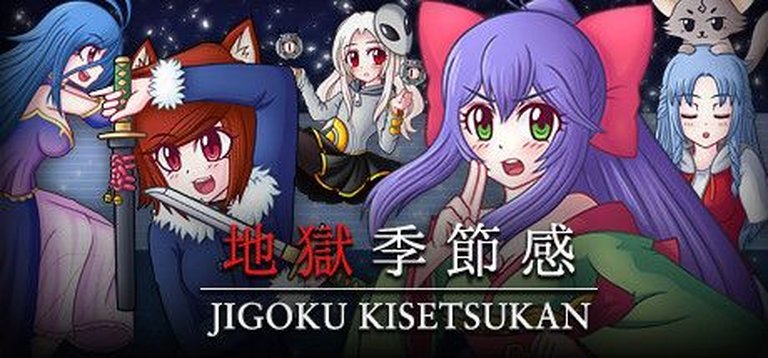
Jigoku Kisetsukan: Sense of the Seasons is a 2D bullet hell shoot ’em up fangame inspired by the Tōhō series, featuring anime-style visuals and chip music. Players control one of six female characters, starting with the deity Tenshi, navigating through intense top-down shooting action, dodging waves of bullets, and battling challenging bosses. The game includes unlockable heroines, special bomb attacks, and power-ups to enhance firepower and lives, delivering a classic danmaku experience with a seasonal twist.
Gameplay Videos
Where to Buy Jigoku Kisetsukan: Sense of the Seasons
PC
Jigoku Kisetsukan: Sense of the Seasons Guides & Walkthroughs
Jigoku Kisetsukan: Sense of the Seasons Reviews & Reception
store.steampowered.com (93/100): A bullet hell shooter with anime-style drawings and chip music.
steambase.io (93/100): Jigoku Kisetsukan: Sense of the Seasons has earned a Player Score of 93 / 100.
axeandnyan.wordpress.com : Overall is Jigoku Kisetsukan average for a free game.
Jigoku Kisetsukan: Sense of the Seasons Cheats & Codes
PC
Type the code in the menu after unlocking ‘dev’ and using ‘bomb’.
| Code | Effect |
|---|---|
| Jigokunotenshi | Unlocks cheat mode to unlock every playable character |
Jigoku Kisetsukan: Sense of the Seasons – A Bullet Hell Love Letter to Touhou
Introduction: A Hidden Gem in the Danmaku Genre
Jigoku Kisetsukan: Sense of the Seasons is a rare breed—a passion project that transcends its fan-game origins to stand as a polished, emotionally resonant bullet hell shooter. Released in 2015 by Italian solo developer Emanuele “Emad” Franceschini, this free-to-play indie title draws heavy inspiration from Touhou Project while carving its own identity through meticulous pixel art, a haunting chiptune soundtrack, and a surprisingly deep narrative. With over 1,700 “Very Positive” reviews on Steam and a cult following among shmup enthusiasts, Jigoku Kisetsukan is a testament to how a single creator’s vision can rival—if not surpass—commercial offerings in the genre.
This review dissects the game’s development, mechanics, storytelling, and legacy, arguing that Jigoku Kisetsukan is not just a Touhou clone but a bold reimagining of the bullet hell formula with a focus on character-driven drama and atmospheric world-building.
Development History & Context: A Labor of Love
The One-Man Studio Behind the Game
Emanuele Franceschini, operating under the moniker Emad, is the sole force behind Jigoku Kisetsukan, handling programming, art, and design. His background in pixel art and chiptune music (evident in his earlier projects like Pepper’s Puzzles) shines through in the game’s aesthetic. The project began as a homage to Touhou but evolved into a standalone experience with its own lore, characters, and mechanical twists.
Technological Constraints & Tools
Built in GameMaker Studio, Jigoku Kisetsukan leverages the engine’s strengths for 2D action while pushing its limits with custom shaders (e.g., the boss health bar) and dynamic lighting effects. The game’s modest system requirements (1.6 GHz processor, 1 GB RAM) reflect its optimization for accessibility, though early players encountered DirectX-related crashes—a common pitfall of GameMaker projects.
The Gaming Landscape in 2015
At the time of release, the bullet hell genre was dominated by:
– Commercial giants like Cave’s DoDonPachi series and Mushihimesama.
– Indie darlings such as Jamestown and Danmaku Unlimited 3.
– Touhou fangames, which often struggled to escape the shadow of ZUN’s originals.
Jigoku Kisetsukan entered this space as a free, high-quality alternative, offering:
– No microtransactions (a rarity in 2015’s F2P landscape).
– Full localization in English, Japanese, French, Russian, and Italian.
– Steam integration (achievements, cloud saves) despite its indie roots.
Greenlight & Community Support
The game’s journey to Steam began on Greenlight, where it garnered attention for its polished trailer and demo. Post-release, Emad maintained an active presence, issuing 10+ updates (e.g., bug fixes, French/Russian translations) based on community feedback—a stark contrast to many abandoned indie projects.
Narrative & Thematic Deep Dive: A Tale of Fear and Redemption
Plot Overview
The game follows Tenshi, a nature deity investigating a supernatural disturbance. Along the way, she crosses paths with five other girls, each with traumatic pasts tied to the game’s antagonists: the Embodiments of Fear (Thanatos, Chronos, Nyctos, etc.). The narrative unfolds through:
– Pre-battle dialogues (skippable but lore-rich).
– Character-specific endings (e.g., Tenshi’s route ends in a Downer Ending, while the “true” ending requires unlocking all characters).
– A meta-twist: The final route introduces Dev, a self-insert author character who “hijacks” the story to save Tenshi.
Themes: Trauma, Identity, and Existential Dread
-
Body Horror & Mortality
- Thanatos (Embodiment of Death) suffers from eternal decay and regeneration, mirroring Tenshi’s fear of losing her divine form.
- Fumin’s illness and Power Incontinence (uncontrolled dimensional travel) reflect anxiety over bodily autonomy.
-
Isolation & Belonging
- Nibiiro (an alien outcast) and Mizuiro (an abandoned child) embody the struggle for acceptance.
- The Embodiments of Fear are tragic villains—each was once human, their souls warped by trauma.
-
The Illusion of Control
- Fumin believes her adventures are All Just a Dream, a coping mechanism for her reality.
- Dev’s fourth-wall-breaking role critiques the “chosen one” trope, framing the heroes as pawns in a larger narrative.
Character Analysis
| Character | Role | Key Trauma | Gameplay Style |
|---|---|---|---|
| Tenshi | Nature deity | Fear of losing divinity | Balanced (default) |
| Mizuiro | Animal tamer | Abandonment by adoptive father | High mobility, weak bombs |
| Eiko | Amnesiac catgirl | Heartbreak, youkai transformation | Rapid-fire, short-range |
| Nibiiro | Alien investigator | Abuse by her species | Slow, high-damage bombs |
| Fumin | Dimensional traveler | Chronic illness, gaslighting | Hitbox shrinks when focused |
| Dev | Meta-author | N/A (breaks the 4th wall) | Unlockable, OP |
Storytelling Strengths & Weaknesses
✅ Strengths:
– Rich backstories (expanded in the Character Book PDF).
– Multiple endings incentivize replays.
– Subversion of tropes (e.g., the “final boss” is a sympathetic figure).
❌ Weaknesses:
– Dialogue pacing can feel abrupt (no voice acting).
– Some routes lack closure (e.g., Eiko’s amnesia is unresolved).
– Dev’s inclusion may alienate players who prefer pure gameplay.
Gameplay Mechanics & Systems: Precision and Punishment
Core Gameplay Loop
Jigoku Kisetsukan adheres to classic danmaku conventions:
1. Movement: Arrow keys or gamepad (no mouse support, a frequent player complaint).
2. Shooting: Hold Z for continuous fire; X for bombs (limited stock).
3. Focus Mode (Shift): Slows movement for precision dodging (critical for survival).
4. Scoring: Graze bullets for points; collect power-ups to upgrade firepower.
Innovations & Flaws
✔ What It Does Well:
– Character Variety: Each of the 6 heroes has unique:
– Shot patterns (e.g., Eiko’s rapid spread vs. Nibiiro’s piercing lasers).
– Bomb mechanics (Mizuiro’s bomb clears bullets in a small radius; Fumin’s shrinks her hitbox).
– Difficulty Scaling: Four tiers (Easy → Hell) cater to newcomers and veterans.
– Training Mode: Lets players practice boss fights with infinite lives.
✖ Criticisms:
– Visibility Issues:
– Dark bullets on dark backgrounds (e.g., Stage 3’s space setting).
– Screen flashes during boss fights (disorienting in Hell mode).
– Lack of Mouse Support: A common request in Steam discussions.
– Bomb Economy: Bombs are scarce, making recovery from mistakes punishing.
Boss Design: A Masterclass in Pattern Memorization
Each of the 5 stages culminates in a boss fight with:
– Multiple phases (e.g., Thanatos’ fight shifts from slow projectiles to chaotic spreads).
– Telegraphed attacks (color-coded bullets indicate danger levels).
– Unique mechanics (e.g., Chronos’ time-stopping bullets).
Standout Fights:
1. Stage 2 (Zelus): A jealousy-themed boss with homing orbs that force constant movement.
2. Stage 5 (Thanatos): The final battle tests graze mastery with dense, overlapping patterns.
Progression & Replayability
- Unlockable Characters: Defeating a boss with a specific character unlocks them for play (e.g., beat Stage 1 with Tenshi to unlock Mizuiro).
- Achievements: 21 Steam achievements encourage experimentation (e.g., “Angel of Hell” for a 1CC on Hell difficulty).
- Score Attack: Leaderboards and high-score chasing add longevity.
World-Building, Art & Sound: A Haunting Aesthetic
Visual Design: Pixel Art Meets Anime
- Character Sprites: Highly detailed, with expressive animations (e.g., Fumin clutching her plush dragon, Elvis).
- Backgrounds: While functional, some stages suffer from repetition (e.g., Stage 1’s forest lacks parallax scrolling).
- Bullet Design: Color-coded for readability, though brown/black projectiles blend into backgrounds.
Soundtrack: Chiptune Mastery
Composed by Lada Laika, Zabutom, and others, the OST blends:
– Melancholic melodies (e.g., Fumin’s theme, reflecting her fragility).
– High-energy battle tracks (e.g., Thanatos’ boss theme, a frantic chiptune crescendo).
– Ambient pieces (Stage 3’s space level features eerie, minimalist synths).
Standout Tracks:
1. “Jigoku Kisetsukan” (Title Theme): A catchy, upbeat introduction.
2. “Embodiment of Fear”: The final boss theme, with a pulsing bassline that mirrors the on-screen chaos.
Atmosphere & Immersion
- Tone: The game oscillates between whimsical (e.g., Nibiiro’s alien antics) and horror (e.g., Thanatos’ body horror).
- Localization: The Japanese/Italian/French/Russian translations preserve the script’s emotional weight.
Reception & Legacy: From Obscurity to Cult Classic
Critical & Commercial Reception
- Steam: 93% positive from 1,763 reviews (as of 2026).
- Metacritic: No critic reviews (a common oversight for free indie games).
- Community Praise:
- “A love letter to Touhou” (Steam user Ctrekoz).
- “The true ending is one of the most satisfying in any shmup” (Reddit).
- Criticisms:
- Visibility issues (e.g., “Stage 5’s fog is unfair” – Axe ‘n Nyan review).
- Lack of innovation (some called it “Touhou with worse visibility”).
Influence & Legacy
- Inspired Other Indies: Games like Lumiette (by biggestboss) cite Jigoku Kisetsukan as a key influence.
- Proved Free Games Can Compete: Its success challenged the notion that F2P games must be monetized aggressively.
- Cult Following: Despite no sequels, the game remains a benchmark for fan-made shmups.
Conclusion: A Flawed Masterpiece
Jigoku Kisetsukan: Sense of the Seasons is a triumph of indie game design—a project born from passion that delivers where many commercial shmups falter. Its rich storytelling, memorable characters, and tight gameplay elevate it beyond a mere Touhou clone, while its technical rough edges (visibility, lack of mouse support) hold it back from true greatness.
Final Verdict:
⭐⭐⭐⭐☆ (4/5) – Essential for shmup fans, but not without flaws.
Where It Excels:
– Narrative depth (rare in the genre).
– Character variety (each feels distinct).
– Atmospheric presentation (music and pixel art).
Where It Stumbles:
– Visibility issues (a cardinal sin in bullet hell).
– Steep difficulty curve (Hell mode is brutal).
– Lack of post-launch content (no DLC or sequels).
Legacy: Jigoku Kisetsukan proves that free games can be labors of love, and that even in a niche genre, storytelling matters. For those willing to endure its challenges, it offers one of the most emotionally resonant bullet hell experiences ever crafted.
Play It If You Like:
– Touhou Project (but want more narrative).
– Jamestown (but prefer anime aesthetics).
– Cave shooters (but enjoy unlockable characters).
Avoid If You:
– Struggle with bullet visibility.
– Prefer mouse-controlled shmups.
– Dislike meta-narrative twists.
Jigoku Kisetsukan is a hidden gem—one that deserves to be unearthed by a new generation of shmup enthusiasts. Download it. Play it. Suffer through its bullet hell. And remember its story.