
- Release Year: 1998
- Platforms: Windows
- Publisher: Mindscape, Inc.
- Genre: Adventure
- Perspective: First-person
- Game Mode: Single-player
- Gameplay: Point-and-click, Puzzle-solving, Real-time puzzles
- Setting: Asylum, Horror
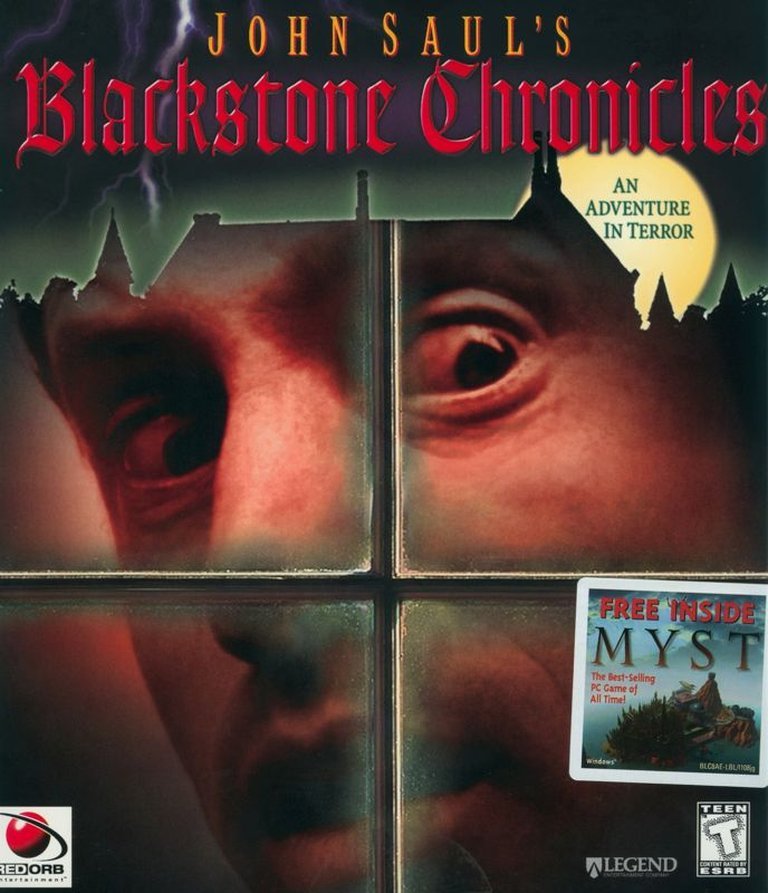
Description
John Saul’s Blackstone Chronicles: An Adventure in Terror is a horror-themed adventure game set in the eerie Blackstone Asylum, now a museum. Players assume the role of Oliver Metcalf, the son of the asylum’s last superintendent, who must confront his father’s vengeful ghost and solve puzzles within the haunted halls to rescue his kidnapped son. The game features first-person exploration, 3D graphics, and an immersive atmosphere blending psychological terror with supernatural threats.
Gameplay Videos
John Saul’s Blackstone Chronicles: An Adventure in Terror Free Download
John Saul’s Blackstone Chronicles: An Adventure in Terror Guides & Walkthroughs
John Saul’s Blackstone Chronicles: An Adventure in Terror Reviews & Reception
genesistemple.com : John Saul’s Blackstone Chronicles is one of the most effective horror adventure games I’ve played.
John Saul’s Blackstone Chronicles: An Adventure in Terror: Review
Introduction
Step into the decaying halls of Blackstone Asylum, where the ghosts of tortured souls and the specter of paternal malice linger in every shadow. Released in November 1998, John Saul’s Blackstone Chronicles: An Adventure in Terror stands as a haunting relic of the late 1990s adventure game renaissance—a time when atmospheric storytelling and psychological horror converged on CD-ROM. As a direct sequel to John Saul’s serialized novel series, the game plunges players into the shoes of Oliver Metcalf, whose quest to rescue his son from his resurrected father’s clutches unravels a tapestry of institutional abuse, generational trauma, and unspeakable cruelty. While its gameplay mechanics show the wrinkles of an era defined by Myst-inspired puzzles, Blackstone Chronicles transcends technical limitations to deliver an unparalleled immersion in psychological dread. This review argues that the game’s enduring legacy lies not in its interactive design, but in its masterful synthesis of literary horror, historical context, and audio-visual atmosphere—a chilling testament to the darkest corners of psychiatric history and the fragility of the human mind.
Development History & Context
Blackstone Chronicles emerged from a collision of literary ambition and gaming pragmatism. Developed by veteran adventure studio Legend Entertainment (creators of Gateway and Callahan’s Crosstime Saloon) and published by Mindscape’s subsidiary Red Orb Entertainment, the project was spearheaded by novelist John Saul himself—a confessed enthusiast of text adventures since the Infocom era. Saul envisioned the game as both an extension of his serialized book series (1996–97) and a standalone narrative, collaborating closely with designer Bob Bates to ensure thematic fidelity. Crucially, the game’s cinematic production was outsourced to Presto Studios (then renowned for The Journeyman Project series), lending FMV sequences and pre-rendered environments a polish rare for non-mainstream titles.
Technologically, the game operated within the constraints of 1998: full-motion video relied on QuickTime, pre-rendered backgrounds demanded high-end CD-ROM drives, and system requirements were steep for the era. The Windows-exclusive release arrived amidst a gaming landscape dominated by first-person shooters (Half-Life) and real-time strategy games (StarCraft), while adventure games struggled against the perception of being “outdated.” Yet Blackstone Chronicles carved a niche by leveraging its licensed horror IP, bundling the original Myst (1993) in some releases to bolster appeal—a tactic revealing the industry’s push for cross-genre accessibility. Despite this, the game’s niche subject matter and mature content limited its commercial reach, cementing it as a cult curiosity rather than a blockbuster.
Narrative & Thematic Deep Dive
Blackstone Chronicles is a masterclass in slow-burn psychological horror, weaving a tale of familial vengeance against a backdrop of institutional atrocity. The plot follows Oliver Metcalf, estranged son of the late asylum superintendent Malcolm, who is lured to the newly renovated Blackstone Asylum—now a Museum of Psychiatric History—after his father’s spirit kidnaps Oliver’s son, Joshua. Malcolm’s ultimatum is brutal: either Oliver embraces his father’s dark legacy and exacts revenge on his enemies, or Joshua is molded into a monster. As Oliver navigates the labyrinthine asylum, he encounters the tormented spirits of patients bound to the building by their personal effects: a girl driven to suicide after losing her baby, a schizophrenic royal falsely imprisoned, and others subjected to brutal “treatments” like electroshock therapy and hydrotherapy.
The narrative’s power lies in its unflinching exploration of psychiatric abuse. Game text and ghostly accounts explicitly detail Malcolm’s descent into sadism—from lobotomies to vivisection—contrasting sharply with the museum’s sanitized exhibits (“lancets balanced bodily humors,” the placards declare). This juxtaposition creates profound thematic dissonance: the past horrors are both preserved and obscured, forcing players to piece together truth from fragmented testimonies. Dialogue is sparse but potent, delivered with chilling authenticity by voice actors like Henry Strozier (Malcolm), whose paternal menace lingers in every whispered command. The game’s climax—where Oliver must destroy Malcolm’s artifacts to banish his spirit—resonates as a cathartic exorcism of generational trauma. Ultimately, Blackstone Chronicles transcends its horror premise to become a searing indictment of institutional power and the cyclical nature of abuse.
Gameplay Mechanics & Systems
As a first-person point-and-click adventure, Blackstone Chronicles prioritizes atmospheric exploration over action-oriented gameplay. Core mechanics revolve around environmental interaction and inventory-based puzzle-solving. Players navigate claustrophobic corridors, clicking on hotspots to inspect objects (e.g., patient diaries, antique tools) and collect clues. Puzzles range from logical (reassembling a patient’s shattered locket) to inventory-driven (using a key to unlock a hydrotherapy chamber). A unique mechanic involves “liberating” ghostly patients by retrieving their stolen personal items, unlocking their memories and advancing the plot.
Yet the gameplay reveals significant flaws. Pixel hunting plagues exploration, with critical objects blending into decaying textures. Timed events—where Oliver must race against unseen threats—feel punishing and illogical, disrupting the game’s deliberate pace. The rebus puzzle, in particular, draws ire for its cryptic design, while the lack of a hint system frustrates modern players. Character progression is non-existent, with Oliver’s abilities remaining static throughout. The UI, though functional, suffers from clunky inventory management and a minimap that often misdirects. While combat is entirely absent—aligning with the game’s psychological focus—its absence highlights the missed opportunity for tension; Malcolm’s threats feel more like narrative devices than interactive challenges.
World-Building, Art & Sound
Blackstone Chronicles excels in transforming its setting into a character. The Blackstone Asylum is a masterpiece of environmental storytelling, rendered in pre-backdrop visuals that evoke Victorian decay and clinical sterility. Peeling paint, rusted restraints, and flickering fluorescents create a palpable sense of dread, while the museum’s juxtaposition of historical exhibits (e.g., “Humoral Theory” placards) and spectral apparitions underscores the game’s themes of memory and erasure. Presto Studios’ FMV sequences bring ghostly patients to life, their performances elevated by emotive acting—especially the haunting portrayals of institutionalized women.
Sound design is equally vital. Ambient audio—dripping water, distant screams, and the groan of aging infrastructure—immerses players in the asylum’s oppressive silence. Voice acting, though occasionally uneven, shines in Malcolm’s manipulative monologues and the patients’ harrowing confessions. The dynamic score, composed by Andrew Frazier and Stephen Lam, shifts per room: dissonant strings in electroshock wards, mournful piano in hydrotherapy chambers. Together, these elements forge an atmosphere of relentless unease, where every shadow feels haunted and every discovery carries visceral weight. The visuals, dated by modern standards, retain a grim charm, with grainy textures amplifying the game’s “found footage” aesthetic of recovered trauma.
Reception & Legacy
Upon release, Blackstone Chronicles received a mixed critical reception, reflecting its polarizing strengths and weaknesses. Aggregator scores hover around 70% (GameRankings), with outlets like Computer Gaming World (90%) praising its “gripping storyline” and “wonderful graphics,” while GameSpot (55%) dismissed it as “average to a fault” for its thin narrative and underdeveloped characters. PC Gamer UK infamously awarded it 3%, condemning its “moronic” design, though PC Gamer US countered with a 79% score, lauding it as a welcome alternative to “soulless Myst clones.” Commercial performance was modest, hindered by its niche horror theme and stiff competition from titles like Half-Life.
Over time, the game’s legacy has evolved into a cult classic, celebrated for its unflinching historical context and psychological depth. It earned a spot as a finalist for Computer Gaming World’s 1998 “Best Adventure” award and was ranked 43rd on Adventure Gamers’ “Top 100 All-Time Adventure Games” list (2011). Thematically, it paved the way for mature horror adventures like Sanitarium (1998) and The Town of Light (2017), which similarly explore psychiatric abuse. Preservationists note its role in documenting late-20th attitudes toward mental health, while retro gamers admire its willingness to prioritize atmosphere over action. Despite its flaws, Blackstone Chronicles endures as a vital artifact of interactive horror—a game that asks players not to solve madness, but to confront it.
Conclusion
John Saul’s Blackstone Chronicles: An Adventure in Terror is a flawed masterpiece, a game that defies easy categorization. Its gameplay, hampered by pixel hunting and dated mechanics, feels like a relic of a bygone era, but its narrative ambition and atmospheric execution transcend technical limitations. The asylum’s walls breathe with the weight of real historical trauma, and Malcolm’s spectral menace lingers long after the credits roll. For players willing to embrace its deliberate pace and harrowing themes, Blackstone Chronicles offers an unparalleled journey into the intersection of family, history, and horror. It is not merely a game but an interactive archive—a chilling reminder that some legacies are forged not in glory, but in the darkest recesses of the human psyche. In an industry obsessed with spectacle, Blackstone Chronicles stands as a testament to the power of restraint, proving that true terror lies not in what is seen, but in what is remembered. Verdict: An essential, if imperfect, artifact of horror gaming history.