
- Release Year: 2016
- Platforms: Nintendo Switch, PlayStation 4, Wii U, Windows
- Publisher: Cooply Solutions Ltd
- Developer: Cooply Solutions Ltd
- Genre: Action, Driving, Racing
- Perspective: Side view
- Game Mode: Single-player
- Gameplay: Arcade, Party game
- Setting: Fantasy, Futuristic, Sci-fi
- Average Score: 63/100
Description
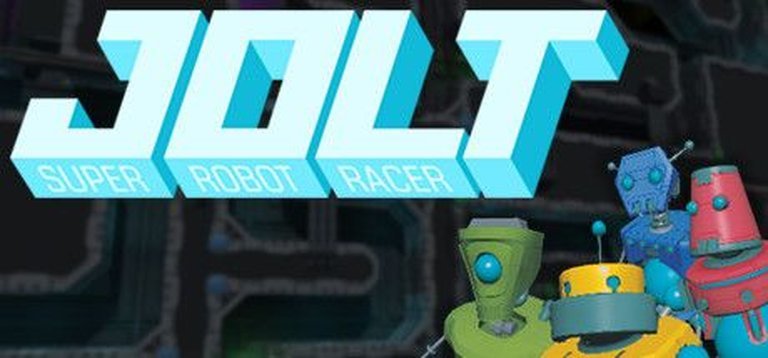
Jolt: Super Robot Racer is a competitive platformer racing game set in a vibrant sci-fi universe where players control customizable robots. The core gameplay revolves around maintaining momentum through skillful navigation and using the ‘JOLT’ mechanic—a charged burst of speed with three stages that allows players to shoot up walls, bypass obstacles, and access shortcuts. Players compete in chaotic, fast-paced rounds across multiple tracks and game modes, with eliminated players able to exact revenge using the ‘VOID’ system, which grants random sabotage power-ups to disrupt the remaining racers. The game supports both local and online multiplayer for up to four players.
Where to Buy Jolt: Super Robot Racer
PC
Guides & Walkthroughs
Reviews & Reception
steambase.io (67/100): JOLT: Super Robot Racer has earned a Player Score of 67 / 100. This score is calculated from 15 total reviews which give it a rating of Mixed.
completionist.me (60/100): Game Rating 61.95, Steam Review Score 6.
Jolt: Super Robot Racer: A Cautionary Tale of Ambition and Obscurity
In the vast and ever-expanding cosmos of video games, there exist titles that achieve legendary status, those that become cult classics, and a great many that fade into quiet obscurity. Then there are games like Jolt: Super Robot Racer, a title that exists not as a monument to triumph or a cautionary tale of failure, but as a spectral entity—a game whose most defining characteristic is its profound lack of definition. Developed by the small Welsh studio Cooply Solutions and released into the wilds of Steam in November 2016, Jolt is a fascinating case study in ambition constrained by execution, a multiplayer party racer that arrived with a whisper and departed just as quietly, leaving behind a digital ghost ship of unfulfilled potential and unanswered questions.
Development History & Context: A Small Studio’s Big Dream
To understand Jolt: Super Robot Racer, one must first understand the landscape from which it emerged. 2016 was a peak year for the indie game scene, a period defined by the explosive success of titles like Stardew Valley and Firewatch, which proved that small teams could achieve massive critical and commercial acclaim. It was also the era of Steam Greenlight and Early Access, a digital frontier that democratized game distribution but also flooded the market with a deluge of content, making discoverability a Herculean task for any developer without a massive marketing budget.
Into this fray stepped Cooply Solutions Ltd, a studio based in South Wales. According to their sparse online presence, they were a “small but capable development team” utilizing Unity, Photoshop, and Maya. Their stated goal was to bring a world of “Robot Racing fun” to life. The game entered Early Access with a planned six-month development period, a hopeful timeline that suggests a team confident in their core design but perhaps underestimating the polish required to stand out.
The technological constraints were likely twofold. First, the choice of a 2D side-scrolling perspective for a racing game was a deliberate, arguably retro, design decision. It hearkened back to classics like Super Off Road or Rock n’ Roll Racing, but modernized with the intent of chaotic, physics-based platforming. Second, the focus on local and online multiplayer for up to four players placed it in a competitive niche alongside beloved party games like SpeedRunners or TowerFall, titles that had already set a very high bar for tight controls and instant fun.
Jolt was not developed in a vacuum; it was crafted in the shadow of giants, by a team hoping its unique mechanics would be its ticket to recognition.
Narrative & Thematic Deep Dive: The Void of Context
If there is a narrative spine to Jolt: Super Robot Racer, it is so minimalist as to be virtually non-existent. This is not a game driven by a rich plot or deep character arcs. The “story” is the context of the race itself. Players assume the role of generic, customizable robots competing in a futuristic, anarchic sporting event. The closest the game comes to narrative motivation is the implied glory of being the “last robot standing.”
The characters are blank slates, presets like “Tim the Preset Robot” (referenced in an achievement) serving as mere templates for player creation. The thematic depth, therefore, is not found in dialogue or lore but in the emergent stories created by gameplay. The core theme is one of chaotic competition and revenge. The game’s signature mechanic, the VOID, thematically reinforces this. Elimination is not the end; it is merely a transition to a spectatorial state where the defeated can exact vengeance upon the living. This creates a cyclical narrative of triumph, defeat, and retaliation within each match, a small-scale drama where the underdog can always fight back.
The world is a loose assemblage of sci-fi and fantasy tropes—futuristic robots racing across levels with names like “Drippy Drains” and “Sandy Times”—suggesting a setting that is less a coherent universe and more a playful arena designed purely for mechanical conflict. The narrative is what you make of it, written in the moments of a perfectly timed JOLT or a well-placed sabotage from beyond the grave.
Gameplay Mechanics & Systems: The Promise and The Pitfalls
At its core, Jolt: Super Robot Racer is built upon a foundation of intriguing, even innovative, ideas. The official description lays out a compelling gameplay loop: a “competitive platformer that’s all about maintaining momentum with skillful navigation.”
-
The JOLT Mechanic: This is the game’s namesake and primary verb. A three-stage charged burst of speed, the JOLT is not just for going faster. It’s a utility tool for interacting with the environment—shooting up walls, bypassing obstacles, and accessing shortcuts. This adds a layer of skill and timing beyond simple acceleration and braking, promising a high skill ceiling for mastery. A well-executed JOLT could theoretically be the difference between victory and defeat.
-
The VOID Mechanic: This is the game’s most radical idea. Instead of idly watching after being eliminated, players enter the VOID. Here, they must “punch in the correct sequence” to be gifted a random “Sabotage Power-Up” to disrupt the remaining racers. This is a brilliant concept for a party game, designed to maintain engagement for all players and prevent the all-too-common boredom of elimination. It ensures the outcome is never certain until the very end.
-
Progression & Customization: The game featured multiple tracks, game modes (including a “Light Mode” where only the leader provides illumination), and a “Create your own Robot” system. Unlocking 40 robot parts was a specific achievement, indicating a tangible, if likely simplistic, reward loop for continued play. A ranking system from “Semi-Pro” to “Legend” provided long-term goals.
However, a mechanic’s design is one thing; its execution is another. The available data, particularly the achievement statistics, paints a telling picture of these systems in practice. The rarest achievements, unlocked by only 2-2.1% of players, are for basic tasks like achieving “Legend” rank or getting a “Super Robot” medal on specific tracks. The most common achievement, “Win Your First Race,” is only at 5.7%.
This suggests one of two things, or likely a combination of both: either the game was purchased by a large number of players who tried it once and never returned, or the skill curve and mechanical execution were so flawed that these goals became prohibitively difficult. The fact that the median playtime is a scant 3.6 hours, with an average achievement completion rate of under 60%, points toward a game that failed to hook players long-term. The promise of high-skill movement and chaotic fun may have been undermined by imprecise controls, unbalanced levels, or a lack of compelling content to justify the grind.
World-Building, Art & Sound: The Aesthetics of Ambiguity
Judging solely from the MobyGames specs and promotional text, Jolt presented a 2D side-scrolling visual style. The settings are described as “Fantasy” and “Sci-fi / futuristic,” a bizarre but potentially interesting fusion that likely resulted in visually distinct tracks—from the mechanical interiors of “Drippy Drains” to the arid landscapes of “Sandy Times.”
The art direction, based on the studio’s use of Maya and Photoshop, was almost certainly 2D sprite-based with potential for detailed robot customization. The described “Light Mode” indicates an awareness of atmosphere, using darkness to change the tactical dynamic of a race. Unfortunately, with no available screenshots or promo art on the primary databases, the visual world of Jolt remains a ghostly silhouette. We can imagine colorful, cartoonish robots and vibrant, hazard-filled tracks, but the specifics are lost to time.
The sound design is a complete unknown. There is no mention of a composer or audio team in the credits, and no samples exist to analyze. It is one of the game’s many black boxes, a critical component of any arcade racer’s feedback loop that has simply vanished from the historical record.
Reception & Legacy: The Echo of Silence
The reception of Jolt: Super Robot Racer is perhaps its most defining and tragic aspect. On MobyGames, there are zero critic reviews and zero user reviews. The Steam community hub is a desolate place, with only three discussion threads from around its release in 2016, one of which simply notes the planned Early Access period. The game has a Player Score of 67/100 on Steambase, calculated from just 15 reviews (10 positive, 5 negative), branding it with a “Mixed” rating—a verdict rendered by a statistically insignificant handful of players.
PlayTracker estimates a player base of around 181,000, but with only 2,000 estimated active players and a paltry 0.5 average achievements per player, it’s clear the vast majority of these owners barely engaged with the product. It was ported to Wii U, PlayStation 4, and Nintendo Switch in 2018, but these releases seem to have done little to raise its profile, often listed under the alternate title Jolt: Family Robot Racer.
Its legacy is one of absolute obscurity. It did not influence a genre. It did not become a cult classic. It is not remembered fondly on retro gaming lists. Its influence on the industry is effectively zero. Instead, its legacy is as a data point—a representative of the hundreds of games that launch every year into the digital marketplace only to disappear without a trace. It serves as a sobering reminder of the immense challenges facing small developers, where a compelling pitch on paper is not enough to survive the intense competition for players’ time and attention.
Conclusion: A Verdict on a Ghost
Jolt: Super Robot Racer is not a bad game. It is, for all intents and purposes, an unknown game. Based on the evidence available, it was a project brimming with interesting ideas—the JOLT and VOID mechanics are genuinely clever innovations for the party-racer genre. However, these ideas were seemingly trapped in a package that failed to execute on their promise, whether due to a lack of polish, content, marketing, or simply the misfortune of bad timing.
Our final verdict cannot be on its quality, but on its existence. Jolt is a fascinating artifact for game historians—a perfect example of a title that slipped through the cracks of history. It is a game defined by its absence: absent reviews, absent screenshots, absent players, and an absent legacy. It is a digital ghost, a series of intriguing mechanics and hopeful design documents floating in the void it so aptly named. For the few who experienced it, it may have provided an evening of chaotic fun. For the rest of the world, Jolt: Super Robot Racer remains a footnote, a cautionary tale written in invisible ink—a reminder that in the vast library of gaming, not every title gets to be a bestseller. Some simply exist, and in doing so, tell their own unique story.