
- Release Year: 2004
- Platforms: Windows
- Developer: Maddy Thorson
- Genre: Action
- Perspective: Side view
- Game Mode: Single-player
- Gameplay: Platform, Puzzle
- Setting: Futuristic, Sci-fi
- Average Score: 60/100
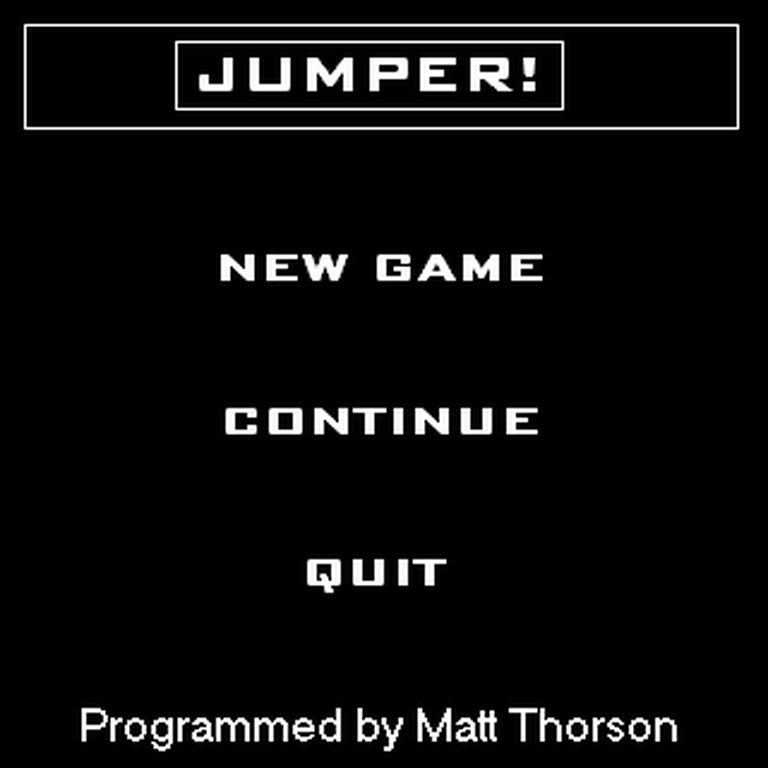
Description
Jumper! is a freeware sci-fi platformer where players guide Ogmo, a lab-created creature designed as a weapon of mass destruction, through an abandoned army research base filled with deadly traps like spikes, lightning arcs, and bottomless pits. Using arrow key controls for movement and double jumps, Ogmo solves self-contained room puzzles by collecting helpful items like golden arrows and super pads to reach exits, with automatic progress saves and a built-in level editor for custom levels.
Jumper! Cheats & Codes
PS2 (NTSC-U)
These are CodeBreaker codes. The Enable Code must be activated first. Use with PCSX2 emulator (see setup guide) or CodeBreaker/GameShark disc on physical console.
| Code | Effect |
|---|---|
| B4336FA9 4DFEFB79 2972A527 BB4A4853 9F3BD2FA 37126FDD 82E61AA5 128166C7 1F036E06 F39B9295 580B3534 9091DFF5 DEEA3D5A 12596DBC 96B52FBE 6BDDF4EF BCEEB4EA 4ECF2065 D019A84F 03F8E3BA 4CBBCCA0 58C06F5B 97BD5D77 29E2D014 31708B47 37F65429 0519DE20 52371D22 498F5609 AC700524 48F3CA7B B9A984A6 410C6DAA D8ED0FE0 AF40F217 9E202727 1F351D2B DA3C7E54 B3F4AFAF B04693EC F66C2B92 92BEEA39 8C4E60E0 6C613392 C82493CD 80922E41 |
Enable Code (Must Be On) |
| 33C707CC 4F4A90E5 29C3FDCB 00CC44EF E122C7C5 EC8E55A1 |
Infinite Health |
| AB78D497 8C01F752 62AD7A56 59988535 8F25A3D4 D8B98FF2 |
Infinite Special Meter |
| AE9A9860 E9627E68 13AC057C 04B4EA86 E4CE6116 66317A59 |
Infinite Grenades |
| D07538B1 4EBBD071 662B5EBE B8AE0B8E 274AE67C 4679BE5E |
Infinite Flamethrower |
| AECF8897 9855A8EA AEA54696 CE855087 752CE809 76D85D9C |
P1 Press Select To Skip FMV |
Jumper!: Review
Introduction
In the dim, trap-laden corridors of an abandoned laboratory, a rectangular red blob named Ogmo somersaults through spikes, electricity, and bottomless pits, embodying the raw thrill of precision platforming long before it became an indie staple. Released as freeware in 2004, Jumper! by solo developer Maddy Thorson arrived like a bolt from a glitchy yellow arc—unassuming, punishing, and revolutionary. This tiny Windows gem, starring a lab-created super-soldier prototype, predates the modern wave of “masocore” platformers like Super Meat Boy and VVVVVV, stripping away lives, continues, and health bars for instant respawns in bite-sized death traps. Its legacy endures not through bombast, but through elegant brutality: Jumper! is the ur-text of high-precision, infinite-retry platforming, proving that short, savage levels could forge mastery without mercy, cementing its place as a foundational artifact in indie game history.
Development History & Context
Maddy Thorson, a budding Canadian developer then in her early twenties, single-handedly programmed, designed, and released Jumper! on February 11, 2004, as a freeware download from her personal site (later mirrored on Matt Thorson’s archive). Built for Windows using a custom engine—likely leveraging simple 2D physics akin to early Flash tools but compiled as a lightweight executable—Thorson crafted it amid the twilight of browser-based gaming and the dawn of desktop indies. Technological constraints were minimal: pixel art rendered in stark monochromes with basic animations, keyboard-only controls (arrows for movement, up for jumps), and no need for advanced hardware. Yet these limits birthed innovation—no variable-height jumps, instant acceleration/deceleration, fixed double-jump arcs—forcing purity in timing and momentum.
The era’s gaming landscape was transitional. Console blockbusters like Half-Life 2 and Grand Theft Auto: San Andreas dominated, while PC freeware thrived on sites like Newgrounds amid Flash’s heyday (Newgrounds Rumble, Alien Hominid). Thorson’s vision echoed arcade roots (Super Mario Bros. precision amid traps) but rejected their multi-tiered failure states (lives, continues). Instead, she pioneered “drill-like” retries: 10-20 second rooms with instant respawns, minimizing frustration while maximizing skill honing. This responded to arcade fatigue—emulator savestates were hacks, not design—positioning Jumper! as a freeware outlier in a shareware-saturated scene. A year later, Thorson iterated with Jumper: Redux (2005), polishing graphics and adding harder levels, hinting at her evolution toward collaborative hits like Super Meat Boy (design) and Celeste (lead designer).
Narrative & Thematic Deep Dive
Jumper!‘s story unfolds in minimalist cutscenes, a deliberate counterpoint to its mechanical ferocity. Ogmo awakens in 2004 from cryogenic stasis in a lab initiated in 1888 to forge the “ultimate soldier”—an alternate history where WWI-abandoned experiments yield ageless waddling heads. Framed as a Weapon of Mass Destruction prototype, Ogmo’s escape narrative is pure pulp sci-fi: containment fails, traps activate, freedom beckons. Post-lab capture by the “National Science Institute” leads to a fakeout plane climax, subverting expectations.
Characters are archetypal silhouettes: silent protagonist Ogmo (heroic mime, somersaulting stoically), faceless scientists, and a shadowy “Jumper Catcher” boss (revealed in Thorson’s later Dim). Dialogue? Absent—Pictorial Speech-Bubbles appear in sequels, but here, environmental storytelling reigns. Themes probe abandonment (dusty labs echo forgotten wars), survival (one-hit deaths mirror lab lethality), and transhuman hubris (unfinished super-soldier vs. godlike platformer). Ogmo’s agelessness foreshadows sequels’ world-conquest plots (Jumper Two‘s Ogmobots), critiquing militarism through absurdity—a blob outjumping history. Economical yet evocative, the narrative services gameplay, embedding themes in traps: spikes as failed experiments, electricity as containment arcs.
Gameplay Mechanics & Systems
At its core, Jumper! is a puzzle-platform gauntlet divided into seven sectors (worlds) of 4-6 screens each, auto-saving per room for frictionless iteration. The loop: arrow left/right to dash (instant accel/decel), up for fixed-height double-jump (somersault animation), reach the exit amid one-hit-kill hazards. Golden arrows recharge mid-air jumps; super pads (orange) launch destructibly; crates activate pressure switches; ghost blocks phase through walls.
Core Loop Deconstruction:
– Traversal: Precision timing trumps speed—squeeze one-tile gaps, space jumps for climbs (e.g., Sector 3’s arrow chains demand rhythmic holds/releases).
– Hazards: Spikes (ubiquitous), yellow lightning (lethal arcs), bottomless pits, fireballs (bouncing), falling blocks (don’t cling), cannonballs (Goomba-stomp for bounces). Red electricity harmless; yellow moving platforms glitchy.
– Puzzles: Toggle switches (power electricity), push crates, ghost-block escorts. Iconic: 3-4’s labyrinthine arrow-run (100+ deaths typical), requiring muscle memory for stops/starts.
– Progression: No unlocks mid-game; difficulty spikes mid-sector (climaxes like 4-4, 7-3). End tallies deaths (causes in Redux), rewarding persistence.
Innovations & Flaws:
– Instant respawn enables “practice drills,” predating masocore.
– Level editor (included) spawns fangames (Jumper: Opposing Forces).
– UI: Minimalist—sector select, fullscreen toggle (F4), taunt mode (Redux). No maps, amplifying isolation.
Flaws persist: Janky physics (ground-landing stutter, inconsistent squeezes), music-loop freezes, fake difficulty (collision quirks). Yet these forge triumphs, like skipping sections via perfect spacing.
| Mechanic | Strength | Weakness |
|---|---|---|
| Double Jump + Arrows | Enables verticality, rhythmic flow | Fixed height limits nuance |
| Hazards | Tense, fair with mastery | Glitchy platforms frustrate |
| Auto-Save/Respawn | Infinite retries | None—pure skill tax |
Sequels refine: Jumper Two adds inertia/wall-jumps; Three varietals (Ice Ogmo).
World-Building, Art & Sound
The sci-fi/futuristic setting—an abandoned research base—builds claustrophobic dread through Malevolent Architecture: sterile tiles devolve into clouds (Sector 7), planes, temples. Atmosphere evokes Cave Story‘s labs but trap-focused—echoes of WWI abandonment linger in dust motes (implied).
Visuals: Retraux pixel art (16×16 Ogmo: head-body rectangles) evolves subtly (Redux polishes). Stark palettes: grays/blues for labs, yellow/red hazards pop. Scrolling finales add vertigo; useless elements (superfluous switches) tease replay.
Sound: Chiptune simplicity—looping tracks halt on death/retry (quirk aids tension resets). Jumps/fireballs squeak; deaths thud. Minimalism amplifies focus: no bombast, just procedural peril. Collectively, they forge immersion—visual cues (arrows glow), audio timing (platform rhythms)—elevating trials to balletic survival.
Reception & Legacy
Launch reception: MobyGames logs one player rating (3/5), no critics—freeware obscurity. Cult status bloomed via forums (TIGSource), downloads (Thorson sites). No sales, but infinite reach: Redux (2005) iterated; sequels (Jumper Two/Three) expanded lore; fangames (Opposing Forces, Jumper 2 Redux) proliferated.
Influence cascades: Ogmo unlocks in Super Meat Boy (Thorson’s collab); mechanics echo I Wanna Be the Guy, VVVVVV, Celeste (Thorson’s GDC talks cite Jumper! roots). Pioneered “Jumper-likes”—short, lethal retries vs. arcade lives. Evolved indie design: savestates legitimized, masocore mainstreamed. Reputations: “baby-punching” hard (TIG wiki), Sylvie calls it “genesis of modern platformer.” Geometry Dash skins homage it. In history: freeware vanguard, Thorson’s springboard to stardom.
Conclusion
Jumper! endures as a pixelated crucible—flawed physics, minimalist narrative, and unrelenting sectors forging platforming purists. Maddy Thorson’s debut distills arcade essence into infinite precision, influencing a genre without compromise. Not flawless (jank persists), but definitive: essential freeware, proto-indie masterpiece. Verdict: 9.5/10—a historical cornerstone, playable today via archives, demanding your deaths for transcendence. Download, die, master; Ogmo awaits.