
- Release Year: 2009
- Platforms: iPad, iPhone, Macintosh, Windows
- Publisher: Run Hello
- Developer: Run Hello
- Genre: Action
- Perspective: Side view
- Game Mode: Single-player
- Gameplay: Crushing, Enemy Avoidance, Explosions, Puzzle platforming, World rotation
Description
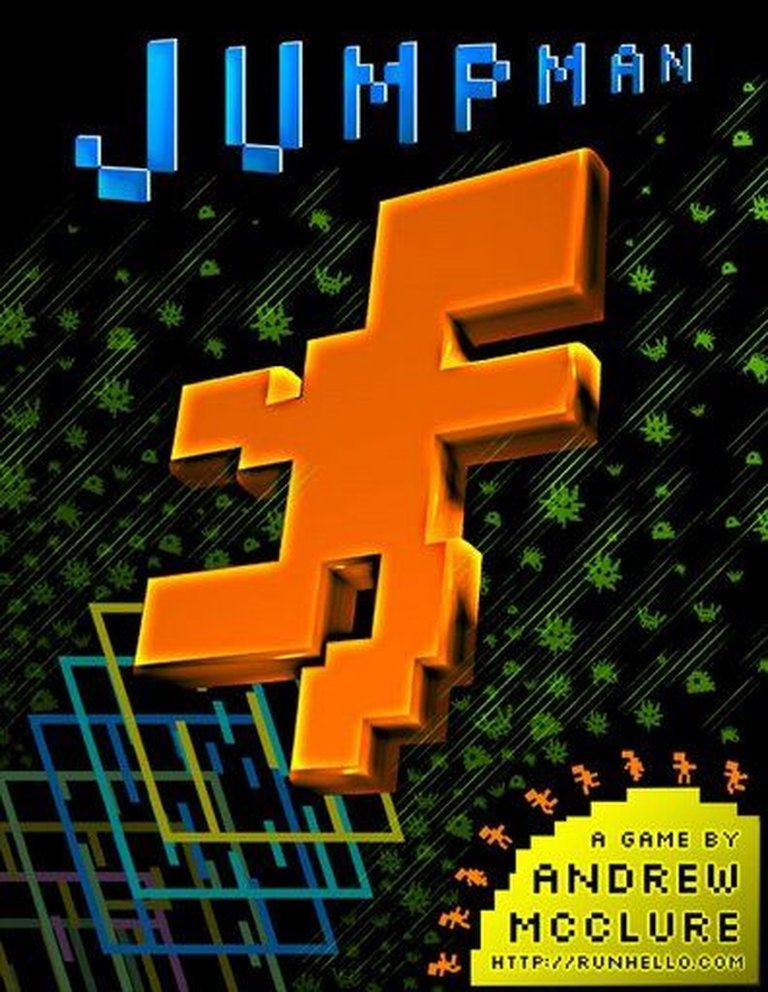
Jumpman is a puzzle platformer designed to emulate the aesthetic of early 1980s Atari and Apple // games while incorporating modern gameplay techniques. Instead of static levels, the game presents a cohesive world where subsequent stages are visible in the background, creating a sense of depth. Players control a character who can move, jump, and rotate entire levels to solve puzzles, avoid enemies, or crush them with yellow balls. Later stages introduce mirrored gameplay, exploding bombs, and restricted rotation zones. The goal is to touch a blue sign to exit each level, with unlimited retries and auto-saved progress. The game also includes a playground mode and a full level editor for custom creations.
Where to Buy Jumpman
PC
Jumpman: Review
Introduction
In the pantheon of 1980s video games, few titles embody the raw, innovative spirit of the early home computer era as profoundly as Jumpman. Released by Epyx in 1983, this deceptively simple platformer transcended its pixelated origins to become a landmark achievement in game design. Randy Glover’s creation—born from a childhood encounter with Donkey Kong and nurtured on Atari hardware—delivered a masterclass in emergent complexity. Its enduring legacy lies not in graphical fidelity or cinematic storytelling, but in its radical approach to level architecture and player agency. This review dissects Jumpman as both a product of its time and a timeless blueprint for puzzle-platforming excellence, arguing that its ingenious fusion of precision mechanics and unpredictable invention cemented its status as an unsung progenitor of modern metroidvanias and puzzle hybrids.
Development History & Context
Jumpman emerged from the fertile, competitive ground of the early 1980s home-computer boom. Its creator, Randy Glover—a self-taught electronics engineer—was inspired by a visceral encounter with Nintendo’s Donkey Kong in a Pizza Hut arcade booth. This exposure catalyzed his ambition to replicate the platforming thrills on home systems, ultimately leading him to the Atari 800 due to its superior hardware sprite capabilities over alternatives like the TI-99/4A.
Development began in earnest in early 1983 with a prototype of 13 levels crafted via Apple II compilers before being ported to Atari. Glover’s technical ingenuity was immediately apparent: he exploited the Atari’s hardware-based collision detection by splitting Jumpman’s sprite into body and foot components, allowing the engine to interpret environmental interactions (e.g., walls, ladders, falls) through register-level color collision. This not only saved processing cycles but enabled intuitive map design—Glover could “draw” hazards and test their behavior in real-time.
After pitching to Broderbund—who demanded creative control—Glover struck a deal with Automated Simulations. The company, already known for strategy titles under the “Dunjonquest” brand, saw Jumpman as a pivot toward action-oriented content. Its success was so transformative that Automated Simulations rebranded as Epyx, adopting Jumpman as the flagship for their new action-label identity. Despite the Atari 800’s limited RAM, Glover expanded the prototype to 30 levels, leveraging the system’s enhanced memory. Commodore 64 and Apple II ports followed, with the former improving Jumpman’s color scheme (red sweater, purple trousers) and the latter suffering from clunky performance. The IBM PC version arrived later via Mirror Images Software, cementing Jumpman’s multi-platform dominance in a pre-console era.
Narrative & Thematic Deep Dive
Jumpman’s narrative is sparse yet potent, framed by a typewritten manual that establishes a high-stakes sci-fi scenario: “Alienators” (terrorists) have infiltrated a Jupiter base, planting bombs across three interconnected buildings. As the titular agent, Jumpman must defuse each explosive before the base—and the moon itself—is obliterated. This premise injects urgency into every pixel, transforming abstract platforming into a race against annihilation.
The game’s thematic brilliance lies in its metaphorical exploration of precision and consequence. Each level is a microcosm of disaster: one misplaced leap triggers cascading failures, while a well-timed defusal averts catastrophe. The “smart darts” (orthogonally homing projectiles) embody the relentless, unpredictable threat of terrorism, while the randomized level order underscores the chaos of sabotage. Even Jumpman’s comical death animation—tumbling to the ground to Chopin’s Funeral March—subverts the heroic trope, emphasizing the fragility of failure in a mission-critical environment.
Character-wise, Jumpman himself is a blank slate, defined by action rather than dialogue. His silent efficiency mirrors the era’s arcade ideals, while the lack of traditional NPCs shifts focus to environmental storytelling. The levels themselves become characters: “Figurit”’s bomb-disarming sequence, “Dragon Slayer”’s spear-throwing sections, and “Grand Puzzle”’s mirrored platforms all narrate unique challenges through their mechanics. This absence of overt narrative forces players to internalize the stakes, making each bomb defusal a personal victory against entropy.
Gameplay Mechanics & Systems
Jumpman’s gameplay loop is a masterclass in escalating complexity. At its core, it’s a bomb-defusal exercise: traverse ladders, ropes, and platforms to collect all bombs per level. Yet Glover layered this framework with ingenious innovations that redefined platformer design:
-
Movement and Physics: Jumpman’s controls are deceptively simple—left/right movement, jumping, and ladder/rope climbing—but the physics demand mastery. Green ropes allow upward ascent; blue ropes downward-only. Jumpman’s momentum and fall damage create high-risk scenarios, yet a forgiving mechanic lets him scramble up platforms if his body makes contact, reducing frustration versus contemporaries like China Miner.
-
Level Gimmicks as Core Mechanics: Unlike linear platformers, Jumpman’s 30 levels are self-contained experiments. “Robots” moves enemies only when bombs are defused; “Hurricane” features hailstones; “Follow the Leader” spawns clones mirroring the player’s path; “Dragon Slayer” replaces jumping with spear-throwing. Each subverts expectations, transforming the core loop into a puzzle-solving matrix.
-
Progression and Customization: Players choose five difficulty tiers (Beginner to Grand Loop) or a “Randomizer” mode that shuffles levels to prevent roadblocks. Jumpman’s speed adjusts via keys 1–8 at level start—faster speeds riskier but grant higher time-based bonuses. Lives are plentiful (7 starting, +1 per 10,000 points), encouraging experimentation.
-
Unconventional Systems: The game’s collision detection engine—using hardware sprites for environmental interaction—allowed Glover to create “impossible” levels by bending sprite boundaries. Later levels feature rotating worlds (via keyboard inputs) and destructible scenery, leveraging Atari hardware quirks for emergent solutions.
These systems created a sandbox of possibilities, turning static screens into dynamic puzzles where failure was both instructive and entertaining.
World-Building, Art & Sound
Jumpman’s world is a triumph of constrained creativity. The Jupiter base comprises three buildings with vertically scrolling floors, each a self-contained biome. Early levels like “Electroshock Traps” feature neon-lit hazard zones, while later stages like “Grand Puzzle III” unfold as Escher-like mazes. The game’s fixed-flip-screen aesthetic—where adjacent levels appear in the background—creates a vertiginous sense of depth, foreshadowing modern open-world design.
Artistically, Jumpman embraces minimalism. The Atari version uses monochrome sprites with color-coded hazards (red for bombs, blue for ladders), while the C64 port adds vibrant palette swaps. Jumpman’s stick-figure design—with hands-on-hips idle animations and ladder-climbing arm extensions—imbues personality beyond technical limitations. Enemies are equally expressive: dart-shooting turrets, robots that shuffle, and birds in “Roost” level add visual rhythm.
Sound design reinforces the game’s tonal duality. Beeps denote bomb collection and jumps, but the death sequence—Chopin’s Funeral March—elevates failure from a setback to a tragicomic catharsis. The absence of musical themes during gameplay amplifies tension, making each leap a heartbeat away from catastrophe. This auditory contrast between playful mechanics and dire stakes creates a uniquely compelling atmosphere.
Reception & Legacy
Jumpman’s 1983 debut was a critical and commercial juggernaut. It sold ~40,000 copies on Atari/C64 by 1987, peaking at #3–6 on Billboard’s video game charts—trailing only Miner 2049er’s #1 spot. Contemporary reviews were effusive: Softline hailed it “wonderfully addicting,” praising its level variety (“30 games in one”); Compute! deemed it a “software classic” surpassing Miner 2049er’s scope. InfoWorld noted its standout status among Epyx’s arcade titles, while K-Power lauded its replayability despite modest graphics.
Its legacy endures through influence and preservation. Jumpman pioneered level-randomization and gimmick-driven design, foreshadowing titles like Lode Runner (1983) and Hap Hazard (2005). Randy Glover’s abandoned Jumpman II (1998–2001) and 2014’s Jumpman Forever (OUYA/PC) kept the spirit alive, though neither replicated its innovation. Unofficial ports abounded: Apogee’s Jumpman Lives! (1991) added a level editor but was withdrawn due to copyright claims, while MS-DOS remakes like The Jumpman Project (2003) preserved the original’s physics.
Culturally, Jumpman secured its place in gaming’s lexicon. It was reissued on Wii Virtual Console (2008) and THEC64 Mini (2018), and its mechanics inspired speedrunning communities. The C64 version’s 7.03/10 rating on Lemon64 and 71st placement in their top 100 games reflect its enduring affection. As Alec of Vintage is The New Old summarized, “Jumpman is classic case of ‘old but gold,’ a game that still manages to be great fun in spite of its basic visuals.”
Conclusion
Jumpman stands as a testament to the transformative power of constraints. In an era defined by crude graphics and technical limitations, Randy Glover crafted a game where brilliance emerged not from horsepower but from ingenious design. Its randomized levels, emergent physics, and thematic cohesion—defusing bombs as a metaphor for navigating chaos—created a blueprint for puzzle-platformers that remains relevant. While its blocky aesthetics and bare-bones narrative may test modern sensibilities, Jumpman’s soul lies in its unrelenting creativity: each level is a love letter to problem-solving, its failures as rewarding as its triumphs.
As a historical artifact, Jumpman defined Epyx’s identity and pushed platforming beyond arcade simplicity. As an experience, it remains a masterclass in elegant complexity. Its legacy endures not in sequels or remakes, but in the DNA of games that challenge players to think, adapt, and embrace delightful failure. In the annals of video game history, Jumpman is not merely a classic—it is a cornerstone, a reminder that the most enduring games are those built on ideas, not pixels.