
- Release Year: 1997
- Platforms: Macintosh, Windows
- Publisher: Jordan Freeman Group, LLC, Knowledge Adventure, Inc.
- Developer: Human Code, Inc.
- Genre: Educational, Puzzle
- Perspective: Third-person
- Game Mode: Single-player
- Gameplay: logic, Math, Mini-games
- Setting: Castle, Medieval
- Average Score: 87/100
Description
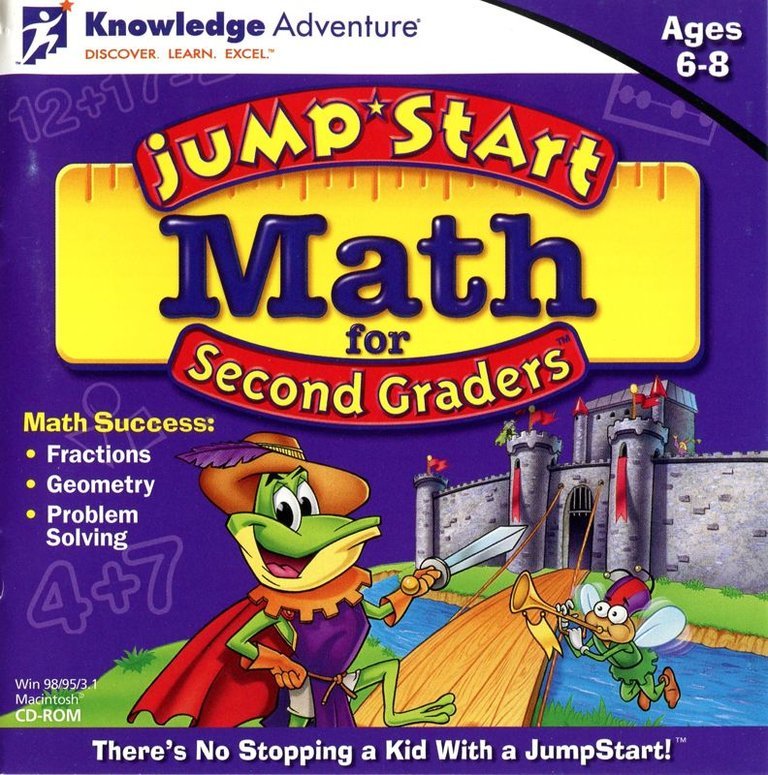
In JumpStart 2nd Grade Math, players join CJ the Royal Fly Catcher and his friend Edison the firefly on a quest to free a medieval castle from the clutches of the evil Duke Ratso. The castle’s inhabitants—the King, Queen, Cook, Jester, and Squire—are trapped in magic mirrors, and players must gather ingredients to break the spell by completing thirteen educational math activities. These activities, such as Catapult Addition and Stained Glass Geometry, teach addition, subtraction, multiplication, fractions, money, geometry, and telling time, making it an engaging learning tool for children aged six to eight.
Gameplay Videos
Where to Buy JumpStart 2nd Grade Math
PC
JumpStart 2nd Grade Math Free Download
JumpStart 2nd Grade Math Guides & Walkthroughs
JumpStart 2nd Grade Math Reviews & Reception
myabandonware.com (87.6/100): I finally got this to work. I tried a few different programs to run the image file but most didn’t work for me. The software that did work was WinCDEmu.
JumpStart 2nd Grade Math: A Masterclass in Edutainment and Nostalgic Adventure
Introduction: The Golden Age of Educational Gaming
In the late 1990s, the educational gaming landscape was a frontier of innovation, where developers sought to blend learning with entertainment in ways that would captivate young minds. Among the pioneers of this movement was JumpStart 2nd Grade Math, a title that not only defined a genre but also left an indelible mark on an entire generation of learners. Released in December 1997 by Knowledge Adventure, this game was more than just a digital workbook—it was a medieval adventure, a puzzle-solving odyssey, and a testament to the power of gamified education.
At its core, JumpStart 2nd Grade Math was designed to teach fundamental mathematical concepts—addition, subtraction, multiplication, fractions, geometry, and time-telling—to children aged six to eight. Yet, what set it apart was its ability to weave these lessons into a rich, narrative-driven experience. Players assumed the role of CJ, a plucky frog and the Royal Fly Catcher, alongside his quick-witted firefly companion, Edison. Together, they embarked on a quest to free a medieval castle from the clutches of the nefarious Duke Ratso, who had trapped the royal family in enchanted mirrors. To break the spell, players had to gather ingredients scattered across the castle, each guarded by a math-based challenge.
This review will dissect JumpStart 2nd Grade Math in exhaustive detail, exploring its development history, narrative depth, gameplay mechanics, artistic design, and lasting legacy. Through this analysis, we will uncover why this game remains a beloved classic and how it influenced the trajectory of educational gaming.
Development History & Context: The Birth of a Genre
The Studio and the Vision
JumpStart 2nd Grade Math was developed by Human Code, Inc. and published by Knowledge Adventure, Inc., a company that had already established itself as a leader in educational software. Knowledge Adventure’s JumpStart series, which began in the early 1990s, was designed to create engaging, curriculum-based games that aligned with school standards while maintaining a sense of fun and adventure. The series was part of a broader movement in the late 20th century to integrate technology into education, leveraging the growing popularity of personal computers in households and schools.
The game’s development was spearheaded by a team of 73 individuals, including David Fratto as Executive Producer and Mary Flanagan as Producer and Designer. Flanagan, a notable figure in game design and education, brought a unique perspective to the project, emphasizing narrative-driven learning and interactive storytelling. The writing was handled by Adam Felber, whose work infused the game with humor and personality, making the educational content more palatable for young players.
Technological Constraints and Innovations
Released in 1997, JumpStart 2nd Grade Math was a product of its time, constrained by the technological limitations of the era. The game was distributed on CD-ROM, a medium that allowed for richer audio and visual assets compared to floppy disks but still required careful optimization. The development team had to balance graphical fidelity with performance, ensuring the game ran smoothly on the average home computer of the late 1990s.
One of the standout innovations of the game was its adaptive difficulty system. While not as sophisticated as modern adaptive learning algorithms, the game featured multiple difficulty levels that could be adjusted based on the player’s performance. This ensured that children were neither overwhelmed nor under-challenged, a critical factor in maintaining engagement.
The game also leveraged voice acting and animation to create a more immersive experience. Characters like CJ and Edison were brought to life with distinct personalities and voices, a rarity in educational games of the time. The inclusion of full-motion video (FMV) sequences for key narrative moments further enhanced the game’s cinematic feel, making it feel more like an adventure and less like a classroom exercise.
The Gaming Landscape of 1997
The late 1990s were a transformative period for gaming. The industry was transitioning from 2D to 3D graphics, with titles like Super Mario 64 (1996) and The Legend of Zelda: Ocarina of Time (1998) redefining what was possible in interactive entertainment. However, the educational gaming sector remained largely rooted in 2D, focusing on accessibility and ease of use for younger audiences.
JumpStart 2nd Grade Math entered a market dominated by other edutainment titles like The Oregon Trail, Reader Rabbit, and Math Blaster. What set JumpStart apart was its narrative coherence and character-driven gameplay. While many educational games of the era were little more than digital flashcards, JumpStart offered a structured adventure with clear goals, a compelling villain, and a sense of progression.
The game’s release also coincided with the rise of CD-ROM-based multimedia experiences, which allowed for more complex interactions and richer storytelling. This shift enabled developers to create games that were not just educational but also emotionally engaging, a quality that JumpStart 2nd Grade Math exemplified.
Narrative & Thematic Deep Dive: A Medieval Math Quest
Plot Overview: The Rescue Mission
The narrative of JumpStart 2nd Grade Math is deceptively simple yet effective. The game opens in a medieval castle, where the royal family—the King, Queen, Cook, Jester, and Squire—have been imprisoned by the villainous Duke Ratso and his henchmen. Ratso, a rat with a penchant for mischief and a desire for power, has trapped the royals in magic mirrors, scattering the ingredients needed to break the spell across the castle.
Enter CJ (Calaveras Jumping Frog), the Royal Fly Catcher, and his loyal friend Edison the firefly. CJ, ever the eager adventurer, sees this as his chance to prove his worth and become a knight. Edison, the more pragmatic of the duo, serves as the voice of reason, often delivering sarcastic quips that add levity to the proceedings. Together, they embark on a quest to gather the spell-breaking ingredients, each hidden behind a math-based challenge.
The game’s structure is episodic, with players progressing through different areas of the castle, each representing a distinct mathematical concept. For example:
– Catapult Addition: Players must solve addition problems to launch projectiles and clear obstacles.
– Subtraction Jousting: A jousting mini-game where subtraction skills determine the outcome.
– Stained Glass Geometry: Players arrange geometric shapes to repair broken stained-glass windows.
– Money Bags: A challenge involving counting and managing virtual currency.
Each successfully completed activity rewards the player with an ingredient, bringing them one step closer to freeing the royal family. The narrative culminates in a final confrontation with Duke Ratso, where players must use all the skills they’ve acquired to outsmart him and restore peace to the castle.
Character Analysis: CJ and Edison
The dynamic between CJ and Edison is the heart of the game’s narrative. CJ is the enthusiastic, somewhat naive protagonist, whose boundless energy and desire to help drive the story forward. His character is designed to be relatable to young players, embodying the curiosity and determination of a child on a grand adventure.
Edison, on the other hand, is the sarcastic, quick-witted sidekick who grounds CJ’s more outlandish ideas. His dry humor and occasional eye-rolls provide comic relief, making the educational content feel less like a chore and more like a shared journey. The contrast between CJ’s optimism and Edison’s pragmatism creates a buddy-cop-like chemistry that keeps the narrative engaging.
Duke Ratso serves as the primary antagonist, a classic villain whose motivations are simple but effective. His role is to provide a sense of urgency and stakes, ensuring that players remain invested in the outcome. Ratso’s henchmen, while not as developed, add variety to the challenges and reinforce the idea that the castle is under siege.
Themes: Learning Through Adventure
At its core, JumpStart 2nd Grade Math is about empowerment through education. The game’s central theme is that knowledge is a tool for overcoming obstacles, a message reinforced by the narrative structure. Each mathematical challenge is framed as a puzzle that must be solved to progress, teaching players that mastery of math is not just academic but also practical.
The medieval setting is more than just a backdrop; it serves as a metaphor for the journey of learning. The castle represents the structured world of education, with its towers and dungeons symbolizing the different facets of mathematics. The royal family, trapped in mirrors, can be seen as knowledge waiting to be unlocked, while Duke Ratso embodies the fear or frustration that can accompany difficult subjects.
The game also subtly promotes teamwork and perseverance. CJ and Edison’s partnership highlights the importance of collaboration, while the gradual progression from simpler to more complex challenges teaches players the value of persistence. The narrative reinforces that mistakes are part of the learning process, a lesson that resonates beyond the game itself.
Gameplay Mechanics & Systems: The Engine of Engagement
Core Gameplay Loop
JumpStart 2nd Grade Math is structured around a hub-and-spoke design, where the castle serves as the central hub, and each room or area contains a distinct mini-game focused on a specific mathematical concept. The core gameplay loop involves:
1. Exploring the Castle: Players navigate through different areas of the castle, each themed around a particular math skill.
2. Engaging in Mini-Games: Each area features a mini-game that tests the player’s understanding of a concept (e.g., addition, subtraction, geometry).
3. Collecting Ingredients: Successful completion of a mini-game rewards the player with an ingredient needed to break the spell.
4. Progressing the Story: As ingredients are collected, the narrative advances, culminating in the final showdown with Duke Ratso.
This structure ensures that players are constantly reinforced for their efforts, with each mini-game serving as both a learning tool and a reward. The variety of activities prevents monotony, keeping players engaged as they switch between different mathematical challenges.
Mini-Games: A Breakdown
The game features thirteen distinct activities, each designed to teach a specific skill. Below is a detailed breakdown of some of the most notable mini-games:
-
Catapult Addition
- Concept: Addition
- Gameplay: Players must solve addition problems to determine the angle and force needed to launch a catapult. The goal is to hit targets or clear obstacles.
- Educational Value: Reinforces addition skills while introducing basic physics concepts (trajectory, force).
-
Subtraction Jousting
- Concept: Subtraction
- Gameplay: Players engage in a jousting tournament where they must solve subtraction problems to determine the strength of their lance strike. Correct answers result in a successful hit.
- Educational Value: Makes subtraction competitive and exciting, with immediate feedback on performance.
-
Stained Glass Geometry
- Concept: Geometry (shapes, patterns)
- Gameplay: Players must arrange geometric shapes to repair a broken stained-glass window. The challenge increases in complexity as the game progresses.
- Educational Value: Teaches shape recognition, spatial reasoning, and pattern completion.
-
Money Bags
- Concept: Money (counting, making change)
- Gameplay: Players must count coins and bills to purchase items or make exact change. The mini-game simulates a marketplace environment.
- Educational Value: Introduces real-world applications of math, such as financial literacy.
-
Clock Tower
- Concept: Telling Time
- Gameplay: Players must set the hands of a clock to match a given time or solve time-based puzzles (e.g., “What time will it be in 30 minutes?”).
- Educational Value: Helps players develop time-telling skills, a critical life skill.
-
Fraction Frenzy
- Concept: Fractions
- Gameplay: Players must identify and match fractions, often in the context of dividing objects (e.g., pies, pizzas).
- Educational Value: Introduces fractional concepts in a visual, interactive manner.
Each mini-game is designed to be self-contained yet progressive, with difficulty scaling based on the player’s performance. This adaptive approach ensures that players are continually challenged without becoming frustrated.
User Interface and Navigation
The game’s user interface (UI) is intuitive and child-friendly, a necessity for its target audience. Key features include:
– Point-and-Click Navigation: Players move through the castle by clicking on doors or interactive objects, a simple and effective system for young children.
– Visual Feedback: Correct answers are met with animations, sound effects, and verbal praise from CJ and Edison, reinforcing positive behavior.
– Progress Tracking: A visual inventory system shows collected ingredients, giving players a sense of accomplishment and direction.
The UI avoids overwhelming players with text, relying instead on icons, animations, and voice acting to guide them. This design choice makes the game accessible to early readers and non-readers alike.
Innovative Systems
While JumpStart 2nd Grade Math is not a technically complex game, it incorporates several innovative systems that were ahead of its time:
-
Adaptive Difficulty
- The game features multiple difficulty levels, allowing parents or teachers to adjust the challenge based on the player’s skill level. This was a relatively rare feature in educational games of the era.
-
Narrative Integration
- Unlike many edutainment titles that treated storytelling as an afterthought, JumpStart wove its educational content into a cohesive narrative. This made the learning experience feel like an adventure rather than a series of disconnected exercises.
-
Multi-Sensory Feedback
- The game employs visual, auditory, and tactile feedback to reinforce learning. Correct answers trigger animations, sound effects, and verbal praise, while incorrect answers prompt encouraging remarks from Edison.
-
Replayability
- The variety of mini-games and the ability to revisit challenges ensure that the game remains engaging even after the main story is completed. This was crucial for educational software, which often needed to sustain interest over multiple play sessions.
Flaws and Limitations
Despite its strengths, JumpStart 2nd Grade Math is not without its flaws. Some of the most notable limitations include:
-
Linear Progression
- While the game offers a sense of exploration, the progression is ultimately linear. Players must complete challenges in a set order, which can feel restrictive to those who prefer open-ended gameplay.
-
Limited Customization
- The game lacks robust customization options for difficulty or content. While it features multiple difficulty levels, these are broad and not finely tunable.
-
Repetitive Mini-Games
- Some mini-games, while initially engaging, can become repetitive over time. The lack of procedural generation means that challenges remain static, reducing long-term replay value.
-
Technical Constraints
- The game’s graphics and animations, while impressive for 1997, are dated by modern standards. The fixed camera angles and limited interactivity can feel restrictive to players accustomed to more dynamic games.
World-Building, Art & Sound: Crafting a Medieval Math Kingdom
Setting and Atmosphere
JumpStart 2nd Grade Math takes place in a whimsical medieval castle, a setting that blends fantasy and education seamlessly. The castle is divided into distinct areas, each with its own theme and corresponding mathematical focus. For example:
– The Great Hall serves as the central hub, where players receive quests and track their progress.
– The Dungeon is home to subtraction challenges, reinforcing the idea of overcoming obstacles.
– The Treasury features money-based mini-games, tying the setting to the content.
The castle’s design is colorful and inviting, avoiding the dark, oppressive aesthetics often associated with medieval settings. Instead, it feels like a storybook kingdom, filled with vibrant colors, playful architecture, and friendly characters. This approach ensures that the environment is non-threatening and engaging for young players.
Visual Design and Animation
The game’s art direction is a standout feature, combining hand-drawn animations with pre-rendered 3D backgrounds. This hybrid approach was common in late-1990s games, allowing for rich, detailed environments without the technical demands of full 3D rendering.
Key visual elements include:
– Character Design: CJ and Edison are expressive and cartoonish, with exaggerated features that make them instantly likable. CJ’s wide-eyed enthusiasm and Edison’s wry smiles convey their personalities without dialogue.
– Environmental Details: The castle is filled with interactive objects and hidden secrets, encouraging exploration. Stained-glass windows, tapestries, and suits of armor are not just decorative but often tied to gameplay.
– Animation Quality: The game features smooth, fluid animations for key actions, such as CJ’s jumps or Edison’s flights. These animations are paired with comical reactions (e.g., CJ stumbling after a wrong answer), adding humor and personality.
The visual style strikes a balance between simplicity and depth, ensuring that the game is accessible to young players while still offering enough detail to feel immersive.
Sound Design and Music
The audio design of JumpStart 2nd Grade Math plays a crucial role in enhancing the player’s experience. The game features:
– Voice Acting: CJ and Edison are fully voiced, with distinct accents and personalities. Edison’s Irish accent (in the US version) adds charm, while CJ’s excitable tone makes him relatable to children.
– Sound Effects: Every action, from solving a problem to collecting an ingredient, is accompanied by satisfying sound effects. These auditory cues reinforce positive behavior and make the game feel responsive.
– Background Music: The game’s soundtrack is upbeat and whimsical, with medieval-inspired tunes that complement the setting. The music is non-intrusive, ensuring that it enhances the atmosphere without distracting from the educational content.
The sound design is minimalist yet effective, focusing on clarity and reinforcement rather than complexity. This approach ensures that young players can easily associate sounds with actions, aiding in their learning process.
The Role of Aesthetics in Learning
The game’s art and sound are not merely decorative; they serve a pedagogical purpose. The vibrant colors and playful designs make the learning environment inviting and non-intimidating, while the sound effects and voice acting provide immediate feedback, reinforcing correct answers and encouraging perseverance.
The medieval setting also serves as a mnemonic device, helping players associate mathematical concepts with specific locations and characters. For example, the Catapult Addition mini-game ties addition to a memorable, interactive experience, making the lesson more likely to stick.
Reception & Legacy: A Timeless Classic
Critical and Commercial Reception
Upon its release in 1997, JumpStart 2nd Grade Math was widely praised for its innovative blend of education and entertainment. Critics and educators alike lauded the game for its:
– Engaging Narrative: The medieval adventure framework was seen as a refreshing departure from the dry, textbook-like approach of many educational games.
– Effective Teaching Methods: The mini-games were praised for their ability to make complex mathematical concepts accessible and fun.
– High Production Values: The game’s voice acting, animations, and sound design were considered top-tier for educational software of the era.
The game was a commercial success, selling well in both retail and educational markets. It became a staple in schools and homes, often recommended by teachers and parents as a supplement to traditional learning. Its success led to the development of subsequent titles in the JumpStart series, including JumpStart Spelling (1998) and JumpStart 3rd Grade (1999).
Evolution of the Series
JumpStart 2nd Grade Math was part of a larger evolution in the JumpStart franchise. The series began in the early 1990s with simpler, more straightforward educational games but gradually incorporated more narrative depth and interactive elements. By the late 1990s, the JumpStart games had become fully realized adventures, with JumpStart 2nd Grade Math serving as a turning point in this transition.
The game’s success also influenced the design of future educational software. Developers began to recognize the value of narrative-driven learning, leading to a wave of edutainment titles that prioritized storytelling and character development. Games like Reader Rabbit and Math Blaster followed suit, adopting similar structures to JumpStart.
Cultural Impact and Nostalgia
For many millennials, JumpStart 2nd Grade Math is more than just a game—it’s a nostalgic touchstone. The game’s characters, particularly CJ and Edison, have become iconic figures in the pantheon of 90s edutainment. The medieval setting, the humor, and the sense of adventure have left a lasting impression on those who played it as children.
The game’s legacy is evident in the ongoing demand for retro educational software. Websites like MyAbandonware and Internet Archive host downloads of JumpStart 2nd Grade Math, with players and parents alike seeking to relive or introduce the game to new generations. The challenges of running the game on modern systems (as seen in user comments on abandonment sites) highlight its enduring appeal despite technological obsolescence.
Influence on Modern Edutainment
The principles established by JumpStart 2nd Grade Math continue to influence modern educational games. Key takeaways include:
– Gamification of Learning: The game demonstrated that learning can be fun when framed as an adventure. Modern titles like Prodigy Math and DragonBox build on this idea, using game mechanics to teach complex subjects.
– Narrative-Driven Design: The importance of storytelling in education is now widely recognized. Games like Minecraft: Education Edition and Kerbal Space Program use narrative and exploration to engage players.
– Adaptive Learning: While JumpStart’s adaptive difficulty was rudimentary, it laid the groundwork for modern adaptive learning platforms that tailor challenges to individual skill levels.
The game’s emphasis on positive reinforcement and interactive feedback has also become a staple of educational software, proving that engagement is key to effective learning.
Conclusion: A Landmark in Educational Gaming
JumpStart 2nd Grade Math is more than just a relic of the 90s edutainment boom—it is a landmark title that redefined what educational games could achieve. By blending narrative depth, engaging gameplay, and effective teaching methods, it set a new standard for the genre, influencing countless titles that followed.
The game’s strengths lie in its ability to make learning feel like an adventure. The medieval setting, the charming characters, and the variety of mini-games ensure that players are motivated to progress, not out of obligation, but out of genuine curiosity and enjoyment. The adaptive difficulty and multi-sensory feedback further enhance the learning experience, making it accessible to a wide range of skill levels.
While the game is not without its flaws—linear progression, repetitive mini-games, and dated graphics—these are minor quibbles in the face of its overwhelming successes. JumpStart 2nd Grade Math remains a beloved classic, cherished by those who grew up with it and discovered by new generations seeking a blend of nostalgia and education.
Final Verdict: A Timeless Masterpiece
Rating: 9/10 – A Classic of Edutainment
JumpStart 2nd Grade Math is a masterclass in educational game design, proving that learning and fun are not mutually exclusive. Its narrative-driven approach, engaging mini-games, and charming presentation make it a standout title in the history of video games. While it may not have the polish of modern games, its heart, creativity, and educational value ensure its place as one of the greatest edutainment titles of all time.
For parents, educators, and retro gaming enthusiasts, JumpStart 2nd Grade Math is essential playing. It is a testament to the power of gamified learning and a reminder of a time when educational games were not just tools, but adventures.
Final Thought: In an era where educational games often struggle to balance fun and learning, JumpStart 2nd Grade Math remains a shining example of how to do it right. Its legacy is not just in the memories of those who played it, but in the ongoing evolution of edutainment—a genre it helped define.