
- Release Year: 2021
- Platforms: Android, Browser, Linux, Macintosh, Windows
- Developer: Foxpancakes
- Genre: Adventure
- Perspective: 3rd-person
- Game Mode: Single-player
- Gameplay: Kinetic, Visual novel
- Average Score: 95/100
Description
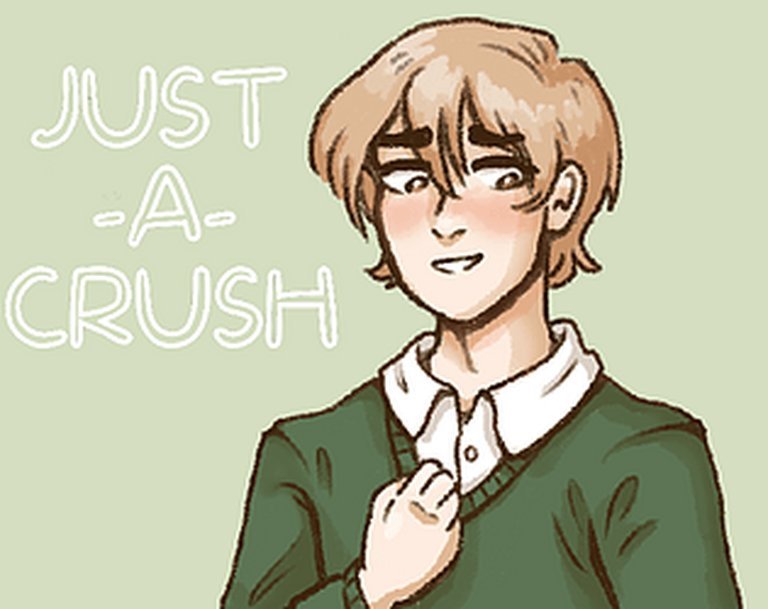
Just-A-Crush is a kinetic visual novel that presents a brief, emotionally intimate Boys’ Love (BL) story. The narrative focuses on Ryan inviting his best friend Elijah over, intending to confess his hidden feelings during a simple hangout, all within a highly constrained format that uses only one sprite, one background, and a 999-word script to emphasize the raw, personal moment of LGBTQ+ romance.
Just-A-Crush Reviews & Reception
gameinformer.com (95/100): Forza Horizon 5 delivers a well-rounded, exciting, and approachable experience, and in doing so, elevates its status to the elite of the racing genre.
Just-A-Crush: Review
Introduction: The Intimacy of Constraint
In the vast and often overwhelming landscape of narrative-driven games, Just-A-Crush stands as a monument to minimalist storytelling—a brief, radiant spark captured in the fleeting moment of a confession. Released in July 2021 by the duo of Foxpancakes (writer/programmer) and Gillian Hughes (credited as Basil, artist), this kinetic visual novel is not a sprawling RPG or a choice-laden epic. It is, in its own words, “a short and sweet BL story” told in exactly 999 words, utilizing a single character sprite, one background, one music track, and one sound effect. Crafted under the intense constraints of the O2A2 (Again!) Jam and the Yaoi Game Jam 2021, Just-A-Crush transcends its jam-game origins to become a poignant, meticulously crafted artifact of queer indie game development. Its legacy is not one of commercial blockbuster status or critical scores (it holds no MobyScore and, as of this writing, has been collected by only one player on MobyGames), but of pure, distilled emotional resonance achieved through formidable creative discipline. This review argues that Just-A-Crush is a masterclass in how severe limitations can elevate thematic focus, proving that profound narrative impact is not a function of scope, but of intentionality and craft.
Development History & Context: The Jam as Crucible
To understand Just-A-Crush, one must first understand the game jam environment from which it emerged. The O2A2 (Again!) Jam imposed a brutalist aesthetic: developers were challenged to “use only one of each asset and tell a story within 1000 words or less in 1 weeks time.” This is not a suggestion; it is a mandate that strips away the customary safety nets of asset libraries, complex branching scripts, and lengthy word counts. Simultaneously, submission to the Yaoi Game Jam 2021 placed it within a specific, vibrant niche of fan and indie creation focused on male-male romance (Boys’ Love / Yaoi), a genre with a long history of grassroots, creator-driven production outside major studios.
The technological constraints were therefore twofold: the Ren’Py engine (version 7.5.0.22052208u), a standard for accessible visual novel creation, and the self-imposed atomic limit of one of everything. This forced a holistic design where every element—a line of dialogue, a musical cue, a single sprite pose—had to bear immense narrative weight. There was no room for filler, for atmospheric tangents, or for visual variety. The development team was tiny even by indie standards: a writer-programmer and an artist, with a proofreader and separate composers for music and SFX. This aligns with a broader trend in the early 2020s of hyper-focused micro-teams leveraging platforms like itch.io for direct distribution, bypassing traditional publishing. The game’s release across Windows, Linux, Macintosh, Browser, and Android (with the Android build added a month later, as per the devlog) exemplifies the cross-platform, low-barrier ethos of the contemporary indie visual novel scene. Just-A-Crush did not exist in a vacuum; it was a direct response to and product of its jam context, a timed experiment in exponential efficiency.
Narrative & Thematic Deep Dive: The Architecture of a Confession
The official ad blurb provides the entire narrative skeleton: “Ryan invites his best friend Elijah over to hang out. He has something important he wants to tell him. Will he have the courage to do so?” This is the entirety of the plot. There is no world-saving, no mystery, no external conflict. The drama is entirely internal and interpersonal, centered on the threshold moment of revealing a same-sex crush within the fraught space of a close friendship.
With only 999 words, the writing by Foxpancakes operates with surgical precision. Every sentence must establish character, build tension, or deliver emotional payoff. The dialogue is the primary vehicle, likely leaning heavily on subtext, hesitant pauses, and the loaded silence between words—the kind of writing where what is unsaid is as important as what is spoken. The characterization of Ryan and Elijah is achieved through tiny, potent exchanges. Ryan’s inner turmoil is the story’s engine; Elijah’s reactions, whether perceptive, oblivious, or reciprocating, form the sole variable. The theme is explicitly queer coming-of-age/coming-out within a platonic-but-potentially-romantic framework. It explores the universal fear of jeopardizing a cherished friendship for the sake of a deeper, riskier love. The narrative’s power derives from its hyper-specificity—this is not “a story about gay crushes” but “this story, about these two people, in this room, at this moment.” Its brevity makes it a vignette, a literary form translated to interactive media. The jam constraint forced a thematic monofocus: there is no room for side plots, character backstories, or thematic digressions. The result is a laser-focused exploration of vulnerability, courage, and the transformative potential of a single, honest conversation.
Gameplay Mechanics & Systems: The Kinetic Novel Paradigm
As a kinetic visual novel, Just-A-Crush has no player choices. The term “kinetic” is critical—it denotes a linear, non-interactive narrative experience where the player progresses through text at their own pace but cannot alter the story’s path. This is the ultimate expression of the visual novel as a digital storybook or interactive film. The gameplay loop is therefore pure reading and pacing: click to advance text, listen to the music, observe the single sprite’s changes (likely shifts in expression or pose), and absorb the scene.
The UI is the standard Ren’Py interface: a text box, a transparent history log, and auto/skip functions. Its simplicity is a feature, not a bug, removing all friction between the player and the narrative. There is no combat, no character progression, no inventory. The only “system” is the reader’s own emotional engagement. This design aligns perfectly with the jam’s ethos: the “game” is the experience of the story itself. Any perceived “flaw” (like the lack of agency) is actually a deliberate aesthetic and narrative choice, committing fully to the power of a pre-determined emotional arc. The innovation lies not in mechanics but in constraint-as-foundation. By eliminating all other gameplay systems, the team ensured every ounce of development energy was funneled into the writing and the minute visual-auditory cues that support it. It argues that in certain contexts, the most radical game design decision is to have none at all, serving only the narrative.
World-Building, Art & Sound: The Economy of Expression
With one background and one sprite, the world-building is achieved through implication and text description. The background, designed by Basil, is not a generic room but a specific, lived-in space that must instantly communicate “a friend’s comfortable hangout spot.” Every detail in that single image—posters, furniture, lighting—becomes a textural clue to the characters’ lives and relationship. The art style, described on itch.io as “cute,” likely employs a soft, expressive aesthetic common in BL/yaoi indie VNs, emphasizing emotional readability over realism. The character sprite is a static image modified for different emotional states (happy, nervous, sad, etc.). This limited palette forces the writer to describe the world beyond the frame, while the artist must imbue a single figure with a wide range of subtle expressiveness. It is a masterclass in suggestive minimalism.
The sound design is famously sparse: one music track by Javier Suárez (Jahzzar) and one sound effect from Rental Sound. The music sets the entire emotional tone—perhaps a gentle, melancholic indie track that swells at the confession. The solitary sound effect (likely a doorbell, a sigh, a rustle) is a punctuation mark, a moment of heightened realism that anchors the scene. This audio economy means the music track cannot be generic; it must carry the entire narrative’s emotional weight from beginning to end. The absence of ambient noise or a dynamic soundtrack paradoxically intensifies the focus, making the few present elements profoundly important. Together, the art and sound create a tonal cohesion that a larger, more varied asset list might fracture. The atmosphere is one of intimate, quiet tension, perfectly calibrated for the story’s beat.
Reception & Legacy: A Cultivation of Quiet Admiration
Just-A-Crush exists in a niche, pre-critical mainstream radar. It has no Metacritic or OpenCritic entry, and its MobyGames page, while present, lacks a MobyScore and has been collected by only one user. Its commercial reception is defined by its freeware status on itch.io, where it has garnered a remarkable 4.6 out of 5 stars from 337 ratings as of this writing. This disparity—absent from aggregator sites but beloved by its direct audience—highlights the * bifurcation in game criticism* between mainstream/AAA coverage and the vibrant, ratings-driven ecosystem of indie platforms like itch.io. The player comments (“Muito bom mesmo,” “YES.,” “i love it,” “Really good.”) are short, effusive, and speak to a satisfied core audience that found exactly what it sought: a “short and sweet BL story.”
Its legacy is therefore not of industry-shaking influence, but of proof-of-concept for constraint. It joins a lineage of jam games that demonstrate how limitations breed creativity. It contributes to the growing canon of queer indie visual novels that prioritize authentic, specific LGBTQ+ narratives often absent from larger productions. The cancelled spin-off devlog (announced in September 2021 for characters Stephen and Mark, a “rivals to lovers” story) hints at the team’s ambition and the community’s appetite for more, but its cancellation also underscores the fragile, passion-project nature of such micro-development. Just-A-Crush’s influence is likely felt most directly by aspiring visual novel developers studying how to tell a complete, moving story with almost nothing. It is a touchstone for the “kinetic novel” subgenre on itch.io, showing that a game can be perfectly whole, deeply affecting, and require less than 30MB of data.
Conclusion: A Masterpiece of the Minimal
Just-A-Crush is not a game for those seeking challenge, exploration, or replayability. It is, instead, a digital haiku—a game that understands its form is the message. By embracing the brutal elegance of the one-asset jam rule, Foxpancakes and Basil created a work where every single element is essential and optimized. The 999-word script is likely without a single redundant phrase; the single background must be perfectly composed; the one song must capture the entire emotional journey. In this, it achieves a rare purity of design.
Its place in video game history is not on a bestseller list, but in the annals of form and subculture. It stands as a shining example of:
1. The jam ethic as a legitimate, rigorous design methodology, not just a prototyping exercise.
2. The kinetic novel as a valid and powerful narrative game genre, where interactivity is redefined as the pacing of consumption.
3. Queer indie game development operating on its own terms, for its own community, with a level of intimate authorial control impossible at larger scales.
4. The profound impact of severe constraint as a creative catalyst, forcing innovation in writing, art direction, and sound design.
For the historian, Just-A-Crush is a primary source document of early-2020s indie VN culture. For the player, it is a perfectly contained emotional experience. It asks for 10-15 minutes of your time and gives back a complete, heartfelt story about the terrifying and beautiful act of revealing your heart. In an industry often obsessed with scale, Just-A-Crush is a vital reminder that mastery can mean saying exactly what you mean, with exactly the right tools, and nothing more. It is, in its own modest way, flawless.