
- Release Year: 2006
- Platforms: OnLive, PlayStation 2, PlayStation 3, Windows, Xbox 360, Xbox
- Publisher: Cenega Poland Sp. z o.o., Eidos Interactive Limited, Mastertronic Games Ltd., Noviy Disk
- Developer: Avalanche Studios AB
- Genre: Action, Driving, Racing
- Perspective: Behind view
- Game Mode: Single-player
- Gameplay: BASE jumping, Driving, Free-roaming, House ownership, Open World, Sandbox, Shooter, Truck racing
- Setting: Jungle, Modern, Tropical Island
- Average Score: 74/100
Description
Just Cause is an open-world action game where you play as Rico Rodriguez, a CIA agent sent to the tropical island of San Esperito to overthrow the corrupt regime of General Salvador Mendoza. The game blends espionage, driving, and shooting mechanics, offering players the freedom to explore the entire island from the start, engage in main missions or side activities, and liberate sectors by battling government forces. Rico’s arsenal includes a variety of weapons, vehicles, and a parachute for high-flying stunts, making for a chaotic and action-packed experience.
Gameplay Videos
Where to Buy Just Cause
Just Cause Free Download
Just Cause Guides & Walkthroughs
Just Cause Reviews & Reception
metacritic.com (83/100): A gaming triumph and a truly next-generational offering – indeed, it’s offering next generation gameplay for PS2 and Xbox owners too, and anyone wanting a taste of where gaming is heading really needs to pick this up now.
ign.com : Just Cause has all of the makings of a great sandbox game. It has a vibrant, open world with a multitude of environments to explore. There are a huge number of side quests to keep you occupied along with a slew of vehicles and weapons to aid you in your quest to see everything and blow it up. The trouble is that the deeper you delve into the game, the more shallow everything gets and the more prevalent the bugs and faults in the game become.
mobygames.com (66/100): You are Rico Rodriguez, a CIA-agent who is sent to the small Island of San Esperito to start a revolution and bring down the current regime under the rule of General Salvador Mendoza.
Just Cause Cheats & Codes
PC
Type during gameplay.
| Code | Effect |
|---|---|
| imhealthy | Unlimited life |
| ammoman | Unlimited ammo |
| spawn (name) | Spawns the specified vehicle (car, boat, plane, etc.) |
PlayStation 2 (CodeBreaker Codes)
Enable Code (Must Be On) first, then use the following codes.
| Code | Effect |
|---|---|
| C61558AD EFB315BB | Infinite Ammo |
| 1A7B760B B58B2184 | Extra Ammo |
| 6371A5E9 A146132C | Max Infinite Ammo |
| 435F7BB3 187594BA | Never Reload |
| E252C8B6 0C470A77 | Never Reload With Max Clip |
| EF6301C4 70366ACE | Infinite Grenades |
| 9F01929E 9AE5B745 | Extra Grenades |
| 1D0E3F8B DCC1A1DF | Max Infinite Grenades |
| 9C414526 7968FCB5 | Max Rioja Cartel Relations |
| 1082E688 B67B39E6 | Max Guerrilla Relations |
| 4110944D 8B4FCD0F 4D68689C 0B4BE45F |
Infinite Health |
PlayStation 2 (Cheat Codes)
Enter the following codes during gameplay.
| Code | Effect |
|---|---|
| [X], [X], [Up], [Up], [Left], [Right], [Left], [Right] | Infinite Health |
| [Up], [Down], [Left], [Right], [Up], [Down], [Up], [Down] | Infinite Health |
| [O], [X], [Down], [Up], [Left], [Right] | Infinite Grenades |
Just Cause: A Flawed but Foundational Open-World Revolution
Introduction: The Birth of a Chaotic Legacy
Just Cause (2006) is a game that defies easy categorization. It is simultaneously a bold pioneer and a cautionary tale—a title that introduced groundbreaking mechanics while stumbling over its own ambition. Developed by Avalanche Studios and published by Eidos Interactive, Just Cause arrived at a pivotal moment in gaming history, when open-world titles were evolving beyond Grand Theft Auto’s shadow. It dared to ask: What if freedom wasn’t just a feature, but the entire point?
The answer was a game that let players skydive onto moving cars, grapple onto helicopters mid-flight, and turn an entire island into a playground of destruction. Yet, for all its spectacle, Just Cause was plagued by repetitive missions, clunky controls, and a narrative as shallow as its Caribbean setting’s turquoise waters. Critics were divided—some hailed it as a breath of fresh air in the open-world genre, while others dismissed it as a buggy, unpolished mess.
This review will dissect Just Cause in exhaustive detail, exploring its development, its mechanics, its world, and its lasting impact. Was it a revolutionary step forward, or a missed opportunity? The truth, as with most things in Just Cause, is explosive, chaotic, and impossible to ignore.
Development History & Context: The Birth of a Sandbox Revolution
Avalanche Studios: The Ambitious Upstarts
Avalanche Studios was founded in 2003 by Christofer Sundberg, Linus Blomberg, and Viktor Blomberg in Stockholm, Sweden. From the outset, the studio aimed to create original IPs with a focus on open-world gameplay and player freedom. Just Cause was their debut title, and it was clear from early pitches that they wanted to push boundaries.
The game’s development began in earnest in 2004, with Avalanche securing a publishing deal with Eidos Interactive. The studio’s vision was simple yet audacious: What if a game didn’t just let you explore an open world, but actively encouraged you to break it? This philosophy would become the cornerstone of the Just Cause series.
Technological Constraints and Innovations
Just Cause was developed during a transitional period in gaming. The PlayStation 2 and original Xbox were still dominant, but the Xbox 360 was on the horizon. Avalanche’s proprietary Avalanche Engine was designed to handle massive open worlds with minimal loading, a rarity at the time.
Key innovations included:
– The Grappling Hook: A tool that allowed Rico to latch onto vehicles, buildings, and even enemies, enabling unprecedented mobility.
– Seamless Traversal: Players could skydive, parachute, swim, and hijack vehicles without loading screens.
– Dynamic Destruction: While not as advanced as later entries, Just Cause allowed players to blow up buildings, vehicles, and military installations with satisfying chaos.
However, these innovations came at a cost. The engine struggled with AI pathfinding, physics glitches, and performance issues, particularly on the PlayStation 2. The Xbox 360 version, developed in just six months, fared better but still suffered from occasional bugs.
The Gaming Landscape in 2006
Just Cause arrived in a crowded field. Grand Theft Auto: San Andreas (2004) had set the standard for open-world games, while The Elder Scrolls IV: Oblivion (2006) redefined RPG freedom. Just Cause carved its own niche by focusing on pure, unadulterated chaos—a sandbox where the goal wasn’t just to complete missions, but to cause as much destruction as possible.
Yet, it faced stiff competition:
– Saints Row (2006) offered a more polished, humorous take on open-world crime.
– Mercenaries: Playground of Destruction (2005) had already explored large-scale military sandbox gameplay.
– Far Cry (2004) and Battlefield 2 (2005) set high bars for shooter mechanics.
Just Cause didn’t just compete with these games—it differentiated itself by embracing absurdity. Where GTA was about crime and Oblivion was about fantasy, Just Cause was about being a one-man army of chaos.
Narrative & Thematic Deep Dive: A Revolution Without Depth
Plot Summary: Rico’s One-Man Coup
Just Cause follows Rico Rodriguez, a CIA operative (or, more accurately, an agent of the shadowy “Agency”) sent to the fictional Caribbean island of San Esperito to overthrow the dictator Salvador Mendoza. The Agency suspects Mendoza of possessing weapons of mass destruction, and Rico is tasked with destabilizing his regime by any means necessary.
The story unfolds in a series of 21 main missions, interspersed with side missions that involve liberating villages, racing, and dismantling drug cartels. Rico allies with guerrilla factions and the Rioja Cartel, all while battling Mendoza’s military forces and the rival Montano Cartel.
The climax sees Rico skydiving onto Mendoza’s private jet, killing the dictator in a dramatic mid-air showdown. The game ends with the Agency securing the WMDs and Rico’s mission complete—but the island’s future remains uncertain.
Themes: Freedom, Chaos, and the Cost of Revolution
Just Cause is, at its core, a power fantasy. It’s about:
1. The Illusion of Freedom: Rico is a tool of the Agency, yet the game frames his actions as heroic. The narrative never questions whether his intervention is justified—it’s assumed that overthrowing Mendoza is a “just cause.”
2. Chaos as a Weapon: The game glorifies destruction, framing it as a means to liberation. Blowing up military bases, hijacking tanks, and causing mayhem are all part of the “revolution.”
3. The Banality of Evil: Mendoza is a cartoonish villain—greedy, corrupt, and cowardly. The game doesn’t explore the complexities of dictatorship; it reduces it to a target for Rico’s arsenal.
Characters: Archetypes Without Depth
- Rico Rodriguez: A silent protagonist with no backstory. He’s a cipher—a vessel for the player’s chaos.
- Salvador Mendoza: A clichéd Latin American dictator, complete with sunglasses and a private jet. He’s more of a symbol than a character.
- Maria Kane: Rico’s handler, providing mission briefings via radio. She’s efficient but lacks personality.
- Tom Sheldon: Rico’s mentor, who disappears early in the game, leaving Rico to fend for himself.
The dialogue is stiff, the voice acting is uneven, and the cutscenes are laughably bad. The game doesn’t take itself seriously—which is fine, given its over-the-top premise—but it also doesn’t give players any reason to care about its world.
The Problem with the Story
Just Cause’s narrative is functional at best, forgettable at worst. It exists solely to justify the gameplay, offering little in the way of emotional stakes or meaningful choices. The factions (guerrillas, cartels, military) are interchangeable, and the missions repeat ad nauseam.
This isn’t necessarily a flaw—Just Cause was never meant to be a storytelling masterpiece. But it does highlight the game’s biggest weakness: it’s all style over substance.
Gameplay Mechanics & Systems: Chaos by Design
Core Gameplay Loop: Destroy, Liberate, Repeat
Just Cause’s gameplay revolves around three pillars:
1. Destruction: Blow up military outposts, hijack vehicles, and cause mayhem.
2. Liberation: Free villages from government control to gain faction support.
3. Exploration: Traverse the island by car, boat, plane, or parachute.
The game’s open-world design is its greatest strength. From the moment Rico lands on San Esperito, the entire island is open for exploration. There are no locked areas, no artificial barriers—just 250,000 acres of chaos waiting to happen.
Combat: Auto-Aim and Invincibility
Combat in Just Cause is simple, arcady, and forgiving:
– Auto-aim ensures that shooting is easy, even from moving vehicles.
– Rico is nearly invincible—enemies rarely pose a real threat unless they hit him with a car.
– Weapons are plentiful, with pistols, rifles, rocket launchers, and grenades all available.
The lack of challenge is both a blessing and a curse. On one hand, it makes the game accessible and fun. On the other, it removes any sense of tension—combat becomes a mindless exercise in pulling the trigger.
Vehicles: A Mixed Bag of Fun and Frustration
Just Cause features over 89 vehicles, including:
– Cars (sports cars, jeeps, trucks)
– Boats (speedboats, fishing boats)
– Planes & Helicopters (fighter jets, attack choppers)
– Motorcycles & Bikes
The Good:
– Hijacking vehicles is satisfying, especially when grappling onto a moving helicopter.
– The physics are chaotic, leading to hilarious crashes and explosions.
The Bad:
– Controls are inconsistent—cars handle like soapboxes, boats are sluggish, and planes are finicky.
– AI drivers are terrible, often crashing into walls or getting stuck.
The Grappling Hook: A Game-Changer
The grappling hook is Just Cause’s defining feature. It allows Rico to:
– Latch onto vehicles and hijack them mid-movement.
– Tether enemies to objects (or each other).
– Swing across gaps like a superhero.
– Parasail behind moving cars for high-speed traversal.
It’s innovative, fun, and essential to the game’s identity. Without it, Just Cause would be just another GTA clone.
Mission Structure: Repetition and Grind
The game’s main missions are linear and scripted, but the side missions are where the grind sets in:
– Liberation Missions: Clear out military bases to free villages. Repetitive but necessary for faction support.
– Races: Timed challenges that test driving skills. Fun but shallow.
– Collection Missions: Gather scattered items for upgrades. Tedious.
The biggest flaw is that side missions feel like chores. There’s little variety, and the rewards (better weapons, faction support) aren’t compelling enough to justify the grind.
The “Heat” System: A Flawed Wanted Mechanic
Just Cause borrows GTA’s wanted system but makes it worse:
– Cops never stop chasing you, even after your “heat” level drops.
– Helicopters spawn endlessly, making evasion frustrating.
– There’s no way to lose the cops permanently—they’ll always find you.
This breaks immersion and makes free-roaming more annoying than fun.
UI and Controls: A Mess of Inputs
The controls are overly complex, with different buttons for:
– Walking, driving, swimming, flying, grappling, parachuting…
– No unified control scheme, leading to constant menu-diving to rebind keys.
The UI is clunky, with blurry textures, small text, and poor feedback. The map is hard to navigate, and mission objectives are often unclear.
World-Building, Art & Sound: A Tropical Paradise of Chaos
San Esperito: A Beautiful but Empty Sandbox
San Esperito is visually impressive for 2006:
– Diverse biomes: jungles, beaches, mountains, cities.
– Dynamic weather: rain, storms, and sunny skies.
– Day-night cycle: affects visibility and enemy behavior.
The Good:
– The world feels alive—civilians drive around, soldiers patrol, and wildlife roams.
– The scale is impressive—250,000 acres is huge for its time.
The Bad:
– The world is empty—most buildings are non-interactive, and NPCs are braindead.
– Repetitive assets—many towns look identical, with the same buildings copied and pasted.
– Performance issues—pop-in, frame drops, and glitches are common, especially on PS2.
Art Direction: A Che Guevara Fantasy
The game’s aesthetic is a mix of:
– Tropical paradise (palm trees, beaches, sunsets).
– Military dictatorship (forts, checkpoints, propaganda).
– Action-movie spectacle (explosions, car chases, helicopter battles).
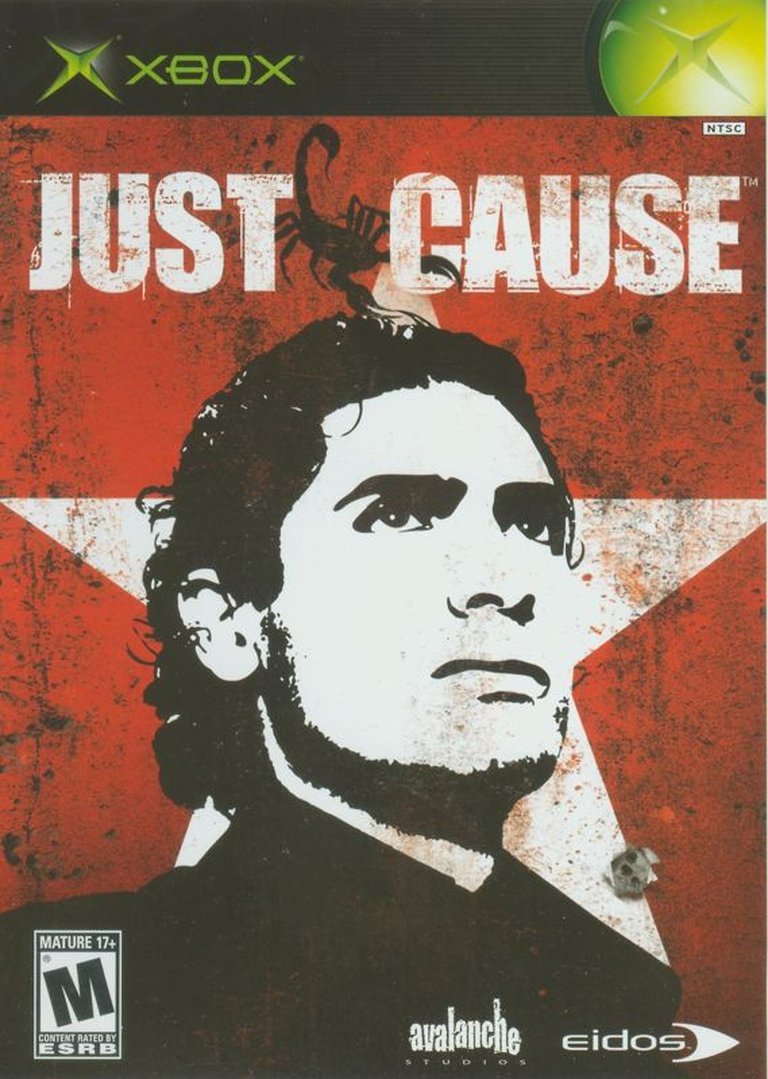
The box art (a Che Guevara-inspired Rico) sets the tone—a revolutionary power fantasy with a Hollywood sheen.
Sound Design: Guns, Engines, and Bad Voice Acting
- Gunfire and explosions sound punchy, adding to the chaos.
- Vehicle engines are satisfying, especially when hijacking a plane.
- The soundtrack is forgettable—generic action music that fades into the background.
The voice acting is terrible:
– Rico sounds like a bad Antonio Banderas impression.
– Mendoza is a cartoon villain, complete with over-the-top dialogue.
– Side characters are wooden and unmemorable.
Reception & Legacy: A Flawed Classic
Critical Reception: Mixed but Memorable
Just Cause received mixed reviews upon release:
– Metacritic Scores:
– PC: 72/100
– Xbox 360: 73/100
– PS2: 60/100
Praise:
– Innovative grappling hook mechanics.
– Huge, open world with freedom to explore.
– Fun, chaotic gameplay.
Criticism:
– Repetitive missions.
– Clunky controls and AI.
– Shallow story and characters.
Player Reception:
– MobyGames User Score: 2.8/5 (based on 62 ratings).
– Many players loved the freedom but hated the grind.
Commercial Performance: A Million Copies Sold
Just Cause sold over 1 million copies by 2009, a respectable but not stellar performance. It was overshadowed by GTA and Saints Row, but it proved there was an audience for chaotic open-world games.
Legacy: The Birth of a Franchise
Just Cause’s true legacy is what it started:
– Just Cause 2 (2010) refined the formula, adding better physics, a bigger world, and improved missions.
– Just Cause 3 (2015) introduced the wingsuit, taking chaos to new heights.
– Just Cause 4 (2018) expanded the sandbox with dynamic weather and even more destruction.
The series has sold over 26 million copies worldwide, proving that Just Cause’s core idea—a sandbox of pure chaos—was ahead of its time.
Influence on Gaming
Just Cause helped popularize:
– Open-world destruction as a gameplay pillar.
– Grappling hooks and parachutes as traversal tools.
– The idea that “fun” can outweigh “polish.”
It also inspired other games, like:
– Mercenaries (already out, but Just Cause refined the formula).
– Mad Max (2015, also by Avalanche Studios).
– Far Cry’s later entries (which embraced chaos).
Conclusion: A Flawed but Essential Experiment
Just Cause is not a great game—but it is an important one.
The Good:
✅ Innovative grappling hook mechanics that redefined open-world traversal.
✅ A massive, open world that encouraged experimentation.
✅ Pure, unadulterated chaos—a game that let players be the hero of their own action movie.
The Bad:
❌ Repetitive, grindy missions that felt like chores.
❌ Clunky controls, bad AI, and technical issues.
❌ A forgettable story and characters that added nothing to the experience.
The Verdict:
Just Cause is a flawed but foundational entry in gaming history. It didn’t get everything right, but it dared to be different—and in doing so, it paved the way for a franchise that would define chaotic open-world gameplay.
Final Score: 7/10 – A Revolutionary Mess
Just Cause isn’t a game you play for its story or its polish. You play it to skydive onto a moving truck, grapple onto a helicopter, and blow up an entire military base just because you can. And for that alone, it deserves its place in gaming history.
Would I recommend it today?
– For historians and fans of the series? Absolutely.
– For modern gamers looking for a polished experience? Probably not—Just Cause 2 or 3 are better starting points.
– For anyone who loves pure, unfiltered chaos? Hell yes.
Just Cause is a game that didn’t just break the rules—it burned them to the ground and laughed while doing it. And sometimes, that’s all you need.