
- Release Year: 2015
- Platforms: PlayStation 4, Windows, Xbox One
- Publisher: Square Enix Co., Ltd., Square Enix, Inc.
- Developer: Avalanche Studios AB
- Genre: Action, Driving, Free-roaming, Open World, Sandbox
- Perspective: Third-person
- Game Mode: Single-player
- Gameplay: BASE jumping, Destruction, Grappling hook, Open World, Shooter, Vehicular, Wingsuit
- Setting: Island, Mediterranean
- Average Score: 75/100
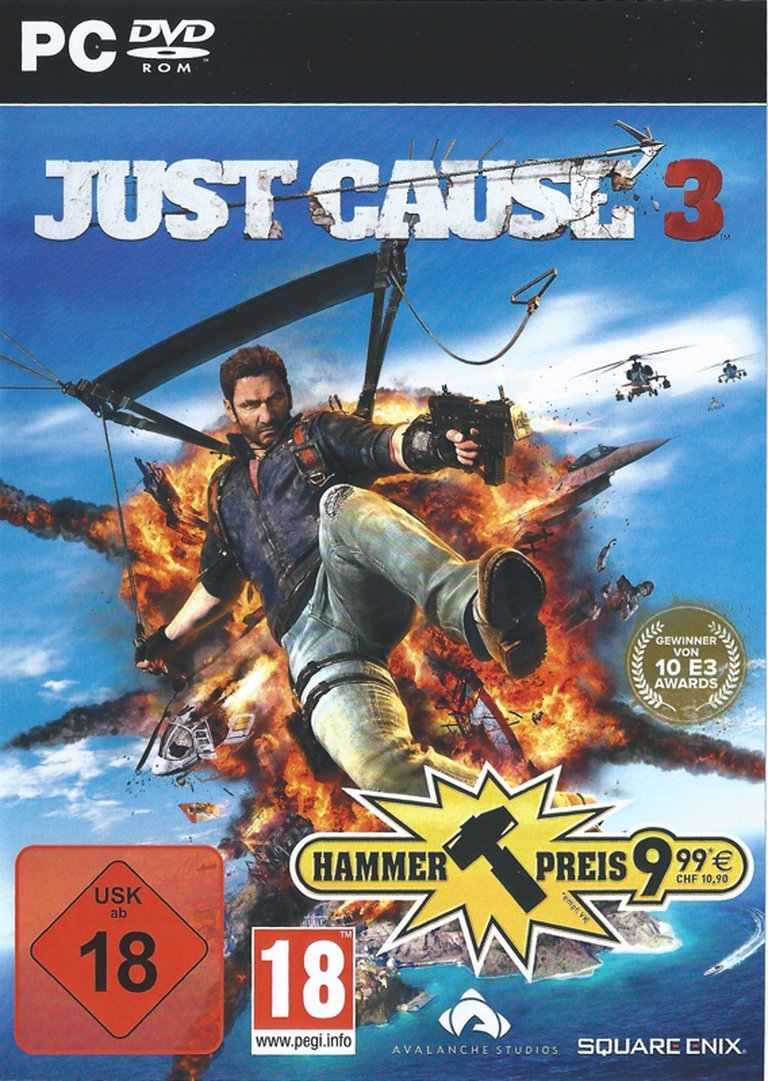
Description
Just Cause 3 is an open-world action-adventure game starring the returning protagonist Rico Rodriguez as he battles to overthrow the ruthless dictator General Sebastiano Di Ravello on the fictional Mediterranean archipelago of Medici. Set six years after the previous installment, Rico allies with a rebellion led by scientist Dimah al-Masri and his childhood friend Mario Frigo to thwart Di Ravello’s global domination plans. Players engage in over-the-top destruction, liberate settlements by completing challenges like capturing command centers and disabling propaganda, and utilize a vast arsenal including vehicles, grappling hooks, wingsuits, and infinite C4 to cause chaos across the island.
Gameplay Videos
Where to Buy Just Cause 3
PC
Just Cause 3 Free Download
Just Cause 3 Cracks & Fixes
Just Cause 3 Mods
Just Cause 3 Reviews & Reception
metacritic.com (79/100): This isn’t the best open-world game, but it’s a blast.
ign.com : A wide-open playground primed for explosive action.
imdb.com (80/100): One of the most repetitive but at the same time fun games i’ve played in a while.
opencritic.com (67/100): The explosions are amazing, and it’s fun in short bursts, but Just Cause 3 is ultimately an unremarkable, shallow experience.
pcgamer.com : The explosions are amazing, and its fun in short bursts, but Just Cause 3 is ultimately an unremarkable, shallow experience.
Just Cause 3 Cheats & Codes
PC
Go to coordinates N 40 42.235, E 5 35.125 in north Porto Darsena. Press the buttons in order (from left to right): 1, 4, 3, 4, 2, 1 to open a wormhole.
| Code | Effect |
|---|---|
| 1, 4, 3, 4, 2, 1 | Warp through a wormhole to the other side of the map. |
PlayStation 4
Go to coordinates N 40 42.235, E 5 35.125 in north Porto Darsena. Press the buttons in order (from left to right): 1, 4, 3, 4, 2, 1 to open a wormhole.
| Code | Effect |
|---|---|
| 1, 4, 3, 4, 2, 1 | Warp through a wormhole to the other side of the map. |
Xbox One
Go to coordinates N 40 42.235, E 5 35.125 in north Porto Darsena. Press the buttons in order (from left to right): 1, 4, 3, 4, 2, 1 to open a wormhole.
| Code | Effect |
|---|---|
| 1, 4, 3, 4, 2, 1 | Warp through a wormhole to the other side of the map. |
Just Cause 3: Review
Introduction
Just Cause 3 arrives not merely as a sequel, but as a chaotic symphony of destruction and unbridled freedom. Set six years after the events of Just Cause 2, this third installment propels Rico Rodriguez back to his Mediterranean homeland, Medici, now under the iron fist of the flamboyantly tyrannical General Sebastiano Di Ravello. The game positions itself as the ultimate playground for mayhem, promising a world where physics are suggestions and explosions are punctuation. While Avalanche Studios succeeds in crafting a breathtaking, hyper-kinetic sandbox that redefines the boundaries of open-world chaos, Just Cause 3 stumbles under the weight of a perfunctory narrative and persistent technical hurdles. This review posits that Just Cause 3 is a masterclass in physics-based anarchy and traversal, hampered by a story that fails to match the spectacle of its gameplay and performance issues that occasionally fracture the illusion of total freedom.
Development History & Context
The development of Just Cause 3, helmed by Avalanche Studios (specifically their New York satellite studio, while the Swedish branch focused on Mad Max), began in 2012. The core vision, as articulated by CEO Christofer Sundberg, was to refine the series’ signature “joy and humor,” aiming for a tone “70 percent wacky and 30 percent serious.” This balanced approach sought to elevate the series beyond its cartoonish roots while retaining its core identity. Avalanche drew inspiration from the vibrant modding community of Just Cause 2, particularly the creative use of the grappling hook and destruction, which directly influenced the “mods” upgrade system in Just Cause 3.
Technologically, the game utilized the Apex engine and middleware like Scaleform GFx and Havok Physics. Avalanche invested heavily in research, sending teams to the Mediterranean (including Costa Rica for foliage and fauna reference) to capture the landscape’s essence, aiming for a setting inspired by Monaco and southern Europe that felt “an untapped resource.” The world size was comparable to Just Cause 2 (1,000 km² or 400 sq mi), but Avalanche promised greater density and verticality through improved volumetric terrain, enabling exploration of caverns and more realistic building scaling. The controls received a significant overhaul, with input from Criterion Games (of Burnout fame) refining the vehicle handling to feel more responsive and impactful.
Crucially, the development prioritized destruction and player agency. Avalanche considered destruction a “key element in creating a cinematic experience,” leveraging advancements in technology for larger-scale, more dynamic explosions. The asynchronous multiplayer challenges and leaderboards from Just Cause 2‘s popular mod were initially retained as the core multiplayer element (co-op/competitive multiplayer was delayed, later addressed by community mods), as the studio focused resources on crafting a dense, reactive world. The setting of Medici, a fictional Mediterranean dictatorship, was chosen to explore themes of oppression and freedom, visually represented by a color scheme of “grey, yellow, and red” to convey Di Ravello’s regime, contrasting with the rebellion’s “blue, white, and orange.”
Narrative & Thematic Deep Dive
The narrative of Just Cause 3 is a classic liberation story, elevated slightly by its personal connection to Rico. Returning to Medici, Rico joins an underground rebellion led by his childhood friend, Mario Frigo, and aided by the brilliant scientist Dimah al-Masri. Their enemy is General Sebastiano Di Ravello, a cackling, pyromaniacal dictator obsessed with global domination, powered by the discovery of “Bavarium,” a rare, volatile mineral unique to Medici. Di Ravello, a “Generalissimo” dressed in white Bling of War, is portrayed as a larger-than-life villain whose actions—from forcing a subordinate to commit suicide to ordering the burning of villages—establish him as a genuinely unhinged tyrant.
The plot follows a familiar pattern: Rico must sabotage Di Ravello’s Bavarium operations, liberate provinces by destroying military bases and propaganda, and uncover a mole within the rebellion. The narrative introduces intriguing elements: Rico’s past connection to the Agency and his fractured relationship with Sheldon (voiced by the excellent Steven Van Zandt, though David Tennant steals the show as the increasingly unhinged, captured propaganda minister), the tragic backstory involving Rico’s family, and the mystery of the Black Hand mercenary group. However, execution is the narrative’s weakest point. Story missions are often repetitive variations of “destroy this base,” “rescue this person,” or “escort this convoy.” Character development is thin; Dimah and Annika (the smuggler Action Girl) remain underutilized, and Mario’s bombastic personality can grate. The dialogue is peppered with Rico’s trademark quips (“Try to transport fuel now, you pipeline jerks!” becomes an achievement), but the overarching story lacks gravitas or emotional depth. It serves primarily as a justification for escalating chaos, never quite achieving the potential suggested by its personal stakes and intriguing antagonists. Thematic exploration of freedom vs. oppression is present but surface-level, buried under explosions.
Gameplay Mechanics & Systems
Just Cause 3 is defined by its triumvirate of traversal tools: the grappling hook, wingsuit, and parachute. This combination allows for unprecedented mobility across Medici’s varied terrain. The grappling hook is the star, enabling players to tether any two objects or people together, creating chain reactions of destruction or creative physics puzzles. Its upgrades (unlocked via “mods” earned through challenges) increase the number of simultaneous tethers and allow for more precise reeling, turning Rico into a human wrecking ball or a slingshot for vehicles and enemies. The wingsuit, a permanent addition, facilitates high-speed gliding, seamlessly integrated with the parachute for vertical movement. Mastering the flow between wingsuit, grapple, and parachute is incredibly satisfying, turning simple traversal into exhilarating aerial ballets.
Destruction is the core gameplay loop. Almost every structure, vehicle, and piece of propaganda can be obliterated. The physics engine (Havok) is programmed for spectacular, chain-reacting explosions, rewarding players who set up elaborate domino effects. Infinite sticky bombs (GE-64) replace the limited C4 of Just Cause 2, constantly available (though capped at 3-5 at a time without upgrades), encouraging creative placement. The “Rebel Drop” system replaces the Black Market, allowing players to call in airdrops of weapons, vehicles, or equipment for free (though enemy AI scales up if you use powerful vehicles), eliminating the need for currency and ensuring players always have access to the tools for mayhem.
The progression system revolves around liberating settlements and provinces. To free a settlement, players must destroy command centers (military bases) and complete secondary objectives like disabling propaganda broadcasts or taking over police stations. Liberated areas become fast-travel points. The world is densely packed with “Chaos Objects” (propaganda items) and “Challenges” (wingsuit races, destruction frenzies, weapon challenges), which offer leaderboard rankings and unlock crucial “mods” (upgrades). While the core liberation loop can become repetitive, the sheer variety of vehicles (cool cars, helicopters, jets, boats, tanks), weapons (from assault rifles to rocket launchers to the devastating UVK-13 RPG), and the constant lure of the next explosive objective provide ample motivation. The AI adapts to player tactics – entering a base in a tank triggers RPG-wielding enemies – adding a layer of unpredictable challenge. However, the lack of faction-specific side missions (replaced by random encounters) and a shorter campaign than Just Cause 2 are noticeable drawbacks. Technical issues, particularly performance dips on consoles and occasional physics glitches at launch, marred the experience.
World-Building, Art & Sound
Medici, the fictional Mediterranean island nation, is Just Cause 3’s greatest triumph. Avalanche Studios meticulously crafted a visually stunning world inspired by real Mediterranean locales. The research trip to Costa Rica and the Mediterranean is evident in the lush, detailed foliage, the crashing waves, and the varied landscapes – arid plains, rugged cliffs, dense forests, and quaint coastal towns. The world is composed of five distinct biomes, each with unique landmarks, from the bustling capital Citate Di Ravello (a monument to Di Ravello’s ego) to the vineyard-covered hills. The art direction brilliantly uses color to represent the conflict: Di Ravello’s oppressive regime is dominated by oppressive greys, stark yellows, and blood reds, starkly contrasting with the vibrant blues, whites, and oranges of the rebellion. This visual language extends to graffiti and rebel aesthetics.
The sound design complements the visuals perfectly. Henry Jackman’s score provides an energetic, orchestral backdrop that shifts between heroic action and playful chaos. The environmental sounds – the whine of a wingsuit, the roar of an explosion, the ambient chatter of towns – are immersive. The voice acting is a mixed bag. Rico (voiced by Terry Crews in some marketing, though in-game the performance is more generic) delivers his lines with appropriate bombast. David Tennant as the captured propaganda minister is a standout, his initial calm professionalism gradually giving way to panicked hysteria as his lies crumble. General Di Ravello, however, leans heavily into cartoonish villainy, lacking the subtle menace that could have made him truly memorable. The occasional witty line (“Black Hand, meet Sparky!”) and the sheer joy of causing mayhem create a soundscape that is often as entertaining as the visuals.
Reception & Legacy
Upon its December 2015 release, Just Cause 3 received a generally positive, though mixed, critical reception. Aggregated scores on Metacritic sit at “Mixed or Average”: 74/100 for PC, 73/100 for PS4, and 71/100 for Xbox One. Critics universally praised the game’s core strengths: the incredible freedom of movement (wingsuit/grapple/parachute), the spectacular destruction physics, the sheer variety of vehicles and weapons, and the joyous, chaotic creativity it fostered. Publications like CGMagazine, DVDfever, and Electronic Gaming Monthly awarded it near-perfect scores, hailing it as a “joy to play” and a “candidate for game of the year,” highlighting the unparalleled freedom and fun.
However, significant criticisms emerged. The narrative was frequently called clichéd, uninspired, and lacking depth compared to the gameplay spectacle. Technical performance, especially on console versions, was a major complaint, with frame rate drops and instability impacting the experience. The repetitive nature of the liberation loop and the lack of meaningful faction missions beyond base destruction were also noted. PC Gamer (67%) and Jimquisition (65%) were among the more critical voices, feeling the game lacked substance beyond its explosions. Player reviews on platforms like Metacritic (User Score: 6.3/10) reflected this divide, many praising the fun while lamenting the technical issues and shallow story.
Commercially, the game performed well, selling over 7 million units by May 2019, solidifying the series’ popularity. Its legacy is complex. It refined the series’ signature chaos to an apex of technical spectacle and player agency, becoming a benchmark for physics-based mayhem. The introduction of the wingsuit and the refined grappling hook are now integral to the series identity. However, it also cemented the series’ reputation for prioritizing explosive spectacle over narrative depth or technical polish. The persistent technical issues and the underwhelming story became common talking points when discussing its shortcomings. The success of the multiplayer mod (released in 2017, developed by Nanos GbR) demonstrated the community’s desire for cooperative mayhem, a desire Avalanche later addressed in Just Cause 4. While it didn’t revolutionize open-world gaming like Just Cause 2 did, it defined the peak of a specific type of joyful, destructive sandbox experience and remains a beloved, if flawed, entry for fans of pure, unadulterated chaos.
Conclusion
Just Cause 3 stands as a testament to Avalanche Studios’ mastery of physics-based chaos and open-world freedom. It delivers on the promise of a playground where the only limit is the player’s imagination, offering unparalleled traversal through the wingsuit, grappling hook, and parachute, combined with spectacular, chain-reacting destruction and a mind-boggling arsenal of vehicles and weapons. The Mediterranean island of Medici is a visual triumph, meticulously crafted and beautifully contrasting the oppressive grays of the regime with the vibrant colors of rebellion.
However, this spectacular achievement is tempered by significant flaws. The narrative, while providing a plausible backdrop for the mayhem, is thin, repetitive, and fails to engage on the level of the gameplay. The liberation loop, initially exciting, can become monotonous. Most critically, the game was launched with notable technical performance issues, particularly on consoles, which hampered the otherwise fluid experience for many players.
Ultimately, Just Cause 3‘s place in gaming history is secure as the pinnacle of the series’ chaotic identity. It is a game that prioritizes joyous, explosive freedom over narrative depth or technical perfection. It won’t be remembered for its story or its launch polish, but for the moments of unbridled creativity it fostered – the insane stunts, the glorious chains of destruction, the sheer, unadulterated fun of being Rico Rodriguez in a world that bends to your will. It is a flawed masterpiece of mayhem, essential for anyone seeking the purest, most cathartic expression of open-world destruction, and a landmark title in the genre of physics-based sandbox action.