
- Release Year: 2015
- Platforms: PlayStation 4, Windows, Xbox One
- Publisher: Square Enix Co., Ltd.
- Genre: Compilation
- Game Mode: Single-player
- Average Score: 74/100
Description
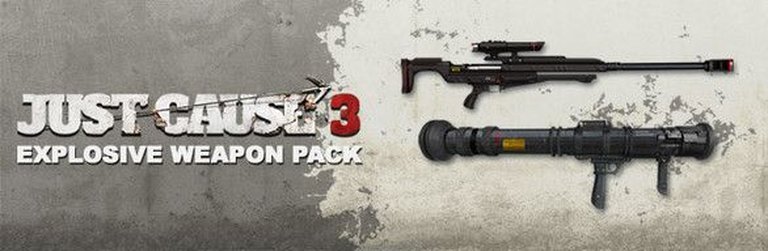
Just Cause 3: Explosive Weapon Pack is downloadable content for the 2015 action-adventure game set in the fictional Mediterranean island of Medici, where protagonist Rico Rodriguez battles to liberate the island from a dictator. This DLC bundle enhances the open-world chaos by adding two powerful explosive weapons—the Capstone Bloodhound RPG and the Final Argument Sniper Rifle—allowing players to intensify their destruction and tactical gameplay in the sweeping, vertically diverse landscapes of Medici.
Gameplay Videos
Just Cause 3: Explosive Weapon Pack Reviews & Reception
ign.com : A wide-open playground primed for explosive action.
metacritic.com (74/100): Just Cause 3 stands for freedom and fun.
Just Cause 3: Explosive Weapon Pack Cheats & Codes
PC
To activate cheats, pause the game, go to the “Extras” menu, and select “Cheats.”
| Code | Effect |
|---|---|
| imnotafraidofghosts | Becomes invulnerable to damage. |
| abracadabra | Never run out of bullets or explosives. |
| baublesofgold | Have an endless supply of grenades and other explosives. |
| explosiveperson | Carry an unlimited number of C4 explosives. |
| sheldon | Access all weapons and gadgets in the game. |
| speedfreak | Vehicles have unlimited nitrous boost. |
| dayoff | Immediately unlock all vehicles and weapons through Rebel Drops. |
| upupandaway | Reduces the cooldown time for Rebel Drops. |
| tether | Grappling hook’s tether strength becomes unlimited. |
| bavariumwingsuit | Provides a jetpack with sustained flight and unlimited rockets for the Bavarium Wingsuit. |
| holygrenade | Gives Rico a rocket launcher. |
| idkfa | Bullets from firearms become explosive. |
| airmoreammo | Vehicles with missile launchers have unlimited missiles. |
| homesick | Unlock the ability to fast travel to any location on the map. |
| evilways | Increase heat level with the authorities. |
| losemytail | Lower heat level and evade the authorities. |
| donttreadonme | Prevent heat level from rising. |
| wingsuit | Reset the cooldown timer for the winch instantly. |
| unlockallchallenges | Access all challenges in the game. |
Just Cause 3: Explosive Weapon Pack: Review
Introduction: The Philosophy of a Single Click
In the sprawling, anarchic sandbox of Just Cause 3, where the very landscape is a canvas for controlled demolition, the addition of two new tools seems almost quaint. The Explosive Weapon Pack is not a narrative expansion, a new region, or a game-changing mechanic. It is, by its most basic definition, a compilation: a digital bundle containing the previously released Capstone Bloodhound RPG and Final Argument Sniper Rifle. Yet, to dismiss it as mere inventory padding is to miss its profound significance as a cultural artifact. This DLC is the purest expression of a specific era in video game monetization—the micro-DLC, the weapon pack, the answer to a player’s whispered desire for “one more cool gun.” It represents a moment where the sublime chaos of Avalanche Studios’ Mediterranean playground was packaged, priced, and sold in discrete, explosive increments. This review will dissect the Explosive Weapon Pack not on the merits of its two items alone, but as a lens through which to understand the design ethos, commercial pressures, and player relationships that defined the mid-2010s AAA live-service landscape. Its thesis is this: the pack’s true value lies not in its ballistic performance, but in its stark illumination of the gap between player fantasy and practical design, between the promise of “more” and the reality of “enough.”
Development History & Context: The Era of the A La Carte Arsenal
To understand the Explosive Weapon Pack, one must first situate it within the tumultuous development and release of Just Cause 3 itself. The game was the product of Avalanche Studios’ New York satellite office, led by director Roland Lesterlin, while the main Stockholm studio concurrently developed Mad Max. This split focus, hinted at in early interviews, may have contributed to the base game’s simultaneously brilliant and janky character. The studio’s vision, as articulated by CEO Christofer Sundberg, was a “70 percent wacky and 30 percent serious” tone—a deliberate recalibration from the more straightforward parody of Just Cause 2. The world of Medici was to be a “denser” playground, inspired by Mediterranean photography books and a desire to portray oppression through a grey, yellow, and red color scheme, in opposition to the rebellion’s vibrant blue, white, and orange.
Technologically, the move to eighth-generation consoles (PS4, Xbox One) and more powerful PCs allowed for “volumetric terrain,” enabling greater verticality with caves and climbable buildings. The destruction physics, inspired by the Red Faction series and the modding community of Just Cause 2, were a core pillar. However, the ambition to create a seamless, fully destructible world ran into the hard constraints of performance, leading to the infamous long load times and frame rate issues that plagued console versions at launch, as noted by IGN’s Dan Stapleton.
The Explosive Weapon Pack emerged from this context not as a grand design pillar, but as a piece of the post-launch support ecosystem. Pre-release rumors of microtransactions, fueled by leaked screenshots showing a “Black Market” with real-money options, were firmly denied by Sundberg. Just Cause 3 would be a full-price game without in-game purchases. Yet, the studio’s promise to support the game “for many years to come” meant DLC was inevitable. The weapon pack, alongside vehicle packs and larger story-driven expansions like Sky Fortress, Mech Land Assault, and Bavarium Sea Heist, formed a multi-tiered monetization strategy. It was the entry point: cheap, immediately comprehensible, and aimed at the player whose primary joy derived from the tactile feedback of a new explosion. Released in January 2016, just a month after the base game, it existed in the liminal space between launch hype and the long tail of expansion pass content.
Narrative & Thematic Deep Dive: Arms Without a Story
Narrative is the one domain where the Explosive Weapon Pack is utterly, intentionally vacant. It provides no new story missions, no character arcs, no lore entries. Its weapons—the Capstone Bloodhound RPG and the Final Argument Sniper Rifle—exist in a thematic vacuum, their origin stories confined to theiritem descriptions in the unlock menu. However, their very existence and presentation within Just Cause 3‘s framework speak volumes about the game’s underlying philosophy of player agency and the “cool factor” as a primary narrative driver.
The base game’s story, a serviceable if clichéd tale of Rico Rodriguez liberating his homeland of Medici from the flamboyantly evil General Di Ravello, is framed by a tone of self-aware, punkish rebellion. Di Ravello’s obsession with fire and his grandiose, oppressive aesthetic (red, yellow, grey) create a world begging to be blown apart. Rico, reimagined as a less-stylized, more relatable figure in casual clothes, is the agent of cathartic destruction. The weapon pack’s items are pure instruments of this catharsis. The Capstone Bloodhound RPG is not a military-issue rocket launcher; its design is sleek, almost futuristic, fitting the game’s fictional “Bavarium” technology. It is a tool of precision demolition, allowing the player to select a specific chaos object—a radar array, a fuel depot, a Di Ravello statue—and erase it with a single, guided projectile. Its thematic role is to empower the player’s desire for targeted, cinematic destruction, complementing the base game’s more indiscriminate GE-64 sticky bombs.
The Final Argument Sniper Rifle, conversely, caters to a different fantasy: the lone, calculating specialist. Its name implies finality and debate-ending power. In a game where most combat is chaotic and close-quarters, it offers a tool for surgical strikes from extreme range, for dismantling a base’s defenses before the main assault. It extends the player’s reach, both literally and metaphorically, reinforcing Rico’s status as a “Living Legend” who can operate on any scale.
These weapons do not comment on the story; they are story-agnostic power fantasies. Their lack of narrative integration—no special mission to acquire them, no unique dialogue from Mario or Dimah—highlights a key truth of Just Cause 3: the narrative is a loose justification for a mechanics playground. The pack’s value is entirely instrumental. It asks, “Do you want to blow things up in a new way?” If yes, it delivers. If you seek narrative justification, it offers none. This reflects a common design choice in open-world action games: the separation of systemic gameplay from authored storytelling. The pack’s weapons are pure system, their “thematic” content projected onto them entirely by the player’s own desires for mayhem.
Gameplay Mechanics & Systems: Density of Choice in an Ocean of Chaos
The Explosive Weapon Pack must be evaluated against the staggering mechanical depth of its host game. Just Cause 3 is a masterclass in “toolkit multiplication.” Its core loop—liberate province by destroying “chaos objects”—is supported by a labyrinthine web of interconnected systems: the multi-tether grappling hook, the parachute/wingsuit hybrid traversal, infinite GE-64 explosives, Rebel Drop instant gratification, and a vehicle roster numbering in the hundreds. Against this backdrop, two new weapons can feel like drops in a volcanic ocean.
Capstone Bloodhound RPG: This is a guided rocket launcher. Its gameplay function is straightforward: lock onto a target (typically a large, destructible object or vehicle), fire, and watch the rocket home in. Its strategic value lies in efficiency and safety. While a standard UVK-13 RPG requires aim and risks splash damage to Rico, the Bloodhound allows for the destruction of well-defended chaos objects from a concealed position. It excels in military bases, where anti-aircraft guns and guard towers can be picked off before triggering an alarm. However, its guided nature makes it less effective against fast-moving aerial targets or groups of infantry. In the hierarchy of Just Cause 3’s explosive arsenal, it sits between the reliable but unguided UVK-13 and the absurd, area-denying “FOW” weapons like the M488. It is a specialist tool, not a primary one, and its inclusion feels most impactful during the early-to-mid game before the player has unlocked more versatile superweapons via the main campaign or DLC.
Final Argument Sniper Rifle: Sniper rifles in Just Cause 3 occupy a niche role. The vast, vertical, and chaotic nature of combat means most engagements happen at medium to short range. The Final Argument offers high damage and presumably good accuracy, but its utility is confined to specific scenarios: picking off distant snipers on mountaintops, disabling vehicle drivers from afar, or initiating a base liberation by removing a few key enemies before the alarm sounds. Its “final argument” moniker suggests ultimate authority, but in practice, it lacks the Area of Effect (AoE) or sustained firepower of the game’s machine guns or the sheer destructive power of launchers. It is a tool for patient, deliberate play in a game that rewards explosive impulsivity.
The pack’s greatest systemic impact is psychological: the feeling of having “complete” or “premium” access. One of Just Cause 3‘s subtle geniuses was its in-game “Rebel Drop” system, which allowed any collected vehicle or weapon to be summoned freely, removing the monetary grind of Just Cause 2‘s Black Market. The pack’s weapons simply expand the permanent, summonable arsenal. They do not unlock new mechanics, but they provide new options within existing ones. In a game that endlessly celebrates player creativity—tying enemies to exploding fuel trucks, wingsuiting into a tank’s open hatch, using a plane as a battering ram—these weapons add two new arrows to an already overflowing quiver. Their worth is measured not in necessity, but in variety. Do you need them? No. The base game can be 100% completed without them. Do they enhance the moment-to moment fantasy for a player who loves long-range precision or lock-on pyrotechnics? Absolutely.
However, the pack also exposes a design tension. In a game where the developers proudly state that “anything can be destroyed in a variety of ways,” adding two more ways runs the risk of dilution. The sheer number of weapons can lead to “choice paralysis,” with players defaulting to the most effective tools (often the Urga Vdova machine gun or a standard RPG) rather than exploring every option. The Explosive Weapon Pack’s weapons are fun, but they don’t feel essential; they are novelties with a high power ceiling, but a low floor of practical, frequent use.
World-Building, Art & Sound: Invisible Additions in a Vibrant Sandbox
Medici, the fictional Mediterranean island, is a character in itself. Avalanche’s art direction, inspired by Monaco and Southern Europe, created a world of striking orange and blue contrasts, sun-bleached ruins, and oppressive Di Ravello propaganda in单调的灰、黄、红色调。 volumetric terrain gives the world a tangible weight, with caves to explore and cliffs to scale. The soundscape is a mixture of chirping birds, crashing waves, distant gunfire, and the ever-present hum of helicopters.
The Explosive Weapon Pack makes no contribution to this world. There are no new sound effects that change the auditory landscape; the Bloodhound’s lock-on beep and the Final Argument’s crack are competent but unremarkable within the cacophony of Just Cause 3‘s audio. There is no new visual model that alters the player’s perception of the environment. These are not weapons that reshape the world’s aesthetic—they are tools that operate within its existing visual and auditory language.
This invisibility is, in a way, their greatest design success. They feel like natural, if premium, inhabitants of Medici’s arms bazaar. They do not jar with the setting. The Bloodhound, with its sleek design, fits alongside the game’s other “futuristic” Bavarium weapons. The Final Argument, a high-caliber sniper rifle, is a logical extension of the existing sniper class. Their integration is seamless because Just Cause 3’s weapon design philosophy is one of exaggerated, comic-book plausibility. Nothing breaks the immersion because the immersion is already a heightened, comic-book reality where Rico can survive a tank shell to the face and where bridges dramatically collapse into misshapen piles of rubble.
Where the pack does interact with the world is in the moment of destruction. The guided missile of the Bloodhound creates a new visual spectacle: a fiery tracer corkscrewing through the air to obliterate a radar dish. The sniper rifle adds the distant, satisfying ping of a successful long-range kill. But these are variants on existing themes. The base game’s destruction engine, its rotating statuary, and its cascading explosions remain the star. The DLC provides two new triggers for that engine, but does nothing to enhance the engine itself. In the gallery of Medici’s artistic triumphs—its sweeping vistas, its crumbling statues, the fiery orange of a sunset over a burning base—the weapons of the Explosive Weapon Pack are footnotes, albeit loud and flashy ones.
Reception & Legacy: A Micro-DLC in a Macro Conversation
Contemporary and retrospective reception of the Explosive Weapon Pack is scarce, a direct result of its nature as a minor add-on. Aggregators like Metacritic list scores only for the base Just Cause 3 (MC 74/100), which received praise for its open-ended gameplay and destruction but criticism for its repetitive mission structure, weak narrative, and technical issues, particularly on consoles. The DLC itself was never reviewed in isolation by major outlets. Community discussions, such as the Steam thread cited in the sources, reveal a mixed but generally receptive audience: “Yea it’s worth it,” one user stated simply, while another noted having one rifle and finding the other “fun.” The pricing, consistently around $3.99 on PC platforms like Steam and Green Man Gaming (with occasional steep discounts, as seen on Steambase, down to 70% off or $1.19), placed it in the classic “impulse buy” category.
Its legacy is twofold. First, it is a data point in the evolution of Avalanche Studios’ and Square Enix’s post-launch strategy for the Just Cause series. Compare this modest weapon bundle to the more substantial “Air, Land & Sea Expansion Pass,” which added entire zones, story missions, and unique vehicles like the jet-powered wingsuit and a mech. The Explosive Weapon Pack represents the bottom tier of this content ladder: the cheapest, least committal, and most easily consumed. It catered to the player who loved the core combat but wanted a slight aesthetic or functional variation without a major time investment. This tiered approach—from small weapon/vehicle packs to massive story expansions—became a standard model for open-world games seeking to monetize their most engaged players.
Second, and more critically, the pack highlights the diminishing returns of such additions in a game already bristling with options. In a world where the base game’s “Rebel Drop” system gives you free, instant access to nearly every vehicle and standard weapon after discovery, the premium value of two extra guns is primarily cosmetic/novelty-based. They don’t unlock new areas (like the Sky Fortress’s floating island) or radically new gameplay (like the mech’s gravity gun). They are, in essence, shortcuts to power that the game’s own systems already make readily available through normal progression. This reflects a common critique of weapon DLC in games with extensive arsenals: it often adds choice without adding meaningful strategic depth. The Explosive Weapon Pack‘s historical significance, therefore, is as a perfect case study in the “why would I buy this?” dilemma. For the completionist, it was a checkbox. For the power gamer, it was a redundant shiny object. For the casual enjoyer, it was likely ignored.
It also exists in the shadow of the multiplayer mods. As the TV Tropes page notes, a community-developed multiplayer mod for Just Cause 3 was released in 2017, fulfilling a desire for a feature the base game lacked. In that context, small, paid DLC for single-player tools could feel misaligned with community priorities. The pack is a single-player luxury in a world increasingly curious about shared, persistent sandbox experiences.
Conclusion: A Historically Telling Trifle
The Just Cause 3: Explosive Weapon Pack is a paradox: a product of immense commercial intent with negligible design heft. It is not a “bad” DLC; it is a negligible one. Its weapons are functionally sound, thematically consistent, and fun to use within the glorious, chaotic engine of its parent game. But they are like adding two new flavors of glitter to a fireworks factory. The explosions they enable are spectacular, but the factory was already exploding in a dozen colors.
Its definitive place in video game history is not as a landmark of design, but as a symptom of an industry moment. It represents the peak of the “a la carte weapon” model in an era of expansive open worlds and live-service ambitions. It asks us to consider what “value” means in a digital marketplace. Is it hours of new content? Is it narrative significance? Or is it the simple, psychological satisfaction of a new tool in a beloved toolbox? For Just Cause 3, a game whose primary pleasure is the tactile joy of blowing things up in creative ways, the answer is the latter—but only for the most avid tool collectors.
Ultimately, the Explosive Weapon Pack is a historical footnote that tells us more about the players, publishers, and economists of 2015-2016 than it does about the art of game design. It is a testament to the fact that in the golden age of the sandbox, even the smallest, most explosive doodad can find a buyer, so long as the playground is big enough, the physics silly enough, and the desire for “one more way to make it go boom” strong enough. Its verdict is not one of quality, but of context: an utterly skippable, historically informative trifle, forever tied to the legacy of a game that was, at its best, a masterpiece of chaotic, systemic, and joyful mayhem. The pack itself does not rise to that level, but in its quiet, commodified way, it reflects the same spirit: a small, purchasable piece of the dream of total, explosive freedom.