
- Release Year: 2018
- Platforms: PlayStation 4, Windows, Xbox One
- Publisher: Square Enix Co., Ltd., Square Enix Limited
- Developer: Avalanche Studios
- Genre: Action, Adventure, Compilation
- Perspective: Third-person
- Game Mode: Online Co-op, Single-player
- Gameplay: Open World
- Setting: Fictional, South American
- Average Score: 68/100
Description
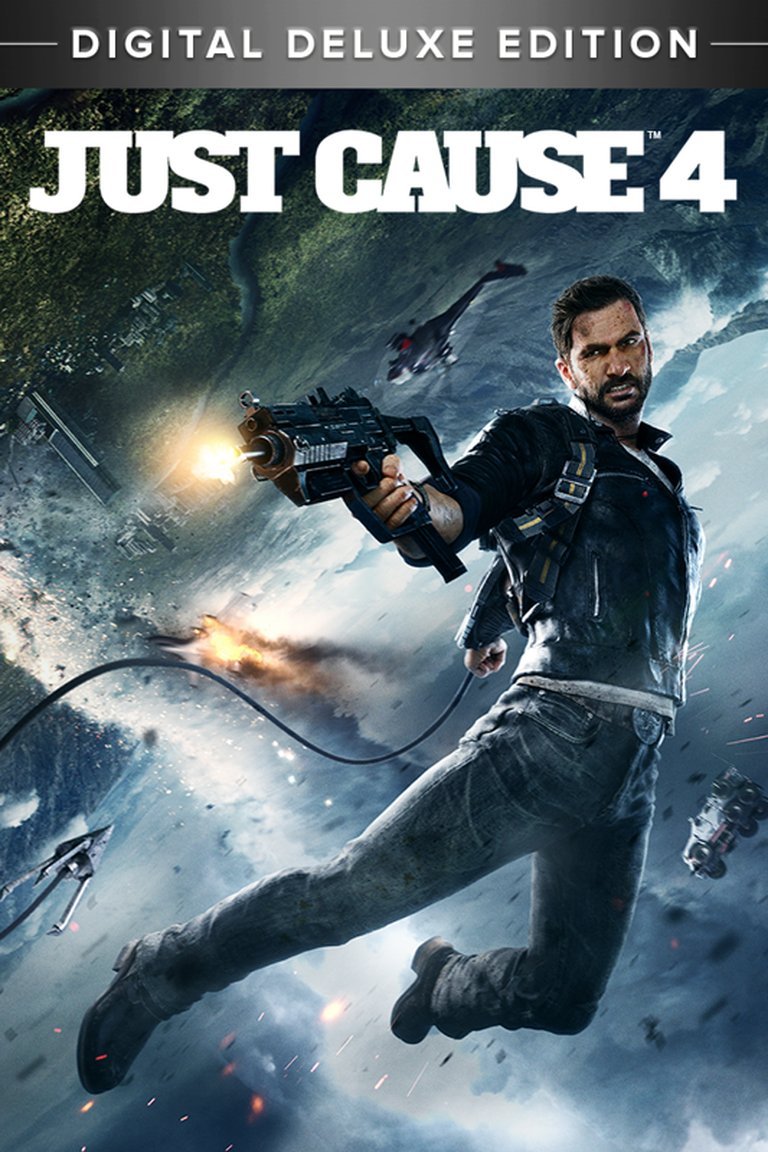
Just Cause 4: Digital Deluxe Edition bundles the base game and its premium content, casting players as Rico Rodríguez in his mission to dismantle the Black Hand, the world’s most powerful private military, within the fictional South American nation of Solís. The game features an expansive open world with diverse biomes and extreme weather dynamics, powered by Avalanche Studios’ Apex engine, which enables innovative traversal via Rico’s wingsuit and grappling hook alongside explosive combat mechanics.
Just Cause 4: Digital Deluxe Edition Mods
Just Cause 4: Digital Deluxe Edition Guides & Walkthroughs
Just Cause 4: Digital Deluxe Edition Reviews & Reception
metacritic.com (68/100): Mixed or Average
ign.com : Rico’s new tricks are goofy physics fun, but it’s missing a big new idea to call its own.
Just Cause 4: Digital Deluxe Edition: Review
Introduction
In the pantheon of open-world mayhem, few franchises embody the chaotic spirit of creative destruction as unapologetically as Just Cause. For over a decade, Avalanche Studios’ flagship series has served as a digital playground for pyromaniacs and stunt enthusiasts, rewarding players not for precision, but for spectacular, physics-defying anarchy. With Just Cause 4: Digital Deluxe Edition—a compendium bundling the base game and its launch-day cosmetic DLC—Avalanche faced a formidable challenge: how to innovate a series built on iterative escalation while recapturing the magic of its most revered entry, Just Cause 2. Released on December 4, 2018, the package promised a revolution in environmental storytelling through its new APEX engine’s extreme weather systems and Rico Rodríguez’s expanded toolkit. Yet, as we shall explore, this iteration represents a pivotal, if flawed, moment in the franchise’s evolution—a game that simultaneously pushes the boundaries of open-world physics and stumbles under the weight of its own ambitions. This review dissects Just Cause 4 as both a technological showcase and a narrative misstep, evaluating its place in the series legacy and its lasting impact on the action-adventure genre.
Development History & Context
Developed by the Swedish studio Avalanche Studios and published by Square Enix, Just Cause 4 emerged from a period of intense pressure for both parties. Avalanche, riding high on the success of Mad Max (2015) and Just Cause 3 (2015), sought to leverage its proprietary APEX engine to deliver a generational leap in environmental simulation. The new engine iteration was specifically engineered to handle “diverse and extreme weather effects,” including blizzards, sandstorms, tornadoes, and lightning storms—a technological feat Avalanche framed as the game’s defining innovation. This ambition was partly born from user criticism of Just Cause 3’s repetitive mission structure and simplified destruction physics, though it also reflected the studio’s broader philosophy of prioritizing emergent chaos over scripted narratives.
Square Enix, meanwhile, was navigating a tumultuous fiscal year. The publisher had invested heavily in AAA titles, expecting Just Cause 4 to replicate the commercial success of its predecessors. The game was unveiled at E3 2018 with bombastic trailers emphasizing weather warfare, and director Francesco Antolini and lead designer Joe Ishikura repeatedly cited “player freedom” as the core tenet. Development timelines were aggressive; the game “went gold” by October 30, 2018, leaving little room for refinement. This context is crucial: Just Cause 4 was a product of competing priorities—a studio pushing technical boundaries against a publisher’s commercial expectations, resulting in a game that was both visually audacious and mechanically compromised at launch.
Narrative & Thematic Deep Dive
Just Cause 4’s narrative is perhaps its most divisive element. Set in the fictional South American nation of Solís—a land of “extreme weather conditions” and political strife—the story attempts to weave personal stakes into its trademark regime-change plot. Rico Rodríguez is lured to Solís by Mira Morales, who reveals that his father, Miguel, once worked on Project Illapa, a weather-control weapon now weaponized by dictator Oscar Espinosa. This personal quest to uncover his father’s legacy pits Rico against the Black Hand, a private military faction led by Gabriela Morales, Mira’s cousin. While the premise promises intrigue, execution falters. Writer Omar Shakir’s script leans into B-movie tropes with campy dialogue and underdeveloped characters: Rico remains a one-dimensional avatar of chaos, and Mira’s “Army of Chaos” allies—including a hacktivist, an archaeologist, and a conspiracy theorist—feel like archetypes rather than fleshed-out companions.
The narrative’s themes—corporate greed, the ethics of weather manipulation, and the cyclical nature of conflict—are muddled by weak cutscenes and uninspired voice acting. Espinosa’s motivation is reduced to cartoonish villainy, while the Black Hand’s shift from antagonist to ally in the climax feels abrupt. The game’s most thematic moment arrives in its finale, where Rico declares, “We were just pawns in a larger game… it always comes back to the Agency,” hinting at a broader conspiracy that the game never explores. This tease feels hollow, underscoring a narrative that prioritizes explosive set pieces over meaningful storytelling. While the “Army of Chaos” liberation mechanic offers a veneer of player-driven revolution, it ultimately serves as a checklist system rather than a meaningful narrative framework.
Gameplay Mechanics & Systems
At its core, Just Cause 4 refines the series’ signature “creative destruction” loop with expanded traversal and combat tools. Rico’s wingsuit and grappling hook remain the game’s spine, now enhanced by the APEX engine’s wind and particle systems. Weather like tornadoes and lightning storms dynamically influence traversal, creating both challenges and opportunities—though their integration into missions is often superficial. The grappling hook’s versatility is its greatest strength, introducing three modular modes: the traditional retractor, attachable balloons, and rocket boosters. Balloons allow for absurd stunts (e.g., lifting soldiers or vehicles), while boosters enable rapid traversal, but both feel more like novelties than practical combat tools. The retractor, by contrast, remains indispensable for chaining explosions and tethering enemies to environmental objects.
Combat emphasizes overwhelming force over tactical nuance. Rico regenerates health rapidly, and enemy AI—despite Avalanche’s claims of improvements—often devolves into predictable patterns. The inclusion of shielded soldiers and power-armored units adds superficial variety but fails to deepen strategy. Supply drops allow players to requisition vehicles or weapons on demand, democratizing access to the game’s arsenal but diminishing the thrill of discovery. Mission design is a mixed bag: while Just Cause 3’s repetitive liberation tasks are replaced by context-specific objectives (e.g., defusing bombs or hunting switches), many missions still devolve into “switch-hunting” or turret-clearing slogs. The “frontline” system, where rebel and Black Hand forces clash at territory borders, offers fleeting moments of scale but lacks the strategic depth implied by its Risk-like map presentation.
Progression is tied to unlocking grapple mods, weapon upgrades, and vehicles, though the system feels disjointed. The Digital Deluxe Edition includes cosmetic DLC like the “Golden Gear Pack” and “Neon Racer Pack,” which add visual flair but no meaningful gameplay advantages. Ultimately, Just Cause 4’s mechanics excel in emergent chaos—linking three fuel tanks to create a chain reaction of explosions is undeniably satisfying—but falter in structured challenges.
World-Building, Art & Sound
Solís is a triumph of environmental diversity, spanning 1,024 square kilometers of rainforests, deserts, snowy peaks, and urban sprawls. The APEX engine renders these biomes with striking detail, from swaying palm trees to sun-drenched canyons. However, the graphics were controversial at launch, with players criticizing downgraded water effects and flat vegetation compared to Just Cause 3. Subsequent patches improved fidelity, but the initial version underscored the tension between ambition and execution. Weather effects are the game’s artistic highlight: tornadoes twist with terrifying realism, sandstorms obscure visibility, and lightning storms illuminate the sky in dazzling bursts. These events transform Solís into a character itself, creating moments of awe that few open-world games match.
The art direction leans into exaggerated vibrancy, with Rico’s “Army of Chaos” pastel uniforms and colorful vehicles contrasting with Solís’ oppressive regime. Yet urban areas feel generic, lacking the personality of Medici in Just Cause 3. Sound design is a strength, with Zach Abramson’s score blending Latin rhythms with orchestral bombast to underscore chaos. Environmental audio—from the roar of tornadoes to the clatter of wingsuit wings—immersion, while weapons and explosions deliver visceral punch. Voice acting, however, is inconsistent; Rico’s lines are delivered with a smirk, but supporting characters like Gabriela Morales lack nuance. Overall, Solís is a world worth exploring, even if its visual and narrative inconsistencies prevent it from feeling truly alive.
Reception & Legacy
Upon release, Just Cause 4 received “mixed or average” reviews, with Metacritic scores of 68 (PC), 65 (PS4), and 70 (Xbox One). Critics praised the open-world traversal, physics, and sound design but lamented the story and mission repetition. IGN awarded it 7.9/10, calling it a “slightly better version of Just Cause 3” that “lacks a big new idea.” GameSpot (6/10) criticized the “underused” weather systems, while PC Gamer (73/100) lauded its “explosive sandbox.” User reviews were more scathing, citing technical bugs and graphical downgrades, though many still acknowledged the joy of unbridled destruction.
Commercially, the game underperformed. Square Enix reported it “sold fewer units on launch than anticipated,” failing to recoup development costs. The publisher cited slow sales as a key factor in its 2018 financial downturn, alongside other AAA disappointments. Yet, Just Cause 4’s legacy has evolved. The Dare Devils of Destruction, Los Demonios, and Danger Rising DLCs expanded the world with new vehicles and supernatural threats, while the 2019 Reloaded edition patched many technical issues. In retrospect, it’s seen as a bold if flawed experiment—particularly its weather systems, which influenced later titles like Forspoken. Its true legacy lies in encapsulating Avalanche’s identity: a studio willing to risk imperfection in pursuit of unbridled player freedom.
Conclusion
Just Cause 4: Digital Deluxe Edition is a microcosm of the Just Cause series: audacious, exhilarating, and frustratingly inconsistent. It pushes open-world physics to new heights, offering a playground where creativity is rewarded over competence. Solís’ diverse landscapes and dynamic weather create unparalleled moments of chaos, while Rico’s expanded grappling toolkit ensures that no two playthroughs are alike. Yet, these strengths are undermined by a forgettable narrative, repetitive missions, and a technical foundation that was rushed to market. The Digital Deluxe Edition’s cosmetic extras add little substance, leaving the core experience to stand—or stumble—on its own merits.
As a historical artifact, Just Cause 4 represents a pivotal juncture for Avalanche Studios. It demonstrated the potential of emergent gameplay in the AAA space but also the pitfalls of prioritizing spectacle over substance. Its weather systems, though underutilized in the base game, foreshadowed future innovations, while its commercial failure served as a cautionary tale for publishers chasing blockbuster sales figures. For players, it remains a testament to the joy of unscripted mayhem—a game that, despite its flaws, captures the anarchic spirit that made the series a cult favorite. Ultimately, Just Cause 4 is not the series’ zenith—that honor still belongs to Just Cause 2—but it is a necessary, if imperfect, chapter in the saga of Rico Rodríguez and his eternal quest to blow things up.