
- Release Year: 2011
- Platforms: Windows
- Publisher: Nordic Softsales AB
- Genre: Compilation
- Game Mode: Single-player
Description
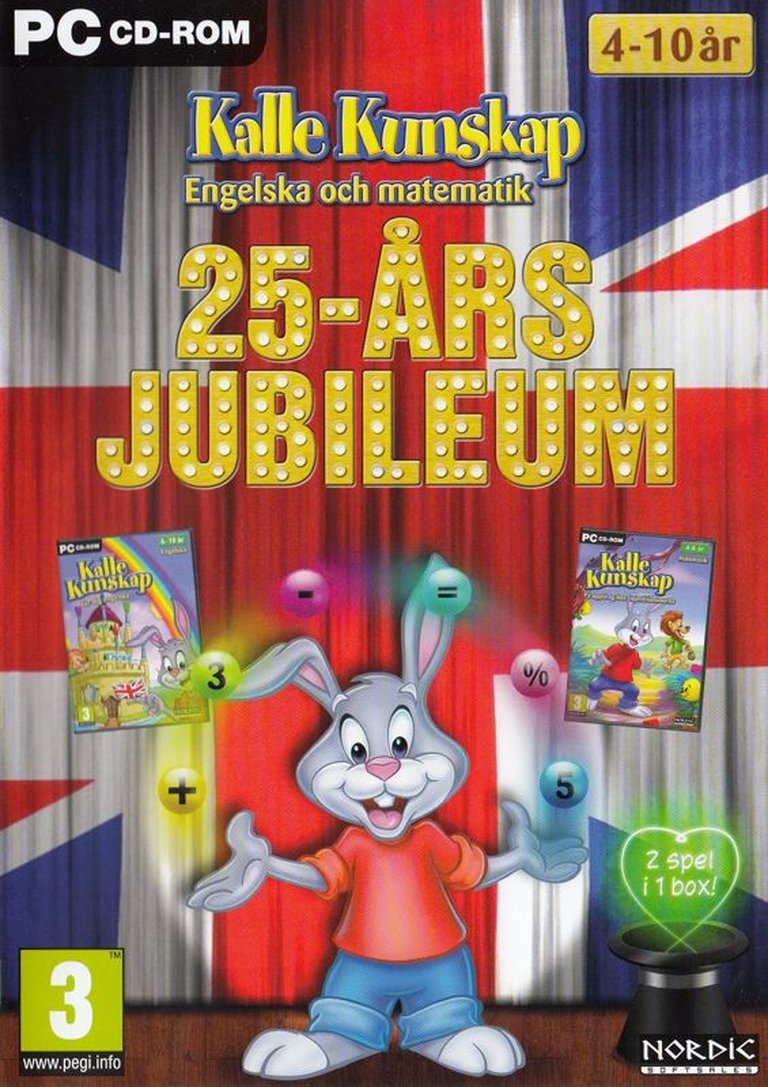
Kalle Kunskap: Engelska och matematik – 25-års jubileum is a 2011 Windows compilation bundling two Swedish-localized Reader Rabbit educational games to mark the franchise’s 25th anniversary, teaching English and mathematics to children aged 4-10 through interactive activities. The included titles, previously released as Kalle Kunskap Lär dig Engelska and Kalle Kunskap på uppdrag hos Lejonblommorna, feature engaging missions like helping lion flowers, drawing from classics such as Reader Rabbit: Learn to Read with Phonics.
Kalle Kunskap: Engelska och matematik – 25-års jubileum: Review
Introduction
In the golden age of CD-ROM edutainment, when floppy disks gave way to vibrant multimedia adventures designed to sneak learning into playtime, few series captured the imagination of young minds quite like Reader Rabbit. Its Swedish incarnation, Kalle Kunskap, arrived fashionably late to the 25th anniversary party with this 2011 compilation, bundling English and math titles for children aged 4-10. Amid a gaming landscape dominated by high-octane shooters and sprawling MMOs, this unassuming Windows release stands as a nostalgic beacon of purposeful play. My thesis: while technologically dated and narratively simplistic, Kalle Kunskap: Engelska och matematik – 25-års jubileum exemplifies the enduring power of localized edutainment, blending gentle fantasy narratives with effective pedagogy to foster foundational skills in an era when digital learning was still a novelty.
Development History & Context
Developed as a localized bundle by Nordic Softsales AB, a Swedish publisher specializing in children’s educational software, this title draws directly from the venerable Reader Rabbit franchise, which debuted in 1983 and amassed over 40 entries by the 2010s. The compilation repackages two prior releases: Kalle Kunskap Lär dig engelska (2009, developed by OpenMind International with a 27-person credit list including producers like Béatrice Jeannès and programmers such as Pierre Lusher) and Kalle Kunskap på uppdrag hos Lejonblommorna, a subset of the 2001 Reader Rabbit: Learn to Read with Phonics – 1st & 2nd Grade. The latter even spawned a Nintendo DS port in 2010/2011 as Reader Rabbit: On a Mission to Help the Lion Flowers, highlighting cross-platform adaptability.
The vision was clear: celebrate 25 years of Reader Rabbit (though infamously two years late, possibly due to localization delays) by targeting non-English-speaking markets like Sweden, France (Lapin Malin), and the Netherlands (Robbie Konijn). Technological constraints of the era—Pentium III/4 CPUs (800 MHz minimum), 256 MB RAM, DirectX-compatible sound, and SVGA graphics with 64 MB VRAM—reflected mid-2000s PC hardware, optimized for CD-ROM distribution (700 MB install, 12x drive required). This was the twilight of edutainment’s dominance; by 2011, smartphones loomed, and the industry shifted toward apps like ABC Mouse. Yet in Scandinavia, where physical media thrived via retailers like those on Tradera (copies sold new for ~199 SEK), publishers like Nordic Softsales filled a gap for parental-approved software. The gaming landscape? Call of Duty reigned supreme, but edutainment persisted in niches, influenced by EU educational mandates and a cultural emphasis on lek och lär (play and learn).
Narrative & Thematic Deep Dive
At its core, this compilation weaves two interconnected tales of heroism, loss, and restoration, themed around discovery and problem-solving—hallmarks of Reader Rabbit‘s anthropomorphic animal protagonists.
The English Adventure: Kalle Kunskap Lär dig engelska
The plot kicks off with a cinematic hook: pirate rats plunder seven colored keys safeguarding a legendary rainbow castle, scattering them across a fantastical island where inhabitants speak only English. Protagonists Kalle (the Swedish Reader Rabbit, a plucky bunny) and Leo embark on a quest to recover them, aided by helpers like Sam the Lion (a bilingual guide), encyclopedia Paige (action prompter), and key-hoarding Chester the Chest. Each key lands in a locale—a farm, village, or beach—disrupting life: a farmer can’t harvest without “apples,” a chef demands “cut the vegetables.” Children eavesdrop on spoken English requests, select pictorial responses, and learn vocabulary organically.
Thematically, it’s a metaphor for language as a bridge: the rainbow symbolizes harmony restored through communication. Dialogue is sparse but immersive—simple phrases like “Give me three balls” repeated for reinforcement—avoiding overload for preschoolers. Subtle morals emerge: cooperation (teamwork with animal NPCs), perseverance (retrying puzzles), and curiosity (exploring encyclopedias). Echoing folklore (rainbow as treasure guardian), it instills wonder without preachiness.
The Math Mission: Kalle Kunskap på uppdrag hos Lejonblommorna
Tied to phonics roots but refocused on arithmetic, this subset narrative centers on Lion Flowers—majestic, seed-dependent blooms—whose vital seeds vanish, threatening extinction. Kalle and friends traverse puzzle-laden gardens, solving math riddles to unearth them: count petals, add/subtract stems, pattern-match blooms. It’s a subset of a 2001 title, so pacing feels episodic, culminating in floral rebirth.
Themes overlap: ecology (sustaining nature via logic), growth (math as “seeds” of knowledge), and agency (child as hero). No deep lore, but recurring motifs—pirates as villains, animals as allies—unify the bundle, reinforcing Reader Rabbit‘s ethos of knowledge conquering chaos.
Gameplay Mechanics & Systems
Point-and-click simplicity defines the core loop: explore fixed/flip-screen scenes, interact via mouse (keyboard optional), tackle mini-games escalating in difficulty. Single-player only, with no combat—pure edutainment.
Core Loops
- English Module: Listen to NPC requests (e.g., “Find two cats”), select from 4-6 image options. Success unlocks keys, tracks learned words (e.g., 50/100 for rainbow restoration). Helpers provide hints: Sam translates, Paige suggests verbs/nouns.
- Math Module: Bite-sized challenges—counting (1-20), addition/subtraction (up to 100), shapes/patterns. Lion Flowers “bloom” on correct answers, with retries and scaling (preschool: visuals; grade 2: equations).
Progression is linear but rewarding: score tables, unlockable scenes, no permadeath. UI is child-proof—large icons, full-screen landscape, minimal text (Swedish menus, English content). Innovations: adaptive difficulty (fewer options for strugglers), multimedia feedback (animations, voiceovers). Flaws? Repetitive (20-30 hours total, but loops tire), no multiplayer, dated controls (no touch support pre-iPad era). Yet, it’s intuitive: 4-year-olds grasp it sans tutorial.
| Mechanic | Strengths | Weaknesses |
|---|---|---|
| Mini-Games | Pedagogically sound, immediate feedback | Limited variety (vocab/math only) |
| Progression | Visual trackers (keys/seeds) | Linear, no branching |
| Helpers | Scaffolding for learners | Underutilized in advanced play |
| UI/Controls | Mouse-friendly, accessible | Clunky on modern resolutions |
World-Building, Art & Sound
Fantasy islands and gardens form cozy, non-threatening realms—vibrant 2D cartoons with fixed perspectives, evoking 1990s edutainment like Putt-Putt. Art direction: bold primaries, anthropomorphic critters (bunnies, lions, rats), parallax scrolling for depth. Atmosphere bubbles with whimsy: sunny shores, blooming meadows, pirate ship silhouettes. Visuals contribute immersion, scaling puzzles to scenes (beach balls for counting).
Sound design shines: cheerful MIDI tunes, DirectX-synced effects (boings for correct answers), clear voice acting (English natives for authenticity, Swedish intros). No orchestral flair, but repetitive jingles reinforce learning—positive chimes for success, gentle nudges for errors. Collectively, they craft a safe, engaging bubble, prioritizing calm focus over spectacle.
Reception & Legacy
Launch reception? Nonexistent in mainstream press—no MobyGames critic scores, zero player reviews, mirroring edutainment’s niche status. Commercial viability evident in Tradera resale (new ~199 SEK, used 49-79 SEK), Archive.org preservations, and Redump dumps, suggesting cult collector appeal. Only 2 MobyGames collectors, but series ties boost visibility.
Reputation evolved from forgotten bundle to retro curiosity: part of Kalle Kunskap‘s ecosystem (dozens of Swedish titles), influencing localized edutainment like Hugo or Mulle Meck. Broader impact? Exemplifies Reader Rabbit‘s longevity (post-2011 ports to iOS), paving for apps like Duolingo Kids. In industry terms, it underscores edutainment’s pivot to bundles amid piracy/download shifts, preserving phonics/math via fantasy— a quiet win for accessibility in non-English markets.
Conclusion
Kalle Kunskap: Engelska och matematik – 25-års jubileum is no graphical tour de force nor narrative epic, but a masterclass in age-appropriate design: two tight, thematic adventures that teach without tears. Its belated anniversary status belies timeless mechanics, fostering bilingualism and numeracy through play. In video game history, it claims a modest pedestal in edutainment’s pantheon—a Swedish gem reminding us that not all legends need explosions. Verdict: 8/10—essential for parents, nostalgic treasure for historians, playable relic today via emulation. Seek it on dusty shelves; the rainbow awaits.