
- Release Year: 2001
- Platforms: Windows
- Publisher: Global Star Software Ltd., Real Networks, Inc.
- Developer: Driver-Inter, Ltd., Small Rockets
- Genre: Driving, Racing, Sports
- Perspective: Behind view
- Game Mode: Single-player
- Gameplay: Skill progression, Time-based challenges, Unlockable equipment
- Setting: African rivers, Alaskan waterways, Alpine mountain streams
- Average Score: 76/100
Description
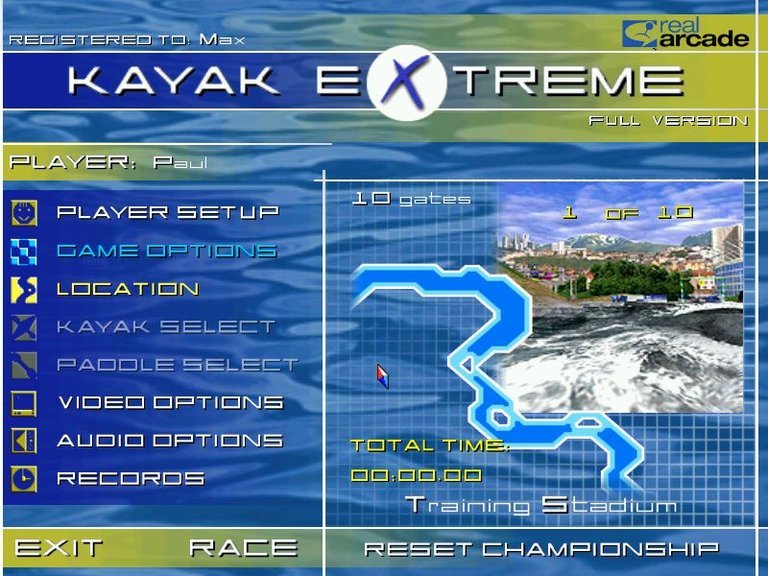
Kayak Extreme is a 3D kayak racing game set across diverse environments, including Alpine mountain streams, African rivers, and Alaskan waterways. Players must navigate challenging courses by passing through gates, avoiding obstacles like slow water and counter flows, and overcoming rapids and waterfalls. As they progress, they unlock new paddle types and kayaks that enhance gameplay, with three difficulty levels to master before achieving victory.
Gameplay Videos
Kayak Extreme Free Download
Kayak Extreme Reviews & Reception
gamepressure.com (67/100): Race against the clock in this fantastic simulation of the ultimate white-knuckle watersport.
myabandonware.com (85/100): This is a brilliant game that I used to play a lot for a couple of years. It has three different environments to kayak in and is very challenging.
Kayak Extreme: A Forgotten Gem of Early 2000s Extreme Sports Gaming
Introduction: The Whitewater Wonder That Slipped Through the Cracks
In the crowded landscape of early 2000s extreme sports games, Kayak Extreme (2001) stands as a fascinating anomaly—a title that dared to focus on one of the most technically demanding and visually underrepresented sports in gaming. Developed by the obscure Russian studio Small Rockets in collaboration with Driver-Inter, Ltd., and published by Global Star Software and Real Networks, Kayak Extreme offered players a rare opportunity to experience the adrenaline of whitewater kayaking in a time when most sports games were fixated on skateboarding, snowboarding, or motocross.
This review argues that Kayak Extreme was a pioneering attempt to simulate the nuances of kayaking with surprising depth, despite its technical limitations and niche appeal. While it never achieved the commercial success or cultural impact of contemporaries like Tony Hawk’s Pro Skater or SSX, its ambitious physics system, diverse environments, and progressive difficulty curve make it a worthy subject of historical analysis. Through this exhaustive examination, we’ll explore how Kayak Extreme captured the essence of kayaking, where it faltered, and why it remains a curious footnote in the evolution of sports simulations.
Development History & Context: A Russian Studio’s Ambition Meets Early 2000s Constraints
The Studios Behind the Paddle
Kayak Extreme was the brainchild of Small Rockets, a Russian development studio that specialized in niche sports simulations. The team, led by Project Leader Frank Parkinson and Game Designer Pavel Grachev, had prior experience with water-based racing games, including Jetboat Superchamps 2 (2000). Their collaboration with Driver-Inter, Ltd.—another Russian studio known for titles like Polaris SnoCross (2001)—suggests a shared interest in extreme sports simulations that catered to underserved markets.
The game’s development coincided with a brief but notable trend in early 2000s gaming: the rise of “extreme sports” as a genre. Following the success of Tony Hawk’s Pro Skater (1999) and SSX (2000), publishers scrambled to capitalize on the trend by attaching the “extreme” moniker to virtually any sport. Kayak Extreme was part of this wave, though it distinguished itself by focusing on a sport that lacked mainstream visibility.
Technological Constraints and Innovations
Released on September 14, 2001 (with some sources citing December 6, 2001), Kayak Extreme was built for Windows PCs with modest system requirements:
– Recommended Specs: Pentium II 233MHz, 64MB RAM, and a dedicated graphics card.
– Supported Resolutions: 800×600 and 1024×768 in full-screen mode.
These specs reflect the game’s position in the transitionary period between 2D and 3D gaming. While titles like Quake III Arena (1999) were pushing polygonal boundaries, Kayak Extreme opted for a more conservative approach, prioritizing fluid physics and environmental interaction over cutting-edge visuals. The game’s behind-view perspective was a pragmatic choice, allowing players to anticipate obstacles while maintaining a sense of speed.
The Gaming Landscape of 2001
Kayak Extreme entered a market dominated by:
– Established franchises: Tony Hawk’s Pro Skater 3 (2001), SSX Tricky (2001), and Mat Hoffman’s Pro BMX (2001).
– Multi-sport compilations: ESPN X Games Skateboarding (2001) and Pepsi Max Extreme Sports (2001).
– Water-based alternatives: Wave Race: Blue Storm (2001) on GameCube, which focused on jet ski racing.
Unlike these titles, Kayak Extreme had no licensed athletes, no multiplayer modes (despite some sources listing it as “multiplayer”), and no flashy trick systems. Instead, it leaned into simulation-like realism, a risky proposition for a sport that lacked widespread appeal.
Narrative & Thematic Deep Dive: The Silent Story of Mastery
The Absence of Plot
Kayak Extreme is a pure gameplay experience, devoid of narrative or character development. There are no protagonists, no rival kayakers, and no overarching story. The game’s “narrative” is instead conveyed through:
– Progression: Players advance from a training course to increasingly challenging environments (Alpine, Africa, Alaska).
– Unlockables: New kayaks and paddles serve as tangible rewards for skill mastery.
– Difficulty tiers: Three levels of challenge (Beginner, Intermediate, Expert) frame the player’s journey as one of personal growth.
This minimalist approach aligns with the zen-like nature of kayaking itself—a sport where the athlete’s battle is against the river, not other competitors. The absence of dialogue or cutscenes reinforces the game’s focus on immersion through mechanics, not storytelling.
Themes: Man vs. Nature and the Pursuit of Mastery
Kayak Extreme explores several subtle themes:
1. The Unpredictability of Nature:
– Rivers are dynamic, with rapids, waterfalls, and counter flows that demand constant adaptation.
– Unlike track-based racing games, no two runs feel identical due to the procedural-like water physics.
2. Precision and Patience:
– Success hinges on timing paddle strokes, navigating gates, and avoiding slow water—a far cry from the twitch reflexes of skateboarding games.
3. Isolation and Focus:
– The solitary nature of kayaking is mirrored in the game’s lack of opponents or spectators, creating a meditative atmosphere.
The Unspoken Challenge: Kayaking as a Metaphor for Game Design
In many ways, Kayak Extreme is a meta-commentary on game design itself. Kayaking requires:
– Reading the water (like reading a game’s mechanics).
– Adapting to currents (like adapting to a game’s difficulty).
– Balancing speed and control (like balancing risk and reward in gameplay).
The game’s structure—training → mastery → unlocks—mirrors the real-world progression of kayakers, making it one of the few sports games of its era to respect the learning curve of its source material.
Gameplay Mechanics & Systems: Where Simulation Meets Arcade
Core Gameplay Loop: Racing Against the River
At its heart, Kayak Extreme is a time-trial racing game with obstacle navigation. The core loop consists of:
1. Selecting a Course: Players choose from four environments:
– Training: A gentle introduction to mechanics.
– Alpine: Fast-moving mountain streams with tight turns.
– Africa: Wider rivers with deceptive currents.
– Alaska: Treacherous rapids and waterfalls.
2. Navigating Gates:
– Ordinary Gates: Must be passed in the correct direction.
– Reverse Gates: Require 180-degree turns, adding complexity.
3. Avoiding Hazards:
– Slow Water: Drains speed, forcing strategic route planning.
– Counter Flows: Can reverse the kayak’s momentum.
– Rapids and Waterfalls: Demand precise timing to avoid capsizing.
Physics and Control: The Game’s Greatest Strength and Flaw
The game’s physics engine was its most ambitious feature:
– Paddle Mechanics: Players control left and right paddle strokes, with timing affecting speed and turning radius.
– Water Interaction: Currents dynamically influence the kayak’s movement, requiring constant adjustments.
– Momentum System: Building speed is crucial for clearing obstacles, but overcommitting can lead to disastrous wipeouts.
However, the controls suffer from imprecision:
– The behind-view perspective occasionally obscures upcoming gates.
– Paddle responsiveness can feel sluggish, particularly in tight turns.
– Collision detection is inconsistent, with some rocks causing unrealistic bounces.
Progression and Unlocks: A Carrot-on-a-Stick System
Kayak Extreme employs a linear progression system:
– Completing courses under par time unlocks:
– New Kayaks: Each has unique handling characteristics (e.g., speed vs. stability).
– New Paddles: Affect acceleration and turning efficiency.
– Three Difficulty Levels: Increase gate complexity and water hazards.
This system encourages replayability, though the lack of a free-roam or sandbox mode limits long-term engagement.
UI and Feedback: Functional but Uninspired
The game’s HUD is minimalist:
– Timer: Tracks progress against the par time.
– Speedometer: Indicates current velocity.
– Gate Indicators: Highlight upcoming obstacles.
While functional, the UI lacks the polish of contemporaries like Wave Race: Blue Storm, which used dynamic camera angles and audio cues to enhance immersion.
World-Building, Art & Sound: Crafting the Illusion of Whitewater
Environmental Design: From Alps to Alaska
Kayak Extreme’s environments are its most visually distinctive feature:
1. Alpine Streams:
– Narrow, winding paths with sheer rock walls.
– Crystal-clear water that reflects the mountainous backdrop.
2. African Rivers:
– Wider, muddier waters with submerged logs and unpredictable eddies.
– Lush vegetation lining the banks.
3. Alaskan Waterways:
– Turbulent rapids and waterfalls that test precision.
– Icy textures and mist effects to convey coldness.
Each environment is thematically distinct, though the low-polygon models and pixelated textures betray the game’s 2001 origins. The draw distance is limited, with fog often obscuring distant scenery—a common concession of the era.
Visual Style: Realism Over Spectacle
Unlike the over-the-top aesthetics of Tony Hawk’s Pro Skater, Kayak Extreme opts for grounded realism:
– Water Effects: The game’s rippling currents and splashing animations were impressive for the time, though they lack the dynamic lighting of later titles.
– Kayak Models: Detailed but static, with no visible wear or damage.
– Weather Effects: Subtle but effective—mist in Alaska, sunlight glinting off Alpine waters.
The art direction succeeds in conveying the isolation of kayaking, though it occasionally feels too sterile compared to the vibrant, chaotic energy of other extreme sports games.
Sound Design: The Unsung Hero
The audio design is where Kayak Extreme shines:
– Ambient Sounds:
– Rushing water dynamically adjusts based on speed and environment.
– Bird calls and wind enhance immersion.
– Paddle Sounds:
– Splashes and strokes are crisp and responsive.
– Music:
– Composed by Richard Beddow, the soundtrack is subdued and atmospheric, avoiding the high-energy rock or electronic tracks of contemporaries.
– Tracks are looping and ambient, reinforcing the game’s meditative tone.
The sound design elevates the experience, making the player feel connected to the river in a way the visuals sometimes fail to achieve.
Reception & Legacy: The Game That Time (Mostly) Forgot
Critical Reception: A Niche Title in a Crowded Market
Kayak Extreme received little critical attention upon release:
– No Metacritic score (as of 2025).
– No professional reviews archived on MobyGames.
– User reviews on MyAbandonware praise its physics and challenge but note its technical limitations.
The game’s lack of marketing and niche appeal likely contributed to its obscurity. In an era where licensed sports games dominated, a kayaking simulator struggled to find an audience.
Commercial Performance: A Cautionary Tale
- No sales figures are publicly available.
- The game was bundled with other extreme sports titles in budget compilations, suggesting modest commercial success.
- Its abandonware status today indicates it was not a major seller.
Legacy: The Quiet Influence on Water Sports Games
While Kayak Extreme didn’t spawn a franchise, its design philosophies can be seen in later titles:
– Kayak VR: Mirage (2022): A modern VR kayaking simulator that shares Kayak Extreme’s focus on realistic water physics.
– Riders Republic (2021): Ubisoft’s extreme sports game includes kayaking as a secondary activity, likely inspired by earlier niche titles.
– Steep (2016): Features whitewater sections that echo Kayak Extreme’s environmental design.
The game also serves as a historical artifact of early 2000s Russian game development, showcasing how small studios experimented with underrepresented sports despite limited resources.
Conclusion: A Flawed but Fascinating Relic
Kayak Extreme is not a lost masterpiece, but it is a fascinating time capsule—a game that dared to simulate the intricacies of kayaking when most developers were chasing the next Tony Hawk clone. Its ambitious physics, diverse environments, and respect for the sport’s learning curve set it apart from the arcadey, trick-focused extremes of its peers.
However, its clunky controls, dated visuals, and lack of multiplayer relegate it to the status of a cult curiosity rather than a classic. For modern players, it’s a challenging but rewarding experience—one that demands patience and precision, much like real kayaking.
Final Verdict: 7.5/10 – A Niche Triumph
- For History Buffs: An essential play for those interested in early 2000s sports games or Russian game development.
- For Kayaking Enthusiasts: The closest thing to a simulation of the sport from its era.
- For Casual Players: A frustrating but unique challenge that rewards persistence.
Kayak Extreme may have been washed away by the currents of gaming history, but its bold vision and uncompromising design ensure it remains a hidden gem for those willing to dive in.
Post-Script: As of 2025, Kayak Extreme can be downloaded for free from abandonware sites like MyAbandonware or Internet Archive. For the full experience, Windows XP compatibility mode is recommended.