
- Release Year: 1993
- Platforms: PlayStation, Sharp X68000, SNES, Windows
- Publisher: ASCII Corporation, Datam Polystar Co.,Ltd., Success Corp.
- Developer: Fupac, Success Corp.
- Genre: Action, Puzzle
- Perspective: Top-down
- Game Mode: Co-op, Hotseat, Single-player
- Gameplay: Tile matching puzzle
- Average Score: 80/100
Description
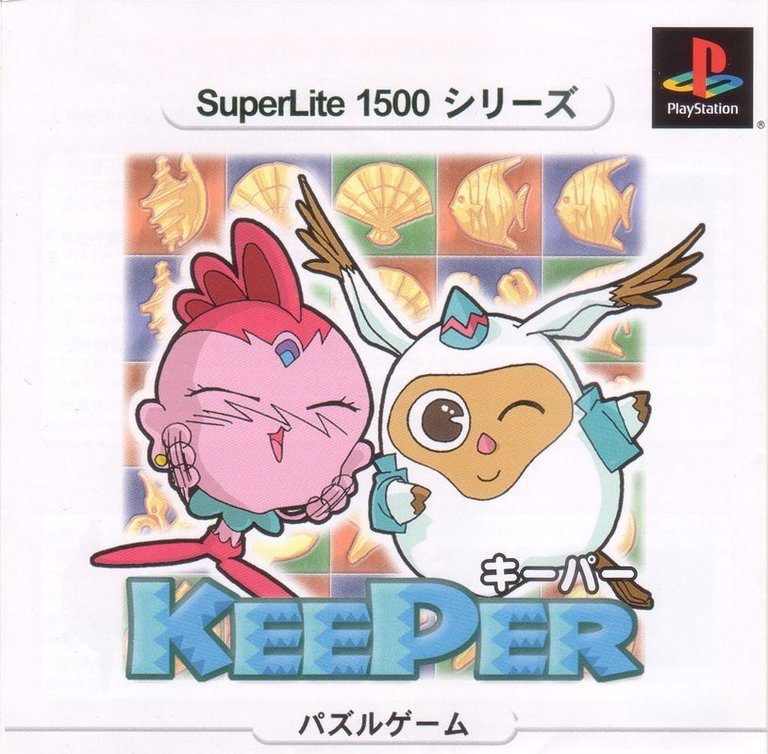
Keeper is a cute action-puzzle game featuring a five-by-five grid that fills with colored blocks adorned with various icons. Players control characters named Pikuru and Kintoto, who can move freely across the grid, climb over blocks, and push or pull them in any available direction. The core objective is to line up three or more matching blocks by either color or symbol to clear them from the grid. The game ends if the entire grid becomes completely filled, and it offers single-player mode alongside two-player battle and cooperative modes.
Gameplay Videos
Where to Buy Keeper
PC
Keeper Reviews & Reception
metacritic.com (80/100): Keeper is one of the most unique and captivating games that you’ll ever play.
opencritic.com (81/100): Psychonauts studio Double Fine returns with a surprising, shapeshifting adventure of captivating wonder and beauty.
ign.com : Double Fine’s surreal puzzle platformer is a feast for the senses.
gamerant.com : Keeper is an absolutely gorgeous game, but in terms of gameplay, it might be the most bland entry in Double Fine’s catalogue yet.
game8.co (80/100): Keeper is a gentle, contemplative journey that may start slow but soon unfolds into something deeply moving.
Keeper Cheats & Codes
SNES
Enter codes at the password entry screen to access specific levels or game modes.
| Code | Effect |
|---|---|
| DOUBLE | Enables Doubles mode |
| START | Unlocks level 1 in puzzle mode |
| SECOND | Unlocks level 2 in puzzle mode |
| FIVES | Unlocks level 3 in puzzle mode |
| TURTLE | Unlocks level 4 in puzzle mode |
| TCRUSH | Unlocks level 5 in puzzle mode |
| SEVEN | Unlocks level 6 in puzzle mode |
| MATOME | Unlocks level 7 in puzzle mode |
| CIRCLE | Unlocks level 8 in puzzle mode |
| PEACH | Unlocks level 9 in puzzle mode |
| ALMIGH | Unlocks level 10 in puzzle mode |
| MOAZAIC | Unlocks level 11 in puzzle mode |
| KOME | Unlocks level 12 in puzzle mode |
| JAMANE | Unlocks level 13 in puzzle mode |
| IPPAI | Unlocks level 14 in puzzle mode |
| SQUARE | Unlocks level 15 in puzzle mode |
| NICOLI | Unlocks level 16 in puzzle mode |
| KAKKO | Unlocks level 17 in puzzle mode |
| TILES | Unlocks level 18 in puzzle mode |
| TWOSET | Unlocks level 19 in puzzle mode |
| BLAST | Unlocks level 20 in puzzle mode |
| KOUJI | Unlocks level 21 in puzzle mode |
| DELUXE | Unlocks level 22 in puzzle mode |
| WAKU | Unlocks level 23 in puzzle mode |
| VECTOR | Unlocks level 24 in puzzle mode |
| MANIAC | Unlocks level 25 in puzzle mode |
| SWORD | Unlocks level 26 in puzzle mode |
| MRHEX | Unlocks level 27 in puzzle mode |
| RIVER | Unlocks level 28 in puzzle mode |
| TRAP | Unlocks level 29 in puzzle mode |
| TEFTEF | Unlocks level 30 in puzzle mode |
| NANAKO | Unlocks level 31 in puzzle mode |
| SPARK | Unlocks level 32 in puzzle mode |
| CONGA | Unlocks level 33 in puzzle mode |
| YOUBIN | Unlocks level 34 in puzzle mode |
| DRAGON | Unlocks level 35 in puzzle mode |
| AKANBE | Unlocks level 36 in puzzle mode |
| SAYUU | Unlocks level 37 in puzzle mode |
| M | Unlocks level 38 in puzzle mode |
| TWOII | Unlocks level 39 in puzzle mode |
| FIXED | Unlocks level 40 in puzzle mode |
| OHYOJI | Unlocks level 41 in puzzle mode |
| TANBO | Unlocks level 42 in puzzle mode |
| IKARI | Unlocks level 43 in puzzle mode |
| PEKE | Unlocks level 44 in puzzle mode |
| THESUN | Unlocks level 45 in puzzle mode |
| IGETA | Unlocks level 46 in puzzle mode |
| SELECT | Unlocks level 47 in puzzle mode |
| ICHMTS | Unlocks level 48 in puzzle mode |
| YUNOMI | Unlocks level 49 in puzzle mode |
| OWARI | Unlocks level 50 in puzzle mode |
| ATOMIC | Unlocks level 51 in puzzle mode |
| BURN | Unlocks level 52 in puzzle mode |
| FLOWER | Unlocks level 53 in puzzle mode |
| KUJIRA | Unlocks level 54 in puzzle mode |
| WITCH | Unlocks level 55 in puzzle mode |
| THREE | Unlocks level 56 in puzzle mode |
| SARURU | Unlocks level 57 in puzzle mode |
| MARS | Unlocks level 58 in puzzle mode |
| TRIANG | Unlocks level 59 in puzzle mode |
| MUCHA | Unlocks level 60 in puzzle mode |
Keeper: Review
Introduction
In the pantheon of video game oddities, few concepts are as delightfully surreal as a sentient lighthouse that grows legs to traverse a decaying, post-human world. Keeper, the latest masterpiece from Double Fine Productions, is not merely a game but a meditative odyssey—a wordless symphony of light, companionship, and ecological rebirth. As a studio renowned for blending whimsy with profound storytelling—from Psychonauts’ psychic depths to Brütal Legend’s heavy-metal satire—Double Fine delivers a title that feels like a playable Salvador Dalí painting. Keeper’s genius lies in its refusal to explain itself, instead trusting players to find meaning in its strange beauty. Yet, this audacious vision is tempered by gameplay that, while charming, often stumbles under the weight of its own ambition. This review explores Keeper as both a technical marvel and a philosophical experiment, arguing that it stands as one of 2025’s most artistically resonant—if mechanically uneven—experiences.
Development History & Context
Keeper emerged from a crucible of introspection and experimentation. Under the direction of Lee Petty—whose prior work on Stacking and Headlander showcased a flair for unconventional protagonists—the game was conceived during the solitude of the COVID-19 pandemic. Petty’s backpacking trips through California’s wilderness sparked reflections on a world stripped of human influence, themes that coalesced into Keeper’s narrative of adaptation and connection. Developed over four years using Unreal Engine 5 and its Lumen ray-traced global illumination system, the game leverages cutting-edge technology to render its dreamlike landscapes.
Double Fine’s involvement is pivotal. Known for embracing niche genres with heart (Broken Age, RAD), the studio positioned Keeper as a “palate cleanser”—a short, wordless adventure designed to evoke emotion over challenge. Its release on October 17, 2025, via Xbox Game Studios and Xbox Game Pass, coincided with a growing appetite for narrative-driven indies, positioning Keeper alongside titles like Spirit of the North and Journey. Yet, its experimental DNA set it apart: while Journey relied on minimalist dialogue, Keeper eliminates text entirely, a radical choice that redefines environmental storytelling.
Narrative & Thematic Deep Dive
Keeper’s story unfolds without a single line of dialogue, relying instead on visual poetry and environmental storytelling. The plot begins with Twig, a leaf-feathered seabird fleeing the “Wither”—a parasitic, purple corruption that manifests as thorned vines or swarming vermin. Twig finds refuge in a dormant lighthouse, which awakens with a beam of light, scaring away the blight. This symbiotic bond forms the heart of the narrative: the lighthouse, now mobile, and Twig embark on a pilgrimage toward a distant mountain, guided by a beacon that promises salvation.
Character development is conveyed through animation alone. The lighthouse’s “eyebrows”—metal fragments above its lens—shift to convey curiosity or distress, while Twig’s chirps and gestures express fear or joy. Their relationship evolves from protector to ally, culminating in Twig raising an abandoned egg, symbolizing hope. Thematically, Keeper explores adaptation as the lighthouse shapeshifts—first as a lighthouse, then a boat, a fiery wheel, and finally a dragon-like entity—mirroring nature’s resilience. The Wither represents ecological decay, with its defeat implying a metaphor for healing a wounded planet.
The narrative’s ambiguity is both its strength and weakness. Optional “Glyph” statues, reassembled with light, hint at a lost civilization, but answers remain elusive. As Petty noted, Keeper thrives on “open interpretation,” allowing players to project their own experiences onto its fable. This mirrors the wordless storytelling of Journey, but Keeper’s surrealism leans more toward the uncanny—moments where the lighthouse tumbles into a chasm of broken lighthouses or fuses with a fishing boat, blurring reality and metaphor.
Gameplay Mechanics & Systems
Keeper’s gameplay loop is deceptively simple: move, shine light, solve puzzles. As the lighthouse, players navigate with a left stick while directing a focused beam of light with the right. This beam burns Wither infestations, grows vines into bridges, or activates glowing mechanisms. Twig, controlled with a dedicated button, pecks at levers or carries objects, adding cooperative depth. Early chapters introduce light-based puzzles, like burning away corrupted flora to reveal paths.
However, the game’s evolution defines its mechanics. After a mid-game transformation into a boat, traversal shifts to aquatic puzzles, culminating in a battle against a giant anemone-boss. Later, a rolling lens form introduces fire-based platforming and wall-jumping. These changes keep gameplay fresh, but execution falters. Puzzles are often rudimentary—shine light, pull lever, repeat—and the fixed camera angles, while cinematic, obscure crucial interactions. Movement remains clumsy; the lighthouse’s deliberate waddle, initially endearing, becomes frustrating when backtracking.
Notably, failure is absent. Keeper avoids frustration by design: there are no health bars, time limits, or irreversible mistakes. This aligns with its meditative ethos but risks monotony. The time-manipulation mechanic—switching between past, present, and future via totems—offers clever twists, such as guiding a ghost-Twig through walls or an egg-Twig across pressure plates. Yet, these moments are fleeting, and the game’s 3–4 hour runtime feels padded by repetitive traversal.
World-Building, Art & Sound
Keeper’s world is a triumph of surrealist artistry. Petty drew inspiration from Max Ernst and Dalí’s juxtapositions, blended with Studio Ghibli’s whimsy and The Dark Crystal’s ecological horror. Each biome is a self-contained vignette: the Pollen Fields float with candy-floss clouds; the Horologe, a steampunk city, features Greek-inspired architecture; the final ascent merges landscapes into a psychedelic collage. Life here is bizarrely organic: rocks sprout ostrich-like legs, trees have gemstone eyes, and towering whales navigate crystalline seas. Every surface bears hand-painted brushstrokes, a testament to Double Fine’s “bespoke, hand-touched” approach.
Sound design amplifies the atmosphere. David Earl’s score oscillates between twinkling hope and eerie dissonance, mirroring the Wither’s presence. Twig’s chirps and the lighthouse’s metallic creaks communicate emotion where words cannot. Yet, audio inconsistencies arise—ambient sounds occasionally drown out key cues, and the music, while beautiful, lacks memorable motifs. The result is a world that feels alive, if sometimes silent when it should speak.
Reception & Legacy
Upon release, Keeper garnered “generally favorable” reviews (Metacritic: 83/100). Critics lauded its visuals as “a feast for the senses” (IGN), with Eurogameer awarding it a perfect 5/5. The wordless narrative was praised for its emotional depth, though some, like The Guardian, criticized button prompts (“Press X to peck”) for undermining ambiguity. Gameplay received mixed reactions: Game8 called puzzles “elegant,” while GameRant found them “safe and dull.” Commercially, it benefited from Xbox Game Pass but faced stiff competition from narrative hits like Sword of the Sea.
Keeper’s legacy lies in its influence on wordless storytelling. It revitalizes the “environmental narrative” genre pioneered by Journey, proving that games can convey complex themes without dialogue. Its nominations for “Best Visual Art” (GDCA) and “Best World” (NY Game Awards) cement its status as a benchmark for artistic ambition. Double Fine’s success here may inspire studios to prioritize mood over mechanics, though Keeper’s pacing issues serve as a cautionary tale.
Conclusion
Keeper is a paradox: a breathtakingly beautiful game that frustrates in execution. As a work of art, it succeeds brilliantly, weaving a wordless fable of friendship and renewal through landscapes that feel like they leapt from a surrealist’s canvas. Its emotional crescendo—a tearjerker ending that transcends language—justifies its place in video game history. Yet, its gameplay, while innovative in concept, often feels underdeveloped, with puzzles that lack challenge and movement that borders on tedious.
For players seeking a meditative journey, Keeper is essential—a “weird but chill” adventure that rewards patience and introspection. For those demanding mechanical rigor, it may disappoint. Ultimately, Keeper embodies Double Fine’s ethos: it is not merely a game, but an invitation to embrace the unknown. In a medium often obsessed with clarity, Keeper’s mystery is its greatest strength. It is a keeper indeed—not for everyone, but unforgettable for those who let it into their hearts.