
- Release Year: 1997
- Platforms: DOS, Windows
- Publisher: Maxis Software Inc.
- Developer: Anco Software Ltd.
- Genre: Sports
- Perspective: Diagonal-down
- Game Mode: Single-player
- Gameplay: 2D, 3D, League Creation, Motion Capture, Replay Saving, Team Creation
- Setting: Football, Soccer
- Average Score: 100/100
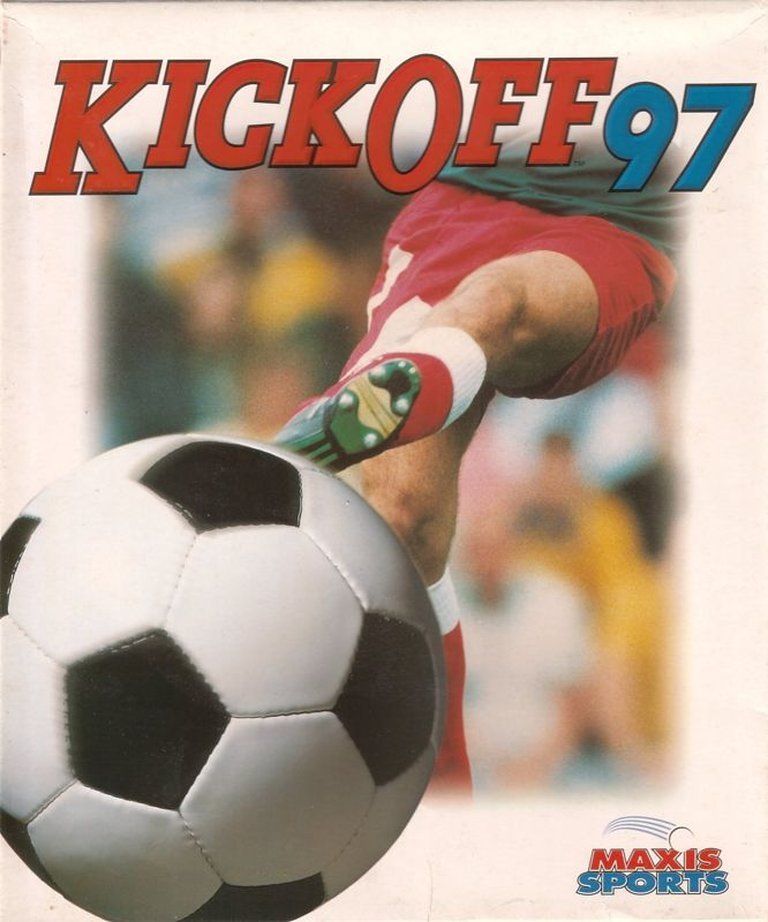
Description
Kick Off 97 is a football (soccer) game released in 1997 for Windows and DOS, offering players the choice between realistic 3D environments with motion-captured animations or a classic 2D arcade style. The game features an extensive selection of 307 teams and 5,200 players, including real-life athletes like Patrick Vieira, David Seaman, and Ian Wright, and allows for the creation of custom teams, leagues, and cups. It includes intelligent computer opposition, replay-saving functionality, and adjustable speed and graphics settings to enhance gameplay.
Gameplay Videos
Kick Off 97 Free Download
PC
Kick Off 97 Patches & Updates
Kick Off 97 Reviews & Reception
oldpcgaming.net : It’s easy to get into Kick Off ’97. And easier still to get tired of it
Kick Off 97: Review
Introduction
In the pantheon of football gaming, few names evoke as much nostalgia and debate as Kick Off. The series, pioneered by Dino Dini, revolutionized the genre with its fluid aftertouch mechanics and lightning-fast pace on the Amiga. By 1997, however, the landscape had shifted dramatically. Enter Kick Off 97, developed by Anco Software and published by Maxis, tasked with resurrecting the legacy in a 3D world dominated by giants like FIFA 97 and Actua Soccer. This review deconstructs Kick Off 97 not merely as a game, but as a cultural artifact—a flawed, ambitious artifact caught between the arcade soul of its forebears and the demands of a new era. Our thesis: Kick Off 97 is a paradox—a technically ambitious yet mechanically compromised attempt to modernize a classic, offering fleeting brilliance marred by systemic flaws that cement its status as a fascinating historical footnote rather than a timeless classic.
Development History & Context
Kick Off 97 emerged from the ashes of a once-dominant franchise. Anco Software, never a studio known for technological innovation, partnered with Maxis (fresh off the success of SimCity) to bridge the gap between the series’ revered 2D arcade roots and the burgeoning 3D revolution. The vision, spearheaded by lead programmer Steve Screech and a team of 21 developers, was to merge the Kick Off ethos of “blazing action” (as lauded by Computer Gaming World) with multimedia flair: motion-captured animations of real-life stars like Patrick Vieira, David Seaman, and Ian Wright, and a roster of 307 teams and 5,200 players.
Technologically, the game operated within the constraints of 1997 DOS/Windows. It eschewed the full 3D polygons of competitors for a hybrid approach: a “realistic 3D environment” with multiple camera angles, including a diagonal-down perspective reminiscent of Kick Off 2, alongside a classic 2D mode. This dual-view system was both a tribute and a concession—acknowledging that hardware limitations (486/66 CPU, 8MB RAM) often made 3D sluggish. The gaming landscape was brutal: FIFA 97’s licensed glamour and Actua Soccer’s 3D prowess dominated shelves. Anco’s gamble was that Kick Off’s signature gameplay could survive the transition to polygons—a bet that would prove spectacularly uneven.
Narrative & Thematic Deep Dive
Unlike story-driven RPGs, football games thrive on simulated narrative—the drama of the match itself. Kick Off 97 attempts to layer authenticity onto its arcade core through multimedia touches. The inclusion of Jim Rosenthal’s commentary (the legendary F1 presenter now better known for apologies over ad breaks than punditry) adds verisimilitude, but as Edge noted, it was “occasionally dodgy.” Rosenthal’s lines, recorded with a British sports-radio flair, inject personality but clash with the game’s AI-induced chaos.
Thematically, the game grapples with identity. Is it an arcade experience or a simulation? This tension permeates every match. The fast, fluid passing and aftertouch mechanics scream “arcade,” but the 3D visuals, realistic player names, and tactical options (create leagues, cups, custom teams) push toward simulation. This dissonance creates a thematic void. There’s no overarching plot, but the subtext is clear: a legacy fighting obsolescence. The motion-captured players (Vieira, Seaman, Wright) symbolize the attempt to anchor the fantasy in real-world credibility, yet their digital avatars often move with the uncanny stiffness of the era’s tech, embodying the game’s central conflict: ambition vs. execution.
Gameplay Mechanics & Systems
Kick Off 97’s gameplay is a study in contrasts. Its core control scheme—one button for shooting, one for passing, with context-sensitive combinations—echoes the series’ minimalist elegance. This simplicity allows for emergent brilliance: lobs, volleys, and headers emerge from player positioning, rewarding skill over complex button combos. As PC Player noted, the 2D view retained “the snörkellose Kick Off 97” charm, with fast, intuitive duels.
Yet this elegance is undermined by systemic flaws. The AI, praised by Computer Gaming World for being “deft,” was universally criticized for inconsistency. Online Gaming Review called it “superhuman” at times, with teams executing “traumwandlerische Sicherheit beim Paßspiel” (dreamlike pass accuracy) even as weaker nations like the Faroe Islands committed baffling errors (e.g., passing back for an own goal). Goalkeeping was a recurring disaster. PC Action lamented keepers who “never hold when you need them most,” while Gamesmania.de mocked their tendency to “fumble or fall over” during routine saves.
The 3D view exacerbated these issues. While offering a “slightly elevated side-on perspective” praised by Old PC Gaming, it often felt cluttered. Defending was “tricky,” as players found themselves “trailing in the wake” of attackers after a single wrong turn. The speed, PC Player admitted, could make play “hektisch” (frenzied), with players like the Netherlands’ Robin van Persie (not in-game, but illustrative) being “flown off” the pitch unrealistically. Customization was robust—leagues, teams, player creation—but couldn’t salvage the core gameplay loop, which devolved into frustration against the AI or elation in two-player matches.
World-Building, Art & Sound
Kick Off 97’s world is one of curated realism. With 307 teams and 5,200 players, it aimed to mirror global football’s breadth. Creating custom leagues or cups fostered a sense of ownership, letting players build their own footballing narratives. The stadiums, while not licensed, were rendered with diagonal-down perspectives that approximated TV coverage, enhancing immersion.
Artistically, the game was a technological compromise. The 3D models, featuring motion-captured animations, showed meticulous detail (e.g., Vieira’s tackles, Seaman’s dives). Old PC Gaming noted the “dazzling” close-ups on the box, but in practice, the graphics were “naive” or “surrealist” (Power Play), with occasional glitches like disappearing balls (MyAbandonware). The 2D view, praised for its clarity, offered a cleaner alternative. Sound design was functional: PC Music’s effects replicated crowd noise and thuds, but Rosenthal’s commentary became repetitive and occasionally out of sync with the action. This sensory mix—detailed 3D, functional audio—created a world that looked the part but often failed to feel alive.
Reception & Legacy
Kick Off 97’s reception was a microcosm of its gameplay: flashes of brilliance, overshadowed by nagging flaws. Critics lauded its ambition and gameplay. Gameplay (Benelux) called it a “geduchte concurrent” (formidable rival) to FIFA 97, while PC Player awarded it 80%, praising its “schnörkellose” (unadorned) fun. Computer Gaming World hailed it as “excellent,” citing “blazing action” and “detailed animation.” Yet the criticism was damning. Adrenaline Vault infamously advised: “Do not buy this game. Don’t play it if someone gives it as a gift. Use the CD as a coaster.” Gamesmania.de scored it 50%, lamenting the “unnötig verzögert” (unnecessarily delayed) gameplay and “hanebüchen” (absurd) player behavior. Player reviews were muted, with a 3.3/5 average reflecting niche appeal.
Legacy-wise, Kick Off 97 was a bridge to nowhere. It failed to dethrone FIFA or Actua Soccer, and the Kick Off series continued its decline with Kick Off 98 within months. Its influence was minimal, though its hybrid approach (2D/3D) anticipated later genre experiments. Today, it’s remembered as a cautionary tale: a sequel that prioritized technical gloss over the soul of its predecessor. As Old PC Gaming summarized, it’s “easy to get into… and easier still to get tired of.”
Conclusion
Kick Off 97 is a game of two halves: one brimming with the anarchic joy of classic Kick Off, the other shackled by the limitations of its era and design. It captures the series’ DNA—the fluidity, the aftertouch, the speed—but struggles to reconcile it with 3D realism. Its ambition is admirable, its execution uneven. The AI’s inconsistencies, goalkeeping follies, and technical roughness prevent it from being the “uncontested ruler” (Online Gaming Review) it aspired to be. Yet, it remains a vital artifact. In its flawed hybridity, it embodies the late-90s football gaming scene—a chaotic transition from arcade to simulation, where heritage and innovation clashed.
Verdict: Kick Off 97 is not a classic, but it is a compelling one. It’s the work of a studio clinging to greatness, a game that gleams with potential yet falters under its own weight. For historians, it’s a fascinating relic of football gaming’s awkward adolescence. For players, it’s a curio—worth revisiting for its 2D purity but ultimately overshadowed by the giants that defined its time. In the end, Kick Off 97’s legacy is not victory, but a valiant, flawed attempt to keep the dream alive.