
- Release Year: 1997
- Platforms: DOS, Windows
- Publisher: Dinamic Multimedia, S.A., Funsoft GmbH
- Developer: Anco Software Ltd.
- Genre: Sports
- Perspective: 3rd-person
- Game Mode: Hotseat, LAN, Single-player
- Gameplay: ANCO Challenge, appearance editor, Cup, Friendly, Name, Network play, Practice, Quick start, Warm up, World Cup
- Setting: Football (European), Soccer
- Average Score: 57/100
Description
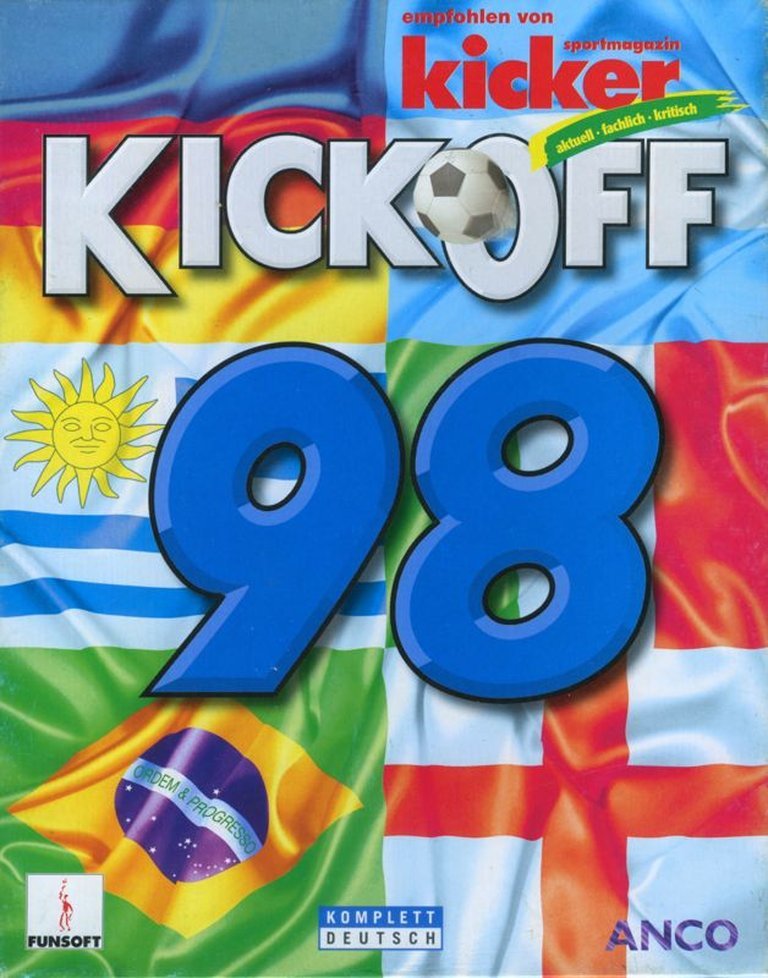
Kick Off 98 is a soccer simulation game released in 1997, capitalizing on the excitement of the upcoming 1998 World Cup. It features international teams and a variety of game modes, including practice sessions, quick matches, cup competitions, and a World Cup mode. The game also includes a unique ANCO Challenge, where players face increasingly difficult opponents, as well as network multiplayer and customization options for team names and appearances. Localized for several European markets, Kick Off 98 offers a mix of arcade-style gameplay and tactical depth, though its reception was mixed due to issues like unrealistic ball physics and inconsistent localization.
Kick Off 98 Free Download
PC
Kick Off 98 Patches & Updates
Kick Off 98 Reviews & Reception
en.wikipedia.org (97/100): Best computer game ever
mobygames.com (57/100): Average score: 57%
oldgames.sk (20/100): reviewer/author: Ondřej Malý, rating/score: 20%
mobygames.com (57/100): Average score: 57%
Kick Off 98: A Legacy of Frustration and Nostalgia
Introduction
In the pantheon of football video games, few franchises have elicited as much passion—and polarization—as Kick Off. The series, which began in 1989 with Dino Dini’s revolutionary top-down soccer simulation, became synonymous with fast-paced, skill-based gameplay that prioritized player control over scripted animations. By the time Kick Off 98 arrived in late 1997, the franchise was a shadow of its former self, struggling to compete with the rising dominance of FIFA and Sensible Soccer. Yet, Kick Off 98 remains a fascinating artifact—a game that, despite its flaws, encapsulates the turbulent transition of sports gaming in the late ’90s.
This review will dissect Kick Off 98 in exhaustive detail, exploring its development history, gameplay mechanics, reception, and legacy. We’ll examine why it failed to recapture the magic of its predecessors, how it fared against contemporaries, and what its existence tells us about the evolution of football games. Whether you’re a nostalgic fan, a historian of gaming’s golden age, or simply curious about the road not taken, Kick Off 98 offers a compelling case study in ambition, missteps, and the relentless march of progress.
Development History & Context
The Rise and Fall of a Dynasty
The Kick Off series was born in 1989, when Dino Dini, a young programmer with a passion for football, created a game that defied conventions. Unlike other soccer titles of the era—where the ball often “stuck” to players’ feet—Kick Off introduced a physics-driven model where the ball moved independently, requiring precise timing and skill. This innovation, combined with a top-down perspective and lightning-fast gameplay, made it an instant classic on the Amiga and Atari ST. Critics lavished praise upon it, with Amiga Format calling it the “best footy game to have appeared on any machine” and The One hailing it as the “ultimate soccer simulation.”
The sequel, Kick Off 2 (1990), refined the formula, adding tactical depth, improved AI, and a more polished presentation. It, too, was a critical darling, cementing the series’ reputation as the gold standard for football simulations. However, the franchise’s trajectory took a sharp turn in 1992 when Dini left Anco Software to join Virgin Games, where he developed Goal!, a spiritual successor that blended Kick Off’s mechanics with Sensible Soccer’s one-touch passing.
Anco, now without its visionary creator, pressed on. Kick Off 3 (1994), developed by Steve Screech, abandoned the series’ signature top-down view for a side-scrolling perspective—a decision that alienated fans and critics alike. The game was panned for its clunky controls and lack of innovation, marking the beginning of the franchise’s decline.
The Late ’90s: A Crowded Field
By 1997, the football gaming landscape had evolved dramatically. FIFA: Road to World Cup 98, with its 3D graphics, licensed teams, and polished presentation, dominated the market. Sensible Soccer remained a beloved arcade-style alternative, while Actua Soccer and International Superstar Soccer offered their own takes on the beautiful game. Anco, desperate to stay relevant, released Kick Off 97 earlier in the year—a modest improvement over Kick Off 3 but still far from the glory days.
Kick Off 98 was conceived as a direct response to the 1998 World Cup, a common marketing strategy in sports gaming. Developed by Anco Software and published by Dinamic Multimedia (with Funsoft handling the German release), the game was localized for multiple European markets, including Germany, Spain, Italy, and Portugal. However, as noted in MobyGames’ trivia section, the Portuguese localization was riddled with errors, mixing Spanish and Portuguese text and featuring poorly edited commentary—a sign of the rushed development cycle.
Technological Constraints and Design Choices
Kick Off 98 was built for DOS and Windows, with a 3D graphics engine developed by John Mitchell. The game utilized motion capture technology (provided by Televirtual) to animate players, a notable step forward from the sprite-based animations of earlier entries. However, the transition to 3D was not seamless. The game’s visuals were criticized for being outdated even by 1997 standards, with PC Action describing the graphics as “hinking der derzeitigen Entwicklung hinterher” (“lagging behind current development”).
The development team, led by Steve Screech (who had worked on Kick Off 3 and Player Manager), faced the daunting task of modernizing a franchise that had lost its identity. Without Dini’s guiding vision, Anco struggled to innovate. The result was a game that felt like a Frankenstein’s monster of ideas—part simulation, part arcade, but never fully committing to either.
Narrative & Thematic Deep Dive
The Illusion of Storytelling in Sports Games
Football games, by their nature, are not narrative-driven experiences. Unlike RPGs or adventure games, they rely on emergent storytelling—moments of triumph, despair, and drama that unfold during gameplay. Kick Off 98, however, makes no attempt to weave a narrative. There are no player careers, no managerial sagas, no underdog tales. The game is a pure, unadulterated simulation of matches, with all storytelling left to the player’s imagination.
That said, the game’s structure does imply a thematic focus: the pursuit of mastery. The inclusion of a “Warm Up” mode, where the AI opponent’s difficulty scales as the player improves, suggests an emphasis on skill progression. The “ANCO Challenge,” which pits players against increasingly tough opponents, further reinforces this theme. Kick Off 98 is, at its core, a game about learning, adapting, and overcoming—even if its execution leaves much to be desired.
The Absence of Personality
One of the most glaring omissions in Kick Off 98 is the lack of player personalities or team identities. Unlike FIFA 98, which featured real-world stars like David Beckham and Ronaldo, Kick Off 98 uses generic, unlicensed teams. While this was common in budget sports titles of the era, it robs the game of emotional investment. There’s no joy in scoring with a faceless “Striker A” when you could be netting a winner with Alan Shearer.
The commentary, too, is devoid of charm. Critics noted its repetitive nature, with PC Action mocking the announcer’s tendency to declare, “Dieser Paß traf genau seinen Mann!” (“This pass found its man!”) at the most inopportune moments. The lack of dynamic commentary—something FIFA was beginning to perfect—makes matches feel sterile and disconnected from the drama of real football.
The Ghost of Dino Dini
Perhaps the most compelling “narrative” in Kick Off 98 is the specter of Dino Dini himself. His absence looms large over the game, a reminder of what once was. The original Kick Off was a labor of love, a game built by a football fanatic who understood the nuances of the sport. By 1997, Anco was churning out sequels to meet market demands, and it showed. Kick Off 98 feels like a game made by committee, lacking the passion and precision of its predecessors.
Gameplay Mechanics & Systems
Core Gameplay: A House Divided
Kick Off 98 attempts to blend the arcade sensibilities of Sensible Soccer with the simulation depth of Kick Off 2, but it never fully commits to either philosophy. The result is a schizophrenic experience that frustrates as often as it delights.
Ball Physics: A Double-Edged Sword
The game’s most contentious mechanic is its ball physics. Unlike FIFA, where the ball behaves predictably, Kick Off 98’s ball bounces and ricochets with a mind of its own. PC Games (Germany) criticized the “unrealistische Ballphysik” (“unrealistic ball physics”), noting that it often led to frustrating, unpredictable outcomes. Shots that should sail into the net might inexplicably veer wide, while weak clearances could somehow evade defenders.
This unpredictability harkens back to the original Kick Off, where mastering the ball’s behavior was part of the challenge. However, in Kick Off 98, it often feels less like a test of skill and more like a dice roll.
Dribbling: A Broken Promise
One of the game’s touted features is its dribbling system. In theory, players could perform intricate dribbles to bypass defenders. In practice, the system was clunky and unreliable. GameStar (Germany) dismissed it as “lächerlich” (“ridiculous”), arguing that it added nothing to the gameplay. The animation for dribbling was stiff, and the controls lacked the precision needed to pull off complex maneuvers.
Shooting and Passing: Hit or Miss
Shooting in Kick Off 98 is a mixed bag. The game allows for power and direction control, but the lack of feedback makes it difficult to gauge shots accurately. Passing, too, suffers from inconsistency. While the game includes a “one-touch” passing option (a nod to Sensible Soccer), the execution is sluggish, making quick build-up play nearly impossible.
Goalkeeping: A Comedy of Errors
If there’s one aspect of Kick Off 98 that unites critics in scorn, it’s the goalkeeping. PC Action noted that keepers often failed to react to shots, standing motionless as the ball sailed past them. Worse, they struggled with basic tasks like catching high balls or rushing off their line. This flaw turns matches into farcical affairs, where goals are scored less through skill and more through exploiting the AI’s incompetence.
Game Modes: Quantity Over Quality
Kick Off 98 offers a plethora of game modes, but few feel fully realized:
- Practice Mode: Allows players to hone specific skills (corners, free kicks, dribbling). While a nice inclusion, the stiff controls make it difficult to improve meaningfully.
- Warm Up Mode: A dynamic difficulty system where the AI adapts to the player’s skill level. In theory, this is a great idea; in practice, the AI’s behavior is erratic, oscillating between incompetent and unfairly overpowered.
- Quick Start/Friendly: Standard exhibition matches. The lack of licensed teams or customization options makes these modes feel hollow.
- Cup/World Cup: Tournament modes that suffer from the same issues as friendly matches, compounded by the absence of any meaningful progression or rewards.
- ANCO Challenge: A ladder-style mode where players face increasingly difficult opponents. This is the closest the game comes to a “campaign,” but the lack of narrative or context makes it feel like a grind.
- Network Play: A rare feature for 1997, allowing modem-based multiplayer. However, given the game’s niche appeal, it’s unlikely many players ever used it.
- Name/Appearance Editor: A rudimentary tool for customizing teams. Given the game’s lack of licenses, this is a necessary inclusion, but the options are limited and uninspired.
AI and Tactics: A Missed Opportunity
One of the original Kick Off’s strengths was its tactical depth. Players could adjust formations, set piece strategies, and even account for referee temperaments. Kick Off 98 retains some of these features, but they feel tacked on rather than integral.
The AI, in particular, is a major weak point. Opponents exhibit little strategic nuance, often resorting to mindless attacking or passive defending. Meristation noted that the game “no se ocupa de tener en cuenta puntos tales como la moral de los jugadores, calidad de los masajistas, economía del equipo” (“does not take into account aspects such as player morale, quality of physiotherapists, team economy”)—a stark contrast to Player Manager, which blended management and gameplay seamlessly.
User Interface: A Relic of the Past
The UI in Kick Off 98 is functional but dated. Menus are cluttered, and navigation is unintuitive. The lack of mouse support in some versions (despite the game being released for Windows) is a baffling oversight. Micro Hebdo criticized the need to “jongler entre les différentes vues” (“juggle between different views”), noting that the radar-style minimap was often the only way to keep track of the action.
World-Building, Art & Sound
Visuals: Stuck in the Past
Kick Off 98’s graphics are a curious mix of ambition and obsolescence. The game uses a 3D engine, but the player models are blocky and poorly animated. The pitches are flat and lifeless, lacking the detail of contemporaries like Actua Soccer. PC Jeux lamented the lack of 3Dfx optimization, a missed opportunity that could have given the game a much-needed visual boost.
The camera angles are another point of contention. The default perspective is a high, zoomed-out view that makes it difficult to track individual players. While alternative angles are available, none feel ideal. The lack of a dynamic camera—something FIFA 98 used to great effect—further dates the experience.
Sound Design: A Symphony of Repetition
The audio in Kick Off 98 is functional but unremarkable. The commentary, provided by PC Music and recorded by Flying Dutchman Co, is sparse and repetitive. As PC Joker noted, the announcer’s lines are often cropped or poorly edited, particularly in the Portuguese localization. The crowd noise is generic, and the in-game sound effects (kicks, tackles, whistles) lack impact.
The soundtrack, too, is forgettable. Unlike FIFA 98, which featured a licensed soundtrack with tracks from Blur and other artists, Kick Off 98’s music is a series of generic, looped tunes that do little to enhance the atmosphere.
Atmosphere: The Ghost of Stadiums Past
Football games live and die by their ability to recreate the atmosphere of a live match. Kick Off 98 fails spectacularly in this regard. The lack of licensed teams, generic stadiums, and lifeless crowds make matches feel like sterile simulations rather than thrilling contests. There’s no sense of occasion, no tension, no drama—just 22 digital avatars chasing a pixelated ball.
Reception & Legacy
Critical Reception: A Tale of Two Extremes
Kick Off 98’s reception was as divided as its gameplay. Some critics, like PC Jeux, praised its “bonnes surprises” (“good surprises”), particularly its training mode and multiplayer options. Others, like GameStar (Germany), were brutal in their assessment, calling it “die ernüchterndsten Stunden meiner PC-Fußballkarriere” (“the most sobering hours of my PC football career”).
A breakdown of critical scores reveals the disparity:
| Publication | Platform | Score | Verdict |
|---|---|---|---|
| PC Jeux | DOS/Win | 88% | Praised training mode, criticized lack of 3Dfx optimization. |
| Meristation | Win | 70% | “A distracted game” that focuses on spectacle over depth. |
| PC Games (Germany) | Win | 61% | Unrealistic ball physics and pointless dribbling mar an otherwise solid game. |
| Gameplay (Benelux) | DOS/Win | 56% | “A waste of money and energy.” |
| PC Action (Germany) | Win | 55% | Mocked the commentary, ball physics, and goalkeeper AI. |
| GameStar (Germany) | Win | 46% | “No idea how proper football should look.” |
| PC Joker | DOS/Win | 41% | “A demolition of a legend.” |
| PC Player (Germany) | DOS/Win | 38% | Frustrating controls and poor AI. |
The player reception was equally lukewarm, with an average score of 2.5/5 on MobyGames. Many fans of the original series were dismayed by the direction Anco had taken, while newcomers found little to recommend over FIFA or ISS.
Commercial Performance: A Niche Within a Niche
Kick Off 98 was not a commercial success. While exact sales figures are unavailable, its poor critical reception and lack of marketing push suggest it sold modestly at best. The game’s legacy is one of obscurity, remembered primarily by die-hard fans of the series and retro gaming enthusiasts.
Influence and Legacy: The End of an Era
Kick Off 98 marked the end of Anco’s attempts to revive the franchise. The following year, Kick Off World (1998) was released for the PlayStation, but it, too, failed to make an impact. The series would not see another major release until Kick Off 2002, a disastrous attempt to modernize the formula that sold a paltry 5,000 copies.
The original Kick Off’s influence, however, cannot be overstated. Its physics-based gameplay inspired countless imitators, and its emphasis on skill over scripting set a standard for sports games. Dino Dini’s later work, including Goal! and Kick Off Revival (2016), attempted to recapture the magic, but none achieved the same cultural impact.
Today, Kick Off 98 is a footnote in gaming history—a cautionary tale about the dangers of resting on past glories. It serves as a reminder that even the most beloved franchises can lose their way when innovation gives way to complacency.
Conclusion: A Flawed Relic of a Bygone Era
Kick Off 98 is not a good game by any objective measure. Its controls are clunky, its AI is braindead, its visuals are outdated, and its presentation is lifeless. Yet, it is not without merit. The training mode is a standout feature, offering a rare opportunity for players to hone their skills in a structured environment. The multiplayer, while limited, provides a glimmer of the competitive fun that made the original Kick Off so beloved.
But these bright spots are overshadowed by the game’s myriad flaws. Kick Off 98 is a victim of its time—a transitional title caught between the past and the future, unable to fully embrace either. It is neither a faithful successor to Kick Off 2 nor a bold reinvention of the formula. Instead, it is a compromised, half-hearted effort that satisfies neither purists nor casual players.
Final Verdict: 5/10 – A Nostalgic Curiosity, But Little More
For historians and retro enthusiasts, Kick Off 98 is a fascinating artifact—a snapshot of a franchise in decline. For everyone else, it is a relic best left in the past. Its legacy is not one of greatness, but of what might have been. Had Anco embraced innovation rather than clinging to nostalgia, Kick Off 98 could have been a triumph. Instead, it stands as a testament to the dangers of stagnation in an industry that demands evolution.
In the grand tapestry of football gaming, Kick Off 98 is a minor thread—a reminder that even the mightiest franchises can stumble. But for those who remember the glory days of Kick Off 2, it remains a bittersweet echo of a time when soccer games were defined not by licenses or graphics, but by the sheer joy of play.