
- Release Year: 2004
- Platforms: PlayStation 2, Wii, Windows
- Publisher: Bold Games, Data Design Interactive Ltd, Metro3D Europe Ltd., Phoenix Games Ltd.
- Developer: Data Design Interactive Ltd
- Genre: Hockey, Sports
- Game Mode: Co-op, Single-player
- Average Score: 25/100
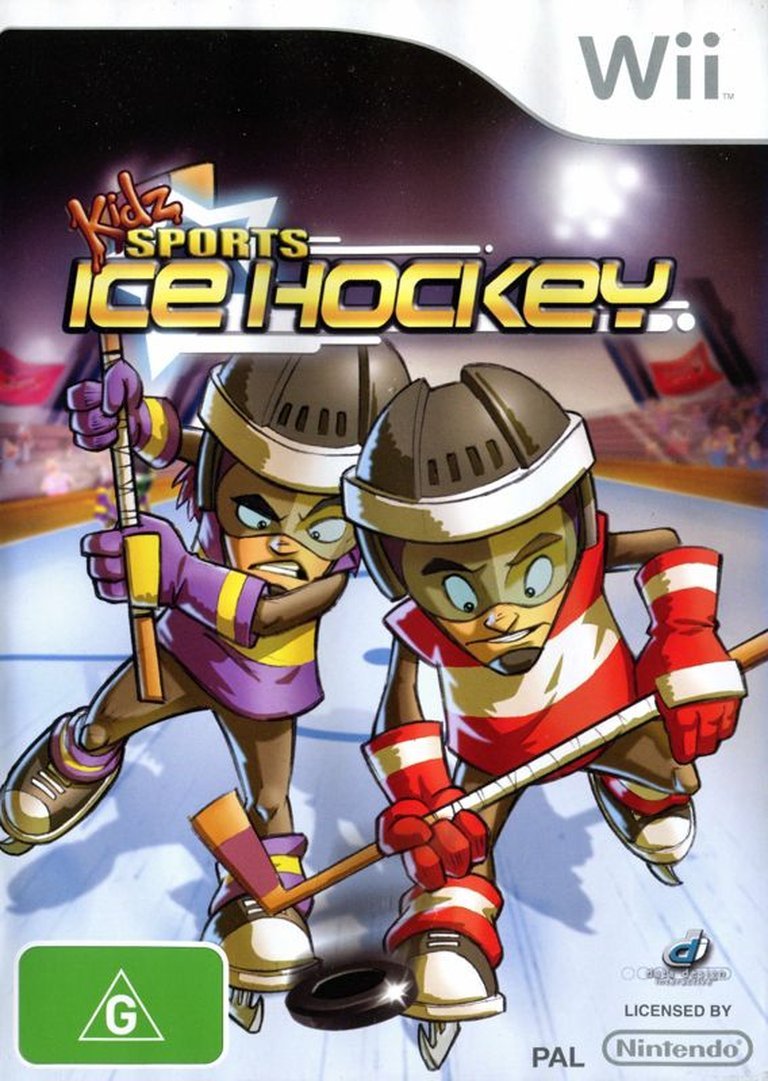
Description
Kidz Sports: Ice Hockey is a simplified, family-oriented sports game from the Kidz Sports series, designed to introduce young players to ice hockey with easy-to-pick-up mechanics. Set in a bright, cartoonish ice rink, it offers arcade-style gameplay for single-player or local multiplayer matches, emphasizing fun over simulation.
Gameplay Videos
Kidz Sports: Ice Hockey Free Download
PlayStation 2
Kidz Sports: Ice Hockey Reviews & Reception
ign.com : Wii’s first hockey game sets the bar very, very low.
metacritic.com (20/100): There isn’t a single redeeming quality in this package. Don’t bother.
Kidz Sports: Ice Hockey Cheats & Codes
PlayStation 2 (PAL)
| Code | Effect |
|---|---|
| 9026FE60 0C09BF40 | |
| 9024D494 0C099221 | |
| 90134750 0C09DA4A |
Kidz Sports: Ice Hockey: A Study in Failed Accessibility and the Bottom of the Barrel
Introduction: The “Coolest” Ice Hockey Game Ever?
In the vast and varied landscape of sports video games, some titles strive for photorealistic simulation, while others aim for chaotic, pick-up-and-play fun. Kidz Sports: Ice Hockey, developed by Data Design Interactive and released in 2004 for the PlayStation 2 before seeing ports to Windows and the Wii, purports to be the latter. Its official marketing promises “wackiest games of ice hockey ever,” “wild zany action,” and the chance to “become the coolest Ice Hockey team ever to hit the ice!” This review, however, must confront a stark and dissenting reality: the game is almost universally remembered not for its fun, but as a canonical example of development at its most cynically cheap and creatively bankrupt. By analyzing its historical context, hollow mechanics, and devastating reception, we uncover not a forgotten gem, but a crucial case study in how not to design a children’s sports game. Its legacy is not one of influence, but of infamy—a stark warning about the perils of prioritizing minimal cost over any semblance of player enjoyment.
Development History & Context: The Budget Factory
Kidz Sports: Ice Hockey was birthed from Data Design Interactive (DDI), a UK-based studio with a clear business model: producing low-budget, quickly developed games for the value and bargain bin markets. The mid-2000s saw publishers like Phoenix Games, Metro3D, and later Bold Games and ValuSoft, actively seeking cheaply produced titles to fill store shelves, particularly targeting casual players and parents with children. The game was developed using Renderware, a common middleware engine of the era that allowed for rapid, cross-platform development with minimal graphical fidelity. This technological “constraint” was less a limitation and more a deliberate cost-saving measure.
The game was the second entry in the nascent Kidz Sports series, following Kidz Sports Basketball (2004) and preceding International Soccer and Crazy Mini Golf. The series’ “vision,” if it can be called that, was to create simplified, arcade-style sports games featuring stylized, “kid” characters. The context is one of aggressive commodification; the series represents the budget end of the family/sports genre, where the primary innovation was in packaging and branding rather than gameplay. The same core team of roughly 12-16 developers (including Lead Designer/Programmer Chris Bell and Producer Stewart Green) would recycle assets, engines, and code across these titles and other low-budget projects like the Myth Makers series, maximizing output with minimal creative investment.
Narrative & Thematic Deep Dive: An Absence of Story
To speak of a narrative or thematic deep dive in Kidz Sports: Ice Hockey is to engage with a void. The game presents no plot, no character arcs, no dialogue, and no setting beyond generic ice rinks. The “Kidz Sports characters” referenced in the ad blurb are not individuals with personalities but generic, poorly modeled avatars distinguishable only by jersey color. There is no tournament storyline, no exaggeration of youth sports drama, no humorous vignettes. The thematic promise of “wild zany action” is not explored through narrative but is instead relegated to a few poorly implemented special moves.
The game’s only implied theme is one of extreme simplification: it strips ice hockey of almost all strategy, physicality, and nuance. However, this simplification is not presented as a charming abstraction (like Mario Strikers) but as a failure of design. The resulting experience is thematically empty—it is not a satire of sports, nor a joyous celebration of playground hockey. It is merely a hollow shell, a checklist of features (teams, stadiums, a cup mode) with no soul, context, or reason to exist beyond filling a SKU.
Gameplay Mechanics & Systems: A Fractured Foundation
The core promise is “pick-up-and-play,” a noble goal for a children’s sports title. The control scheme on the Wii (using the Remote and Nunchuk) and PS2 aims for simplicity: one button for passing/shooting, another for speed boosts or “Super Moves.” This simplicity, however, collapses under the weight of broken fundamental systems.
-
Core Gameplay Loop: The loop is broken from the first puck drop. Player movement on ice lacks any sense of momentum or friction; skating feels like sliding on a frictionless surface, making precise positioning impossible. Passing and shooting mechanics are unresponsive and inconsistent. The game’s alleged “Super Moves”—chip shots, power shots, jumping—are gated behind a “SKILL points” meter that fills haphazardly. Even when triggered, their execution is visually jarring and mechanically pointless, often failing to provide a tangible advantage due to the game’s chaotic physics and AI.
-
AI & Balance: The AI is rudimentary to the point of being non-functional. Opponents exhibit either passive, aimless wandering or hyper-aggressive, teleporting harassment. There is no gradation of difficulty that feels fair or based on skill. The “Knockout Cup” and league modes mentioned in the ad blurb are rendered meaningless by the fact that every match feels like a random, frustrating scramble rather than a contest of skill.
-
Rules & Presentation: The game claims to present hockey “with a pinch of salt,” but it fundamentally misunderstands what makes hockey fun. There is no offside, no icing, and penalties seem arbitrary or non-existent. Yet, it also lacks the clear, arcade-style power-ups or over-the-top violence that could justify its departure from realism. It exists in a no-man’s-land: too basic for sim fans, too broken and ugly for arcade fans. The UI is cluttered and ugly, and the “8 fantastic stadiums” are indistinguishable, low-polygon arenas with repetitive textures.
-
Multiplayer: The 1-2 player local multiplayer is the only redeeming potential, as human opponents can create their own fun. However, the underlying control issues and broken physics ensure that any competition is rooted in frustration with the game itself, not friendly rivalry.
World-Building, Art & Sound: Aesthetics of Neglect
The visual presentation is the game’s most notorious aspect and a primary reason for its scorn. Using the Renderware engine to its absolute cheapest limit, Ice Hockey is a masterclass in bad PS2/Wii-era graphics.
-
Visual Direction: Character models are blocky, with poorly textured jerseys and faces that look like melted clay. The ice surface is a flat, shimmering blue plane lacking any reflections, scratches, or texture. Arenas are composed of a handful of repeated, low-polygon bleachers and advertising boards. The color palette is garish and washed out. The “zany” aesthetic is not one of stylized cartoon charm (like Rocket League or Mario Strikers) but of sheer technical poverty. Animations are stiff, jarring, and frequently clip through geometry. The overall effect is not charmingly retro but visually offensive, looking worse than many contemporaneous indie titles.
-
Sound Design: The audio is equally cheap. Sound effects for puck hits, skates, and crowd noise are tinny, repetitive, and clearly sourced from the cheapest sample libraries. The soundtrack, if one can call it that, consists of a few loops of generic, upbeat rock/pop music that becomes grating within minutes. There is no commentary, no dynamic audio cues for exciting plays—just a bland, forgettable backdrop that underscores the game’s total lack of atmosphere.
These elements do not contribute to a cohesive experience; they actively undermine it. The ugly visuals and annoying sounds create a constant sensory punishment that distracts from any minimal gameplay, making the entire package feel unloved and disposable.
Reception & Legacy: The Infamy of “Don’t Bother”
Kidz Sports: Ice Hockey did not just receive negative reviews; it was savaged by them, achieving a mythical status among “worst of” lists.
-
Critical Reception: IGN’s 2008 Wii review by Bozon is the game’s enduring epitaph: “There isn’t a single redeeming quality in this package. Don’t bother.” This 1.0/10 score (matching the rating given to the Basketball entry) is a blanket condemnation of its Every facet. Other critics echoed this, with Metacritic listing a “tbd” metascore due to insufficient reviews, a sign of its complete obscurity. The few user ratings on MobyGames average a dire 1.5/5. Review aggregators and “worst games” features (like IGN’s own “Worst Reviewed Nintendo Console Games”) have consistently featured it as a prime example of shovelware.
-
Commercial Legacy: As a budget title, its commercial impact was likely minimal and short-lived, sold in bargain bins and discount retailers. Its true legacy is as a cautionary tale. It represents the nadir of the “value” market—where cost-cutting was applied to every aspect of design, programming, and art, resulting in a product that fails even the most basic definition of playable fun. It stands in stark contrast to other accessible sports games of the era, from the polished simplicity of Mario Sports Mix to the chaotic but functional NFL Blitz series.
-
Influence: The game had no positive influence on the industry. Its sole contribution is as a benchmark for low quality. It demonstrated that releasing a game with such fundamental flaws was commercially viable—for a time—in the crowded, low-awareness budget sector. Its modern relevance lies in retrospectives about bad games and the importance of core gameplay loops, serving as the antithesis of a well-crafted casual experience.
Conclusion: A Case Study in Failure
Kidz Sports: Ice Hockey is not a game that warrants analysis for its brilliance, but for its profound failure. It is a product of a specific, cynical development ethos: use a cheap engine, recycle assets and code, target a non-discriminating demographic (parents buying for kids), and hope the low price point masks the catastrophic lack of quality.
Its thesis—providing a fun, accessible hockey experience for children—is utterly betrayed by every line of code and polygon. The controls are unresponsive, the physics are broken, the visuals are painful, and the audio is grating. It offers no “zany” charm because it lacks the polish or creative spark to make its absurdity enjoyable. It is not so bad it’s good; it is simply bad.
In the grand history of video games, Kidz Sports: Ice Hockey occupies a necessary, if ignoble, position. It is a ghost in the machine of sports gaming—a reminder that accessibility and simplicity do not equate to low quality, and that even budget titles must respect fundamental game design principles. Its final, definitive verdict is the one IGN bestowed upon it: “Don’t bother.” To study this game is to study a void, a black hole of fun where all elements of game design collapse. It is, quite simply, one of the worst sports games ever made.