
- Release Year: 1998
- Platforms: Windows
- Publisher: Cosmi Corporation
- Developer: Cosmi Corporation
- Genre: Action
- Perspective: 3rd-person
- Game Mode: Single-player
- Gameplay: High Score, Mouse control, Shooter
- Setting: Insects, Space
- Average Score: 66/100
Description
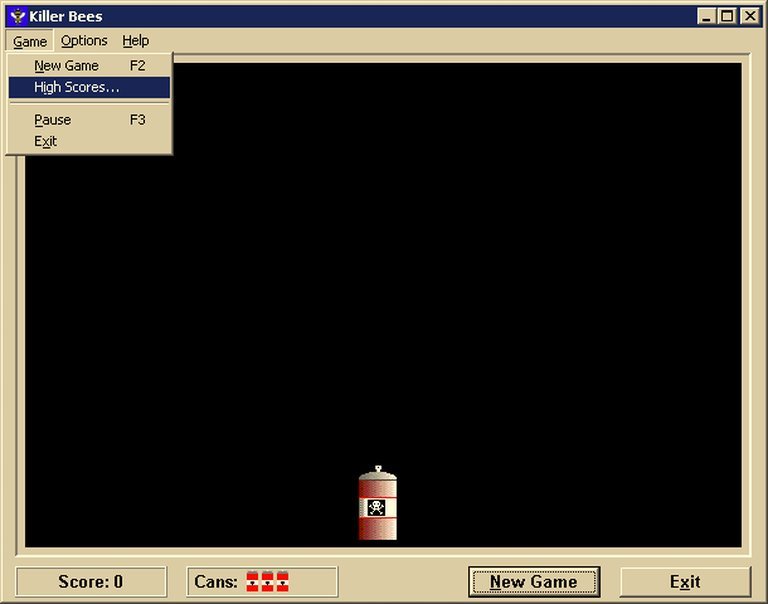
Killer Bees is a 1998 single-player shoot ’em up for Windows that reimagines classic space-based games like Galaxian by substituting alien ships with swarms of bees. Players control a ship at the bottom of the screen using only a mouse, launching insecticide to blast descending bees and accumulate high scores, with optional sound featuring ‘The Flight of the Bumblebee’ and a focus on simple, arcade-style action.
Killer Bees Reviews & Reception
odyssey2.info (82/100): But whatever you want to call it, there’s no denying it’s fun.
Killer Bees! (1983): The Odyssey²’s Insectoid Masterpiece
Introduction: A Sting in the System’s Tale
In the vast, often overlooked library of the Magnavox Odyssey², one title hums with a peculiar, defiant energy. Killer Bees! is not merely another shooter; it is a compact, frenetic vortex of innovative design, technical ingenuity, and sheer, unadulterated chaos. While its 1998 Windows namesake—a derivative, mouse-controlled Galaxian clone with insect skins—faded into bargain-bin oblivion with a paltry 33% critic score, the original 1983 Odyssey² cartridge, conceived by programmer Robert S. “RoSHa” Harris, stands as a landmark of early ’80s creativity. This review argues that Killer Bees! is a profoundly influential, ahead-of-its-time classic whose intricate systems, hidden depths, and relentless pace carved a unique niche in video game history, representing both the zenith of the Odyssey²’s potential and a poignant “what if” for a system cut down by market forces.
Development History & Context: The Second Wave at Magnavox
To understand Killer Bees!, one must understand the fractured, corporate odyssey of the Odyssey² itself. The console’s first programming group, led by Ed Averett, was disbanded by Magnavox around 1978 after the company decided video games were a passing fad, not a TV sales driver. Averett, an Intel salesman turned prolific auteur, continued to write games independently, producing classics like K.C. Munchkin! amidst legal battles. By 1981, following Philips’ acquisition of the Magnavox brand, a second group was formed in Knoxville, Tennessee, under Sam Overton, a veteran from the original team. Bob Harris, recruited from Milton Bradley where he’d worked on speech synthesis and TI-99/4A games, joined this new cadre.
The technical landscape was one of brutal constraint. The Odyssey²’s 8048 CPU ran at a mere 5.37 MHz (NTSC), with a paltry 4KB of ROM space per cartridge. As Harris noted in his seminal interview, “the hardware was not very sophisticated. Consumer electronics in those days meant ‘make it as cheap as you can’.” The system’s voice synthesizer was notoriously limited, and graphics were handled by a pair of 8×8 sprites and a static background layer. Yet, within these walls, Harris and his small team (including artist Ed Hensley) labored, often using an HP 64000 development system mounted on plywood. Killer Bees!, developed circa 1982-83, emerged from this environment as one of the final first-party Odyssey² titles before Philips shut down the division in 1984/85. Its later European release for the Philips G7000/G7400+ featured enhanced background graphics, but the core code, Harris insists, remained identical across regions—a testament to its solid foundational design.
Narrative & Thematic Deep Dive: Absurdist Invasion Lore
Killer Bees! presents a narrative so delightfully pulpish it borders on satire. The backstory, delivered through a brief manual or attract mode text, explains that Earth is under invasion by the insect civilization of planet BEM. Their agents, the “BEEBOTS”—robots impervious to conventional weaponry—are terrorizing the planet. Their tactic? Running around haphazardly in enclosed areas. Earth’s last defense? Swarms of ordinary bees. You control a “solitary swarm of ‘good’ bees,” trailing two ray guns (the “RoSHa Ray”), to sting the Beebots to death.
This is not a story of epic heroism but of surreal, bureaucratic warfare. The Beebots’ strategy is nonsensical; the solution is entomological. The theme is one of absurd escalation: to defeat a robot army, you unleash a biological agent. The grave markers left by defeated Beebots—grim little tombstones—add a morbid, gallows-humor touch. The game’s tagline, which used the phrase “Totally different!” twice, wasn’t just marketing fluff; it was a honest admission that here was a shoot-’em-up that rejected space ships and aliens for a bizarre, earth-bound bug battle. The lore, while simple, creates a cohesive, memorable world where the stakes are both planetary and utterly ridiculous.
Gameplay Mechanics & Systems: A Symphony of Gradual Intensity
Deconstructing Killer Bees! reveals a masterclass in layered, emergent gameplay from minimalist components.
The Core Loop & Beebot Behavior: The playfield is a simple rectangle. Beebots (red and blue) move in straight lines, turning 90 degrees upon hitting walls or grave markers. Their movement is governed by Harris’s key innovation: gradual acceleration. Unlike contemporaneous shooters where objects moved at fixed 1-2 pixels per frame, Beebots incrementally speed up (e.g., from 3/16 to 48/16 pixels per frame). This creates an “illusion” of ever-increasing chaos without taxing the CPU. A lightly stung Beebot slows, allowing you to herd it. A dead Beebot becomes an immovable, strategic obstacle that reroutes surviving bots, transforming the battlefield in real-time. You don’t just shoot; you architect the field’s topology.
The Enemy Swarm Lifecycle: Guarding the Beebots are the titular “Killer Bees,” spawning from hives at the screen edges. They exist in three evolutionary states:
1. Green Meanies: Slow, erratic, and easy to avoid.
2. Blue Bodyguards: They attach to a Beebot or grave, shielding it from your sting. You must wait for them to detach, during which they may…
3. Mutate into Red Devils: Homing attackers that make a “beeline” for your swarm. Contact means instant death.
This creates a brutal triage system. Do you ignore a guarded Beebot to recharge your ray? Do you risk zapping a Blue swarm early, knowing it will respawn as a Green Meanie but possibly spawn a Red Devil later? The pressure is constant.
The RoSHa Ray & Resource Management: Your only offensive tool against the bees (not the Beebots) is the RoSHa Ray, a horizontal laser burst. It charges only when you successfully sting a Beebot. This creates a vicious cycle: to defend yourself, you must attack Beebots, but attacking Beebots alters the field and may attract more bee swarms. It’s a perfect, tense feedback loop of risk and reward.
Progressive Difficulty & “The Wall”: The game features 26 levels. The primary scaling is speed; by level 20+, the Beebots reach velocities that feel impossible on other contemporary systems (though Harris clarifies this is due to the fractional acceleration trick, not raw CPU power). The true “wall” is not a specific level but the compounded chaos of multiple Red Devil swarms on a field clogged with graves.
Hidden Systems & Cheat Codes: Killer Bees! is a treasure trove of developer secrets, uncovered over a decade after release:
* Debug Modes: 1+RESET enables slow-motion (for debugging/learning). 2+RESET grants invincibility.
* Credits & Easter Eggs: Entering specific symbols (+, -, *, /, ., ?, =) in the high-score initials displays team member codes (RLC, SRO, JMB, AWP, REX, RSH).
* The “Beeline” Verification System: The = code generates a unique, score-dependent algorithm. Harris’s visionary idea was for players to submit scores with this code for contest verification, a pre-internet anti-fraud measure dismissed by marketing. This is a staggering piece of foresight, hidden in a 4KB cartridge.
World-Building, Art & Sound: Punching Above the Hardware Weight
The Odyssey² was no graphical powerhouse, yet Killer Bees! achieves a distinct, functional aesthetic.
Visual Design: The screen is a stark, black void with a white rectangular border. Sprites are simple, blocky bees (white for player, colored for enemies) and square Beebots. The genius lies in animation and proportion. Swarms are represented by 2-3 tightly-grouped sprites, creating a convincing “cloud” effect. The Beebots’ turning motion is clear. Most impressively, the attract mode features a pulsating, rotating triangle of shifting colors—a technical hack Harris discovered by exploiting the system’s scan cycle limitations. “We thought it could be an attention grabber,” he said, “that it gave the illusion that the O2 could do some better graphics.” It’s a silent declaration of intent.
Sound & The Voice Synth: The sound design is iconic. The main theme is Rimsky-Korsakov’s “Flight of the Bumblebee,” a perfect, thematically resonant marriage of classical music and gameplay. The Odyssey²’s Voice module emits the unforgettable, staticky “bee buzz” as swarms move and the plaintive, synthesized “Oh!” upon player death. While rudimentary, these sounds are intensely evocative and uniquely tied to the game’s identity. The “Voice” score in community reviews is often lower, but its charm is inseparable from the experience.
Atmosphere: The combination of simple graphics, relentless sound, and escalating speed creates a uniquely stressful, arcade-like atmosphere. It feels less like a cartoon and more like a desperate, high-stakes extermination mission. The European G7400+ version added a detailed, static background of a suburban neighborhood, which some feel grounds the absurdity, but the original’s abstract void arguably focuses pure, unadorned tension.
Reception & Legacy: A Cult Classic’s Long Sting
Contemporary Reception: Killer Bees! arrived near the end of the Odyssey²’s commercial life (1983). It was not a mainstream hit. The sole critic review cited by MobyGames, from German magazine PC Player (scoring 33%), called it “recht langweilig” (quite boring) and visually unimpressive—a perspective that likely stemmed from judging it against more advanced systems or expecting a different genre. However, within the tight-knit Odyssey² community, its reputation soared. Reviews on dedicated sites like odyssey2.info consistently rate it 4+/5, praising its addictive intensity and originality. William Cassidy’s review perfectly captures its essence: an arcade-style game that leaves you “drained,” with “26 levels of challenge” and gameplay that is “just hard to classify.”
Evolving Legacy & Influence: Killer Bees!‘s legacy is twofold:
1. A Technical & Design Benchmark: It demonstrated the Odyssey² could host a fast, deep, systemically rich action game. Its gradual acceleration trick and dynamic obstacle creation were innovative. Harris’s high-score verification system, though unused, was a conceptually brilliant solution to a common problem.
2. A Preservation Darling: The 1996 rediscovery of its cheat codes by Thomas Becker and subsequent 1999 interview with Bob Harris via Dieter Koenig’s “Games That Weren’t” article became a classic preservation story. It illuminated the hidden culture of developer Easter eggs on “conservative” systems and provided an invaluable primary source on Odyssey² development. The game is now a permanent exhibit in the museum of classic gaming history.
3. Cultural Footprint: It inspired a surprising number of thematic successors (Bubble Bees, Pocket Bees, Angry Space Bees), though none captured its specific magic. Its mention in The Vid Kid’s Book of Home Video Games cemented its cult status.
The 1998 Windows Killer Bees by Ron Paludan, a simplistic Galaxian clone included in the “Top 20 Solid Gold” compilation and Multimedia Algebra, serves only as a confusing namesake, a ghost of the original’s ambition. Its obscurity is total, a stark contrast to the enduring fascination with its 1983 predecessor.
Conclusion: An Undisplaced Masterpiece
Killer Bees! for the Magnavox Odyssey² is a profound anomaly: a game that feels utterly of its time—clinging to a dying console in a collapsing market—yet possesses mechanics so clever and tension so pure that it transcends its era. It is a粒 of concentrated game design, where every element (acceleration, guard-swarm lifecycle, grave-markers) interlocks to create a brutal, cerebral, and exhilarating experience. Bob Harris and his team, working with crude tools and severe limitations, engineered not just a game but a Living System. Its hidden cheats and verification code reveal a programmer who thought like a hacker and a marketer, even if his bosses didn’t listen.
Its commercial failure and the console’s demise are tragedies of business, not design. In the pantheon of shoot-’em-ups, it stands beside Centipede and Robotron not in visual fidelity, but in raw, mechanical genius. Killer Bees! is not a forgotten relic; it is a discovered artifact, humming with a complex, intelligent life that proves the greatest constraints can breed the most original creations. It is, quite simply, one of the best and most important games ever made for the Odyssey², and a lasting testament to the power of “Totally different.”
Final Verdict: 5/5 — A pioneering, deeply systemic classic that redefines what was possible on the Odyssey². The 1998 Windows game, however, is a forgettable footnote. Seek out the original.