
- Release Year: 2004
- Platforms: Windows
- Publisher: .theprodukkt GmbH
- Developer: .theprodukkt GmbH
- Genre: Action
- Perspective: 1st-person
- Game Mode: Single-player
- Gameplay: Arcade, Shooter
- Setting: Futuristic, Sci-fi
- Average Score: 49/100
Description
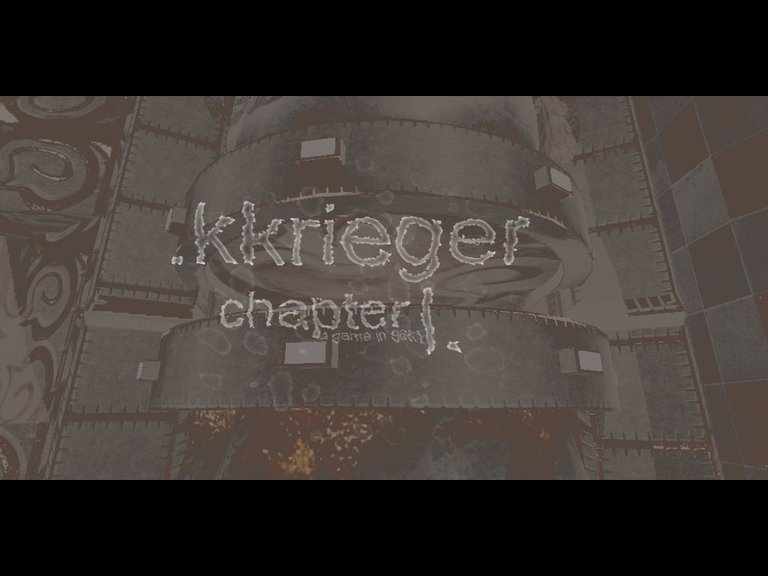
.kkrieger: Chapter 1 is a groundbreaking first-person shooter created for the Breakpoint Demoscene Party’s 96k Game Competition in 2004. Designed to showcase the power of procedural programming, the entire game is compressed into just 97,280 bytes, yet delivers a fully functional 3D experience with enemies, weapons, and power-ups. Set in a sci-fi environment, the game features stunning lighting effects, inverse kinematics for animated monsters, and a haunting ambient soundtrack, all while maintaining a compact size that defies traditional game development norms.
Gameplay Videos
.kkrieger: Chapter 1 Mods
.kkrieger: Chapter 1 Guides & Walkthroughs
.kkrieger: Chapter 1 Reviews & Reception
mobygames.com (74/100): A triumphant return to form for the series.
metacritic.com (0/100): juego del 2004 que se vendio como juego muy optimizado pero requeria un hardware de muy potente para el momento
mobygames.com (74/100): A triumphant return to form for the series.
.kkrieger: Chapter 1 Cheats & Codes
PC
During gameplay, press the following keys:
| Code | Effect |
|---|---|
| M + [1-9] | Teleports the player to a corresponding part of the level. |
| M + N | Reloads health, maxes out ammo and weapons. |
| K | Deals 10 points of damage to the player. |
| Y | Causes the camera to ‘bob’ upside down; done in a correct tempo, the player can levitate. |
.kkrieger: Chapter 1: A Technical Marvel in a Tiny Package
Introduction
In the annals of video game history, few titles stand as boldly as .kkrieger: Chapter 1—a game that defies expectations not through sprawling narratives or cutting-edge graphics, but through sheer technical audacity. Released in 2004 by the German demogroup .theprodukkt (a subdivision of Farbrausch), .kkrieger is a first-person shooter that fits entirely within a 97,280-byte executable—a feat that remains astonishing even decades later. This review explores the game’s development, its procedural brilliance, its gameplay mechanics, and its enduring legacy as both a technological showcase and a playful experiment in game design.
Development History & Context
.kkrieger was born from the 2004 Breakpoint Demoscene Party’s 96k Game Competition, a challenge that pushed developers to create functional games within a minuscule file size. The team at .theprodukkt, leveraging their proprietary tool .werkkzeug3, embraced procedural generation to achieve the impossible: a fully playable FPS with dynamic lighting, enemy AI, and weapon mechanics—all compressed into less than 100 KB.
At the time, mainstream shooters like Doom 3 and Unreal Tournament 2004 required gigabytes of storage. .kkrieger’s existence was a direct rebuttal to the industry’s bloating trends, proving that clever programming could rival brute-force asset storage. The game’s source code, later released under the 2-clause BSD license, revealed its secrets: textures and models were generated algorithmically at runtime, while sound effects and music were synthesized on the fly using a MIDI-driven engine.
Narrative & Thematic Deep Dive
.kkrieger eschews traditional storytelling. There are no cutscenes, no dialogue, and no lore—just a nameless protagonist navigating a surreal, industrial labyrinth. The “narrative” emerges from environmental cues: flickering lights, eerie graffiti, and the occasional glimpse of a monstrous silhouette. The game’s minimalism invites players to project their own interpretations, whether it’s a dystopian facility overrun by experiments or a digital purgatory.
Thematically, .kkrieger is a celebration of constraints. Its brevity (a mere 10 rooms) and linear design underscore its purpose as a proof-of-concept rather than a full-fledged experience. The lack of a crosshair, the repetitive enemy spawns, and the abrupt ending all serve as reminders that this is a demo—a love letter to the demoscene’s ethos of “less is more.”
Gameplay Mechanics & Systems
Core Loop
.kkrieger’s gameplay is stripped to its essence:
– Movement: Standard WASD controls with mouse-aiming.
– Combat: A trio of weapons (a pistol, a shotgun, and a “light-ball” launcher) face off against three enemy types: crawling insects, horned demons, and hulking brutes.
– Progression: Linear corridors with scripted enemy encounters and occasional power-ups.
The combat is functional but unremarkable. Enemies charge head-on, and ammunition is scarce, forcing players to prioritize shots. The lack of a crosshair (a deliberate omission) adds tension, as players must rely on spatial awareness to land hits.
Flaws & Innovations
- Procedural Generation: The game’s greatest strength is also its Achilles’ heel. While textures and models are generated dynamically, the level design is static and repetitive. The same 10 rooms recycle with minor variations, and collision detection is occasionally wonky.
- Performance: Despite its tiny size, .kkrieger demands surprisingly robust hardware for 2004 standards (a 1.5GHz Pentium III and a GeForce 4 Ti were recommended). The real-time asset generation strains older systems, a trade-off for its compact footprint.
World-Building, Art & Sound
Visual Design
.kkrieger’s aesthetics are a study in procedural artistry. Textures are generated via noise algorithms, giving walls a gritty, organic feel. Lighting is the star: dynamic shadows stretch across corridors, and colored light sources bathe the environment in an eerie glow. The result is a game that feels larger than its file size suggests, though the repetitive geometry betrays its limitations.
Audio
The soundtrack, composed by Tammo Hinrichs (kb), is a haunting ambient piece reminiscent of Quake’s industrial dread. Sound effects—gunfire, monster growls, and environmental hums—are synthesized in real time, adding to the game’s uncanny atmosphere.
Reception & Legacy
.kkrieger won the 2004 Breakpoint competition and later earned two German Developer Awards (2006) for innovation. Critics praised its technical prowess but noted its lack of depth. Player reviews were mixed: some marveled at its ingenuity, while others dismissed it as a “tech demo with guns.”
Its legacy endures in two ways:
1. Procedural Generation: .kkrieger predated mainstream procedural games like No Man’s Sky and Minecraft, proving that algorithms could replace handcrafted assets.
2. Demoscene Influence: It remains a touchstone for indie developers and demoscene artists, inspiring projects like .kkrieger’s spiritual successor, .theprodukkt’s unreleased Chapter 2.
Conclusion
.kkrieger: Chapter 1 is not a “great game” in the traditional sense. It is, however, a great experiment—a testament to what happens when creativity collides with constraints. Its 97 KB footprint is a middle finger to bloated AAA titles, and its procedural magic still dazzles today.
Final Verdict: 7/10 – A must-play for tech enthusiasts and demoscene historians, but a curiosity for casual gamers. Download it, marvel at its audacity, and then move on—just as the developers intended.
“It’s like shooting a glowing hamburger at a goat-Satan hybrid. What’s not to love?” — Gargaj, MobyGames review.