
- Release Year: 2019
- Platforms: Macintosh, Nintendo Switch, Windows
- Publisher: Hybrid Squad Co., Ltd., Minimol Games, QUByte Interactive Ltda.
- Developer: Minimol Games
- Genre: Puzzle
- Perspective: Diagonal-down
- Game Mode: Single-player
- Gameplay: Board game, Turn-based
- Average Score: 81/100
Description
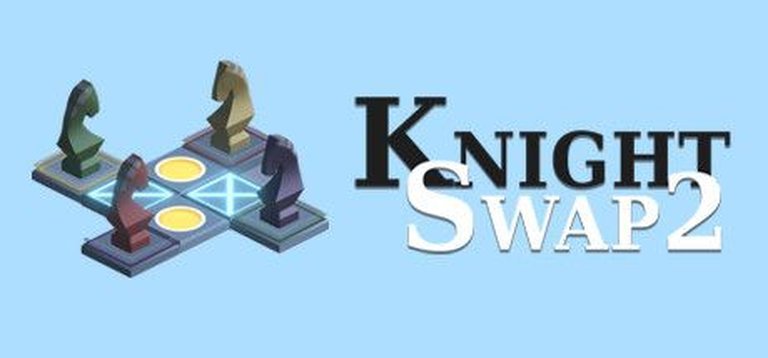
Knight Swap 2 is a turn-based puzzle game where players strategically move knights across a chess-like board to swap their positions. With a minimalist, isometric design and challenging mechanics, the game builds on its predecessor by introducing more levels and intricate gameplay elements, blending logic and strategy in a casual yet engaging experience.
Gameplay Videos
Where to Buy Knight Swap 2
PC
Knight Swap 2 Guides & Walkthroughs
Knight Swap 2 Reviews & Reception
keengamer.com : A stress-free atmosphere that makes it easy to escape the world for a few moments (or hours) each day.
opencritic.com (70/100): This mixture of chess and movement puzzles can appeal to those who like to rack their brains with visual puzzles.
metacritic.com (90/100): Knight Swap 2 offers a wonderfully unique puzzling challenge to fans of the genre while keeping things simple enough for anybody to enjoy.
steambase.io (85/100): Knight Swap 2 has earned a Player Score of 85 / 100.
Knight Swap 2: A Minimalist Masterpiece of Puzzle Design
Introduction
In the vast ocean of puzzle games, where complexity often drowns accessibility, Knight Swap 2 emerges as a beacon of elegant simplicity. Developed by Minimol Games and released in December 2019, this sequel to the original Knight Swap refines and expands upon its predecessor’s core mechanics, delivering a meditative yet challenging experience that transcends its modest presentation. At its heart, Knight Swap 2 is a love letter to the timeless logic of chess, distilled into a turn-based puzzle game where the goal is deceptively straightforward: swap the positions of opposing knights on a grid. Yet, beneath this simplicity lies a labyrinth of mechanical depth, where each new level introduces subtle twists that transform the gameplay into a cerebral dance of strategy and foresight.
This review will dissect Knight Swap 2 in exhaustive detail, exploring its development history, narrative (or lack thereof), gameplay systems, artistic direction, and its place in the broader puzzle genre. By the end, it will become clear why this unassuming title has carved out a niche as one of the most underrated puzzle games of its era—a game that proves less can indeed be more.
Development History & Context
The Studio Behind the Knights
Minimol Games, the indie studio responsible for Knight Swap 2, is a relatively small but ambitious developer with a focus on minimalist, mechanics-driven games. Their portfolio includes titles like Super Chibi Knight and the original Knight Swap, all of which share a common philosophy: strip away the superfluous and let the gameplay shine. Knight Swap 2 is a direct evolution of this ethos, building on the foundation laid by its 2019 predecessor.
The original Knight Swap was a modest success, praised for its clever adaptation of chess mechanics into a puzzle format. However, it was also criticized for its limited scope and lack of mechanical variety. Knight Swap 2 was conceived as a response to these critiques, aiming to expand the game’s depth while retaining its accessible core. According to interviews and developer notes, the team at Minimol Games sought to create a game that could appeal to both casual players and hardcore puzzle enthusiasts—a balancing act that required meticulous design and iteration.
Technological Constraints and Design Philosophy
Knight Swap 2 was developed using the Unity engine, a choice that allowed the team to rapidly prototype and refine its mechanics. The game’s minimalist aesthetic was not just a stylistic preference but a deliberate design decision to ensure clarity and focus. Every element on the screen serves a purpose, and the absence of unnecessary visual noise allows players to concentrate solely on the puzzle at hand.
The game’s turn-based, grid-based nature also reflects the constraints of its development. Unlike action-heavy puzzlers that rely on real-time reflexes, Knight Swap 2 is a game of pure logic, where every move is deliberate and reversible (though the lack of an undo button in the initial release was a notable oversight, as highlighted in community discussions). This design philosophy aligns with the studio’s broader mission to create games that are easy to learn but difficult to master.
The Gaming Landscape at Launch
Knight Swap 2 entered a crowded market in late 2019. The puzzle genre was dominated by titles like The Witness, Baba Is You, and Return of the Obra Dinn, all of which offered deep, narrative-driven experiences. In contrast, Knight Swap 2 positioned itself as a no-frills, mechanics-first puzzle game—a refreshing counterpoint to the increasingly complex and story-heavy puzzlers of the time.
Its release on Steam, followed by a Nintendo Switch port in May 2020, allowed it to reach a broader audience. The Switch, in particular, proved to be an ideal platform for the game’s pick-up-and-play nature, making it a perfect fit for the console’s portable, bite-sized gaming sessions. The game’s reception on both platforms was overwhelmingly positive, with players praising its addictive gameplay and relaxing atmosphere.
Narrative & Thematic Deep Dive
The Absence of Story
Knight Swap 2 is a game that eschews traditional narrative in favor of pure gameplay. There are no characters to speak of, no dialogue, and no overarching plot. Instead, the game’s “story” is told through its mechanics and level design, with each new puzzle serving as a chapter in an evolving challenge.
This minimalist approach to storytelling is not a flaw but a feature. By removing narrative distractions, Knight Swap 2 allows players to fully immerse themselves in the act of solving puzzles. The game’s themes—patience, strategy, and perseverance—are conveyed not through words but through the gradual escalation of difficulty and the introduction of new mechanics.
The Chess Analogy
The game’s core mechanic is rooted in the movement of the knight in chess: an L-shaped jump that allows the piece to move two squares in one direction and then one square perpendicular. This movement is the foundation of every puzzle in Knight Swap 2, and the game’s brilliance lies in how it iterates on this simple rule.
The chess analogy extends beyond movement. Like chess, Knight Swap 2 is a game of foresight, where players must anticipate the consequences of each move several steps ahead. The absence of a narrative allows the game to focus entirely on this strategic depth, making it a pure expression of puzzle design.
The Zen of Puzzle-Solving
Knight Swap 2 is often described as a “zen” experience, and this description is apt. The game’s minimalist visuals, soothing soundtrack, and methodical gameplay create an atmosphere of calm focus. There are no time limits, no penalties for failure, and no pressure to perform. The game invites players to take their time, to experiment, and to enjoy the process of solving each puzzle.
This zen-like quality is further enhanced by the game’s lack of traditional “progression.” While the levels do increase in difficulty, there is no overarching goal beyond the satisfaction of solving each puzzle. This makes Knight Swap 2 a rare breed of game that is both challenging and relaxing—a paradox that few titles achieve.
Gameplay Mechanics & Systems
Core Gameplay Loop
At its core, Knight Swap 2 is a game about swapping the positions of two knights on a grid. The knights move in the classic L-shaped pattern of their chess counterparts, and the goal is to maneuver them into each other’s starting positions. This simple premise is the foundation for a surprisingly deep puzzle experience.
The game’s 100 levels are divided into several sections, each introducing new mechanics that build on the previous ones. Early levels are straightforward, teaching players the basics of knight movement and board navigation. As the game progresses, however, it introduces a variety of mechanics that add layers of complexity:
- Teleportation Tiles: These tiles allow knights to instantly move to another designated tile on the board, adding a spatial dimension to the puzzles.
- Rotating Boards: Some levels feature boards that can be rotated, requiring players to reconsider their approach from multiple angles.
- Movable Parts: Certain tiles or sections of the board can be shifted, creating dynamic puzzles where the environment itself is part of the solution.
- Linked Knights: In later levels, knights may be linked together, forcing them to move in unison and adding a layer of coordination to the puzzles.
The Evolution of Mechanics
One of the most impressive aspects of Knight Swap 2 is how it introduces and iterates on its mechanics. New elements are introduced gradually, with each level serving as a tutorial for the next. For example, the game might introduce a teleportation tile in one level, then combine it with a rotating board in the next, and finally add a movable part in the following level. This incremental approach ensures that players are never overwhelmed, even as the puzzles become increasingly complex.
The game’s difficulty curve is expertly crafted. Early levels are accessible to newcomers, while later levels offer a significant challenge even to experienced puzzle solvers. This balance is achieved through the careful introduction of new mechanics and the gradual escalation of complexity.
Control Schemes and Accessibility
Knight Swap 2 supports multiple control schemes, including keyboard, mouse, and gamepad. On the Nintendo Switch, it also supports touch controls, which are particularly well-suited to the game’s grid-based nature. However, as noted in community discussions, the touch controls can sometimes be imprecise, leading to accidental moves that require players to restart the level.
The game’s lack of an undo button in its initial release was a notable oversight, as it forced players to restart levels if they made a mistake. This was particularly frustrating in later levels, where a single misstep could derail an entire solution. Fortunately, later updates addressed this issue, adding an undo feature that significantly improved the game’s accessibility.
The Role of Music and Sound
The game’s soundtrack is a minimalist composition that complements its visual style. The music is soft, ambient, and repetitive, designed to fade into the background and create a calming atmosphere. While some players might find the lack of musical variety monotonous, the soundtrack’s simplicity is intentional, serving to enhance the game’s meditative qualities.
Sound effects are equally understated, with subtle cues for knight movements and puzzle completions. These audio elements are functional rather than decorative, ensuring that players can focus on the puzzles without distraction.
World-Building, Art & Sound
Visual Design: Less Is More
Knight Swap 2’s visual design is a masterclass in minimalism. The game’s aesthetic is defined by clean lines, simple shapes, and a muted color palette. The knights are represented as abstract figures, and the board is a grid of unadorned tiles. This minimalist approach ensures that the gameplay remains the sole focus, with no visual clutter to distract from the puzzles.
The game offers multiple color schemes, allowing players to customize the visual experience to their preferences. These schemes include options for colorblind players, ensuring that the game is accessible to a wide audience. The ability to switch between color schemes also adds a layer of personalization, allowing players to tailor the game’s appearance to their tastes.
Atmosphere and Immersion
Despite its abstract visuals, Knight Swap 2 creates a surprisingly immersive atmosphere. The game’s minimalist design, combined with its soothing soundtrack, fosters a sense of calm focus that is rare in modern gaming. There are no flashy animations, no elaborate cutscenes, and no unnecessary distractions—just the player and the puzzle.
This atmosphere is further enhanced by the game’s pacing. Levels are short and self-contained, making it easy to play in brief sessions or extended marathons. The lack of a narrative or progression system means that players can jump in and out of the game at their leisure, making it an ideal title for casual play.
Sound Design: The Power of Subtlety
The game’s sound design is as minimalist as its visuals. The soundtrack consists of a single, looping ambient track that is designed to be unobtrusive. The music’s repetitive nature might seem like a flaw, but it is intentional, serving to create a consistent mood that enhances the game’s meditative qualities.
Sound effects are equally subtle, with soft chimes and clicks accompanying knight movements and puzzle completions. These effects are functional rather than decorative, providing feedback without drawing attention to themselves. The result is a sound design that complements the gameplay without overwhelming it.
Reception & Legacy
Critical and Commercial Reception
Knight Swap 2 was met with positive reviews upon its release, with critics praising its clever mechanics, relaxing atmosphere, and accessible yet challenging gameplay. On Steam, the game holds an “Overwhelmingly Positive” rating, with 87% of user reviews recommending it. The Nintendo Switch version, published by QUByte Interactive, also received favorable reviews, with critics highlighting its suitability for portable play.
The game’s reception was particularly strong among puzzle enthusiasts, who appreciated its depth and mechanical variety. However, some critics noted that the game’s minimalist approach might not appeal to players seeking a more narrative-driven experience. Despite this, Knight Swap 2 has developed a dedicated fanbase, with players praising its addictive gameplay and relaxing atmosphere.
Influence and Legacy
While Knight Swap 2 has not had the same cultural impact as larger puzzle games like The Witness or Baba Is You, it has carved out a niche as a beloved indie title. Its success has demonstrated that there is still a market for mechanics-driven puzzle games, even in an era dominated by narrative-heavy experiences.
The game’s influence can be seen in the growing popularity of minimalist puzzle games, which prioritize gameplay over storytelling. Titles like A Good Snowman Is Hard To Build and Gorogoa share Knight Swap 2’s focus on simplicity and mechanical depth, suggesting that the game’s approach has resonated with both players and developers.
Conclusion
Knight Swap 2 is a triumph of minimalist design, a game that proves that complexity and depth can emerge from the simplest of premises. Its clever mechanics, relaxing atmosphere, and accessible yet challenging gameplay make it a standout title in the puzzle genre. While it may lack the narrative ambition of larger puzzlers, its focus on pure gameplay ensures that it remains a timeless experience.
In an era where games are increasingly judged by their storytelling and graphical fidelity, Knight Swap 2 is a refreshing reminder that great games can be built on the foundation of strong mechanics and thoughtful design. It is a game that rewards patience, strategy, and perseverance, and it deserves a place in the pantheon of great puzzle games.
Final Verdict: 9/10 – A minimalist masterpiece that proves less can indeed be more.