
- Release Year: 2001
- Platforms: Linux, Macintosh, Windows
- Publisher: 1C Company, BestBuys Interactive BV, Blackstar Interactive GmbH, Snowball.ru, ZUXXEZ Entertainment AG
- Developer: Joymania Development
- Genre: Strategy, Tactics
- Perspective: Top-down
- Game Mode: LAN, Online PVP, Single-player
- Gameplay: Base building, Real-time strategy, Resource Management
- Setting: Medieval
- Average Score: 72/100
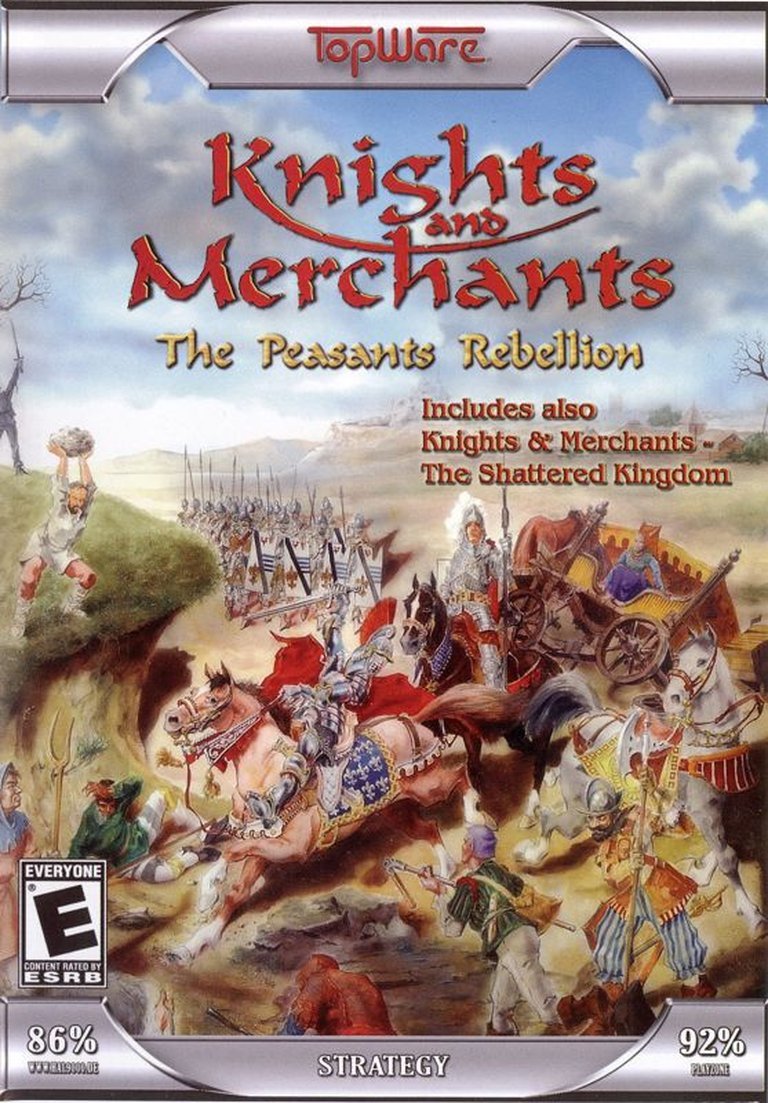
Description
Knights and Merchants: The Peasants Rebellion is a real-time strategy game set in a medieval world, where players must build and manage a thriving settlement while defending it against enemy forces. As an expanded re-release of the original Knights and Merchants: The Shattered Kingdom, it includes the original campaign, a new campaign with 34 missions, and a skirmish mode, offering a blend of city-building, resource management, and tactical combat.
Gameplay Videos
Where to Buy Knights and Merchants: The Peasants Rebellion
PC
Knights and Merchants: The Peasants Rebellion Free Download
Knights and Merchants: The Peasants Rebellion Patches & Updates
Knights and Merchants: The Peasants Rebellion Guides & Walkthroughs
Knights and Merchants: The Peasants Rebellion Reviews & Reception
gog.com (86/100): A triumphant return to form for the series.
metacritic.com (74/100): The game is just a Masterpiece. Yeah, gameplay and game design of its are outdated, but it is still hella complex and strategy-directed, that is cool.
mobygames.com (67/100): A fun little game. I spent an absolute age trying to find this game, and in my opinion it was worth it.
knights-and-merchants-the-peasants-rebellion.en.softonic.com (64/100): It is not perfect, but is a nice trip down memory lane.
Knights and Merchants: The Peasants Rebellion Cheats & Codes
PC
Click on the crossbow in the inventory of a warehouse to mark it with a red triangle. Then click on the horse symbol to increase all goods by 10, or click on the fish bucket to instantly win the current mission.
| Code | Effect |
|---|---|
| Click on the crossbow, then click on the horse symbol | Increases all goods by 10 |
| Click on the crossbow, then click on the fish bucket | Instantly win the current mission |
| F8 | Triples the current game speed (Turbo Mode) |
Knights and Merchants: The Peasants Rebellion: A Comprehensive Retrospective
Introduction
In the pantheon of real-time strategy (RTS) games, Knights and Merchants: The Peasants Rebellion (2001) occupies a unique and often underappreciated niche. Developed by Joymania Entertainment and published by ZuXXeZ Entertainment, this standalone expansion to Knights and Merchants: The Shattered Kingdom (1998) is a fascinating artifact of late-1990s and early-2000s RTS design. It is a game that defies many conventions of its genre, prioritizing deep economic simulation and logistical complexity over the fast-paced, combat-centric gameplay that dominated the era. This review aims to dissect The Peasants Rebellion in exhaustive detail, exploring its development history, narrative depth, gameplay mechanics, artistic direction, and enduring legacy.
Development History & Context
The Studio and the Vision
Joymania Entertainment, a German developer, was founded in the mid-1990s and quickly gained a reputation for creating meticulously detailed strategy games. Their debut title, Knights and Merchants: The Shattered Kingdom, was a critical and commercial success, praised for its innovative approach to RTS gameplay. Unlike contemporaries such as Age of Empires or Warcraft, Joymania’s vision was to create a game where economic management was not merely a precursor to combat but an integral, ongoing challenge. The studio’s ethos was rooted in realism and complexity, aiming to simulate the intricacies of medieval life rather than romanticize it.
Technological Constraints and Era
The Peasants Rebellion was developed during a transitional period in gaming. The late 1990s and early 2000s saw the rise of 3D graphics, with games like Age of Empires II and The Settlers IV pushing the boundaries of visual fidelity. However, Joymania chose to retain the 2D isometric perspective of The Shattered Kingdom, opting for depth in gameplay over graphical innovation. This decision was partly due to technological constraints—Joymania was a smaller studio without the resources of industry giants like Blizzard or Ensemble Studios—but it also reflected a philosophical commitment to gameplay over aesthetics.
The game’s engine, while capable of rendering detailed sprites and animations, lacked the polish of newer 3D engines. Yet, it compensated with a level of simulation depth that was unprecedented. The use of Gouraud shading for terrain gave the game a pseudo-3D appearance, and the sheer number of animations—from peasants tilling fields to blacksmiths forging weapons—created a living, breathing world.
The Gaming Landscape
At the time of The Peasants Rebellion’s release in November 2001, the RTS genre was dominated by titles that emphasized combat and tactical maneuvering. Warcraft III: Reign of Chaos had just been released, showcasing Blizzard’s mastery of accessible yet deep gameplay. Age of Empires II: The Conquerors expansion had reinvigorated interest in historical RTS games, and The Settlers IV had set a new standard for economic simulation within the genre.
The Peasants Rebellion entered this crowded market as a niche product. It was not designed to compete directly with these giants but to offer an alternative experience for players who craved complexity and realism. The game’s focus on resource chains, logistical challenges, and the interplay between economy and military made it a standout, albeit one that struggled to find a broad audience.
Development Challenges
The development of The Peasants Rebellion was fraught with challenges. Originally conceived as a free expansion pack for The Shattered Kingdom, the project faced multiple delays due to financial troubles at publisher TopWare Interactive. The expansion was initially slated for a 1999 release but was repeatedly pushed back, eventually emerging as a standalone product in 2001.
The delays were not merely financial; they also reflected the ambitious scope of the project. Joymania sought to refine and expand upon the original game’s mechanics, adding new units, buildings, and a entirely new campaign. The introduction of mercenaries, siege weapons, and a more complex economic system required extensive playtesting and balancing, which contributed to the prolonged development cycle.
Narrative & Thematic Deep Dive
Plot Overview
The Peasants Rebellion presents two distinct campaigns: the original The Shattered Kingdom campaign and the new Peasants Rebellion campaign. The former follows the story of King Karolus, whose kingdom is torn apart by civil war after his son, Prince Lothar, rebels against his rule. The player assumes the role of the captain of the palace guard, tasked with defending the kingdom and restoring order.
The Peasants Rebellion campaign introduces a new narrative thread. Prince Matthias Postumus, a distant relative of King Karolus, seeks aid after his father is mysteriously killed. The kingdom is on the brink of collapse, with powerful merchants and aristocratic clans vying for control. The player is dispatched to assist Prince Matthias, navigating a web of political intrigue and military conflict.
Characters and Dialogue
The game’s narrative is conveyed through a series of briefings and cutscenes, all rendered in a pseudo-medieval English that lends an air of authenticity. The dialogue is formal and archaic, with phrases like “forsoth” and “verily” peppering the text. While this stylistic choice enhances the game’s immersion, it can also feel stilted and overly theatrical to modern audiences.
The characters themselves are archetypal rather than deeply developed. King Karolus is the wise but beleaguered ruler, Prince Lothar the ambitious usurper, and Prince Matthias the inexperienced but noble heir. The lack of character depth is somewhat mitigated by the game’s focus on gameplay over storytelling. The player’s avatar—the captain of the palace guard—is a silent protagonist, a common trope in RTS games of the era.
Themes
The Peasants Rebellion explores several themes that resonate with its medieval setting:
-
Power and Legitimacy: The game’s central conflict revolves around the struggle for power within a fractured kingdom. The question of who has the legitimate right to rule—King Karolus, Prince Lothar, or Prince Matthias—is a recurring motif. The game subtly critiques the notion of divine right, suggesting that legitimacy is as much about control and influence as it is about bloodline.
-
Economic Control: The game’s mechanics reinforce the idea that economic power is the foundation of military might. The player must constantly balance resource production, trade, and military expenditure. This theme is particularly evident in the Peasants Rebellion campaign, where the merchants’ control over resources becomes a central plot point.
-
Survival and Sacrifice: The game’s harsh mechanics—where soldiers and peasants can starve if not properly fed—highlight the precariousness of medieval life. The player is constantly reminded that every decision has consequences, and that survival often requires difficult sacrifices.
-
Order vs. Chaos: The fractured kingdom of The Peasants Rebellion is a world on the brink of chaos. The player’s role is to restore order, but the game complicates this narrative by showing that order can be maintained through both noble and tyrannical means.
Gameplay Mechanics & Systems
Core Gameplay Loop
At its heart, The Peasants Rebellion is a game about logistics. The core gameplay loop revolves around building and maintaining a functional economy to support a military force. Unlike many RTS games, where resource gathering is a means to an end (i.e., building an army), The Peasants Rebellion makes the economy the end itself. The player must manage a complex web of production chains, ensuring that resources are gathered, processed, and distributed efficiently.
The game begins with a modest set of resources: a storehouse, a few serfs, and some basic materials. From there, the player must construct buildings, train workers, and establish production chains. Each building serves a specific purpose, and the interdependencies between them create a delicate ecosystem. For example, to produce bread—a staple food—the player needs:
- A farm to grow wheat.
- A mill to process wheat into flour.
- A bakery to turn flour into bread.
Each of these buildings requires wood and stone, which must be gathered from quarries and forests. The serfs who perform these tasks must be fed, creating a feedback loop where the player must constantly expand and optimize their economy to sustain growth.
Combat and Military Systems
While the economy is the game’s backbone, combat is its ultimate test. The Peasants Rebellion features a realistic combat system where unit types have distinct strengths and weaknesses. The rock-paper-scissors dynamic is in full effect:
- Cavalry excel against archers but are vulnerable to spearmen.
- Spearmen counter cavalry but struggle against heavy infantry.
- Archers are effective against infantry but weak in melee combat.
The game introduces several new unit types in The Peasants Rebellion, including mercenaries and siege weapons. Mercenaries can be hired from the town hall for gold, offering a flexible but expensive alternative to trained soldiers. Siege weapons, such as ballistae and catapults, are powerful but require significant resources and careful positioning.
One of the game’s most controversial mechanics is the lack of direct control over units during combat. Once engaged, melee units cannot be retreated or repositioned, forcing the player to rely on pre-battle tactics and unit composition. This design choice emphasizes the importance of preparation and can be frustrating for players accustomed to the micromanagement of other RTS games.
UI and Controls
The user interface of The Peasants Rebellion is functional but dated. The game employs a point-and-click system, with a top-down perspective that allows for easy navigation. However, the lack of modern conveniences—such as unit grouping hotkeys or advanced pathfinding—can make large-scale battles cumbersome.
The game’s UI is divided into several key components:
- Resource Panel: Displays the player’s current stockpile of wood, stone, food, and other materials.
- Building Menu: Allows the player to construct new buildings, provided they have the necessary resources and prerequisites.
- Unit Menu: Enables the recruitment and management of military units.
- Minimap: Provides a bird’s-eye view of the battlefield, though its utility is limited by the game’s small unit cap.
Innovative and Flawed Systems
The Peasants Rebellion introduces several innovative systems that set it apart from its contemporaries:
-
No Population Cap: Unlike most RTS games, which impose a hard limit on the number of units a player can control, The Peasants Rebellion allows the player to build as large an army as their economy can sustain. This creates a unique dynamic where the player’s success is directly tied to their ability to manage resources.
-
Food as a Critical Resource: Food is not just a secondary resource but a primary concern. Soldiers and peasants alike will starve if not fed, adding a layer of urgency to economic management.
-
Road Network: Buildings must be connected to the storehouse via roads, which are used by serfs to transport goods. Poor road planning can lead to bottlenecks and inefficiencies, making spatial management a key strategic consideration.
However, the game is not without its flaws. The AI, in particular, is a significant weak point. Enemy AI often cheats, with unlimited resources and pre-built bases that give it an unfair advantage. The AI’s inability to adapt to player strategies or utilize new units effectively further diminishes the game’s replayability.
World-Building, Art & Sound
Setting and Atmosphere
The Peasants Rebellion is set in a fictional medieval kingdom inspired by Anglo-Saxon England. The game’s world is richly detailed, with a variety of terrains—from lush forests to barren wastelands—that influence gameplay. The pseudo-3D terrain, rendered using Gouraud shading, gives the game a distinct visual style that blends 2D sprites with a sense of depth.
The game’s atmosphere is one of constant struggle. The player is always on the brink of collapse, whether due to resource shortages, enemy attacks, or internal inefficiencies. This tension is reinforced by the game’s sound design, which features ambient noises like the clanging of blacksmiths’ hammers, the chatter of peasants, and the distant sounds of battle.
Visual Direction
The art style of The Peasants Rebellion is functional rather than flashy. The game’s sprites are detailed but lack the polish of contemporary 3D games. Buildings and units are rendered in a cartoonish, almost whimsical style, which contrasts with the game’s serious tone.
Despite its dated graphics, the game’s animations are a standout feature. Each unit and building has multiple animation states, from peasants harvesting crops to soldiers engaging in combat. These animations bring the world to life, creating a sense of bustling activity that is rare in RTS games.
Sound Design
The game’s soundtrack is a mix of medieval-inspired tunes and ambient tracks. The music is composed to evoke the game’s setting, with instruments like lutes, flutes, and drums creating a period-appropriate atmosphere. While the soundtrack is not as memorable as those of contemporaries like Age of Empires II, it effectively complements the gameplay.
The sound effects are similarly well-crafted. The clatter of swords, the thud of arrows, and the cries of soldiers in battle all contribute to the game’s immersive quality. The voice acting, while limited, is competent, with the briefings and cutscenes delivered in a formal, medieval tone.
Reception & Legacy
Critical and Commercial Reception
The Peasants Rebellion received mixed reviews upon release. Critics praised the game’s depth and complexity but criticized its outdated graphics, clunky controls, and weak AI. The game’s reception was further hampered by its delayed release, which placed it in direct competition with more visually advanced titles.
Commercially, the game performed modestly. It found a niche audience among fans of deep strategy games but failed to achieve the mainstream success of titles like Age of Empires II or Warcraft III. The game’s steep learning curve and unforgiving mechanics likely contributed to its limited appeal.
Evolution of Reputation
Over time, The Peasants Rebellion has developed a cult following. Its unique blend of economic simulation and military strategy has earned it a place in the hearts of hardcore RTS fans. The game’s emphasis on realism and complexity has aged well, with many modern players appreciating its depth in an era where RTS games often prioritize accessibility over challenge.
The release of the KaM Remake mod—a fan-made overhaul that addresses many of the game’s technical issues and adds modern conveniences—has further cemented the game’s legacy. The mod’s improvements, such as enhanced multiplayer functionality and quality-of-life changes, have introduced The Peasants Rebellion to a new generation of players.
Influence on Subsequent Games
While The Peasants Rebellion did not spawn a direct sequel, its influence can be seen in later RTS games that emphasize economic management. Titles like Banished and Frostpunk share The Peasants Rebellion’s focus on resource chains and logistical challenges, albeit in different settings. The game’s emphasis on realism and complexity has also inspired indie developers to explore similar mechanics in their own projects.
Conclusion
The Peasants Rebellion is a game that defies easy categorization. It is neither a pure RTS nor a pure economic simulation but a hybrid that blends the best (and worst) of both genres. Its strengths—deep gameplay, realistic mechanics, and a richly detailed world—are offset by its weaknesses—outdated graphics, clunky controls, and a weak AI.
Yet, despite its flaws, The Peasants Rebellion remains a landmark title in the RTS genre. It is a game that rewards patience, strategy, and careful planning, offering a level of depth that is rare in modern strategy games. For those willing to invest the time to master its complexities, The Peasants Rebellion is a rewarding and immersive experience.
In the annals of video game history, The Peasants Rebellion occupies a unique place. It is a testament to the power of gameplay over graphics, of depth over accessibility, and of realism over romanticism. While it may not have achieved the commercial success or critical acclaim of its contemporaries, its legacy endures as a cult classic—a game that continues to inspire and challenge players to this day.
Final Verdict: 8.5/10 – A flawed but brilliant masterpiece of economic strategy.