
- Release Year: 2018
- Platforms: Android, iPad, iPhone, Macintosh, Windows
- Publisher: Iron Horse Games LLC, Ponywolf, LLC
- Developer: Ponywolf, LLC
- Genre: RPG
- Game Mode: Single-player
- Gameplay: Cards, Tiles
- Setting: Fantasy
- Average Score: 70/100
Description
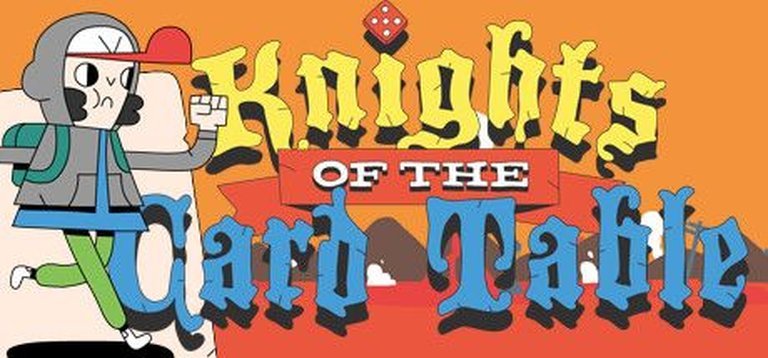
Knights of the Card Table is a turn-based fantasy dungeon crawler card game where players strategically rearrange and activate dungeon cards to collect loot and defeat quirky enemies like vampire cats and rocket-throwing dogs. Set across three whimsical worlds—Suburbia, the Haunted Forest, and the Deadly Dojo—the game emphasizes tactical card sequencing for streak bonuses, dice-based combat, and careful decision-making as you master over 100 dungeons in a humorous RPG experience.
Gameplay Videos
Where to Buy Knights of the Card Table
PC
Knights of the Card Table Patches & Updates
Knights of the Card Table Guides & Walkthroughs
Knights of the Card Table Reviews & Reception
metacritic.com (70/100): Knights of the Card Table has a few irksome features, but is otherwise a solid dungeon-crawling card game.
pocketgamer.com : It’s not perfect, and there’s certainly room for improvement, but for the most part you’re going to enjoy the time you spend killing spider kings and drinking milk in this one.
appunwrapper.com : It’s not necessarily a bad game, but also not one I’d choose to play over all the other options out there.
Knights of the Card Table: A Card Crawl Caught Between Genius and Grind
Introduction: A Pun-Fueled Proposal With a Dicey Proposition
In the crowded landscape of digital card games, Knights of the Card Table (2018) arrives with a swagger built on silliness and a promise of tactical card manipulation. From the developers at Ponywolf, LLC, the game presents itself as a lighthearted, accessible dungeon crawler where you rearrange a layout of cards representing monsters, potions, and hazards, then roll dice to determine your fate. Its official tagline—”Master over 100 dungeons and 3 worlds”—positions it as a value-packed, casual indie romp. However, beneath its cartoony veneer and “puntastic” dialogue lies a design philosophy caught in a tension between clever, player-centric mechanics and a lingering, structural reliance on chance and grind that recalls its free-to-play mobile origins. This review will argue that Knights of the Card Table is a fascinating, deeply flawed artifact: a game with a brilliant core idea—the active rearrangement of a dynamic dungeon deck—that is ultimately undermined by a progression system and combat loop that prioritizes random number generation over meaningful strategic evolution, leaving it a curious footnote rather than a genre-defining classic.
Development History & Context: From Game Jam to (Conditional) Premium
Knights of the Card Table was developed by a two-person team, Ponywolf, LLC. Its origins trace back to a game jam project titled Dungeon Dealer, which provided the foundational prototype of dealing and ordering cards to navigate a dungeon. The full release, launched on December 28, 2018, for Windows and subsequently ported to Mac, iOS, and Android, was built using the Solar2D (formerly Corona SDK) engine—a middleware choice indicative of its cross-platform, mobile-first ambitions. This technical context is crucial: Solar2D is renowned for facilitating rapid deployment to iOS and Android, which shaped the game’s interface (optimized for touch with “1 finger gameplay”) and, as critics noted, possibly its underlying economic design.
The gaming landscape of late 2018 was saturated with “roguelite” deck-builders and card-based dungeon crawlers, most notably the monumental success of Slay the Spire. Knights of the Card Table sought to carve its niche by simplifying the deck-building aspect entirely. Instead of constructing a deck from a pool, players are dealt a random hand of five cards representing the immediate dungeon “room,” which they can reorder. The vision was one of immediate, tactile tactical control over a procedurally presented challenge. However, the game’s release history is telling. It launched simultaneously as a paid premium title on Steam ($4.99) and as a free-with-ads/IAP title on mobile. This dual-launch strategy, common for small studios seeking cross-platform reach, resulted in a hybrid design. The mobile version’s monetization scaffolding—currencies (gold coins, ice pops), unlock timers, and consumable continues—was not fully excised for the premium PC release. As we will explore, this “free-to-play ghost” haunts the game’s balance and pacing, making its “premium” status feel more like a skin applied over a skeleton built for a different economic model.
Narrative & Thematic Deep Dive: Absurdism Over Epic
Do not seek a traditional fantasy epic in Knights of the Card Table. Its narrative is intentionally thin, serving primarily as a whimsical scaffold for its gameplay. The plot is a bare-bones premise: you are a “Knight” (with character classes like the “Sodamancer”) descending through dungeons across three “whacky” worlds—Suburbia, the Haunted Forest, and the Deadly Dojo—to purify them of monsters. The storytelling is delivered through fleeting, pun-laden text and the absurdist descriptions of enemies and items.
The game’s true narrative voice is its thematic commitment to absurdist humor and consumerist parody. The world is one where “mailmen of suburbia are really mad about something, I’m not sure what, but they’re throwing envelopes at me and it really hurts!” Weapons have names like “flash saber” and “brass knuckles,” and you collect “ice pops” and “power milk.” The dialogue is “puntastic,” revolving around silly wordplay (“Can I carry cool weapons like this in real life? No, you cannot.”). This creates a cohesive, if simplistic, comedic atmosphere that satirizes both high fantasy tropes and modern consumer culture (saving gold coins in a “piggy bank”). The theme is not deep lore but a consistent, playful tone—a “hilarious card crawl” where the juxtaposition of mundane items (milk, envelopes) with martial combat defines its identity. The absence of a grand narrative is not a bug but a feature; the game’s “story” is the player’s own sequence of tactical successes and failures against this backdrop of silly menace. It’s a theme park of puns, not a saga of Arthurian legend.
Gameplay Mechanics & Systems: A Brilliant Core Hamstrung by Randomness and Retention
The genius of Knights of the Card Table lies in its core loop of card rearrangement and activation. Each dungeon floor presents a 3×2 grid (or similar layout) of face-up cards. Cards are of several types:
* Monster Cards (Goblins, Vampire Cats, Rocket-Propelled Dogs): Must be defeated by tapping, which initiates a dice roll.
* Consumable Cards (Health Drank, Power Milk): Provide immediate HP recovery or temporary attack buffs.
* Spell Cards (Fireball, Freeze): Area-of-effect or utility effects that can be strategically applied to multiple monsters.
* Hazard Cards (Chained Cards): Force the player to play adjacent cards in a specific order, removing their agency.
* Treasure/Shop Cards: Offer gold or access to a shop between floors.
The player’s primary interaction is tapping cards to activate them in an order of their choosing. This simple act is the game’s strategic heart. Should you drink the Power Milk first to buff your attack for the upcoming fight, or use the Fireball to soften up three clustered monsters before engaging? Activating cards in a sequence (e.g., three Power Milks in a row) builds a “streak” bonus, granting extra damage, gold, or other perks. This “streak” system is the game’s most innovative mechanic, encouraging players to create optimal chains rather than simply reacting.
Combat itself is a dice roll against a monster’s health. Your weapon dictates the die type (start with a D4, unlock D6, D8). Your roll must meet or exceed the monster’s health to kill it without taking damage; failure means you absorb damage equal to the monster’s strength. This introduces Player vs. Randomness (PvR). Mitigation comes from equipment: shields provide armor or dodge chance; weapons can have modifiers (e.g., a D6 with -1 damage, where a roll of 1 does zero). Characters offer unique traits (e.g., Sodamancer gets extra potion effects). You can swap equipment mid-dungeon, adding a layer of adaptation.
However, this is where the game’s fundamental imbalance emerges. The AppUnwrapper review meticulously documents the crippling problems:
1. Luck Dominance: The combination of random card draws, random die rolls, and random dungeon layout creates scenarios where no strategy can prevail. A string of high-health monsters with no healing items is a death sentence regardless of card order.
2. Progression Wall: The unlock system feels punitive. After 2-3 hours (about a third of the game), the reviewer had unlocked only 3 weapons, 3 shields, and 1 character out of a total of 11 weapons, 12 shields, and 5 characters. This forces players to use suboptimal starting gear against increasingly tough enemies, amplifying the reliance on lucky rolls.
3. The “Free-to-Play Ghost”: The premium game retains mobile-style currencies. Gold coins are earned in-dungeon but must be spent to unlock the next dungeon. Ice Pops are used to continue after death. The reviewer astutely notes that these currencies feel like “a tacky remnant of a free-to-play game going premium.” They add no meaningful strategic choice; gold is abundant and pointless to collect, while ice pops trivialize failure, removing “skin in the game.” The achievement tied to using an ice pop to cheat death highlights this design schizophrenia.
4. Hazard Cards Remove Strategy: Chained cards, which force a specific play order, can appear in devastating positions (first card in a row), completely nullifying the player’s core agency—the ability to rearrange. This feels less like a tactical challenge and more like a punishment for RNG.
5. Limited Toolkit: Unlike deeper card games (Slay the Spire, Meteorfall), the player’s active tools are confined to the five cards in the current hand. There are no persistent skill cards, energy systems, or complex deck manipulation. The only long-term growth is in static equipment bonuses.
The gameplay, therefore, is a battle between a brilliant, tactile core (card ordering/streaks) and a overwhelming, often unfair, external randomness. It shines in short bursts where luck aligns with your plan but sours into frustration during prolonged runs where the RNG conspires against you.
World-Building, Art & Sound: Where Charm Obscures Shallow Design
If Knights of the Card Table has a universally acclaimed strength, it is its presentation. The game’s world and aesthetic are its strongest selling points, expertly masking some of its mechanical shallowness with sheer personality.
* Visual Direction: The art style is consistently described as “hand-drawn,” “cartoony,” “sketchy,” and “slick.” It avoids the polished uniformity of many indie games for a more ephemeral, playful look that feels like a series of witty doodles come to life. Environments and characters are exaggerated and colorful, perfectly suiting the absurdist humor. The “whacky” worlds—Suburbia, Haunted Forest, Deadly Dojo—are instantly recognizable through visual shorthand (mailboxes, spooky trees, martial arts gear).
* Sound Design & Music: The soundtrack is praised for being “great” and “captivating,” though noted as potentially repetitive during long sessions. Sound effects are punchy and comedic, reinforcing the game’s lighthearted tone. The “puntastic dialogue” is delivered via on-card text and is a constant source of the game’s charm (“power drank,” “health drank”). This audio-visual package creates a cohesive, low-stakes, funhouse atmosphere that makes failure feel less cruel and more like part of the joke.
* Contribution to Experience: This charm is not superficial; it is essential to the game’s playability. The frustration of a bad die roll is softened by the silly enemy you just lost to (a “vampire cat” or “rocket-whatever dog”). The act of collecting “ice pops” and “power milk” feels whimsical rather than predatory. The art and sound sell the fantasy of a playful, consequence-light adventure, which allows the player to tolerate the underlying randomness to a degree. However, they cannot completely paper over the cracks when progression stalls or balance feels broken.
Reception & Legacy: A Modest Success, A Niche Curiosity
Knights of the Card Table enjoyed a quiet, moderately positive reception that never translated into widespread acclaim or significant commercial success. Its Metacritic score for iOS sits at 70 (Mixed or Average) based on four critic reviews. Individual scores:
* Pocket Gamer UK (80%): Praised it as “a bright, smart card crawl” with “really nice ideas” and an “interesting art style,” acknowledging its slow pace and lack of action but concluding it’s “a treat” for the right player.
* Pocket Tactics (80%): Called it a “colorful, addictive twist” with “frenetic dungeon runs.”
* 148Apps (70%): Labeled it a “solid dungeon-crawling card game” with “irksome features.”
* Metro GameCentral (60%): Delivered the harshest critique, stating its “heavy reliance on chance and your limited agency… make it feel a little too much like gambling rather than a game of skill.”
Steam user reviews paint a similar picture: a “Mostly Positive” (72%) rating from approximately 32 reviews at the time of writing. This indicates a satisfied niche audience that enjoys the game’s casual, quirky appeal, but no cult following or “hidden gem” status.
Its legacy is minimal. It is not cited as an influence on major titles. Within the card crawler genre, it is overshadowed by more sophisticated contemporaries like Slay the Spire (2018), Card Quest (2015), and even mobile peers like Meteorfall. Its primary value as a historical artifact is as a case study in hybrid monetization design—a game that straddles the line between premium and free-to-play, bearing the scars of that transition. It demonstrates how mobile-first design principles (currency sinks, continue mechanics, slow unlock pacing) can feel alienating in a premium context, even when the core gameplay is sound. It also stands as an example of how a single, brilliant mechanic (the card-streak system) is not enough to sustain a full game without deep, complementary systems for player expression and mitigation of randomness.
Conclusion: A Flawed Curio, Not a Classic
Knights of the Card Table is a game of contrasts. Its heart is in the right place: a simple, tactile, and clever system of ordering cards to build streaks provides flashes of genuine tactical satisfaction. Its presentation is a masterclass in tone and charm, making its fantasy world feel unique and engaging. However, it is ultimately derailed by its own design compromises.
The legacy of its free-to-play roots—the grindy, unrewarding currency system and the punitive, luck-dependent progression curve—saps the long-term motivation that a great rogue-like or crawler requires. The strategic depth promised by the card-ordering is consistently undercut by the binary, high-variance combat resolution and hazards that remove player agency. For every moment of brilliance where you perfectly chain spells and attacks, there is a frustrating run undone by a series of “1” rolls or a chained monster blocking your only healing potion.
Therefore, its place in video game history is not as a classic but as a curio—a well-presented, conceptually interesting indie project that showcases the perils of not fully committing to a single design philosophy. It is a game worth experiencing for its intriguing core loop and delightful aesthetics, but one whose flaws are too systemic to ignore. It finds a home only in the library of the player who seeks a casual, pun-filled diversion and can tolerate—or even laugh at—the whims of the dice god. For those seeking a serious, deep, or balanced card-based dungeon experience, Knights of the Card Table remains a fascinating “what if” rather than the definitive answer.
Final Verdict: 6.5/10 – A charming and clever card crawler with a fantastic core mechanic, fatally flawed by excessive randomness, a grindy progression system, and a lingering free-to-play ghost that prevents it from achieving its potential. A must-play for genre enthusiasts studying design trade-offs, but a skip for those seeking a polished, strategic successor to the greats.