
- Release Year: 1997
- Platforms: Windows
- Publisher: 10 out of 10 Educational Systems
- Genre: Educational, Puzzle
- Perspective: Fixed
- Game Mode: Single-player
- Gameplay: Game show, quiz, trivia
- Setting: Ecology, Nature
Description
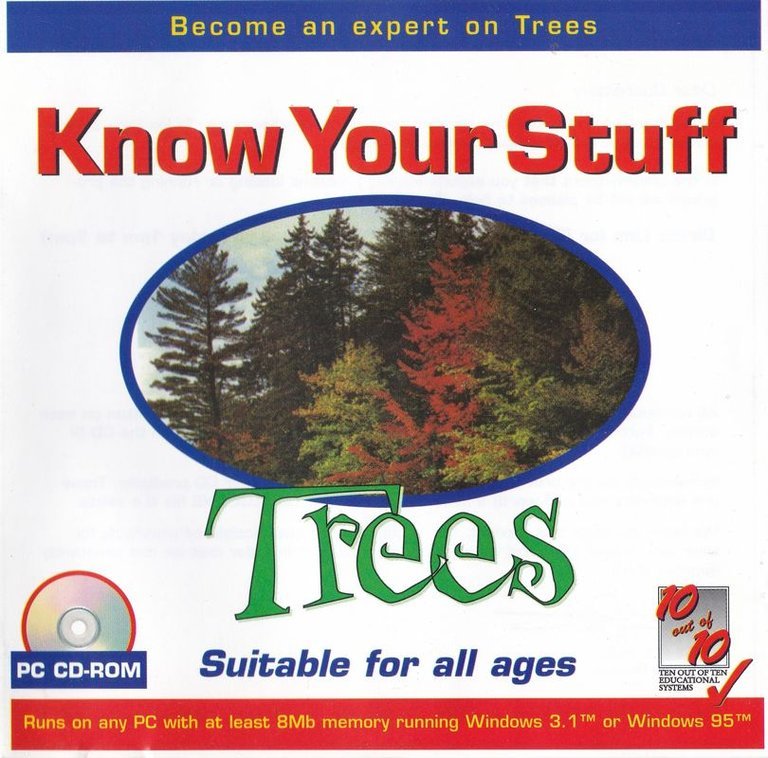
Know Your Stuff: Trees is an educational single-player game released in 1997 for Windows, designed to teach players about botany through interactive trivia. Players answer multiple-choice questions about tree characteristics like height, leaf shape, and bark color, with incorrect answers triggering an educational book that provides detailed information before continuing the tutorial. The game also includes a quiz mode to assess learning progress, combining puzzle mechanics with ecology-themed education.
Know Your Stuff: Trees: Review
Introduction
In the annus mirabilis of 1997—a year that birthed Final Fantasy VII, GoldenEye 007, and Gran Turismo—a quiet revolution unfolded in the realm of educational software. Amidst the polygonal explosions and cinematic narratives of mainstream gaming, Know Your Stuff: Trees emerged as a humble yet ambitious CD-ROM title from publisher “10 out of 10 Educational Systems.” This single-player, mouse-driven educational puzzle game dared to distill the majesty of arboreal science into a quiz-based tutorial, where players grappled with questions about tree heights, leaf shapes, and bark colors. More than a mere trivia app, it represented a pioneering fusion of interactivity and pedagogy, offering a glimpse into how gaming could democratize niche knowledge during an era of technological transition. This review examines Know Your Stuff: Trees not as a lost classic, but as a fascinating artifact—a window into the unheralded intersection of ecology, education, and early digital interactivity.
Development History & Context
Know Your Stuff: Trees was crafted by “10 out of 10 Educational Systems,” a studio dedicated to producing commercial educational content on CD-ROM. Its 1997 release placed it at a pivotal juncture in gaming history. While titles like Quake and Tomb Raider pushed 3D rendering boundaries, this title operated under strict constraints: Windows NT 3.1 compatibility, 8MB RAM requirements, and a 640×480 resolution cap. The CD-ROM format enabled rich multimedia—animated transitions, illustrated “books,” and auto-save functionality—but the game relied on fixed/flip-screen visuals and point-and-click interfaces typical of educational software.
The gaming landscape of 1997 was dominated by cinematic RPGs and genre-defining action games, leaving little room for niche educational titles. Yet Know Your Stuff: Trees carved a niche by targeting environmental literacy, reflecting a growing 90s interest in ecology. As noted in broader industry trends of the era, educational titles often prioritized accessibility over spectacle, using CD-ROMs to package reference materials—here, a virtual library of tree knowledge—that were impractical in earlier floppy-disk iterations. The game’s creators recognized that trees, once mere static sprites in titles like 3D Deathchase (1987), could become central to learning if rendered as interactive subjects. Their vision was to transform passive observation into active engagement, leveraging CD-ROM capacity to blend quiz mechanics with encyclopedic depth.
Narrative & Thematic Deep Dive
Know Your Stuff: Trees eschews traditional narrative in favor of a thematic journey centered on knowledge acquisition. The “plot” unfolds as a Socratic dialogue between player and game: questions about trees prompt answers, and incorrect responses trigger the revelation of facts, creating a recursive loop of learning. This structure mirrors the principles of effective educational design, where failure becomes a gateway to understanding—a stark contrast to the punishing difficulty of contemporaneous games like Dark Souls.
The game’s core theme is ecological literacy. Each question—e.g., “What is the average height of a Coast Redwood?” or “Which tree has needle-shaped leaves?”—serves as a micro-lesson in dendrology. The “library” function acts as a narrative device, transforming abstract trivia into tangible knowledge through illustrated “books.” Though devoid of characters or plot, the game implicitly champions environmental awareness by framing trees as subjects worthy of study—a precursor to the ecocritical analyses seen in later titles like Assassin’s Creed Valhalla (2020), where trees symbolize interconnected ecosystems. The absence of a traditional narrative underscores the title’s pedagogical purity: here, growth isn’t measured in hit points, but in the expansion of the player’s understanding of nature.
Gameplay Mechanics & Systems
At its core, Know Your Stuff: Trees is a quiz-driven tutorial with two primary modes: a continuous Q&A session and a progress-testing quiz. The loop is elegant in its simplicity:
1. Question Phase: A multiple-choice query appears (e.g., “Which tree has peeling bark?”).
2. Response: If answered correctly, the player advances to a new question. Incorrectly, the game opens a “book” detailing the correct answer.
3. Feedback: After viewing the book, the player returns to the quiz, typically with a new question.
This system embodies the principle of immediate feedback, a key element in effective educational gaming. The library—accessed via a menu interface—houses ten “books,” each dedicated to a tree species or ecological trait. Supporting multiple player profiles (though single-player only), the game auto-saves progress, allowing incremental learning.
The interface is minimalist but functional. Point-and-click navigation governs all interactions, with animated transitions (e.g., a cinematic “flight” through the library) adding visual flair. However, the fixed screens and limited interactivity highlight the era’s constraints: this is not a world to explore, but a knowledge base to navigate. The lack of audio cues or dynamic elements underscores its identity as a reference tool first, a game second—a design choice that aligns with contemporary educational titles like Muppet Monster Adventure, where supplementary materials in manuals enriched the core experience.
World-Building, Art & Sound
Know Your Stuff: Trees constructs a world of contained knowledge: a virtual library where trees become the protagonists. Art direction prioritizes clarity over realism, with clean lines and simple illustrations ensuring readability on 640×480 displays. Screenshots reveal a muted color palette—browns for bookshelves, greens for foliage—creating a studious atmosphere. The most striking visual is the animated library transition, where the player “flies” past towering bookshelves, symbolizing the vastness of arboreal knowledge.
Sound design, per the source material, is unremarkable—likely limited to click effects and minimal ambiance. This absence prioritizes visual focus, though it reflects the era’s limitations in educational multimedia. The library setting itself is world-building by metaphor: books represent the collective wisdom of ecology, while the quiz space is a testing ground for applying that wisdom. This contrasts sharply with the immersive forests of The Witcher 3 (2015), where trees serve as environmental storytelling tools. Here, trees are abstracted into data points, reinforcing the game’s mission: to transform nature into digestible knowledge.
Reception & Legacy
Upon release, Know Your Stuff: Trees garnered little mainstream attention, overshadowed by AAA giants. Its MobyGames page remains devoid of critic reviews, and only two players have “collected” it—a testament to its niche appeal. Commercial reception is unrecorded, but as a CD-ROM educational title, it likely performed modestly, catering to schools, libraries, and environmentally curious households.
Its legacy is one of quiet influence. The game exemplified the CD-ROM era’s potential for rich educational content, foreshadowing modern apps like iNaturalist. Its immediate-feedback loop predated adaptive learning systems, while the virtual library model anticipated digital encyclopedias. However, it also highlights the challenges of edutainment: without narrative hooks or engaging gameplay, it struggled to compete with entertainment-focused titles. In the broader history of trees in gaming, it stands as a utilitarian counterpoint to the atmospheric forests of Firewatch or the resource-driven mechanics of Minecraft. Its true legacy lies in its preservation of 90s educational design—a reminder that gaming’s history isn’t just defined by blockbusters, but by the tools that democratized knowledge.
Conclusion
Know Your Stuff: Trees is a time capsule of 1997’s experimental spirit—a game where the humble oak and sequoia became protagonists in a digital classroom. Its quiz-based mechanics and library interface, while technologically primitive by today’s standards, represent a sincere attempt to leverage gaming for environmental education. In an era defined by graphical leaps and cinematic ambition, this title prioritized pedagogy over spectacle, offering a model for how games can facilitate learning without sacrificing interactivity.
Yet its limitations are equally telling: the fixed screens, minimal sound, and repetitive underscore the constraints of its genre. It is not a “game” in the contemporary sense but a functional tool, best appreciated as a historical artifact. For gaming historians, it illuminates the overlooked ecosystem of edutainment; for educators, it exemplifies the power of immediate feedback in knowledge acquisition. In the grand arboreal pantheon of gaming, Know Your Stuff: Trees may not stand as a giant redwood, but it remains a vital sapling—a root system from which future educational gaming would grow. As we reflect on its place in history, we recognize that its true value lies not in entertainment, but in its unwavering belief that even the simplest digital experiences can cultivate a deeper understanding of the natural world.