
Description
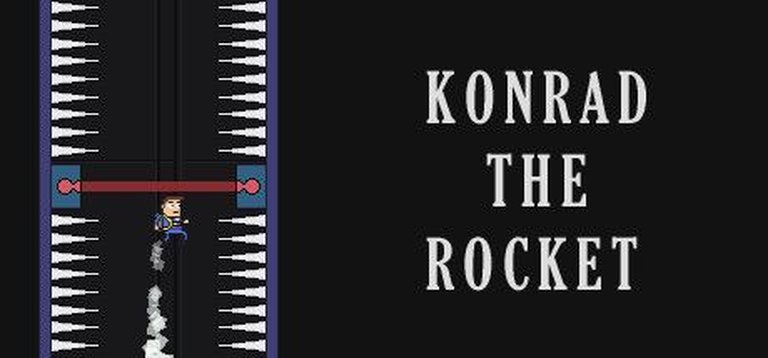
Konrad the Rocket is a hardcore 2D platformer set in a dystopian world inspired by George Orwell’s 1984. Players control Konrad, a humble worker forced to test a secret jetpack weapon through 75 perilous levels, where survival is uncertain but heroism is forged in the face of extreme challenges.
Where to Buy Konrad the Rocket
PC
Konrad the Rocket Guides & Walkthroughs
Konrad the Rocket Reviews & Reception
steambase.io (86/100): A solid player score of 86% based on a mix of positive and negative reviews.
Konrad the Rocket: Review
Introduction
In the crowded pantheon of indie platformers, few titles capture the chilling essence of dystopian propaganda with the stark, minimalist urgency of Konrad the Rocket. Released on October 16, 2017, this solo-developed masterpiece thrusts players into the role of Konrad—a nameless worker forced to test a “secret weapon” for a totalitarian regime. With its Orwellian undertones, punishing difficulty, and unflinching dedication to its grim premise, Konrad the Rocket transcends mere gameplay to become a searing commentary on sacrifice and dehumanization. As a journalist and historian, I argue that this game, despite its brevity and humble origins, represents a significant entry in the indie canon—a microcosm of how constraint and vision can coalesce into a potent, unforgettable experience.
Development History & Context
Konrad the Rocket is the brainchild of Leonardo Alexandrino, a solo developer operating under the banner of “boustrophedon” (a term referencing ancient boustrophedon writing, where text alternates direction by line—a fitting metaphor for the game’s themes of cyclical oppression). Conceived in the mid-2010s and developed using GameMaker, the project was chronicled meticulously on the GameMaker Community forums, where Alexandrino shared progress, prototypes, and player feedback. The game emerged during a renaissance for indie platformers, with titles like Hollow Knight and Cuphead dominating the discourse. Yet, Konrad the Rocket carved its niche by eschewing sprawling worlds for claustrophobic, industrial test chambers—a deliberate choice reflecting its dystopian inspiration.
Technologically, the game operated within modest constraints: it required a mere 1GB RAM and DirectX 9.0c-compatible hardware, underscoring Alexandrino’s commitment to accessibility. The development process was iterative and community-driven; early demos faced criticism for controls that felt “heavy” and hazards that felt unfair. Alexandrino responded swiftly, adjusting physics, increasing walking speed, and redesigning traps to include telegraphed warnings (e.g., glowing lasers). This responsiveness not only refined the gameplay but also highlighted the symbiotic relationship between solo developers and their audiences—a hallmark of the indie ethos.
Narrative & Thematic Deep Dive
The narrative of Konrad the Rocket is a masterclass in atmospheric storytelling, conveyed through sparse text, environmental design, and unspoken dread. The player is never explicitly introduced to Konrad; they are simply thrust into the role via the game’s infamous propaganda-laden opening: “Our GLORIOUS NATION needs you! You will test the secret weapon that will guarantee our SUPERIORITY! The Project Rocket! The tests aren’t easy and we don’t expect your survival, but that’s how HEROES are born!” This framing device establishes the game’s central conflict: individual sacrifice for state power.
The “GLORIOUS NATION” is a clear pastiche of Orwell’s Oceania, blending Soviet-era aesthetics (hammer-and-sickle imagery, red color palettes) with North Korean-style cults of personality. The recurring “big mustache man”—a shadowy figure with a dictatorial grin—symbolizes the regime’s omniscient, oppressive gaze. Dialogue is intentionally limited, with propaganda blurbs appearing during loading screens and level transitions, reinforcing the idea that language itself is a tool of control. Phrases like “DISAPPOINTMENT WILL BE MET WITH CONSEQUENCES FOR YOUR FAMILY” underscore the regime’s brutality, while the designation of Konrad as a “hero” upon completion satirizes the perverse glorification of expendable pawns.
Themes permeate every pixel. The jetpack, the titular “Project Rocket,” is both a weapon of progress and a death sentence—a metaphor for technological advancement in authoritarian states. The 75 levels function as ritualistic trials, where failure is not just a setback but a confirmation of the state’s low expectations. The absence of traditional narrative cutscenes forces players to infer the story through the environment: sterile corridors, oppressive machinery, and the constant threat of annihilation. Konrad’s silence becomes a powerful symbol of dehumanization; he is not a character but a vessel, his identity erased by the regime’s machinery.
Gameplay Mechanics & Systems
At its core, Konrad the Rocket is a brutally precise 2D platformer, demanding pixel-perfect navigation through 75 meticulously crafted levels. The central mechanic, the jetpack, is both a lifeline and a liability. Fuel is never explicitly displayed, but its constraints are palpable: excessive thrust leads to precarious momentum, while conservative use risks falling into spikes or lasers. This creates a high-stakes balancing act, turning each level into a physics puzzle where survival hinges on timing and resource management.
The game’s architecture is built around adversarial design, with obstacles escalating in lethality and creativity. Early levels introduce basic spikes and lasers, but later chapters feature hydraulic presses that accelerate unpredictably, breakable walls hiding hidden dangers, and laser traps that glow ominously before activation—a direct response to player feedback. Movement is governed by tight, weighty controls; Konrad feels substantial, with a walking speed increased in post-launch patches to alleviate frustration. Combat is absent, replaced by environmental hazards that demand reflexes and pattern recognition. Death is frequent but swift, with instant respawns that encourage perseverance over punishment.
Progression is linear and achievement-driven. The 20 Steam achievements range from the straightforward (“Konrad the Beginner,” for completing the first level) to the masochistic (“Konrad the Immortal,” for beating the game without dying). These serve as both milestones and bragging rights, rewarding mastery while reinforcing the game’s cult of difficulty. The UI is minimalist, with options limited to controls and sound settings—a testament to Alexandrino’s focus on purity. Yet, this simplicity belies the game’s depth. Each level is a distilled challenge, a microcosm of the regime’s cruelty, where every jump and dodge is an act of defiance against overwhelming odds.
World-Building, Art & Sound
The world of Konrad the Rocket is a labyrinth of industrial dread, rendered in a stark, utilitarian pixel art style. Levels are confined to fixed or flip-screen segments, emphasizing claustrophobia and the artificiality of Konrad’s prison. The environments shift from sterile test chambers to decaying corridors, their walls adorned with propaganda posters—bold, blocky text praising the “GLORIOUS NATION” and depicting rockets as symbols of progress. This visual language mirrors real-world authoritarian aesthetics, borrowing from Soviet constructivism and Cold-era propaganda to create a world that feels both alien and hauntingly familiar.
Character designs are intentionally abstract. Konrad is a diminutive figure, often lost in the frame, their anonymity highlighted against towering machinery and looming hazards. The “big mustache man” appears only as a static icon—a looming face that watches the player’s every move, embodying the regime’s surveillance. Traps are rendered with functional brutality: spikes resemble industrial hazards, lasers beam with clinical precision, and hydraulic presses piston with chilling efficiency. Even the jetpack, a symbol of hope, is depicted as a clunky, rudimentary device, its fire a weak puff of orange—underscoring the regime’s disregard for its test subject’s safety.
Sound design is equally deliberate. The original soundtrack, composed by Alexandrino, is a blend of dissonant synth drones and industrial percussion, evoking the oppressive hum of machinery. Sound effects are sparse but impactful: the thwump of a hydraulic press, the zap of a laser, the muffled explosion upon death. The jetpack’s sputter, criticized in early demos as sounding like a “pipe with a hole,” was retained as a thematic choice—its weakness emphasizing the weapon’s flaws and Konrad’s expendability. Together, art and sound forge an atmosphere of unrelenting tension, where silence is as menacing as the screech of a sawblade.
Reception & Legacy
Upon release, Konrad the Rocket flew under the radar of major critics, with no professional reviews recorded on Metacritic. Yet, it found a dedicated audience on Steam, where it boasts an 85% positive rating from 7 user reviews. Players lauded its “tight controls” and “addictive difficulty,” with one noting: “The controls aren’t exactly stated anywhere… but once you figure them out, they’re perfect.” Another, who completed the game in 4 minutes and 14 seconds, quipped, “I feel proud of myself… somewhat.” A solitary negative review cited frustration with the game’s brevity, a common sentiment given the hour-long playtime.
Commercially, Konrad the Rocket was a modest success, priced at $0.99 and later bundled with Alexandrino’s other titles. It sold enough to sustain its developer’s indie career but remained a niche curiosity. Its legacy, however, extends beyond sales. As a solo project, it exemplifies the power of constraint—proving that a strong narrative and focused mechanics can trump budget or scope. Thematically, it resonated in an era of rising authoritarianism, offering a playable metaphor for systemic oppression. Influences are subtle; its emphasis on environmental storytelling and minimalist design echoes Inside and LIMBO, though its direct progenitors are classic platformers like Jet Set Willy reimagined through a dystopian lens.
Conclusion
Konrad the Rocket is a paradox: a game that feels both rushed and complete, both punishing and rewarding. Its flaws—a lack of polish, abrupt brevity, and relentless difficulty—are inseparable from its identity. Yet, these imperfections amplify its strengths. Alexandrino’s vision, unvarnished and uncompromising, transforms a simple platformer into a powerful indictment of authoritarianism. Konrad’s journey, from anonymous worker to “hero,” is a harrowing reminder of how systems consume individuals, yet also a testament to the resilience of the human spirit.
As a historian, I view Konrad the Rocket not as a classic but as a cult artifact—a digital relic of the indie boom that deserves preservation. It is not the best platformer ever made, but it is one of the most honest. For players seeking a quick, visceral experience that lingers long after the final screen, it is essential. For scholars of game design and narrative, it is a case study in how minimalism can yield maximal impact. In the end, Konrad the Rocket is more than a game; it is a rocket, fueled by defiance, aimed straight at the heart of oppression. And in that, it is undeniably glorious.