
- Release Year: 2017
- Platforms: Windows
- Publisher: Oculus VR, LLC
- Developer: Force Field Entertainment B.V.
- Genre: Action
- Perspective: Diagonal-down
- Game Mode: Co-op, Single-player
- Gameplay: Mech combat, Shooter, Tactical, Twin-stick shooter
- Setting: Post-apocalyptic
- Average Score: 85/100
- VR Support: Yes
Description
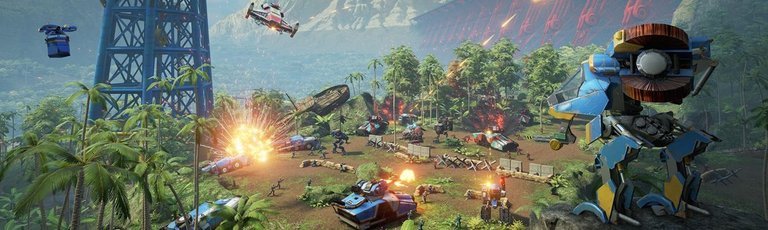
Landfall is a tactical shooter set in a post-apocalyptic world where the poles have melted, and most of the planet is submerged. Players control a single character in a top-down perspective, leading an army to suppress a rebellion in one of the recovered colonies. The game features a variety of loadouts with unique weapons and abilities, allowing players to switch between different strategies during gameplay. Players can also pilot giant Striders (mechs) to dominate the battlefield. The game supports both single-player and multiplayer modes, including cooperative and versus gameplay.
Where to Buy Landfall
PC
Landfall Guides & Walkthroughs
Landfall Reviews & Reception
metacritic.com (85/100): Seemingly with ease this twinstick-induced strategy-explosion on a postapocalyptic diorama is more immersive that imagined – and fun to play as well.
uploadvr.com : That fluctuation and variety is what kept me coming back for more while playing and will likely keep people engaged long after release.
Landfall: A Tactical VR Shooter That Redefined Perspective
Introduction
Imagine commanding a battlefield not from the trenches but from the skies—a godlike perspective where every decision echoes through ravaged landscapes. Released in 2017, Landfall emerged as a bold experiment in VR gaming, blending the chaos of twin-stick shooters with the calculated depth of tactical warfare. Developed by Dutch studio Force Field Entertainment and published by Oculus VR, the game dared to ask: What if strategy and immersion could coexist in virtual reality? While its narrative may lack nuance, Landfall carved a niche by innovating within VR’s limitations, offering a post-apocalyptic playground where mechs, rebellion, and flooded Earth collide. This review argues that Landfall is a flawed yet foundational title that expanded VR’s design language, even as its ambition occasionally outpaced execution.
Development History & Context
Born from a team of 140 developers, including veterans like Creative Director Martin de Ronde (known for Killzone: Shadow Fall), Landfall was crafted during VR’s early-adopter era. Built on Unreal Engine 4 and Wwise for dynamic audio, the game targeted the Oculus Rift’s nascent ecosystem. Force Field sought to merge the “toy soldier” accessibility of tabletop wargaming with VR’s immersion—a response to the era’s flood of first-person wave shooters.
Technological constraints shaped its design:
– Perspective Limitations: The diagonal-down camera angle sidestepped VR motion sickness while allowing strategic oversight.
– Controller Simplicity: Designed for gamepads (with optional Oculus Touch support), Landfall prioritized accessibility over motion-controlled gimmicks.
Released alongside titles like Superhot VR and Robo Recall, Landfall stood out by rejecting VR’s fixation on first-person intimacy. Instead, it echoed classics like Halo Wars and MechCommander, reimagined for a tactile, headset-driven world.
Narrative & Thematic Deep Dive
Landfall’s lore is skeletal but evocative: climate collapse has flooded Earth, leaving warring factions to battle over newly exposed resources. Players lead an elite unit suppressing a rebellion, with dialogue reduced to mission briefings and stoic one-liners. While Godoculus praised its “vividly realized world,” the plot serves primarily to contextualize destruction.
Themes are blunt but resonant:
– Environmental Collapse: Melting poles and submerged cities frame humanity’s desperation.
– Cyclical Conflict: The rebellion mirrors real-world resource wars, though moral ambiguity is undercooked.
– Techno-Fetishism: Striders (piloted mechs) symbolize humanity’s reliance on machines to reclaim dominance.
Characters are nameless ciphers—a missed opportunity to humanize the conflict. Yet, the minimalist approach aligns with the gameplay’s focus on tactical improvisation over emotional stakes.
Gameplay Mechanics & Systems
Landfall’s DNA is a hybrid of twin-stick shooting and RTS-lite strategy:
– Core Loop: Deploy loadout-specific soldiers (12 classes, from snipers to shield bombers), capture zones, and summon Striders to obliterate foes.
– Innovations:
– Dynamic Camera Zones: Battles unfold across three rotating sectors, forcing players to adapt sightlines.
– Strider Mechanic: Echoing Titanfall, calling in a mech shifts power balances but risks leaving the pilot vulnerable.
– XP Progression: Unlock loadouts in versus mode, though VR-World criticized imbalanced upgrades.
Flaws:
– Repetitive objectives (escort, plant explosives) in the 4–5 hour campaign.
– Sparse post-launch support; player counts dwindled without new maps or modes.
Yet critics lauded its “crisp, precise” controls (UploadVR) and “rock-paper-scissors meta-game” depth (VRBeginnersGuide).
World-Building, Art & Sound
The drowned Earth is rendered in stark contrasts:
– Visual Design: Crumbling skyscrapers pierce toxic oceans; rebel strongholds glow with jury-rigged tech. The diorama-like perspective (compared to “Airfix toy soldiers” by Godoculus) amplifies the setting’s scale.
– Sound Design: Wwise-engineered audio layers radio chatter, Strider footsteps, and explosions into a cacophonous symphony. Silence during stealth missions accentuates tension.
– VR Immersion: Peering around cover or leaning into explosions adds tactile depth absent in flat-screen strategy games.
Reception & Legacy
Critical Reception:
– 86% average score (MobyGames), with praise for its “fresh tactical creativity” (VR Heads).
– Awards: Won “Best VR Game” at the 2017 Dutch VR Awards.
Player Reception:
– Mixed feelings on multiplayer balance; SteamSpy noted modest player counts post-launch.
Legacy:
– Pioneered non-first-person VR design, influencing later titles like Brass Tactics.
– Demonstrated VR’s potential for strategy games, though its niche appeal limited mainstream impact.
Conclusion
Landfall is a paradox: a VR gem that transcended the medium’s early pitfalls yet faltered in sustaining momentum. Its marriage of tactical depth and godlike immersion remains unmatched, even as thin storytelling and uneven updates hold it back from greatness. For VR historians and strategy devotees, Landfall is essential—a proof-of-concept that redefined what “perspective” could mean in virtual warfare. Force Field’s ambition earns it a place in the canon, albeit as a cult classic rather than a household name.
Verdict: Landfall is a flawed triumph—a game that dared to ask more of VR and, in doing so, carved a legacy as deep as its drowned world.