
- Release Year: 2005
- Platforms: Macintosh, Windows
- Publisher: Mindscape SA
- Developer: Riverdeep Interactive Learning Limited
- Genre: Educational
- Game Mode: Single-player
- Gameplay: Coloring, Mini-games, Music, Puzzle, Reading, writing
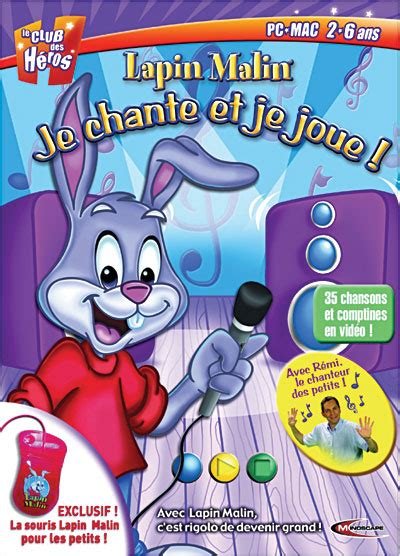
Description
Lapin Malin: Je Chante et je Joue! is a 2005 educational children’s game from the Reader Rabbit series, released exclusively in France. Designed for young learners, it combines music and play through mini-games like sing-alongs with Makaton sign language demonstrations, memory matching, coloring activities, and puzzles. Featuring live-action presenters and printable artwork, the game focuses on sound recognition, creative expression, and cognitive development in a playful, interactive environment.
Gameplay Videos
Lapin Malin: Je Chante et je Joue! Reviews & Reception
mobygames.com : Released exclusively in France, this Reader Rabbit title teaches the player about sound and playing through mini-game activities
Lapin Malin: Je Chante et je Joue!: Review
Introduction
In the crowded landscape of early-2000s educational software, Lapin Malin: Je Chante et je Joue! — the French-localized iteration of the iconic Reader Rabbit series — carved out a quietly revolutionary niche. Released exclusively in France in 2005, this title diverged from traditional literacy-focused edutainment by pioneering accessibility through Makaton sign language integration and multisensory musical learning. Far more than a mere translation, the game reframed educational design for Francophone preschoolers, weaving live-action pedagogy into a digital playground. Its legacy lies not in blockbuster acclaim but in its empathetic reimagining of inclusivity in children’s media — a thesis underscored by its hybrid of song, sign, and play.
Development History & Context
The Riverdeep-Mindscape Alliance
Developed by Riverdeep Interactive Learning Limited (a heavyweight in educational software since the 1980s) and published by Mindscape SA, Je Chante et je Joue! emerged during a transitional era for digital learning tools. By 2005, CD-ROMs were nearing obsolescence, yet remained the dominant medium for budget-conscious educational titles. Riverdeep’s expertise in adapting Reader Rabbit for global markets — rebranded as Lapin Malin (“Clever Rabbit”) in France — informed this release, which targeted preschoolers aged 3–6.
Technological Constraints and Innovations
Built with Macromedia (likely Flash or Director) and QuickTime for video playback, the game’s hybrid Mac/Windows CD-ROM delivery prioritized accessibility over technical ambition. The use of live-action video — a rarity in children’s software of the era — demanded careful balancing of file sizes against resolution quality, resulting in grainy but functional full-motion segments. Crucially, Riverdeep leveraged the V12 Database Engine to streamline asset management, allowing seamless integration of printable activities — a forward-thinking feature for fostering offline engagement.
Narrative & Thematic Deep Dive
A Pedagogy of Joy
Unlike narrative-driven entries in the Reader Rabbit series, Je Chante et je Joue! leans into emergent play rather than structured storytelling. The “plot” is one of discovery: children explore sound, rhythm, and communication through five activities framed as playful interactions with live-action hosts. Themes of inclusivity and multimodal learning dominate, with Makaton sign language — a simplified signing system for children with communication difficulties — elevated to core mechanic rather than supplemental feature.
Characters and Dialogue
Voiced by Françoise Blanchard and Thierry Kazazian, the unseen narrators adopt warm, encouraging tones reminiscent of French public television hosts. The true protagonists, however, are the live-action presenters — unnamed but exuding charismatic pedagogy. Their signing demonstrations and song performances (accompanied by artist Rémi Guichard) model emotional expressiveness, framing communication as a blend of movement, music, and verbal articulation.
Gameplay Mechanics & Systems
Mini-Games as Learning Modules
Each activity targets distinct developmental skills:
– Songs: Players watch live-action performances where Makaton signs accompany lyrics (e.g., “Savez-vous planter les choux?”). Progressive difficulty emerges through tempo shifts and lyrical complexity, with songs recycled from prior Reader Rabbit titles for nostalgic continuity.
– Mimes: A presenter acts out verbs (e.g., “eating,” “jumping”) via exaggerated gestures and signs, encouraging mimicry. This kinesthetic learning bridges digital and physical play.
– Memory Match: An 18-card pairs game testing visual recognition, customizable via printable assets.
– Coloring: A freeform art tool with an “auto-color” option for instant gratification — a clever concession to differing fine motor skills.
– Puzzle: Jigsaw assembly with optional irregular-shaped pieces, fostering spatial reasoning.
UI and Progression
The interface — controlled via mouse or touchpad — opts for maximal clarity: oversized icons, uncluttered menus, and a static Lapin Malin mascot observing from the margins. Notably, progression is non-linear and reward-agnostic; completion earns no points or unlocks, prioritizing intrinsic motivation. This design philosophy reflects a pedagogical stance that avoids gamified pressure — a double-edged sword, as it risks under-stimulating children accustomed to more dynamic feedback loops.
World-Building, Art & Sound
Aesthetic Synthesis
Je Chante et je Joue! juxtaposes live-action human guides against a backdrop of quaint 2D scenery — rolling hills, crayon-bright flowers — evocative of French countryside illustrations. This contrast (live video vs. static backdrops) creates a charmingly disjointed visual language, positioning the presenters as “visitors” to Lapin Malin’s world. Artistic director Aténéa Victoria D’angelo Panagiotopulos likely drew from European children’s book art, favoring soft edges and primary colors.
Sound Design as Curriculum
The soundtrack — engineered at Scopitone Studio — blends original tunes with repurposed Reader Rabbit melodies, all anchored by call-and-response vocal arrangements. Crucially, audio never overwhelms; instruments are sparingly layered to foreground vocal articulation and signing rhythms. Ambient sounds (birds chirping, gentle clicks on UI interactions) maintain a serene atmosphere, avoiding the overstimulation common in contemporaneous edutainment.
Reception & Legacy
Silent Impact
No critical reviews or sales figures survive, symptomatic of regional educational titles’ archival neglect. However, its placement in Mindscape’s Hits Collection implies modest commercial viability. Pedagogically, the game’s Makaton integration marked a quiet milestone — predating mainstream awareness of inclusive design — while its printable activities foreshadowed the “blended learning” models of the 2010s.
Industry Ripples
While Je Chante et je Joue! never achieved the cultural footprint of flagship Reader Rabbit titles, it influenced localization strategies. Later entries like Lapin Malin: J’Apprends a Lire et a Ecrire (2008) retained its emphasis on multisensory engagement, and its live-action approach echoed in French series like T’choupi à l’école. Today, it stands as a relic of an era when educational software dared to prioritize empathy over algorithmic adaptability.
Conclusion
Lapin Malin: Je Chante et je Joue! is neither a technical marvel nor a commercial legend. Yet within its unassuming CD-ROM lies a radical proposition: that educational software should celebrate multiple forms of communication, visible in its singing presenters’ signing hands and in the silence of a child matching puzzle pieces. Its lack of scoring systems or narrative stakes feels almost subversively humane next to today’s dopamine-driven apps. For historians, it exemplifies early-2000s regional edutainment’s quiet ambitions; for players, it was a gateway to seeing language as something sung, signed, and felt. In the pantheon of children’s software, its legacy is a whisper — but one that taught Francophone children to listen with their eyes and speak with their hands.