
- Release Year: 2021
- Platforms: Windows
- Publisher: smatrade GmbH
- Genre: Compilation
- Game Mode: Single-player
- Setting: New York, Venice
Description
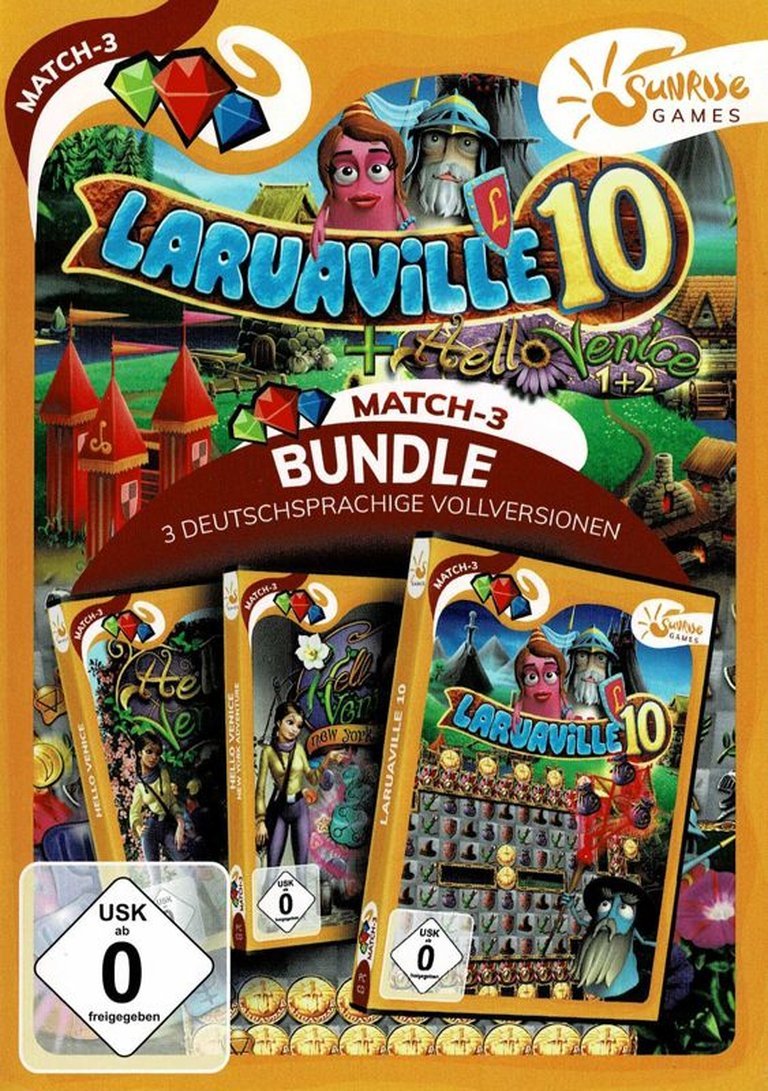
Laruaville 10 + Hello Venice 1+2 is a 2021 retail compilation for Windows, combining three distinct titles: Laruaville 10, Hello Venice, and Hello Venice 2: New York Adventure. The bundle offers a mix of puzzle and adventure gameplay, with Hello Venice focusing on a Match 3 fantasy quest to restore a mystical garden in Venice, and its sequel expanding the journey to New York. The Laruaville series contributes its signature gameplay style, though details on Laruaville 10 remain sparse. This compilation provides a varied experience for fans of casual and puzzle-driven adventures.
Laruaville 10 + Hello Venice 1+2 Reviews & Reception
gadgetspeak.com : Developing a suitable area of the Land of the Dead may not be your favourite pastime but have you the skills to try?
Laruaville 10 + Hello Venice 1+2: A Time Capsule of Casual Puzzle Hybridization
Introduction
The casual puzzle genre is a battlefield of iterative sequels and repackaged compilations, yet few franchises demonstrate the endurance and niche appeal of Laruaville and Hello Venice. Released in 2021 as a physical CD-ROM bundle by German publisher smatrade GmbH, Laruaville 10 + Hello Venice 1+2 represents a curious artifact of mid-2010s match-3 design philosophy, repurposed for a retail audience still clinging to disc-based media. This compilation—featuring Laruaville 10 (2020), Hello Venice (2014), and Hello Venice 2: New York Adventure (2014)—offers a triple-tiered snapshot of a fading era in digital distribution, where Big Fish Games and its peers dominated the desktop casual market. Yet beneath its pragmatic bundling lies a deeper narrative of thematic ambition, mechanical repetition, and the quiet evolution of a genre often dismissed as “mere time-wasters.”
Development History & Context
Studio Vision & Market Positioning
Smatrade GmbH’s decision to bundle these titles reflects a calculated nostalgia play. Hello Venice and its sequel originated from Pixel Shard Labs SRL, a Romanian studio known for thematic match-3 hybrids, and were initially distributed via digital storefronts like Big Fish Games and Masque Publishing. Laruaville, meanwhile, emerged from LGT SIA (Latvia), with GameHouse as its primary platform—a series notorious for its afterlife-themed city-building wrapped around match-3 mechanics. By 2021, the casual market had shifted toward mobile dominance, making this Windows-exclusive compilation a defiant anachronism.
Technological Constraints & Design Philosophy
Built for low-spec PCs (requiring only 512MB RAM and 50–150MB disk space), these games prioritized accessibility over innovation. The Hello Venice duology leveraged fixed-screen, first-person exploration to disguise its tile-matching core—a common trick in mid-2010s casual design to add narrative heft. Laruaville 10, meanwhile, continued the series’ Aztec-infused afterlife management, using static 2D art to minimize rendering demands. All three titles adhered to the “freemium-to-premium” pipeline: brief, demo-friendly levels (75+ in Hello Venice), with CD-ROM bundling appealing to demographics skeptical of digital storefronts.
Narrative & Thematic Deep Dive
Hello Venice: Gothic Gardening & Familial Legacies
Hello Venice centers on Adda and Ciro Grimani, grandchildren of the alchemist Sacrobosco Grimani, whose death triggers the decay of Venice’s most ornate garden. The narrative—delivered through stilted dialogue and environmental vignettes—pitches itself as a “mystery,” yet its true focus is ritualistic renewal. Each match-3 level (framed as garden revitalization) and time-management segment (herb cultivation, shrine maintenance) reinforces themes of cyclical rebirth. The Gothic undertones—a wilting Eden overseen by a cryptic will—echo The Secret of Monte Cristo (2007), but lack its textual depth.
Hello Venice 2: Transatlantic Ambition
The sequel relocates the siblings to New York, trading Venetian canals for Central Park and art deco apartments. Thematic coherence frays here: Sacrobosco’s legacy inexplicably ties to a Manhattan brownstone, diluting the original’s regional charm. Narrative urgency collapses into anemic fetch quests (e.g., restoring mosaic murals via tile-matching), though the expanded time-management scenes—now simulating urban logistics—hint at unfulfilled ambition.
Laruaville 10: Aztec Afterlife & Capitalist Utopias
Diverging sharply, Laruaville 10 drops players into the “Land of the Dead,” tasked with rebuilding an Aztec-inspired district under the gaze of a petulant Sun God. Its narrative framework—ghostly developers appeasing deities with tomatoes and chili peppers—embraces absurdist satire. Progress unlocks temples and trade routes, framing match-3 as spiritual capitalism: every tile swap generates gold to fuel divine appeasement. The tonal dissonance—whimsical undead architects versus Hello Venice’s maudlin family drama—exposes the compilation’s patchwork nature.
Gameplay Mechanics & Systems
Match-3 Evolution (or Stasis)
All three games share a rigid adherence to genre fundamentals:
– Hello Venice uses constrained grids (keys, locks) and tile types (amulet tiles in Laruaville 10 destroy color groups).
– Power-up creation via manual combos (four tiles = shell projectile; five = bomb) eschews purchasable boosters.
– Progression gating: Hello Venice alternates match-3 and time-management stages, while Laruaville locks construction behind level completion.
Innovation is minimal. Laruaville 10’s “moveable obstacle bars” and directional cannons add fleeting strategy, but fail to disrupt the genre’s Skinner-box lethargy. The compilation’s sole flourish is Hello Venice 2’s “mosaic repair” minigame—a pixel-art reassembly task—yet it feels grafted from a hidden-object title.
User Interface: Functional Clutter
Menus resemble early-2010s Flash games: oversized buttons, saccharine tooltips, and progress trackers overwhelmed by particle effects. Hello Venice’s first-person hub—a labyrinth of locked doors and glowing hotspots—prioritizes aesthetic over usability, forcing players to pixel-hunt for progression triggers.
World-Building, Art & Sound
Visual Direction: Budget Baroque vs. Aztec Kitsch
- Hello Venice layers Renaissance opulence over match-3 grids: gilded frames, cobblestone textures, and garden vistas dripping with pre-rendered ivy. It’s Assassin’s Creed II’s Venice stripped to tourist-trap essentials.
- Laruaville 10 opts for cartoonish Aztec kitsch—jade pyramids, skull-adorned temples—rendered in flat, clash-heavy palettes. The result feels like a Day of the Dead diorama animated by spreadsheet.
Sound Design: Ambience as Afterthought
Looped gondola oars and generic “mystery” harp arpeggios define Hello Venice. Laruaville counters with marimba rhythms and parrot squawks, though neither series invests in dynamic audio. Sound effects—gem crunches, construction clatters—are serviceably tinny, reinforcing the games’ disposable aura.
Reception & Legacy
Commercial Performance & Critical Silence
No Metacritic or MobyGames critic reviews exist—a telling silence. Player testimonials on retail sites like Games & Guides (“Alles gut, kaufe gerne wieder“) praise transactional efficiency (e.g., fast shipping) over the games themselves. The USK 0 rating (Germany’s “no age restriction”) underscores its perceived innocuousness.
Industry Impact: The Casual Compilation Curio
This bundle’s legacy lies in its format, not content. By 2021, digital-only casual publishers like Big Fish shifted to subscription models, making smatrade’s CD-ROM gambit a swan song for physical casual distribution. The Laruaville series’ persistence—16 entries by 2025—reveals a devout niche audience, yet its mechanics remain fossilized, uninfluencing peers like Royal Match or Gardenscapes.
Conclusion
Laruaville 10 + Hello Venice 1+2 is less a game than a time capsule: a triple-pack of mechanically competent, thematically disjointed puzzle relics, preserved for retail’s dwindling faithful. Its value lies not in innovation, but as a monument to an era when “casual” meant desktop downloads and CD-ROM bargain bins—not microtransactional mobile empires. For genre historians, it offers academic interest; for players, it’s a passable diversion best enjoyed with lowered expectations. In the annals of puzzle history, it is neither revolution nor catastrophe—simply there, like a tile waiting to be swapped.
Final Verdict: ★★☆☆☆ (2/5)
A perfunctory compilation that repackages forgettable entries from two fading series. Only recommended for physical-media completists or Aztec afterlife enthusiasts.