
- Release Year: 2017
- Platforms: Windows
- Publisher: astragon Sales & Services GmbH
- Developer: FRH Games
- Genre: Puzzle
- Perspective: 1st-person
- Game Mode: Single-player
- Gameplay: Tile matching puzzle
- Setting: Fantasy
- Average Score: 80/100
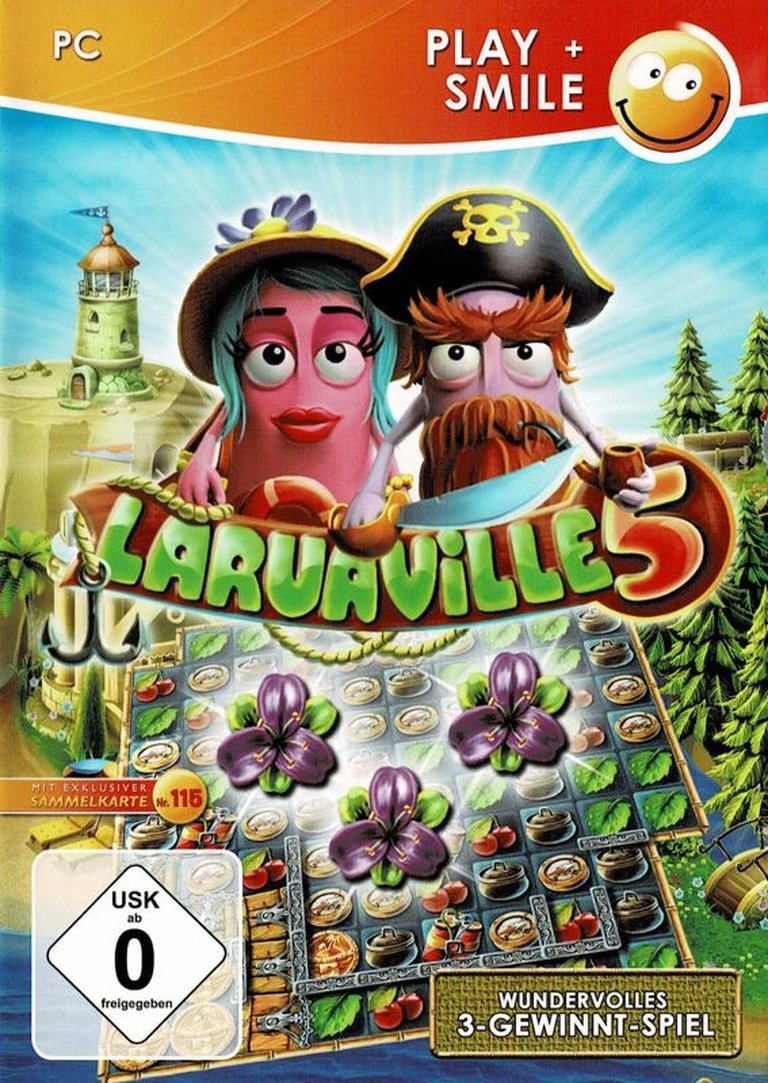
Description
In Laruaville 5, a group of adventurous ghosts embarks on a sea voyage but ends up shipwrecked on a deserted island after a violent storm destroys their ship. Stranded yet spirited, they challenge players to solve tricky match-3 puzzles, 20 solitaire games, spot-the-difference, and hidden object scenes across relaxed, limited moves, and timed modes to gather materials, knowledge, and energy needed to build a new ship and return to the mainland.
Where to Buy Laruaville 5
PC
Laruaville 5 Reviews & Reception
rgamereview.com : Laruaville 5 continues the series with some nice new challenging twists… even more tricky and interesting than previous Laruaville games.
gamezebo.com (80/100): Laruaville 5 isn’t afraid to stick with what works, all in the name of fun. Fleshing out the match-3 formula goes a long way to providing a long lasting experience.
Laruaville 5: Review
Introduction
Imagine a band of cheerful ghosts, lured by the siren call of the sea, only to be dashed upon a forsaken shore by a tempest’s fury—their ship splintered, their dreams adrift, yet their ethereal spirits unbroken. This is the whimsical premise of Laruaville 5, the fifth installment in FRH Games’ enduring match-3 puzzle series, released in early 2017 for Windows. As a cornerstone of the casual gaming ecosystem popularized by portals like Big Fish Games and GameHouse, Laruaville 5 builds on its predecessors’ legacy of lighthearted ghost-town building and puzzle-solving antics. In an era dominated by mobile free-to-play match-3 giants like Candy Crush Saga, this title carves a niche with its hybrid formula: core tile-matching augmented by solitaire, hidden objects, and spot-the-difference mini-games, all wrapped in a shipbuilding survival narrative. My thesis? Laruaville 5 exemplifies the casual puzzle genre’s golden age of variety-packed experiences, delivering accessible yet tactically rich gameplay that elevates it beyond rote swapping, though its formulaic familiarity tempers its innovation in a saturated market.
Development History & Context
FRH Games, a modest studio specializing in casual PC titles, unleashed Laruaville 5 amid the mid-2010s boom in browser and downloadable puzzle games. Published primarily through digital storefronts like Big Fish Games (October 2016 trial release) and later bundled by astragon Sales & Services GmbH (February 1, 2017 Windows CD-ROM edition), the game emerged from a prolific series pipeline—flanked by Laruaville 3 (2016) and Laruaville 6 (2017), eventually spanning 16 entries by 2025. FRH’s vision, as gleaned from ad blurbs and series consistency, centered on iterative evolution: transforming simple match-3 into multifaceted adventures with resource management and mini-game interludes, appealing to the aging PC casual demographic seeking offline, trial-based entertainment.
Technological constraints of the era shaped its design. Built for fixed/flip-screen visuals and point-and-select interfaces on Windows CD-ROM (84 MB install size per GameFools), it eschewed high-fidelity 3D or live-service models, opting for lightweight 2D sprites optimized for mid-range PCs. This mirrored the gaming landscape: 2016-2017 saw casual portals thriving amid mobile dominance, with match-3 hybrids like Bejeweled spin-offs and Jewel Quest dominating Big Fish charts. FRH navigated this by emphasizing replayability through modes (Relaxed, Limited Moves, Timed) and escalating complexity, countering criticisms of genre stagnation. No public dev logs exist, but the game’s MobyGames entry (added 2024) and inclusion in bundles like Das große 3-Gewinnt-Paket 3 (2019) and the Laruaville Collection (16 games for $49.99) underscore its role as evergreen filler in value packs, reflecting a business model prioritizing volume over virality.
Narrative & Thematic Deep Dive
At its core, Laruaville 5 weaves a breezy tale of resilience and ingenuity, starring a “couple of ghosts” (expanding to a “group of goofy ghosts” in GameHouse lore) heeding “the call of the sea.” A violent storm wrecks their vessel, stranding them on an uninhabited isle tantalizingly close to the mainland. Undeterred, they embark on a bootstrapped shipbuilding odyssey, scavenging coins, trunks, materials, knowledge, and energy. Dialogue is sparse and campy—interludes feature chatty specters brainstorming builds, unlocking structures like workshops via puzzle earnings—evoking a Robinson Crusoe for the afterlife, minus survival grit.
Thematically, it explores ethereal optimism amid adversity: ghosts, unbound by mortality, treat shipwreck as a lark, their “spirits remained high” (GameHouse). This contrasts darker ghost tales, infusing whimsy—red/green explosive cells mirror volatile tempers, bugs symbolize pesky setbacks. Progression ties narrative to mechanics: collect trunk coins to reveal keys/power-ups, mirroring real shipbuilding’s resource hunt. Subtle evolution from prior entries (e.g., Laruaville 4‘s Christmas theme) shifts from town-building to survival, hinting at series sprawl—later titles tackle Dracula, Vikings, alchemy—yet retains fantasy setting’s charm. Critiques note “drawn-out” story beats (Gamezebo), but they foster pacing, blending puzzle marathons with characterful breaks. Overall, the narrative is no literary epic but a serviceable hook, using adorable ghosts to humanize (or ghost-ify) puzzle drudgery.
Gameplay Mechanics & Systems
Laruaville 5‘s loop is a masterclass in match-3 evolution: swap tiles in fixed-screen boards to collect all coins and trunks per level, fueling ship progress. Three modes cater to skill levels—Relaxed for zen play, Limited Moves for efficiency tests, Timed for adrenaline—across “new tricky” levels escalating from basic swaps to labyrinthine obstacle mazes.
Core Mechanics Deconstructed:
– Tile Matching & Objectives: Standard 3+ swaps cascade for combos; 4/5 yield dynamite bundles (match to explode areas). Goals prioritize collection over clearance: simple coins drop free, but dirty coins need adjacent blasts, frozen require fire, halved demand reassembly, locked keys, moulds gold drops. Trunks unlock via subset coins, spilling bonuses—strategic prioritization reigns.
– Obstacles & Power-Ups: Boards bristle with boards/rubble (ground/clay/stones)/fog/shields/bugs, plus red/green cells that explode on activation, punishing hasty plays. Cannons, bombs, fire clear paths; higher levels unlock advanced tools, rewarding score-chasing via combos.
– UI & Progression: Clean point-and-select interface shines—intuitive swaps, visible goals (e.g., {3} counters in find-object modes, per Steam gripes). Coins fund island builds, gating levels; stars (1-3) track mastery.
Mini-Games & Variety (praise from GameFools/RGameReview):
– 20 Solitaire Variants: Klondike-style for coin bursts.
– Spot-the-Difference/Hidden Object: Sharp-eyed breaks; Steam notes UI flaws (missing labels, empty boards).
– Logic Puzzles: Vial-filling, bug-shooing—hybrid strategy.
Flaws? Repetitive late-game (Gamezebo), opaque counters, no tutorial depth. Yet innovations—like obstacle interplay and build-gated narrative—transform it into “casual strategy with puzzle baked in,” per reviewers, sustaining 100+ levels.
World-Building, Art & Sound
The uninhabited isle evolves from barren sands to bustling ghost haven, with player-funded builds (workshops, docks) fostering light world-building. Atmosphere evokes tropical paradise: verdant hills, pristine shores (Kotaku/GameHouse), fixed-screen pans revealing wreckage and mainland vistas—teasing escape.
Visual Direction: Vibrant 2D cartoons pop—goofy ghosts with expressive animations, colorful tiles (gems? fruits?), detailed obstacles (cracked ice, swarming bugs). Flip-screen maintains intimacy, suiting puzzle focus; whimsical style (e.g., dynamite ghosts) charms all ages, though dated by 2017 standards—no parallax or shaders, pure casual polish.
Sound Design: Undocumented, but inferred ambient waves, bubbly SFX for matches/explosions, jaunty chiptune OST (typical FRH). Mini-games add solitaire shuffles, HO twinkles—relaxed modes benefit from non-intrusive audio, enhancing “easy fun” (Gamezebo). Collectively, elements immerse in goofy survival, visuals carrying the load where narrative lags.
Reception & Legacy
Launch reception was muted: MobyGames/ Metacritic list no critic scores or player reviews (n/a MobyScore, collected by 1 player); Steam community sparse (bug reports, no ratings). Gamezebo’s 80/100 lauds “engaging twists” and mini-games but dings similarity to priors (“no stand-out features”). Forums (Genki’s Game Gab, RGameReview) praise challenge/variety for fans; casual portals bundled it lucratively (Laruaville Collection).
Reputation evolved modestly: niche darling in match-3 circles, fueling FRH’s output (16+ titles). Influence? Reinforced hybrid formulas—obstacle tactics inspired Jewel Match ilk, mini-game integration echoed in Amanda’s Magic Book. In industry terms, it epitomizes casual PC’s twilight: pre-mobile exodus, sustaining portals amid 2017’s battle royale shift. Legacy: archival gem (MobyGames 2024 entry), value in bundles, embodying “prolific series” endurance over blockbuster impact.
Conclusion
Laruaville 5 distills casual puzzling’s essence—tactical depth in accessible packaging, whimsical ghosts turning shipwreck into delight. FRH Games’ hybrid mastery shines in mechanics and variety, though formulaic narrative and sparse reception cap its transcendence. In video game history, it secures a footnote as mid-series peak: not revolutionary, but reliably enchanting for match-3 faithful. Verdict: 8/10—essential for genre historians, recommended for cozy puzzle binges. Amid 309,000+ MobyGames titles, it ghosts on as evergreen escapism. Play it, build that ship, and float home smiling.