
- Release Year: 1998
- Platforms: Macintosh, Windows 16-bit, Windows
- Publisher: Stiftelsen Håll Sverige Rent
- Developer: Stiftelsen Håll Sverige Rent
- Genre: Action, Educational
- Perspective: First-person / Third-person
- Game Mode: Single-player
- Gameplay: Mini-games, Point and select
- Setting: Contemporary, Europe
Description
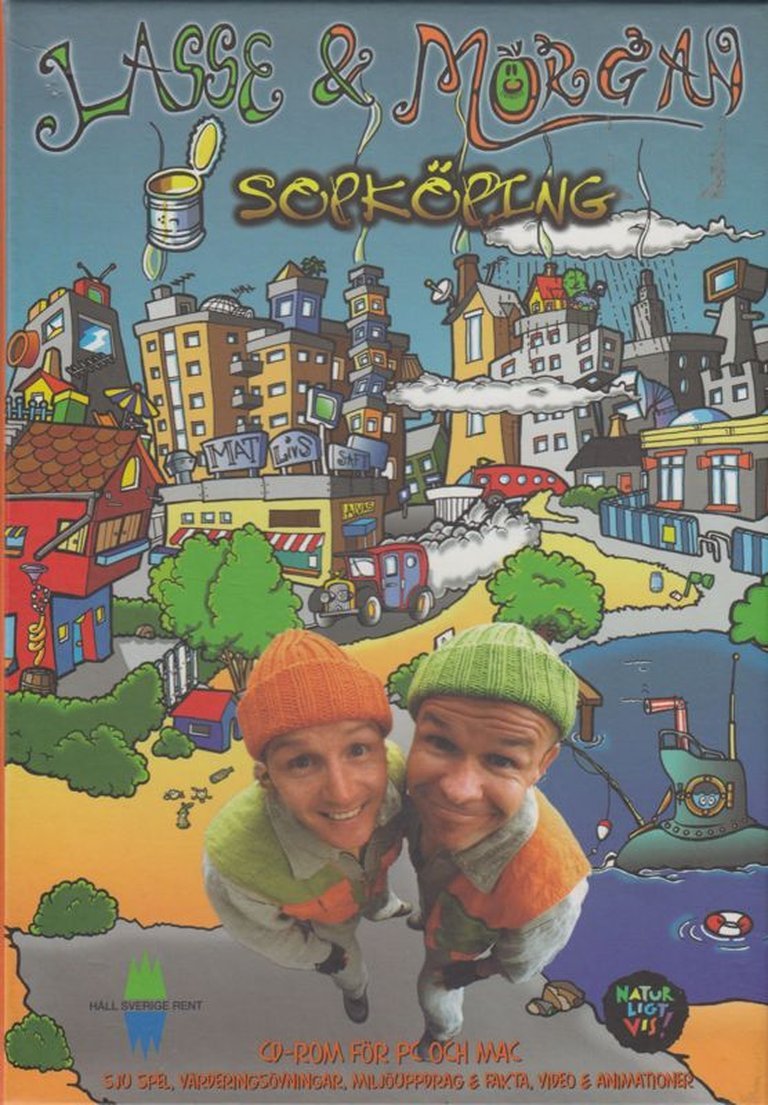
Lasse & Morgan i Sopköping is an educational game in Swedish that focuses on proper recycling of garbage and environmental care. It was developed by the non-profit ‘Håll Sverige Rent’ Foundation as part of the ‘NaturligtVis’ educational project for schools. The game features actors Lasse and Morgan as themselves, competing in various mini-games in the fictional town of Sopköping (Garbagetown). Each mini-game includes subject descriptions, optional real-world tasks, and evaluations to reinforce learning. The games cover topics such as recycling, composting, nutrient cycles, water savings, energy conservation, and battery disposal. The game uses Macromedia technology with full Swedish voice acting from the actors, occasional banter, and no subtitles. There’s also a high-score list to track performance.
Lasse & Morgan i Sopköping Free Download
Lasse & Morgan i Sopköping: Review
Introduction
In the bustling landscape of 1990s edutainment software, where titles often prioritized rigid pedagogy over playful engagement, Lasse & Morgan i Sopköping emerges as a uniquely Swedish gem. Developed for the non-profit foundation Stiftelsen Håll Sverige Rent (Keep Sweden Tidy) as part of the educational project NaturligtVis, this 1998 title transcends the typical “edutainment” label by blending environmental advocacy with charismatic celebrity personas. As a product of its era—conceived for Windows 3.1/95 and Macintosh CD-ROMs—it represents a fascinating intersection of technology, culture, and pedagogy. This review contends that while Lasse & Morgan i Sopköping is constrained by its niche audience and technical limitations, its ingenious fusion of humor, interactivity, and real-world relevance makes it not merely a relic of the past, but a prescient model for how games can meaningfully shape societal attitudes.
Development History & Context
Decam AB, a Swedish development studio, undertook the ambitious task of creating Lasse & Morgan i Sopköping under the aegis of Stiftelsen Håll Sverige Rent. The project emerged from a broader environmental initiative targeting Swedish schools, aiming to transform abstract ecological concepts into tangible, engaging activities. The technological constraints of 1998 are evident in its specifications: for Windows, a 486/33MHz processor, 8–16MB of RAM, and a 4x CD-ROM drive were required, with graphics limited to 640×480 resolution in 256 colors. The choice of Macromedia (likely Director) as the development framework reflected the era’s multimedia ambitions, enabling point-and-click interfaces and rudimentary animations but restricting complexity.
The gaming landscape of 1998 was dominated by commercial blockbusters, yet edutainment thrived in educational niches. Titles like The Oregon Trail or Where in the World Is Carmen Sandiego? leveraged gameplay to teach history and geography, but Lasse & Morgan distinguished itself through its hyper-localized focus on Scandinavian environmentalism. Its release coincided with growing global consciousness about climate change, positioning it as a timely tool for cultivating eco-friendly habits in Sweden’s youth. The involvement of real-life Swedish actors Lasse Beischer and Morgan Alling—who lent their voices and likenesses—was a masterstroke, bridging the gap between celebrity culture and educational authority in a way few games dared at the time.
Narrative & Thematic Deep Dive
The narrative unfolds in Sopköping (“Garbagetown”), a fictional Swedish town drowning in ecological neglect. Players assist Beischer and Alling as themselves, embarking on a crusade to rehabilitate the environment through a series of interconnected mini-games. The plot is deliberately thin, serving as a scaffold for its educational payload, but the dialogue elevates it beyond mere instruction. Voiced entirely in Swedish, the actors engage in playful banter—comparing recycling speeds, bickering over composting techniques—that injects warmth and authenticity. Their camaraderie transforms abstract concepts like “nutrient chains” into accessible, character-driven exchanges.
Thematically, the game is a masterclass in contextualized learning. Each mini-game targets a facet of environmental stewardship:
– “More Recycling” teaches waste categorization.
– “Shopping Cart Rally” promotes sustainable consumption.
– “Turbo Compost” demystifies decomposition.
– “A Puzzle of Nutrient Chains” visualizes ecosystem interdependence.
– “The Drop in the Tap” addresses water conservation.
– “Electrical Energy Thieves” identifies phantom power drains.
– “The Hunt for Batteries” stresses proper disposal of hazardous waste.
Embedded in each activity is an optional real-world task (e.g., auditing home energy use), creating a seamless loop between virtual and lived experience. The recurring theme of agency—empowering children to “fix” Sopköping—reinforces the message that individual actions collectively impact the planet. This approach avoids preachiness, instead framing eco-consciousness as an empowering adventure.
Gameplay Mechanics & Systems
The game’s structure revolves around seven self-contained mini-games, each adhering to a consistent template:
1. Objective: A clear, eco-themed challenge (e.g., sorting waste into bins).
2. Subject Description: A text/voiceover explaining the environmental principle.
3. Interactive Gameplay: Point-and-click mechanics tailored to each task (e.g., dragging batteries to recycling bins).
4. Evaluation: Post-game feedback on performance and environmental impact.
5. High-Score List: Encouraging replay through friendly competition.
Combat is absent; instead, “combat” manifests as solving ecological puzzles—like identifying energy-wasting appliances or assembling nutrient chain diagrams. The pacing, real-time yet relaxed, avoids the frantic energy of action games, fostering deliberate learning. Character progression is minimal; scores and high scores drive replayability, but there are no RPG-style advancements.
The UI is admirably simple: a central hub maps Sopköping’s districts, each unlocking a mini-game. Icons for “subject,” “task,” and “evaluation” provide clear navigation. However, the lack of subtitles creates barriers for non-Swedish speakers, while reliance on Macromedia limits scalability—modern players may encounter compatibility issues. The most innovative system is the out-of-world task integration, transforming gameplay into a springboard for real-world action, a forward-thinking feature rarely seen in contemporaries.
World-Building, Art & Sound
Sopköping is a whimsical caricature of Swedish suburbia, exaggerated to highlight environmental decay. Garbage piles overflow, rivers run murky, and energy grids flicker—problems players rectify through gameplay. The art direction embraces a hand-drawn aesthetic, with vibrant colors and cartoonish character designs reminiscent of children’s book illustrations. Environments are rich with detail: crumbling infrastructure juxtaposes hopeful green sprouts, symbolizing regeneration.
Sound design is pivotal to its charm. Sven-Gunnar Petersson’s score—jaunty, upbeat, and occasionally goofy—mirrors the actors’ comedic timing. Sound effects, from the clatter of recycling bins to the gurgle of composting, enhance immersion. Beischer and Alling’s voice acting is the game’s soul; their playful ad-libs (e.g., arguing over which vegetable composts fastest) transform dry facts into memorable exchanges. The absence of subtitles, however, limits accessibility, while the Macromedia framework produces compressed audio that feels dated today. Collectively, these elements forge an atmosphere that is both instructive and delightfully absurd—turning ecological lessons into a joyous romp.
Reception & Legacy
Upon release, Lasse & Morgan i Sopköping was distributed through Swedish schools and environmental channels, bypassing mainstream retail. Its reception was muted in global gaming circles due to language barriers and regional specificity, but it likely resonated deeply in educational contexts. As an abandonware title preserved by the Internet Archive and MyAbandonware, it has earned a cult following among retro enthusiasts nostalgic for 90s edutainment.
Critically, it prefigures modern trends in “serious games” that tackle climate change, like Eco or Beyond Blue. Its legacy lies in demonstrating how celebrity endorsement and localized storytelling can make complex topics relatable. The NaturligtVis project influenced subsequent Swedish environmental initiatives, while Decam AB’s technical choices (e.g., hybrid CD-ROMs for Windows/Mac) showcase adaptability. Yet, its narrow focus ensures it remains a cultural artifact rather than a industry pillar—a charming footnote in the annals of gaming history.
Conclusion
Lasse & Morgan i Sopköping is a time capsule of Swedish innovation, where environmental pedagogy meets playful celebrity charisma. Its mini-games, though mechanically simple, are brilliantly effective at translating ecological theory into interactive experiences. The game’s greatest strength lies in its authenticity: the actors’ chemistry, the localized setting, and the seamless blend of virtual and real-world tasks create a template for engagement that transcends its technical limitations. While its narrow audience and language constraints prevent it from achieving universal acclaim, it stands as a testament to the potential of games as tools for societal change.
In the broader landscape of video game history, Lasse & Morgan i Sopköping occupies a unique niche—not as a commercial triumph, but as a cultural artifact that championed environmental consciousness when such initiatives were nascent. For modern players, it serves as a poignant reminder that the most meaningful games are often those that teach us to see the world differently—one compost heap at a time. Verdict: A flawed but fascinating relic, worthy of preservation for its historical significance and enduring charm.