
- Release Year: 2019
- Platforms: Linux, Macintosh, Nintendo Switch, Windows
- Publisher: Pillow Fight LLC
- Developer: Pillow Fight LLC
- Genre: Adventure
- Perspective: 1st-person
- Game Mode: Single-player
- Gameplay: Graphic adventure, Mini-games, Multiple endings, Puzzle elements
- Setting: Fantasy
- Average Score: 73/100
Description
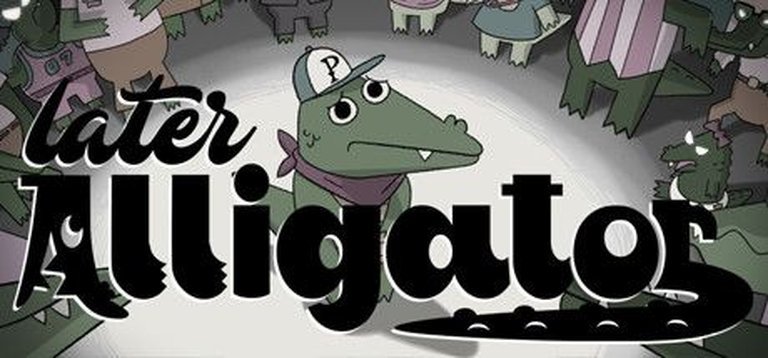
Later Alligator is a comedic point-and-click adventure game where players embody an alligator protagonist tasked with navigating a bizarre, family-centric fantasy world. Featuring fully animated humor, varied mini-games, and puzzle elements, the setting blends prohibition-era aesthetics with modern oddities in a stylized urban landscape, all underscored by a heartwarming narrative with LGBTQ+ themes and multiple endings.
Gameplay Videos
Where to Buy Later Alligator
PC
Later Alligator Guides & Walkthroughs
Later Alligator Reviews & Reception
metacritic.com (90/100): Later Alligator may turn off some adventure fans with its minigame-heavy gameplay, but those willing to try something different will find a beautifully animated, wonderfully replayable and often hilarious experience.
metacritic.com (90/100): Ruthlessly charming to a degree that renders minor quibbles negligible [insert alligator joke].
metacritic.com (70/100): pretty cute game for one night, it has replay value as well, worth a shot..
metacritic.com (80/100): Later Alligator is the perfect Sunday afternoon game, many miles away from considerably more epic and demanding time-sinks, and most any player will want to return to its world to fully rinse the breadth of content to be found. Pillow Fight has made a real gem, and their outstanding creative instincts and sense of humor can be found in every clickable corner of the modest little world they’ve crafted. Overall, Later Alligator will love you, but inevitably leave you wanting more.
metacritic.com : I have never been more invested in saving a video game character’s life, and I certainly didn’t expect to laugh as much as I did while doing so.
metacritic.com (70/100): A short game with a fun story, some good mini games, and lots of style.
metacritic.com (70/100): A small charming game. Some of the minigames were misses for me, but this should definitely be checked out by fans of humor, cartoons, adventure or hidden object games.
metacritic.com (60/100): A short little game with a fun tone and look. I liked the characters and the dialog as well. However, the actual gameplay did not do anything for me. Very simple mini-games that are not very fun. Then there is an odd time restraint and even if you are not done exploring an area, it will back you out of it if story needs to play out. Just a very odd structure. I wish it would just let me freely explore and talk to people and go back to the main character when I wanted. Could have been much better with just a better structure and mini-games, but since that’s most of the game, I walked away a bit disappointed.
metacritic.com (30/100): only worth 5 dollar for kids or watch it on utube
polygon.com : Later Alligator, out now on Steam, continues the humor-filled legacy of point-and-click mystery games with its own twist.
monstercritic.com (80/100): Later Alligator is a fantastic visual novel for those who are fans of cartoons like SpongeBob Squarepants. It features a wonderful cast of characters that I would gladly watch on TV. The art is superb, and the writing quickly communicates the personality of the characters and maintains consistent humor, with a variety of styles and jokes.
monstercritic.com (80/100): More than that, though, it’s a true joy to find a game that doesn’t stretch out its stellar moments with long sections of padding. Every minute you spend in Later Alligator is time well-spent, with background details to look at, terrible puns to appreciate, and a noodly jazz soundtrack that’s full of bops. It’s worth the price, we say, because it has the highest laughs per second (LPS) of any game we’ve played. That’s damn good value!
monstercritic.com (80/100): Later Alligator is a hilarious adventure game whose strong visuals and music tie it together into a lovely little package.
Later Alligator: A Review
Introduction: A Noirish Knockout of Charm and Chaos
In the vast, often derivative landscape of indie adventure games, Later Alligator arrives not with a whimper, but with the chaotic, joyous clatter of a dropped pinball machine. It is a game that immediately announces its peculiar identity: a black-and-white, film-noir-inspired world populated entirely by waddling, talking alligators in a meticulously rendered “Alligator New York City.” Yet beneath this absurd surface lies a tightly wound spring of narrative genius, emotional intelligence, and a comedic timing so precise it feels orchestrated by a maestro of the silliest possible arts. This review will argue that Later Alligator transcends its label as a “point-and-click adventure with minigames” to become a seminal work of interactive comedy—a game that uses its structural constraints and whimsical aesthetic to deconstruct player agency, familial anxiety, and the very nature of its own genre, all while delivering a consistently hilarious and surprisingly heartfelt experience. It is a masterclass in charm-over-substance that, paradoxically, achieves profound substance through that very charm.
Development History & Context: A Small Studio’s Big Dream
Later Alligator is the product of a unique and fortuitous collaboration. The game was developed by Pillow Fight Games, a studio founded by Conrad and Jo Kreyling, in close partnership with SmallBü Animation, the Emmy Award-winning husband-and-wife duo of Lindsay and Alex Small-Butera. The two teams had previously crossed paths, and it was SmallBü that pitched the initial concept—a noir mystery starring alligators—to Pillow Fight, who would handle prototyping and programming. This creative division of labor defined the game’s DNA: SmallBü provided the visual and narrative soul (animation, writing, character design), while Pillow Fight built the functional skeleton (code, game systems, minigame prototypes).
The development spanned roughly two years (from announcement in late 2018 to release in September 2019) and resulted in a staggering over 80,000 frames of hand-drawn animation. The technical hurdles were significant. The team animated in Toon Boom Harmony with post-production in Adobe After Effects, but the memory cost of detailed, densely animated scenes with numerous moving parts pushed the limits. The solution was ingeniously simple yet effective: packaging each PNG individually to manage resources. This painstaking process explains the game’s most celebrated feature: its lavishly expressive, weighty, and absurdly detailed character animation, which gives the world a lived-in, theatrical quality rare in 2D adventures.
Inspirations were notably eclectic. Visually, the team cited old photos of ornate 1950s and 70s homes, contributing to a film noir aesthetic filtered through a cartoon lens. Gameplay-wise, they looked to Japanese visual novels for pacing and dialogue presentation and the Professor Layton series for the integration of puzzle-solving as a narrative driver. The decision to make minigames conceptually simple was a pragmatic one—to ensure they could be coded and designed within the project’s scope—but this simplicity became a strength, allowing the writing and presentation to shine. The game’s core engine was Unity, a common but capable choice for this scale of 2D project.
Its release on Steam and Itch.io for Windows and macOS (Sept 2019), followed by Linux (Dec 2019) and a later Nintendo Switch port (Mar 2021) with added content, shows a deliberate, platform-conscious rollout. The Switch version, featuring a physical edition via Fangamer, cemented its status as a cult favorite with a dedicated console audience. The development was also “generously supported” by notable indie figures like Neil Cicierega, Ming Doyle, and the King twins (May and Carl), signaling its deep roots in the interconnected web of indie game and animation communities.
Narrative & Thematic Deep Dive: The Paranoia of the Self
The plot of Later Alligator is a masterclass in bait-and-switch storytelling and layered irony. On the surface, it is a classic noir setup: ajittery client (Pat the Alligator) hires a private investigator (the player) to uncover a conspiracy against his life from his own “big, scary family” before “the Event” that night. The player explores Alligator New York City, interviewing over 30 family members, each of whom withholds information unless the player completes a personalized minigame challenge.
The first, and most brilliant, twist is that there is no twist. Or rather, the expected twist—that the family is planning a murder—is instantly subverted when “the Event” is revealed to be Pat’s surprise birthday party. Pat’s entire paranoid worldview is built on a foundation of mistaken assumptions and familial love. The game seems to conclude here, with a warm, if slightly manic, group photo.
This is where the narrative elevates into something special. A second playthrough (actively encouraged by the game’s time-loop and badge retention mechanics) reveals that someone really is trying to kill Pat. The player character, upon leaving the party with Pat, pushes him off the hotel balcony. The “Wham Shot” and “Wham Line” (“FINISH THE JOB”) are devastating in their sudden, brutal clarity, retroactively coloring every previous interaction. The player was not an investigator; they were a professional hitman.
The final, “Golden Ending”—unlocked by helping every single family member—provides the ultimate layer: Pat accidentally ordered the hit on himself. A classified ad in a newspaper, partially obscured by his jelly sandwich, led him to believe he was hiring an investigator to help with his “paranoia problem.” He hired a killer instead. The true danger was not his family, but his own self-sabotaging anxiety and impulsivity.
Thematically, the game explores:
1. Paranoia as Self-Fulfilling Prophecy: Pat’s fear of betrayal creates the very scenario he dreads.
2. The “Big, Screwed-Up Family” Trope: The family is weird, large, and full of eccentricities (mafia implications, outrageous jobs), but ultimately loving and harmless—a subversion of the cartoonish mob family cliché.
3. Agency and Complicity: The player is complicit in the murder plot from the start, their “detective” role a sham. The game asks: are you playing along because it’s a game, or because you want to?
4. Therapy and Mental Health: Both Pat and Joanie are mentioned as seeing therapists weekly. The true ending has Pat resolving to discuss the events with his therapist, framing the story as a breakthrough in managing his anxiety.
5. Miscommunication and Secrecy: The entire plot stems from a missed word (“hitman” vs. “investigator”) and the family’s insistence on keeping the party a secret, inadvertently fueling Pat’s fears.
The narrative structure itself is a thematic device. The first playthrough feels wholesome but hollow, mirroring Pat’s superficial understanding. The second reveals the grim truth, forcing a reevaluation. The third provides catharsis and understanding. It’s a three-act structure played out across multiple, mechanically enforced playthroughs.
Gameplay Mechanics & Systems: The Minigame as Character Study
Later Alligator operates on a point-and-click interface with a unique contextual twist. The bottom of the screen houses a briefcase (inventory), a watch (timekeeper), and a tram symbol (to travel between the four districts of Alligator NYC: Downtown, Unsavory Part of Town, Uptown, and the Park). Navigation is click-to-move on a node-based map.
The core loop is: Travel to district → Find family member → Ask 3 standard questions (WHOM?, PAT?, the ‘EVENT?’) → Agree to their minigame challenge → Complete minigame → Receive badge → Report to Pat at checkpoints. Time passes with each travel and minigame attempt. The clock is a gentle, non-punitive pressure; reaching 8:00 PM triggers the finale based on badges collected. A “New Game+” retains badges and puzzle pieces, allowing for completion without re-doing everything.
The 30+ minigames are the game’s defining feature and its most divisive. They range from:
* Arcade & Skill: Pinball (Joanie), a “Three-Fingered” Five-Finger Fillet (Bobby Blue Eyes), a Flappy Bird clone (Gentle Lorenzo).
* Puzzle: Sliding puzzles (restoring photos), Towers of Hanoi with pancakes (Diamond Alice), a haunted phone exorcism via deleting ghost photos (Tall Jared).
* Absurdist & ARG-lite: A dating sim parody (“Mack the Knife” for The Knife), a crane game heist (Sweet Geraldine), finding identical shoes while avoiding a haunted armoire (Nana Rue). One puzzle, a 15-puzzle, can be skipped outright.
* Interaction & Choice: “Throwing the fight” in Hide-and-Seek with Skids Valentino.
The genius of these minigames is that they are direct extensions of character and plot. The challenge isn’t generic; it’s their challenge, reflecting their personality, profession, or neurosis. Winning them provides a moment of insight and a connection, making the badge collection feel meaningful. The badges themselves are added to a family tree portrait with Pat’s mother, Lovely Maria, providing a tangible sense of progression and filling out a quirky, sprawling genealogy.
However, this system is not without flaws:
* Repetition: The same questions and minigame structure can feel formulaic on subsequent playthroughs, though the writing varies.
* Time Pressure vs. Failure: Losing a minigame costs 15 in-game minutes. Combined with a few minigames relying on luck or twitch skill (the pinball game’s flipper control is noted as tricky), this can create frustration and force restarts to maintain progress.
* Permanently Missable Content: The character Derry can be missed if you don’t sequence a specific event correctly, requiring a full restart—a harsh penalty in a game encouraging multiple runs.
The UI is clean and thematic, with the watch, briefcase, and tram all diegetic elements. The “Ant-Frustration Feature” update cleverly made previously-unskippable Pat phone calls skippable, replacing them with an off-screen text log you can peruse, respecting player time in later runs.
World-Building, Art & Sound: A Gotham by the Swamp
Alligator New York City is the game’s silent protagonist. It’s a retro-futuristic, anachronistic mishmash: 1930s/50s noir architecture (art deco hotels, smoky diners, seedy alleys) meets 2010s technology (clamshell cell phones, social media influencers). The palette is mostly black-and-white, with stark shadows and ink-washed backgrounds, making the splashes of color on the alligators themselves pop with cartoonish vitality. This “Squiggle Vision” style—thick, wobbly outlines and exaggerated expressions—comes from the Small-Buteras’ background in flash animation (Baman Piderman). It is not a high-fidelity style, but an expressive one, where a flick of a wrist or a bounce in a walk cycle conveys more personality than pages of dialogue.
The world is densely animated. Background characters mill about, signs blink, environmental objects have tiny interactive animations (an eye in a cabinet blinks). This creates a palpable sense of life and bustle. The locations are characterful: the opulent hotel lobby, the dusty Adelaide’s Arcade, the ominous Unsavory Part of Town with its “GIRLS GIRLS GIRLS” sign leading to a feminist history seminar (a brilliant bait-and-switch), the quiet Alligator Memorial Park. Each screen is a rich visual gag.
The sound design is the perfect companion. Composer Matt “2 Mello” Hopkins delivers a noodle jazz soundtrack full of syncopated piano, walking basslines, and playful melodies that shift subtly between districts. It evokes classic noir but with a playful, spring in its step. The main theme is a recurring riff, subtly woven into most minigame music, creating a cohesive audio tapestry. The lack of voice acting is notable, but the expressive animation and sharp writing make this omission forgivable; the characters “speak” through their movement. Sound effects are used comedically (the “Scare Chord” during Pat’s phobia moments) and effectively.
Reception & Legacy: A Cult Classic Forged in Charm
Upon release, Later Alligator received generally positive critical reception, with scores ranging from 80% to 95% from major outlets (Adventure Gamers, CGMagazine, Nintendo World Report), though with notable outliers like a 22% from Geeks Under Grace (whose review itself was positive, suggesting a scoring error or niche disconnect). Critics universally praised its animation, humor, and character writing. Polygon called it “relentlessly charming,” while Adventure Gamers highlighted its “wonderfully replayable” nature. Common criticisms focused on minigame repetition and some imprecise controls, particularly on Switch (noted by Nintendo Life).
Its commercial performance is not publicly detailed, but its MobyScore of 7.3 and status as a “Collected By” game on MobyGames indicates a dedicated, if not massive, audience. Its legacy is that of a cult classic and a benchmark for indie comedy adventures. It demonstrated that a small team could create a visually stunning, narratively complex game by leveraging a unique art style and focusing on character-driven humor. Its influence can be seen in subsequent indie titles that prioritize expressive 2D animation and quirky, systemic humor over grand scale.
The game is also a quiet milestone for LGBTQ+ representation in gaming. It is tagged as such on Steam and MobyGames, and its director/writer, Lindsay Small-Butera, is part of a creative partnership that values inclusive storytelling. The themes of identity, performance (Pat’s “normal” outfit, The Knife’s dating sim), and acceptance resonate within this context, though it is not a centrally “about” being LGBTQ+—it’s simply part of its inclusive fabric.
The Nintendo Switch port in 2021, with added content (a new family member/minigame) and a physical edition via Fangamer, introduced it to a wider console audience and solidified its status as a perfect “pick-up-and-play” indie gem. Its presence on Steam with “Overwhelmingly Positive” (96% of 2,313 reviews) user scores is a testament to its enduring appeal.
Conclusion: The Crocodile’s Truth
Later Alligator is more than the sum of its puns. It is a meticulously crafted comedic artifact that uses the language of 1930s noir and the structure of the point-and-click genre to tell a story about modern anxiety, the lies we tell ourselves, and the families we mistakenly believe are out to get us. Its brilliance lies in its commitment to the bit—every system, from the time loop to the badge tree, reinforces its themes. The minigames are not busywork; they are conversations. The animation is not just pretty; it is exposition. The lack of voice acting is not a budget cut; it forces the writing and visuals to do the heavy lifting, which they do with aplomb.
Its flaws are genuine: some minigames misfire, the time pressure can feel arbitrary, and the core loop is undeniably repetitive. Yet these are the growing pains of an audacious project that aimed to be a fully-realized cartoon you can play. It achieves that goal with such palpable love and wit that its shortcomings fade into the background noise of a bustling, alligator-filled city.
In the canon of video game history, Later Alligator will not be remembered for revolutionizing graphics or gameplay mechanics. Instead, it will be remembered as a pinnacle of indie charm and narrative creativity—a game that proved you could build a profound, twist-filled character study within a framework of silly puns and pinball. It is a testament to the power of a singular comedic vision, executed with technical care and emotional sincerity. It earns its place not as a forgotten relic, but as a beloved, frequently recommended touchstone—the game you press into a friend’s hands with the words, “Trust me, you need to meet Pat.” It is, in the end, a game that loves its characters and its players, and asks only for an afternoon of your time to share that love. And like the best inside jokes, its impact lingers long after the last laugh. Later, Alligator isn’t just a farewell; it’s a promise to return to a world that feels, against all odds, like home.